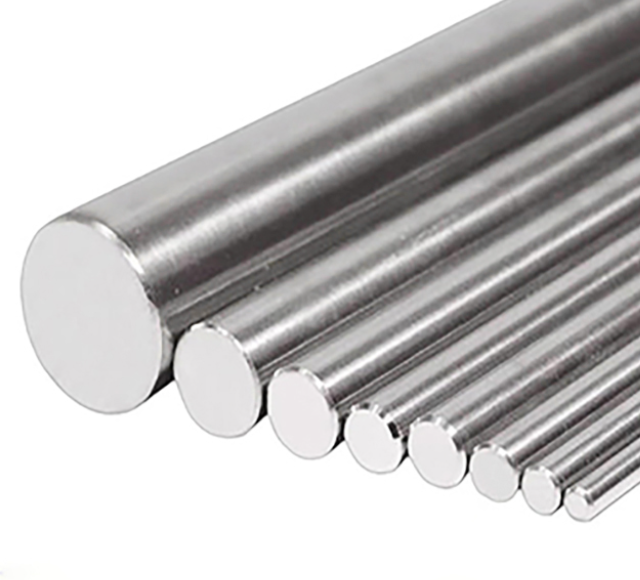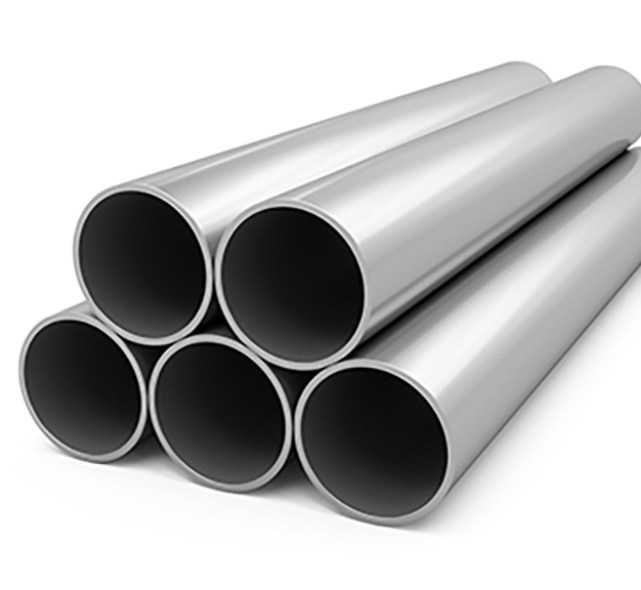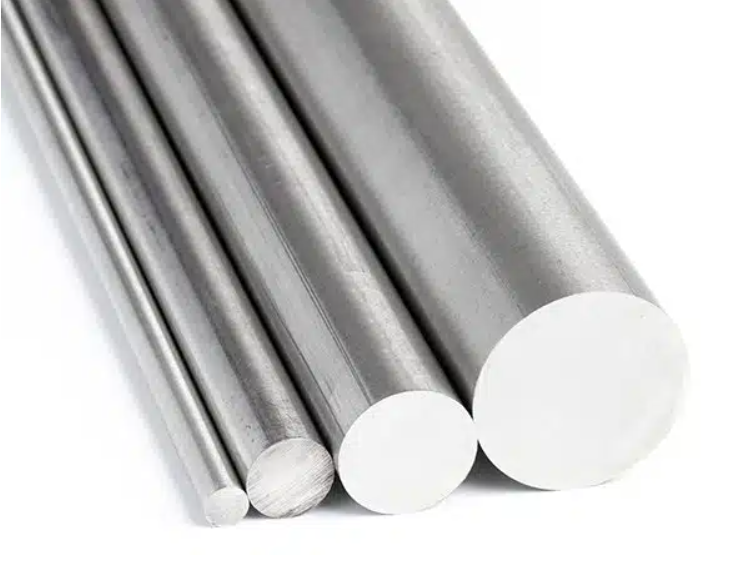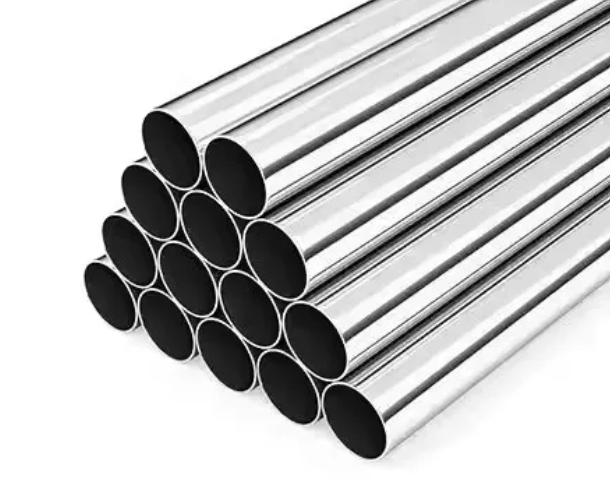

Titanium, nickel alloys, and stainless steels can all be suitable for heat exchanger tubing, but they solve different corrosion, temperature, fabrication, availability, and cost problems.
Quick answer: stainless steel is often the first material family to review for mild or controlled service; titanium is frequently shortlisted for seawater, brine, and many oxidizing chloride environments; selected nickel alloys are commonly reviewed for reducing acids, mixed chemicals, high-temperature corrosion, or severe process conditions. None of the three is universally best.
This article is a focused three-way comparison. For a broader selection process that also covers duplex stainless steel, copper alloys, fouling, inspection, and life-cycle planning, read the heat exchanger tube material selection guide.
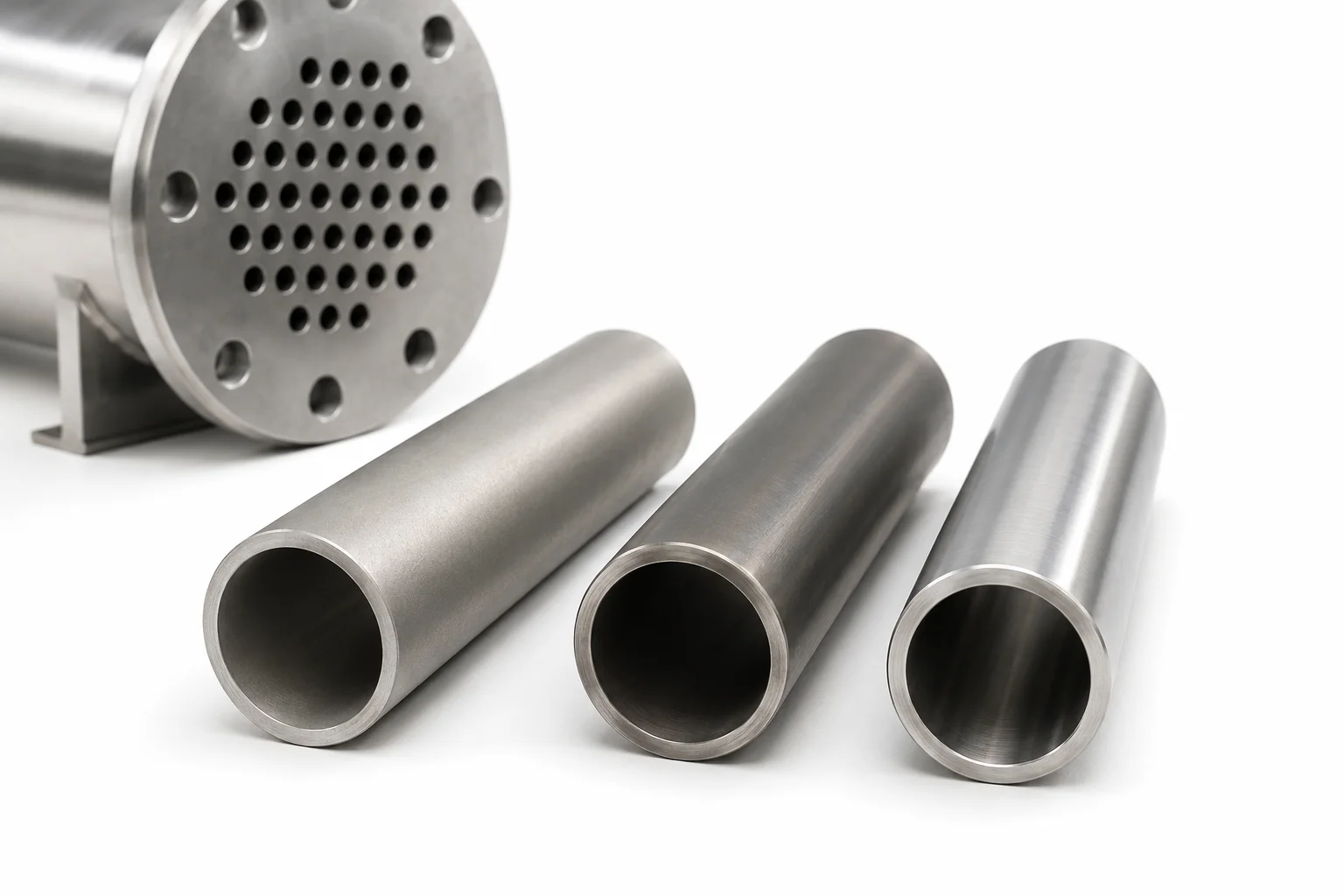
The final choice should be based on the actual tube-side and shell-side fluids, concentration, impurities, temperature, pressure, velocity, deposits, cleaning method, fabrication route, tube standard, tubesheet material, inspection scope, and consequences of leakage.
Titanium vs Nickel Alloy vs Stainless Steel: Fast Comparison
| Selection Factor | Stainless Steel Tubes | Titanium Tubes | Nickel Alloy Tubes |
|---|---|---|---|
| Typical first-use direction | Mild to moderately corrosive industrial, utility, food, pharmaceutical, steam, and water service | Seawater, brine, condensers, desalination, marine cooling, and selected oxidizing media | Severe chemical service, selected acids, mixed media, high-temperature corrosion, and demanding chloride conditions |
| Initial material cost | Usually lowest of the three | Usually higher | Usually higher and highly grade-dependent |
| Density | Medium | Lowest | Highest |
| General availability | Broad for common grades and sizes | Good for common heat-exchanger grades, but size and form matter | Varies greatly by alloy, tube size, condition, and quantity |
| Seawater direction | Common grades may face pitting, crevice corrosion, or SCC | Often a strong starting candidate | Some grades may be suitable, but selection is grade-specific |
| Reducing-acid direction | Often limited unless a higher alloy is selected | Frequently limited | Selected nickel-molybdenum or nickel-chromium-molybdenum grades may be preferred |
| Oxidizing-chloride direction | Grade- and temperature-dependent | Often strong when the passive film remains stable | Grade-specific; some alloys provide broad resistance |
| High-temperature strength | Depends strongly on grade | More limited than many high-temperature nickel alloys | Often the strongest family for combined heat and corrosion |
| Thermal conductivity | Moderate and grade-dependent | Relatively low | Generally low to moderate and grade-dependent |
| Welding and fabrication | Familiar and widely available | Requires excellent cleanliness and shielding | Requires controlled procedure, filler, heat input, and sometimes post-weld requirements |
| Galling / wear | Manageable with grade and surface selection | Can be important in expansion, sliding, and threaded contact | Grade-specific; machining and work hardening may be challenging |
| Life-cycle value | Strong when the environment is controlled | Strong where seawater corrosion and replacement risk dominate | Strong where severe service would cause cheaper alloys to fail |
| Main procurement risk | Underestimating chloride, temperature, stagnation, or SCC | Assuming titanium works in every acid or crevice condition | Ordering only “nickel alloy” without defining the exact grade and standard |
This matrix is a screening tool, not a design approval. Each material family contains grades with very different behaviour.
The First Decision Is Not the Alloy Name—it Is the Damage Mechanism
Many buyers begin with a familiar grade. A stronger method is to begin with the most credible failure mechanism.
| Primary Risk | Material Families Commonly Reviewed First | Questions That Change the Decision |
|---|---|---|
| Uniform corrosion | Stainless, titanium, or nickel alloy depending on chemistry | Concentration, temperature, aeration, impurities, oxidizing or reducing condition |
| Pitting corrosion | Higher-alloy stainless, titanium, or nickel alloy | Chlorides, temperature, oxidizing species, deposits, surface condition |
| Crevice corrosion | Titanium grade selection, high-alloy stainless, or nickel alloy | Gaskets, tubesheet joints, deposits, low flow, crevice geometry, temperature |
| Stress-corrosion cracking | Grade-specific stainless, nickel alloy, or titanium | Tensile stress, chlorides, caustic media, temperature, cold work, weld residual stress |
| Erosion-corrosion | Material plus velocity and geometry review | Solids, two-phase flow, inlet turbulence, impingement, local velocity |
| Fouling-under-deposit attack | Material plus cleaning and water-treatment review | Biofouling, scale, sludge, stagnant zones, cleaning interval |
| High-temperature oxidation | Heat-resistant stainless or nickel alloy | Metal temperature, gas chemistry, cycling, scale spallation |
| Creep or stress rupture | High-temperature stainless or nickel alloy | Design life, stress, temperature, welds, code allowables |
| Thermal fatigue | All three, depending on design | Startup frequency, temperature gradient, restraint, expansion mismatch |
| Galvanic corrosion | Complete tube–tubesheet–water system review | Area ratio, electrolyte, electrical contact, coatings, isolation |
| Tube vibration or mechanical fatigue | All three, with design validation | Support spacing, cross-flow, fretting, surface defects, cyclic stress |
The UK Health and Safety Executive notes that material selection for plant should consider mechanical strength, toughness, fatigue, creep, corrosion, fabrication, availability, and cost—not corrosion resistance alone. See HSE Design Codes for Plant.
When Stainless Steel Tubes Are Usually the Best Starting Point
Stainless steel is often the most economical and practical first material family for controlled industrial service.
Stainless Steel Is Commonly Shortlisted When
- The fluids are mild or moderately corrosive.
- Chlorides are low or controlled.
- Operating temperature is within the selected grade’s capability.
- Cleaning chemicals are compatible.
- Fabrication, welding, and replacement availability are important.
- Initial cost and short lead time matter.
- The system has a proven service history with the same water chemistry and design.
Common Stainless Steel Directions
| Stainless Family | Typical Screening Direction | Main Cautions |
|---|---|---|
| 304 / 304L | Fresh water, clean utilities, food, pharmaceutical, and mild process service | Chlorides, acidic cleaning, crevices, and elevated-temperature SCC |
| 316 / 316L | Moderate chloride or process service where molybdenum improves localized-corrosion resistance | Not a universal seawater grade; pitting and crevice risk remain |
| Duplex stainless | Higher strength and improved chloride resistance compared with common austenitic grades | Welding procedure, phase balance, heat treatment, and product availability |
| Super duplex / high-alloy stainless | More severe chloride service where standard stainless is inadequate | Fabrication control, availability, cost, and application-specific corrosion data |
| Heat-resistant austenitic grades | Elevated-temperature boiler or heat-exchanger duty | Creep, oxidation, sensitization, and code requirements |
When Stainless Steel Becomes a Higher-Risk Choice
Stainless steel deserves additional scrutiny when the heat exchanger has:
- Warm or hot chlorides
- Stagnant seawater or brine
- Tight crevices
- Acidic chloride cleaning
- High tensile or weld residual stress
- Frequent shutdowns with deposits remaining wet
- Sulfides or reducing contamination
- A history of pitting, SCC, or tube-to-tubesheet attack
Current stainless heat-exchanger tube standards include ASTM A213/A213M for seamless ferritic and austenitic alloy-steel boiler, superheater, and heat-exchanger tubes, and ASTM A249/A249M for welded austenitic steel boiler, superheater, heat-exchanger, and condenser tubes. The correct grade, construction, wall basis, tests, and edition must still be stated in the purchase order.
Buyer Takeaway
Choose stainless steel because the service conditions support it—not simply because it is familiar or less expensive.
When Titanium Tubes Are Usually the Best Starting Point
Titanium is often evaluated where seawater and chloride-bearing cooling media dominate the corrosion risk.
Titanium Is Commonly Shortlisted When
- Raw seawater or treated seawater is used for cooling.
- Brine or desalination service is involved.
- Condenser or evaporator tube life is a major concern.
- Low density is useful.
- The environment is oxidizing enough to maintain titanium’s protective oxide film.
- Long shutdown or replacement cost makes localized corrosion unacceptable.
- The design can manage crevices, deposits, hydrogen-related risks, and galvanic effects.
The Royal Society of Chemistry’s titanium overview notes titanium’s marine use and corrosion resistance. That general advantage is important, but it does not mean every titanium grade is suitable for every chemical environment.
Common Titanium Grade Directions
| Titanium Grade | Typical Heat-Exchanger Direction | Main Cautions |
|---|---|---|
| Grade 2 | Common starting point for seawater condensers, evaporators, and general heat-exchanger tubes | Crevice conditions, reducing acids, fluorides, hydrogen uptake, and design details |
| Grade 7 / 16 | Palladium-enhanced grades considered where reducing-acid or crevice resistance needs improvement | Higher cost; suitability remains chemistry- and temperature-specific |
| Grade 12 | Ti-0.3Mo-0.8Ni for selected higher-temperature chloride and reducing environments | Must be compared with exact media, grade availability, and project standard |
| Grade 9 | Higher-strength Ti-3Al-2.5V tubing where the product standard and application justify it | Not automatically preferable to Grade 2 for corrosion; tube condition and forming matter |
Titanium’s Important Limits
Titanium can become a poor choice when:
- Fluorides are present at damaging concentration or pH.
- Hot reducing acids destabilize the passive film.
- Tight crevices create unfavorable local chemistry.
- Hydrogen absorption is possible.
- The metal temperature is beyond the selected grade’s practical range.
- Iron contamination or poor welding shielding damages the surface.
- A titanium tube is coupled to a less-noble tubesheet without galvanic review.
- The cleaning process contains incompatible chemicals.
ASTM B338 covers seamless and welded titanium and titanium-alloy tubes intended for surface condensers, evaporators, and heat exchangers. It defines product and test requirements; it does not independently prove suitability for a buyer’s actual process chemistry.
Buyer Takeaway
Titanium is often a strong seawater answer, but it is not a universal acid or high-temperature answer.
When Nickel Alloy Tubes Are Usually the Best Starting Point
Nickel alloys are usually shortlisted when the environment is too chemically aggressive or too hot for conventional stainless steel, or when titanium is limited by reducing conditions.
Nickel Alloys Are Commonly Shortlisted When
- The service contains reducing acids.
- Oxidizing and reducing species coexist.
- Chlorides combine with high temperature, acidity, or crevices.
- Mixed acids or contaminated process streams are present.
- High-temperature strength and oxidation resistance matter.
- A previous stainless or titanium selection has failed.
- The consequence of leakage justifies a higher-alloy solution.
“Nickel Alloy” Is Not One Material
| Alloy Family or Example | Common Screening Direction | Main Cautions |
|---|---|---|
| Nickel 200 / 201 | Caustic and selected reducing environments | Nickel 200 has an elevated-temperature graphitization boundary; oxidizing contaminants matter |
| Alloy 400 | Selected hydrofluoric acid, seawater, alkali, and reducing service | Aerated or oxidizing acids and stagnant seawater can be limiting |
| Alloy 600 | High-temperature oxidation and selected chemical service | Not the default choice for every chloride or acid environment |
| Alloy 625 | Broad corrosion resistance, chloride environments, seawater, and high-strength applications | Cost, fabrication, exact standard, and environment-specific limits |
| Alloy 825 | Sulfuric and phosphoric acid, reducing and oxidizing conditions, and selected chloride service | Grade-specific corrosion data and temperature remain necessary |
| Alloy C276 / C22 | Severe mixed acids, chlorides, oxidizing and reducing process environments | Higher cost; exact chemistry and fabrication route determine selection |
| Alloy 800H / 800HT | High-temperature strength and oxidation/carburization service | Not selected primarily as a universal aqueous-corrosion alloy |
Nickel alloy condenser and heat-exchanger tubing may be ordered under standards such as ASTM B163, while particular alloy families may require another product specification. The grade, UNS number, tube construction, condition, wall basis, tests, and standard must all match.
The Nickel Institute also emphasizes that alloy selection should reflect actual process conditions; temporary changes in temperature or chemistry can move a material from passive to active corrosion behaviour. See The Nickel Advantage.
Buyer Takeaway
Do not request only “nickel alloy heat exchanger tube.” Request the exact alloy and UNS number—or provide enough service data for a responsible grade review.
Service-by-Service Material Screening Matrix
Water, Seawater, Brine, and Steam
| Service Condition | Stainless Steel Direction | Titanium Direction | Nickel Alloy Direction |
|---|---|---|---|
| Clean fresh water | Often first choice | Usually unnecessary unless other risks justify it | Usually unnecessary |
| Steam / clean condensate | Often suitable with grade and oxygen chemistry review | Less common | Selected high-temperature alloys when metal temperature or chemistry requires |
| Cooling-tower water | Common, but chloride concentration, biocide, deposits, and temperature matter | May be considered in aggressive water | Selected grades if stainless risk is high |
| Brackish water | Higher-alloy stainless may be reviewed | Often shortlisted | Grade-specific alternative |
| Open seawater | Common austenitic grades may carry high localized-corrosion risk | Often the first serious candidate | Some nickel alloys and copper-nickel systems may be reviewed |
| Concentrated brine | Usually requires higher-alloy review | Chemistry, temperature, crevice risk, and scaling control are critical | Selected grades may be preferable where titanium is limited |
| Desalination evaporator / condenser | Application-specific | Widely used in many designs | Selected severe zones or different chemistries |
Chemical Processing
| Chemical Direction | Stainless Steel | Titanium | Nickel Alloy |
|---|---|---|---|
| Mild organic or utility media | Often suitable | May be over-specified | May be over-specified |
| Oxidizing acids | Grade-specific | Often reviewed | Grade-specific |
| Reducing acids | Often limited | Often limited without an enhanced titanium grade | Selected nickel alloys commonly reviewed |
| Mixed oxidizing/reducing acids | Frequently high risk | Depends on chemistry | Ni-Cr-Mo alloys often shortlisted |
| Chlorinated process media | Temperature and oxidizing potential matter | Can be strong in suitable oxidizing conditions | Grade-specific broad-resistance option |
| Fluoride-bearing media | Grade-specific | Potentially severe limitation | Selected nickel alloys may be reviewed |
| Caustic alkali | Grade- and concentration-dependent | Selected conditions only | Nickel 200/201 or other nickel alloys may be relevant |
| Sulfur-bearing contamination | Can change corrosion mechanism | May affect titanium selection | Alloy-specific; high-temperature sulfur can be severe |
High-Temperature Service
| Requirement | Stainless Steel Direction | Titanium Direction | Nickel Alloy Direction |
|---|---|---|---|
| Moderate metal temperature | Broad grade range | Grade-specific | Broad grade range |
| Creep-controlled design | Heat-resistant grades may work | Usually not the first family | Often strongest candidate |
| Oxidizing gas | Heat-resistant stainless may be suitable | Application-limited | Many nickel alloys are developed for this duty |
| Carburizing or nitriding atmosphere | Grade-specific | Generally not a default choice | Selected nickel alloys may be preferred |
| High-temperature corrosion plus stress | May be suitable within code limits | Often limited | Frequently reviewed first |
These tables identify material families to investigate. They do not establish maximum chloride, temperature, pressure, or corrosion-rate limits.
How Thermal Conductivity Changes the Decision
A common mistake is to select the tube with the highest thermal conductivity without considering the complete exchanger design.
Heat transfer depends on:
- Tube-wall thermal conductivity
- Wall thickness
- Inside and outside film coefficients
- Fouling resistance
- Flow regime
- Tube geometry
- Surface condition
- Scale and deposits
- Required heat-transfer area
- Temperature driving force
A lower-conductivity but thinner, cleaner, corrosion-resistant tube can outperform a higher-conductivity material that accumulates deposits or must use a larger corrosion allowance.
Buyer Takeaway
Thermal conductivity is an input to exchanger design, not a stand-alone material ranking.
How Tube Wall, Strength, and Modulus Affect Selection
Titanium’s low density is attractive, but exchanger design is not controlled by density alone.
| Property or Design Issue | Why It Matters |
|---|---|
| Allowable stress | Affects required wall thickness under the governing code |
| Elastic modulus | Affects stiffness, vibration, tube support, and expansion behaviour |
| Yield and tensile strength | Affect forming, expansion, pressure design, and handling |
| Ductility | Important for bending, flaring, expansion, and installation |
| Creep strength | Controls long-term high-temperature service |
| Thermal expansion | Affects differential movement between tubes and tubesheet |
| Fatigue performance | Important under thermal cycling, pressure cycling, and vibration |
| Surface hardness and galling | Affect tube expansion, tools, joints, and maintenance |
The same nominal OD and wall should not be copied from one material to another without design review.
Tube-to-Tubesheet Compatibility Can Change the “Best” Tube Material
A tube that resists the process fluid may still create problems at the joint.
Buyers should review:
- Tubesheet alloy
- Weld overlay or cladding
- Galvanic potential
- Tube-to-tubesheet area ratio
- Mechanical expansion
- Seal welding or strength welding
- Groove geometry
- Residual stress
- Crevice formation
- Differential thermal expansion
- Repair procedure
- Inspection method
A titanium tube connected to carbon steel, a nickel alloy tube expanded into stainless steel, or a duplex tube welded to a dissimilar overlay may require a very different joint strategy.
For a deeper review, see How to Select Compatible Tube and Tubesheet Materials for Heat Exchangers.
Fabrication Comparison: Stainless vs Titanium vs Nickel Alloy
| Fabrication Factor | Stainless Steel | Titanium | Nickel Alloy |
|---|---|---|---|
| Seamless availability | Broad for many grades | Available for specified grades and sizes | Alloy- and size-dependent |
| Welded tube availability | Broad | Available under applicable titanium standards | Available for some grades under separate standards |
| U-bending | Familiar, but strain and heat treatment matter | Clean tooling and bend qualification are important | Work hardening and springback may be significant |
| Tube expansion | Common process | Galling, modulus, cleanliness, and wall control matter | Strength, hardness, work hardening, and joint design matter |
| Welding | Broad industry experience | Excellent shielding and contamination control required | Grade-specific filler, heat input, and procedure control |
| Machining | Generally familiar | Heat concentration and galling require control | Work hardening and tool wear may be high |
| Cleaning | Wide chemical options, but grade-specific | Avoid fluoride-containing or incompatible cleaning media | Confirm cleaner against exact alloy |
| Repair | Usually accessible | Requires titanium cleanliness and shielding discipline | Requires alloy-specific welding procedure and consumables |
The required manufacturing route should be identified before material is ordered. A corrosion-resistant grade that cannot be reliably fabricated into the required tube bundle is not a complete solution.
Standards: Match the Product, Construction, and Test Scope
| Material / Construction | Common Standard Example | What Buyers Still Need to State |
|---|---|---|
| Titanium seamless or welded heat-exchanger tube | ASTM B338 | Grade, seamless/welded construction, OD, wall basis, length, condition, tests, supplementary requirements |
| Nickel or nickel-alloy seamless condenser tube | ASTM B163 | UNS grade, condition, OD, minimum/average wall, length, tests |
| Specific nickel-alloy seamless pipe or tube | ASTM B444, B622, or another alloy-specific standard | Exact UNS grade, tube/pipe designation, condition, tests |
| Stainless seamless heat-exchanger tube | ASTM A213/A213M | Grade, minimum/average wall, finish, heat treatment, tests |
| Stainless welded heat-exchanger tube | ASTM A249/A249M | Grade, welded or heavily cold-worked welded route, heat treatment, tests |
| Project or pressure-code material | ASME, EN, customer specification | Code edition, adopted material, allowable stress, supplements, inspection documents |
The article’s material comparison cannot replace the governing standard. Always verify the current edition before ordering.
Initial Cost vs Life-Cycle Cost
| Cost Element | Stainless Steel | Titanium | Nickel Alloy |
|---|---|---|---|
| Raw tube price | Often lowest | Higher | Higher and grade-dependent |
| Fabrication familiarity | Usually strongest | Specialized control required | Specialized control often required |
| Inspection cost | Project-dependent | Project-dependent | Project-dependent |
| Replacement availability | Usually broad | Grade- and size-dependent | Can involve longer lead time |
| Corrosion-related downtime | Low when correctly matched; potentially high when under-alloyed | Often low in suitable seawater service | Often low in correctly matched severe chemical service |
| Cleaning compatibility | Broad but not unlimited | Cleaner selection is critical | Alloy-specific |
| Scrap and salvage | Market-dependent | Market-dependent | Market-dependent |
| Best economic use | Mild to moderate environments | Seawater or chloride duty where reliability offsets price | Severe chemistry or temperature where lower alloys carry high failure risk |
The lowest initial quote is not automatically the lowest-cost selection. The highest-alloy option is not automatically the best value either.
A disciplined comparison should estimate:
- Material and fabrication cost
- Installation and qualification cost
- Cleaning and inspection frequency
- Expected corrosion allowance or tube loss
- Probability and consequence of leakage
- Shutdown and lost-production cost
- Replacement lead time
- Expected service life
- End-user risk tolerance
Three Practical Selection Examples
Example 1: Seawater Surface Condenser
Likely first comparison: Titanium Grade 2 vs a suitable high-alloy stainless or nickel/copper-nickel option.
Important questions:
- Open or closed seawater?
- Chloride concentration and temperature?
- Biofouling and sulfides?
- Minimum velocity and stagnant shutdown periods?
- Tubesheet material?
- Mechanical cleaning method?
- Crevice geometry?
- Galvanic isolation?
- ASTM B338 grade and tube construction?
Titanium may be the strongest starting candidate, but the complete water chemistry and joint design still control.
Example 2: Mixed-Acid Chemical Heat Exchanger
Likely first comparison: Selected nickel-chromium-molybdenum alloys vs titanium or high-alloy stainless.
Important questions:
- Which acids are present?
- Oxidizing or reducing?
- Normal and upset concentration?
- Chlorides and fluorides?
- Metal temperature?
- Aeration and impurities?
- Previous failure mode?
- Welding and cleaning route?
- Corrosion test or service-history evidence?
A generic “nickel alloy” quotation is not enough. The exact UNS grade must be selected.
Example 3: Mild Cooling Water or Clean Utility
Likely first comparison: 304L/316L or another suitable stainless steel.
Important questions:
- Chloride level?
- Water-treatment program?
- Temperature?
- Shutdown stagnation?
- Cleaning chemistry?
- Required surface finish?
- Expected life?
- Is a higher-alloy material justified economically?
In mild, controlled service, titanium or nickel alloy may add cost without solving a real risk.
A Five-Step Decision Path
Step 1: Eliminate Unsuitable Families
Use fluid chemistry, temperature, pressure, and known failure mechanisms to remove clearly unsuitable options.
Step 2: Compare Specific Grades, Not Only Families
Do not stop at “stainless,” “titanium,” or “nickel alloy.” Compare actual grades and UNS numbers.
Step 3: Confirm Product and Fabrication Compatibility
Verify seamless or welded tube, wall basis, U-bending, tube expansion, welding, cleaning, tubesheet compatibility, and inspection.
Step 4: Compare Life-Cycle Risk
Estimate failure consequence, downtime, replacement lead time, and maintenance—not only tube price.
Step 5: Approve the Final Specification
Record the grade, UNS number, product standard, edition, construction, condition, dimensions, tests, certificates, and substitution rules in the purchase order.
What to Send for a Three-Material Comparison
For a useful titanium vs nickel alloy vs stainless steel review, provide:
| RFQ Area | Required Information |
|---|---|
| Heat exchanger type | Condenser, evaporator, cooler, heater, shell-and-tube, U-tube, fixed tubesheet |
| Tube-side fluid | Full composition, concentration, pH, chlorides, fluorides, sulfur compounds, solids |
| Shell-side fluid | Full composition and contaminants |
| Temperature | Normal, minimum, maximum, startup, shutdown, and cleaning temperature |
| Pressure | Operating, design, surge, vacuum, and differential pressure |
| Flow | Velocity, phase, turbulence, solids, inlet geometry, and stagnant zones |
| Corrosion concern | Uniform attack, pitting, crevice corrosion, SCC, erosion, galvanic attack |
| Fouling and cleaning | Deposit type, cleaning chemistry, mechanical cleaning, frequency |
| Tube requirement | Grade, UNS, seamless/welded, straight/U-tube, OD, wall, length |
| Tubesheet and joint | Tubesheet alloy, cladding, expansion, welding, groove details |
| Testing | ET, UT, hydrostatic, pneumatic, PMI, tensile, hardness, corrosion testing |
| Documentation | MTR/MTC, heat traceability, EN 10204 certificate, third-party inspection |
| Commercial data | Quantity, annual demand, destination, schedule, and replacement lead-time risk |
Common Selection Mistakes
- Choosing titanium solely because the service contains chlorides.
- Choosing nickel alloy without specifying the grade.
- Choosing 316L because it worked in a different water system.
- Comparing only thermal conductivity.
- Copying the same wall thickness across different materials.
- Ignoring the tubesheet and galvanic couple.
- Using bulk-fluid chemistry but ignoring crevices and deposits.
- Forgetting cleaning chemicals and shutdown conditions.
- Treating a general data sheet as project approval.
- Comparing purchase price without downtime and replacement cost.
- Ordering “100% tested” without defining the method and acceptance criteria.
- Assuming a tube standard proves corrosion suitability.
FAQ: Titanium vs Nickel Alloy vs Stainless Steel Tubes
Which heat exchanger tube material is best?
There is no universal best material. Stainless steel, titanium, and nickel alloys address different combinations of chemistry, temperature, pressure, fabrication, availability, and cost.
Is titanium always best for seawater?
Titanium is frequently a strong starting candidate for seawater, but crevices, deposits, biofouling, hydrogen risk, tubesheet compatibility, flow, temperature, and cleaning chemistry still require review.
Are nickel alloys always more corrosion-resistant than titanium?
No. Resistance depends on the exact alloy and environment. Titanium may outperform many nickel alloys in suitable oxidizing seawater service, while selected nickel alloys may be superior in reducing acids or mixed chemical media.
Is 316L enough for seawater heat exchangers?
Not automatically. Temperature, chloride concentration, aeration, flow, crevices, deposits, and shutdown conditions can make localized corrosion unacceptable.
Which material is best for reducing acids?
Selected nickel alloys are often reviewed first, but acid type, concentration, temperature, oxidizing contaminants, and flow must be defined.
Which material is best for high-temperature heat exchangers?
Heat-resistant stainless steels and nickel alloys are commonly considered. Nickel alloys often provide stronger high-temperature capability, but design stress, atmosphere, creep, oxidation, and code requirements control.
Does titanium transfer heat better than stainless steel?
Not necessarily by intrinsic thermal conductivity. Overall exchanger performance also depends on wall thickness, film coefficients, fouling, geometry, and cleanliness.
Can the same tubesheet be used with all three materials?
Not without review. Galvanic behaviour, expansion, welding, thermal expansion, and joint design can change with the tube material.
Are ASTM B338, B163, A213, and A249 interchangeable?
No. They cover different materials and constructions. The standard must match the selected alloy family and tube manufacturing route.
What documents should accompany the tubes?
The order may require a heat-specific MTR/MTC, heat and lot traceability, dimensional report, surface inspection, NDT or pressure-test reports, and third-party inspection documents.
How Emily PIPE Supports the Comparison
Emily PIPE supplies nickel alloy tubes and titanium alloy tubes for heat exchangers, condensers, evaporators, chemical equipment, seawater systems, and other industrial applications.
We can support preliminary review of:
- Titanium and nickel-alloy grade options
- Grade and UNS identification
- ASTM or project tube specifications
- Seamless or welded construction
- OD, wall thickness, length, tolerance, and surface condition
- Straight tubes, U-tubes, and project-specific tubing
- MTR/MTC and heat-number traceability
- PMI, eddy current, ultrasonic, hydrostatic, dimensional, and third-party inspection requirements
- Export packing and delivery planning
Because Emily PIPE does not position this page as a stainless steel supply page, stainless steel is included as a neutral comparison baseline. Final material approval remains with the buyer, engineer, end user, or design authority.
Conclusion
Stainless steel, titanium, and nickel alloys should not be ranked from “worst” to “best.” They should be matched to different risks.
- Start with stainless steel when the service is mild, controlled, and cost-sensitive.
- Start with titanium when seawater, brine, low density, and oxidizing chloride resistance dominate.
- Start with a selected nickel alloy when reducing acids, mixed chemicals, high-temperature corrosion, or severe service dominate.
Then confirm the exact grade, tube standard, wall design, fabrication route, tubesheet compatibility, inspection scope, documentation, and life-cycle cost.
For a project-specific comparison, send the tube-side and shell-side chemistry, temperatures, pressures, flow conditions, tube size, construction, tubesheet material, testing requirements, quantity, and delivery schedule to emilymetalsh@163.com.