
Titanium Galling in Fasteners, Shafts, and Sliding Components: Causes and Prevention
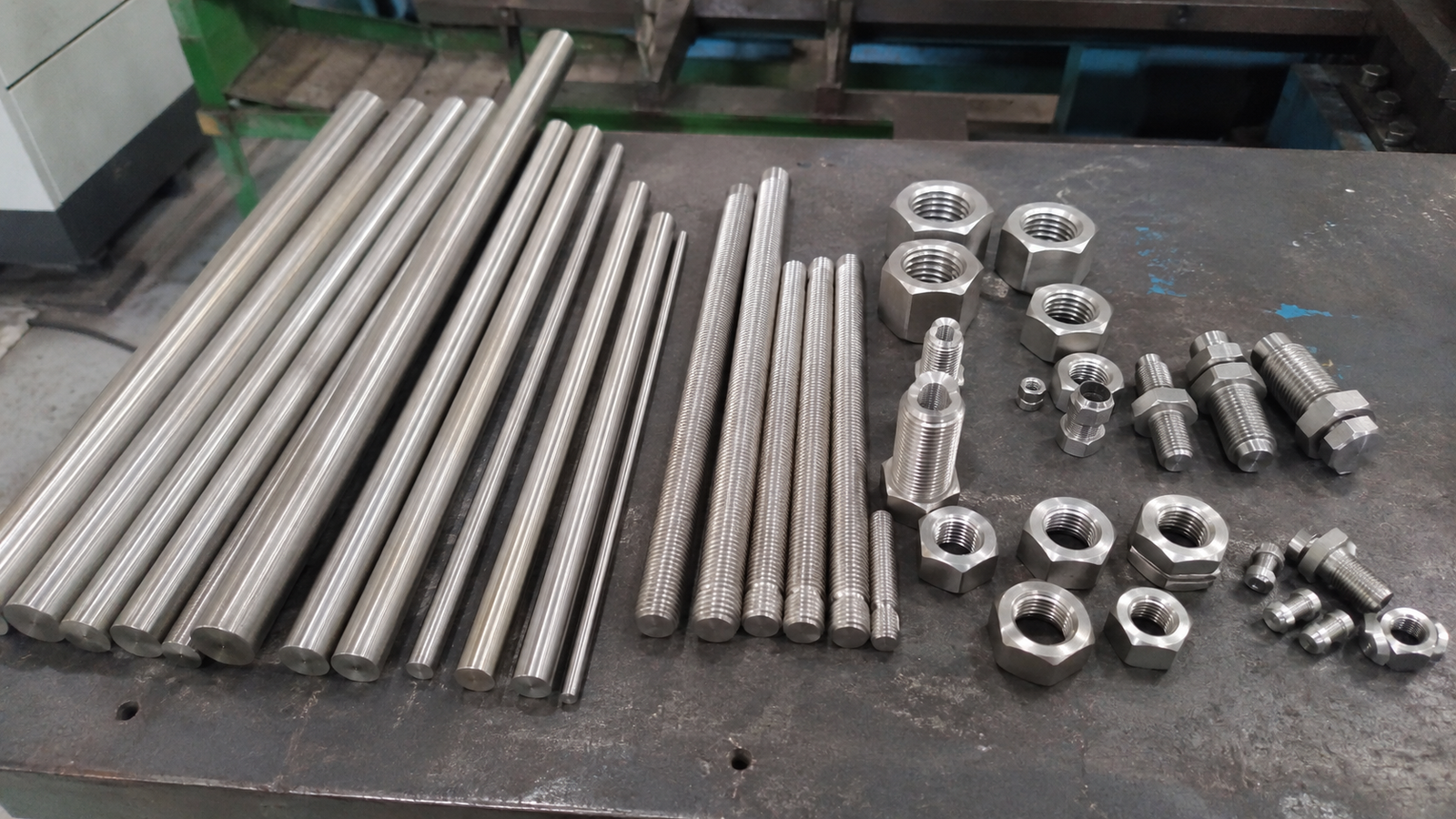
Image credit: Kees08, Wikimedia Commons, CC BY-SA 4.0. The photographed component is stainless steel, but the image illustrates the thread damage and material transfer associated with galling.
Titanium galling is a severe form of adhesive wear that can cause threaded fasteners to seize and sliding components to develop rapid surface damage.
It is not controlled by the titanium grade alone.
Galling risk depends on the complete contact system: titanium grade and condition, mating material, contact pressure, relative motion, surface finish, coating, lubrication, temperature, alignment, debris, and assembly procedure.
Buyers ordering titanium bars for fasteners, shafts, pins, stems, or sliding components should therefore specify both the bar material and the intended surface-contact system.
What Is Titanium Galling?
Galling occurs when contacting surface asperities adhere during relative motion.
Continued motion may then produce:
- Plastic deformation
- Surface tearing
- Material transfer
- Raised protrusions
- Rapid friction increase
- Thread damage
- Complete seizure
Galling is more severe than gradual dimensional wear.
ASTM G98-23 describes galling as a failure mode in which the damaged surfaces make the component non-serviceable. Threaded components operating with slow, intermittent sliding are a classic example.
Galling is sometimes described as cold welding, but the complete mechanism normally includes local adhesion, deformation, rupture, and repeated transfer of material.
Why Is Titanium Susceptible?
Titanium combines excellent corrosion resistance and strength-to-weight ratio with relatively poor unlubricated sliding behaviour.
The main reasons include:
Reactive Fresh Metal
Titanium is normally protected by a thin oxide film.
When contact stress and sliding rupture this film, fresh titanium can be exposed at the contact junction. The clean surfaces may adhere strongly before a new oxide film forms.
Local Plastic Deformation
Microscopic surface peaks carry much higher contact stresses than the nominal component load suggests.
These asperities may deform, shear, and transfer material between the mating surfaces.
Limited Heat Dissipation
Titanium has lower thermal conductivity than many steels and copper alloys.
Frictional heat may therefore remain concentrated near the contact surface, although temperature alone does not determine whether galling occurs.
Repeated Adhesive Junctions
Once transferred titanium creates a raised area, local pressure increases.
This can accelerate further adhesion and turn a small damaged area into complete seizure.
The risk is especially high when two untreated titanium surfaces contact each other without an effective separation layer.
Fasteners and Sliding Components Have Different Risks
| Component | Main Motion | Main Galling Risk |
|---|---|---|
| Bolt and nut | Short helical sliding during tightening | Thread seizure before the required preload is reached |
| Reusable titanium fastener | Repeated tightening and removal | Accumulated thread damage and changing friction |
| Shaft and bushing | Continuous or intermittent rotation | Adhesive wear, scoring and seizure |
| Valve stem | Slow reciprocating motion | Local material transfer and high operating force |
| Guide pin | Short repeated sliding | Surface tearing and dimensional loss |
| Actuator component | Start–stop or oscillating motion | Boundary-lubrication failure and stick–slip |
| Vacuum mechanism | Sliding with limited conventional lubrication | High adhesion and friction |
| Marine component | Sliding plus salt, debris or corrosion products | Combined adhesion, abrasion and lubricant loss |
A fastener installation test cannot automatically qualify a continuously rotating shaft.
The motion, geometry, load and lubrication must resemble the actual component.
Which Factors Increase Titanium Galling Risk?
| Risk Factor | Effect |
|---|---|
| Titanium against untreated titanium | Increases chemical and mechanical similarity between surfaces |
| High contact pressure | Enlarges real contact area and breaks surface films |
| Dry or boundary-lubricated contact | Allows more direct asperity contact |
| Slow, intermittent sliding | Common condition for severe galling |
| Repeated assembly | Accumulates thread and coating damage |
| Misalignment | Concentrates load on a small surface area |
| Inadequate clearance | Raises contact pressure in shafts and guides |
| Abrasive debris | Damages coatings and exposes fresh titanium |
| Unsuitable surface finish | Can raise asperity stress or prevent lubricant retention |
| High or low temperature | Can change lubricant, coating, oxide, and material behaviour |
| Vacuum | Limits conventional lubricants and changes surface-film behaviour |
| Aggressive chemicals | May degrade the lubricant or surface treatment |
The effect of sliding speed is not always linear.
Higher speed may increase heating and wear, while slow loaded movement can provide more opportunity for strong adhesive junctions to form.
Does Grade 5 Resist Galling Better Than Grade 2?
Grade 5 titanium is stronger and normally harder than Grade 2.
That does not make Grade 5 immune to galling.
| Grade | Relevant Characteristic | Galling Limitation |
|---|---|---|
| Grade 2 / UNS R50400 | Commercially pure, ductile and corrosion resistant | Untreated titanium-on-titanium contact remains susceptible |
| Grade 5 / UNS R56400 | Higher strength and hardness | Can still gall severely under poor lubrication or high contact stress |
| Grade 23 / UNS R56407 | ELI version of Ti-6Al-4V | ELI chemistry does not provide automatic anti-galling performance |
| Beta titanium alloys | Different strength and microstructure | Must be tested as part of the exact mating pair |
Hardness may influence the result, but it is not a universal galling-resistance index.
The mating surface and surface treatment frequently matter more than the difference between two untreated titanium grades.
Should Titanium Be Paired With a Different Material?
Avoiding untreated titanium-on-titanium contact can reduce risk.
Possible counterface materials may include:
- Qualified hardened steel
- Nickel alloy
- Copper alloy or bronze
- Ceramic
- Polymer or composite bearing material
- Coated titanium
- Surface-hardened titanium
A dissimilar material is not automatically safe.
The buyer must also consider:
- Galvanic compatibility
- Corrosion environment
- Temperature
- Hardness difference
- Thermal expansion
- Wear debris
- Electrical requirements
- Lubricant compatibility
- Allowable contamination
NASA testing has shown that the friction and wear performance of titanium changes significantly with the selected counterface material. See the study on alloys sliding against Ti-6Al-4V.
The complete material couple should be tested.
Which Surface Treatments May Help?
Surface treatment is often more effective than changing the bulk titanium grade alone.
Possible options include:
| Treatment | Intended Function | Qualification Concern |
|---|---|---|
| Nitriding | Creates a harder nitrogen-enriched surface | Case depth, brittleness, distortion and fatigue effect |
| Thermal oxidation | Forms a thicker hardened oxide-supported layer | Dimensional change, oxide integrity and fatigue |
| DLC coating | Provides a hard, low-friction barrier | Adhesion, coating thickness and edge loading |
| TiN or CrN coating | Increases hardness and separates titanium surfaces | Some coatings can fail under high contact load |
| Solid-film lubricant | Reduces friction where liquid lubricant is unsuitable | Cure, wear life, environment and reapplication |
| Metallic or ceramic coating | Separates the titanium from the counterface | Bond strength, porosity and dimensional tolerance |
Research comparing titanium surface treatments found that DLC-type coatings and selected conversion treatments provided strong galling protection, while some TiN coatings protected only at lower contact loads. This shows why coating names alone are insufficient; the contact pressure and sliding distance must also be qualified. See the study on surface treatments for galling protection of titanium alloys.
Coating specifications should state:
- Coating process
- Substrate preparation
- Coating material
- Thickness
- Hardness where relevant
- Adhesion requirement
- Surface finish
- Coverage area
- Post-treatment dimensions
- Inspection method
- Repair policy
Lubrication Must Be Linked to Installation Torque
Lubricants and anti-seize compounds can reduce direct metal contact and lower galling risk.
They also change friction.
For threaded fasteners, lower friction means that the same applied torque may produce a higher preload.
The NASA Fastener Design Manual identifies thread friction, bearing-surface friction, coatings, and lubricants as major variables in torque determination.
SAE J1701_202508 recommends determining critical-joint torque through testing with the exact assembly components.
The specification should therefore link:
- Fastener material
- Nut or tapped-hole material
- Thread finish
- Coating
- Lubricant
- Washer
- Tightening method
- Target preload
- Assembly speed
- Number of reuse cycles
A dry-installation torque value should not be applied automatically after lubrication is added.
The lubricant must also be compatible with the operating temperature, vacuum, oxygen service, chemicals, cleanliness requirements, and adjacent materials.
Surface Finish Alone Cannot Prove Galling Resistance
A rough surface may create high local stresses and damage the mating surface.
An extremely smooth surface may increase intimate contact or retain less lubricant in some systems.
Therefore, the RFQ should not state only:
“Polish the titanium to prevent galling.”
Instead, specify:
- Required Ra or another surface parameter
- Measurement direction
- Sampling locations
- Coating or lubricant to be used
- Counterface finish
- Cleaning condition
- Contact geometry
- Qualification test
The appropriate finish is part of the tribological system, not an independent solution.
Which Tests Should Buyers Request?
ASTM G98
ASTM G98-23 ranks the galling resistance of material couples.
It is especially relevant to unlubricated, low-speed, intermittent contact and threaded-component-type behaviour.
It does not provide a final component design limit because alignment, geometry, stiffness, lubrication and environment can change the result.
ASTM G99
ASTM G99-23 measures wear and friction using a pin-on-disk or ball-on-disk apparatus.
It is useful for comparing:
- Titanium grades
- Counterface materials
- Coatings
- Friction
- Wear volume
Its result applies to the selected load, speed, distance, material pair and environment.
ASTM G133
ASTM G133-22 evaluates reciprocating ball-on-flat sliding wear.
It can be useful for stems, guides and oscillating components, but its standard scope does not cover corrosive environments or extreme temperature and humidity.
Component-Level Test
A representative test should reproduce the final system.
| Test Input | Required Information |
|---|---|
| Material pair | Titanium grade and exact counterface |
| Condition | Heat treatment and hardness |
| Surface | Finish, coating and cleaning |
| Lubrication | Product, amount and application method |
| Load | Normal load or contact pressure |
| Motion | Rotation, reciprocation, oscillation or thread assembly |
| Speed | Actual or justified test speed |
| Distance | Sliding distance or assembly cycles |
| Temperature | Operating and transient range |
| Environment | Air, water, chemical, vacuum or other |
| Acceptance | No seizure, torque range, wear limit or coating integrity |
The test should evaluate the pair—not only a single titanium specimen.
ASTM B348 Does Not Qualify Galling Performance
ASTM B348/B348M-25 covers annealed titanium and titanium alloy bars and billets, including Grades 2, 5 and 23.
It can verify:
- Grade and UNS designation
- Chemical composition
- Tensile properties
- Dimensions
- Supplied surface condition
- Product certification
It does not establish:
- Galling threshold
- Friction coefficient
- Thread torque
- Coating performance
- Lubricant compatibility
- Shaft or bushing clearance
- Resistance to seizure
A compliant bar can still produce a component that galls after machining.
What Buyers Should Include in the RFQ
| RFQ Category | Required Information |
|---|---|
| Intended component | Fastener, shaft, stem, pin, guide or sliding part |
| Titanium grade | Grade and UNS designation |
| Product standard | ASTM B348/B348M, AMS or project specification |
| Bar condition | Annealed, heat treated or project-defined |
| Dimensions | Diameter, length, tolerance and quantity |
| Mechanical properties | Tensile, yield, hardness and other requirements |
| Mating material | Exact alloy, grade and condition |
| Motion | Threaded, rotating, reciprocating or oscillating |
| Load | Clamp load, radial load or contact pressure |
| Speed and cycles | Sliding speed, distance and expected cycles |
| Environment | Temperature, vacuum, water, chemicals or debris |
| Surface finish | Titanium and counterface requirements |
| Treatment | Nitriding, coating, oxidation or other |
| Lubricant | Product, application and compatibility |
| Fastener installation | Target preload, torque method and reuse limit |
| Galling test | G98 or project-specific method |
| Wear test | G99, G133 or component procedure |
| Acceptance | Seizure, friction, torque, wear and coating limits |
| Documentation | MTC, heat treatment, surface and test reports |
| Approval authority | Component designer or tribology engineer |
A request stating only:
“Need Grade 5 titanium bars with good galling resistance.”
does not provide enough information for a technically reliable quotation.
Frequently Asked Questions
Is titanium-on-titanium contact always unacceptable?
No. It may be used when contact stress, motion, surface treatment, lubrication and assembly procedure have been qualified. Untreated dry titanium-on-titanium contact presents a higher risk.
Is Grade 5 immune because it is harder than Grade 2?
No. Grade 5 can still gall. Hardness is only one part of the contact system.
Can anti-seize completely prevent thread galling?
Not automatically. The product must remain effective under the actual temperature, chemistry and assembly conditions. It also changes the torque–preload relationship.
Is a polished titanium shaft galling-resistant?
Not from polishing alone. The mating material, load, lubrication, clearance and motion must also be defined.
Does ASTM G98 provide a safe design pressure?
No. It ranks material couples under the test conditions and is primarily a screening method.
Are DLC and TiN equally effective?
Not necessarily. Coating performance depends on adhesion, thickness, contact load, sliding distance and environment. Some TiN systems may fail under loads where a qualified DLC system remains effective.
Can factory ultrasonic testing detect galling risk?
No. UT detects specified internal discontinuities in the bar. Galling develops at the final contact surfaces during assembly or service.
What information is most important for quotation?
Provide the titanium grade, bar dimensions, intended component, mating material, motion, load, surface treatment, lubricant, test method and documentation requirements.
Conclusion
Titanium galling is a contact-system problem rather than a simple alloy-grade problem.
Reliable prevention requires buyers to define:
- The titanium grade and condition
- The mating material
- Contact load and motion
- Surface finish and treatment
- Lubrication
- Assembly or operating procedure
- Representative galling and wear tests
- Acceptance criteria
Changing from Grade 2 to Grade 5 may not solve an untreated titanium-on-titanium contact problem.
For titanium bar enquiries, buyers should provide the grade, UNS designation, product standard, diameter, length, condition, intended component, surface allowance, testing, documentation and quantity.
Emily PIPE can review whether the requested titanium bar grade, dimensions, supplied condition, surface, inspection and certification requirements are technically manufacturable.
Final mating-material selection, coating qualification, lubrication, fastener torque and component-level galling approval should remain with the component designer and responsible tribology or materials engineer.