

XRF vs OES: What Can Each Method Prove for Alloy Verification?
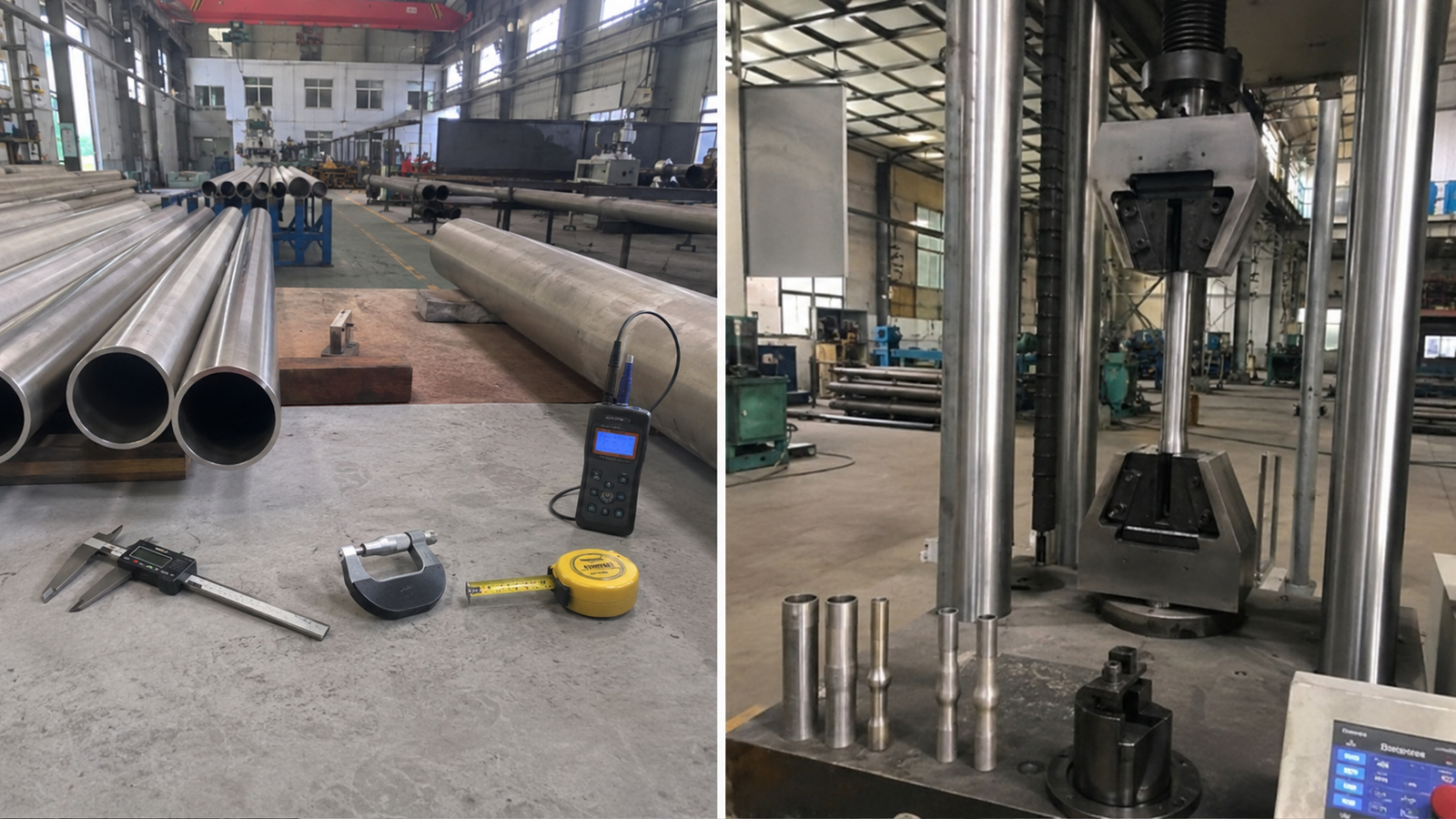
Image credit: Dean Calma / IAEA Imagebank, Wikimedia Commons, CC BY 2.0.
XRF and OES answer different alloy-verification questions.
Handheld XRF is normally the better tool for rapid, nondestructive grade identification using detectable alloying elements. Spark OES is normally the stronger option when the buyer needs localized quantitative chemistry, particularly carbon and other elements that portable XRF cannot reliably determine.
Neither method alone proves heat treatment, mechanical properties, internal soundness, complete product homogeneity, traceability, or suitability for the intended service.
XRF vs OES: Quick Comparison
| Question | Handheld XRF | Spark OES |
|---|---|---|
| Rapid alloy identification | Strong | Strong |
| Field portability | Excellent | Mobile systems exist but require more preparation |
| Surface damage | Normally none | Leaves a small burn mark |
| Carbon measurement | No | Possible with a validated matrix-specific method |
| Oxygen, nitrogen, and hydrogen in titanium | No | Not automatically; separate methods are normally required |
| Surface coating influence | High | Coating must be removed from the test location |
| Sample preparation | Cleaning may be sufficient for screening | Flat, clean, oxide-free surface normally required |
| Quantitative chemistry | Possible only within the validated instrument and method scope | Strong within the validated calibration range |
| Bulk homogeneity proof | No | No, not from one test location |
| Finished-part PMI | Well suited | Limited where a burn mark is unacceptable |
| Full product certification | Not by itself | Not by itself |
The correct choice depends on the element that must be verified and the evidence required by the purchase specification.
What Can Handheld XRF Prove?
Handheld XRF exposes the test surface to X-rays and measures the characteristic fluorescent X-rays emitted by detectable elements.
It is commonly used for:
- Incoming-material inspection
- Positive Material Identification
- Alloy sorting
- Preventing grade mix-ups
- Checking installed equipment
- Confirming major alloying elements
- Verifying material before fabrication
For nickel alloys, XRF may help distinguish grades by elements such as:
- Nickel
- Chromium
- Molybdenum
- Niobium
- Tungsten
- Cobalt
- Copper
- Iron
For example, an appropriate XRF program may help separate:
- Alloy 625 from Alloy 825
- C-276 from C-22
- Alloy 600 from Alloy 625
- Monel 400 from nickel–chromium alloys
The result supports grade identification only when the measured elements create a sufficiently clear distinction.
What Can Handheld XRF Not Prove?
Carbon Content
Portable XRF cannot determine carbon.
It therefore cannot independently prove:
- Low-carbon compliance
- Carbon-controlled welding behaviour
- Carbon limits in nickel alloys
- The difference between grades separated mainly by carbon
An XRF grade name displayed on the instrument is an identification generated by its alloy library. It is not proof that every specified element has been measured.
Titanium Interstitial Elements
Titanium grades are often controlled by:
- Oxygen
- Nitrogen
- Hydrogen
- Carbon
Handheld XRF cannot provide the complete interstitial analysis required to certify these limits.
It may identify major elements in Ti-6Al-4V, but it cannot prove that the material meets all requirements for Grade 5 or Grade 23.
In particular, XRF should not be used alone to distinguish Grade 5 from Grade 23 ELI because the ELI designation depends partly on tighter interstitial limits.
Complete Product Homogeneity
One XRF reading proves only what was measured at the selected surface location.
It does not prove that:
- The entire bar or tube has identical chemistry.
- Every piece in the bundle is the same grade.
- The material belongs to the stated heat.
- The internal material matches a plated surface.
- No segregation or mix-up exists elsewhere.
A sampling plan remains necessary.
Why Surface Condition Matters for XRF
XRF is sensitive to the material inside its effective measurement region near the tested surface.
The result can be affected by:
- Paint
- Plating
- Oxide scale
- Dirt
- Oil
- Corrosion products
- Grinding contamination
- Curved surfaces
- Small tube diameter
- Thin wall
- Incomplete contact with the analyzer window
A coated component may produce a reading dominated by the coating rather than the substrate.
Surface grinding may improve substrate access, but it changes the inspection from fully nondestructive to locally surface-altering and may introduce contamination from the grinding tool.
The PMI procedure should define:
- Surface-preparation method
- Minimum test area
- Calibration verification
- Test duration
- Number of readings
- Allowed uncertainty
- Acceptance logic
- Handling of inconclusive results
Handheld XRF and Laboratory XRF Are Not the Same
It is inaccurate to state that all XRF analysis is only qualitative or semi-quantitative.
ASTM E2465-24 covers quantitative analysis of nickel-base alloys using laboratory wavelength-dispersive X-ray fluorescence spectrometry.
A laboratory WDXRF method may use:
- Carefully prepared samples
- Matrix-matched reference materials
- Validated calibration ranges
- Drift correction
- Laboratory quality controls
- Defined precision and bias
This capability should not be confused with rapid handheld PMI.
The test report should identify whether the result came from:
- Handheld XRF
- Benchtop energy-dispersive XRF
- Laboratory wavelength-dispersive XRF
- Another analytical method
The word XRF alone is incomplete.
What Can Spark OES Prove?
Spark Optical Emission Spectrometry creates a controlled electrical discharge on a prepared metal surface.
A small amount of material is vaporized and excited. The emitted light is measured to determine elemental concentrations.
Spark OES can provide quantitative local chemistry when:
- The instrument has the correct alloy-base calibration.
- Certified reference materials cover the required range.
- The sample is properly prepared.
- The analytical method has been validated.
- The element lies within the method’s demonstrated range.
ASTM E3047-22 covers Spark-AES analysis of nickel alloys.
Its validated scope includes selected ranges for elements such as:
- Carbon
- Boron
- Sulfur
- Phosphorus
- Chromium
- Molybdenum
- Niobium
- Titanium
- Aluminum
- Iron
- Nickel
For titanium alloys, ASTM E2994-21 covers Spark-AES and Glow Discharge AES for specified elemental ranges.
OES is therefore useful when the purchase specification requires quantitative verification beyond handheld PMI.
OES Is Local Analysis, Not Automatic Bulk Proof
Spark OES removes material from a small test location.
It should not be described as proof of the chemistry throughout an entire bar, tube, billet, or forging.
Reliable verification may require:
- Multiple burns at one location
- Tests at multiple locations
- Tests from both ends of a long product
- Separate samples from different pieces
- Heat-analysis records
- Product or check analysis
- A documented sampling plan
OES also cannot independently detect:
- Internal segregation away from the tested location
- Porosity
- Inclusions
- Cracks
- Incorrect heat treatment
- Incorrect mechanical properties
Those conditions require other inspection or testing methods.
Can OES Measure Every Light Element?
No.
Spark OES capability depends on:
- Alloy matrix
- Instrument optics
- Argon quality
- Wavelength selection
- Calibration
- Reference materials
- Analytical range
- Laboratory validation
For nickel alloys, a validated Spark-OES method may determine carbon, boron, sulfur, and phosphorus within specified ranges.
For titanium alloys, oxygen, nitrogen, and hydrogen normally require separate gas-analysis methods.
| Titanium Requirement | Common ASTM Method |
|---|---|
| Oxygen and nitrogen | ASTM E1409-13(2021) |
| Hydrogen | ASTM E1447-22 |
| Carbon | ASTM E1941-10(2024) |
| Major metallic alloying elements | ASTM E2994-21 or another validated method |
A report stating only “OES tested” does not prove that every specified element was measured by an appropriate method.
Which Method Should Buyers Choose?
| Procurement Question | Recommended Starting Method |
|---|---|
| Is this Alloy 625 rather than Alloy 825? | Handheld XRF |
| Are incoming pieces mixed with another alloy? | Handheld XRF with a defined sampling plan |
| Does the nickel alloy meet its carbon limit? | Validated Spark OES, combustion analysis, or applicable laboratory method |
| Is the titanium Ti-6Al-4V? | XRF may screen major elements; complete certification requires additional analysis |
| Is the titanium Grade 23 ELI rather than Grade 5? | Full chemistry including interstitial elements |
| Does the titanium meet oxygen and nitrogen limits? | ASTM E1409 or approved equivalent |
| Does the titanium meet its hydrogen limit? | ASTM E1447 or approved equivalent |
| Is a finished component the expected alloy? | XRF where no surface mark is permitted |
| Is a supplier certificate chemically correct? | Independent laboratory analysis using applicable methods |
| Is the entire batch homogeneous? | Neither method alone; use a sampling and traceability plan |
For critical procurement, XRF and OES are often complementary rather than competing methods.
What Neither Method Can Prove
Chemical analysis does not establish every property of the supplied material.
Neither XRF nor OES alone proves:
- Tensile strength
- Yield strength
- Elongation
- Hardness
- Heat-treatment condition
- Grain size
- Corrosion resistance
- Fatigue performance
- Internal soundness
- Surface defects
- Dimensional compliance
- Product traceability
- Service suitability
A material may have the correct chemistry and still fail the ordered product specification.
The acceptance package may also require:
- Mechanical testing
- Heat-treatment records
- Ultrasonic testing
- Eddy-current testing
- Hydrostatic testing
- Surface examination
- Dimensional inspection
- Corrosion testing
- Heat-number traceability
Does XRF or OES Replace the MTR?
No.
A Material Test Report links specified test results to a defined heat, product, condition, and purchase order.
An independent XRF or OES result can help verify chemistry, but it does not automatically prove:
- Heat identity
- Manufacturing history
- Heat treatment
- Mechanical properties
- NDT results
- Compliance of every delivered piece
A piece of material may match the expected alloy chemistry while still carrying an incorrect or unverified heat number.
PMI and traceability should therefore be treated as separate controls.
What Buyers Should Include in the RFQ
| RFQ Category | Required Information |
|---|---|
| Material | Exact grade and UNS designation |
| Product form | Tube, pipe, bar, billet, plate, or finished component |
| Product standard | ASTM, ASME, AMS, EN, ISO, or project specification |
| Verification purpose | Grade screening, product analysis, or full certification |
| Test method | Handheld XRF, WDXRF, Spark OES, ICP-OES, gas fusion, or combustion |
| Required elements | List every element requiring verification |
| Sampling | Number of heats, lots, bundles, pieces, and test locations |
| Surface preparation | Cleaning, grinding, milling, or no surface alteration |
| Finished-surface restriction | Whether burn marks or grinding are permitted |
| Calibration | Reference-material and verification requirements |
| Acceptance | Grade match or element-by-element limits |
| Uncertainty | Required reporting or decision rule |
| Traceability | Heat and piece identification |
| Retesting | Procedure for borderline or failed results |
| Documentation | MTR, PMI report, laboratory report, and instrument method |
| Laboratory | ISO/IEC 17025 accreditation where project-required |
A request stating only:
“XRF or OES verification required.”
does not define what must be proven.
Frequently Asked Questions
Is OES always more accurate than XRF?
Not universally. Accuracy depends on the instrument, sample preparation, matrix, calibration, element, concentration range, and validated method. Laboratory WDXRF can provide quantitative results for specified elements.
Can XRF detect carbon?
Handheld XRF cannot reliably measure carbon in metal alloys. Another validated method is required.
Can OES prove the complete chemistry of titanium?
Not automatically. Oxygen, nitrogen, hydrogen, and carbon may require inert-gas-fusion or combustion methods.
Can XRF distinguish Grade 5 from Grade 23 titanium?
It may identify the main Ti-6Al-4V alloying elements, but it cannot prove the tighter interstitial limits required for Grade 23 ELI.
Is OES a bulk-analysis method?
It analyzes material beneath a prepared surface more directly than handheld XRF, but each spark remains a localized analysis. One burn does not prove whole-product homogeneity.
Can XRF identify a plated component?
It may identify the coating rather than the substrate. Coating thickness, composition, and measurement conditions must be considered.
Should every tube or bar be tested?
That depends on the project risk and traceability system. The purchase specification should define whether testing is performed by heat, lot, bundle, piece, or selected sample.
Which method is better for incoming inspection?
Handheld XRF is normally more practical for rapid nondestructive grade screening. Inconclusive or specification-critical results should be escalated to an appropriate laboratory method.
Conclusion
XRF and OES prove different parts of alloy identity.
Use handheld XRF primarily to answer:
“Does this surface show the major alloying elements expected for this grade?”
Use a validated Spark-OES or laboratory method to answer:
“Do the measured elements at this test location meet the specified quantitative limits?”
Use gas fusion, combustion, ICP, or another appropriate method when the required element lies outside the validated XRF or OES scope.
For nickel alloy or titanium alloy enquiries, buyers should provide the grade, UNS designation, product standard, dimensions, required elements, sampling plan, analytical method, acceptance limits, traceability, documentation, and quantity.
Emily PIPE can review whether the requested tube or bar grade, dimensions, PMI, laboratory-analysis, inspection, certification, and traceability requirements are technically manufacturable.
Final analytical-method approval, sampling plan, acceptance decision, and material qualification should remain with the purchaser and responsible quality or materials engineer.
_(45372292762).jpg)