
Nickel vs Titanium Alloys for Offshore Wind Hydraulic and Cooling Systems
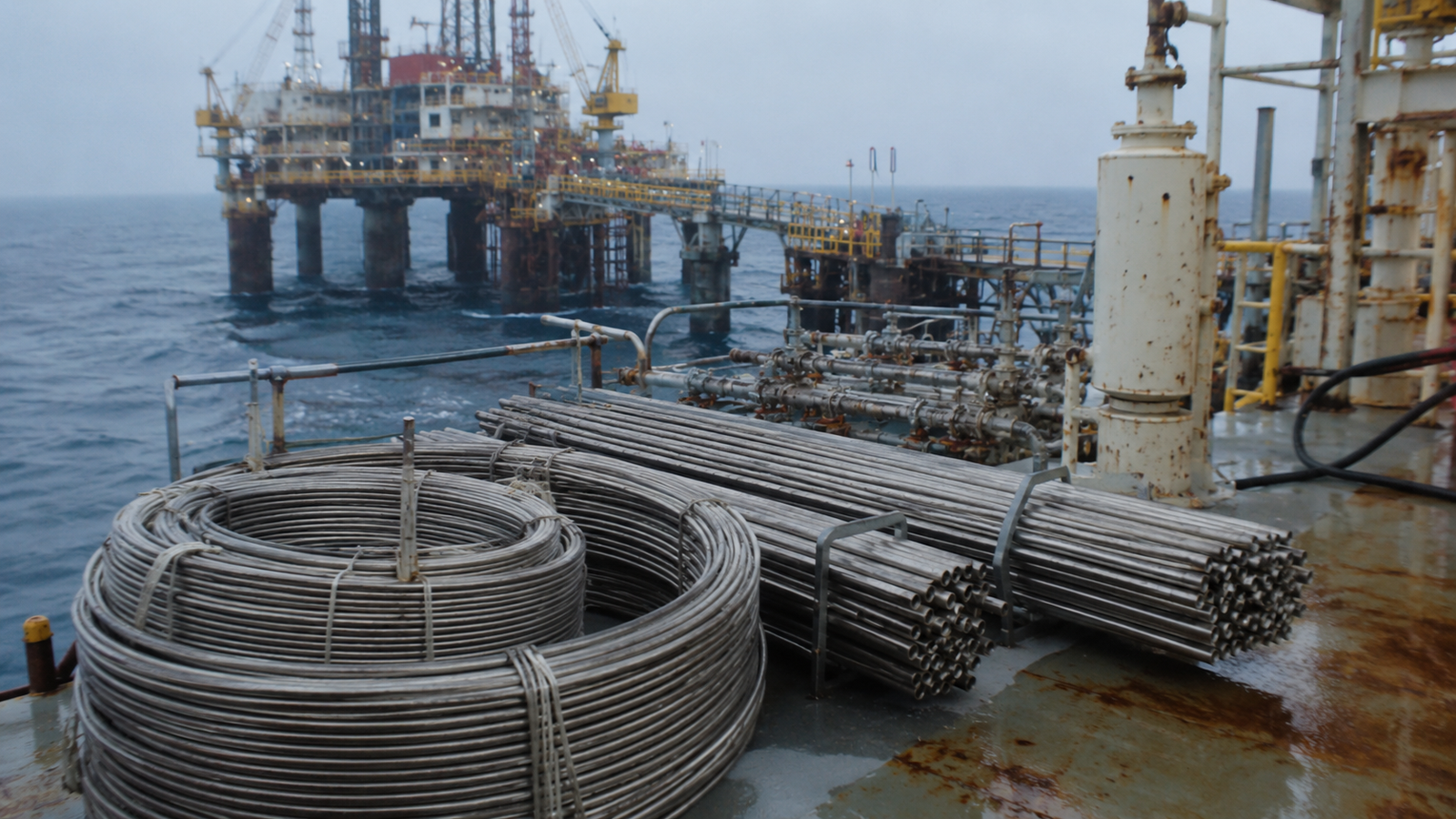
Image credit: Lauri Veerde, Wikimedia Commons, CC BY-SA 4.0. The image shows the interior of a wind turbine nacelle and its equipment cooling system; the visible material grades are not identified.
Nickel and titanium alloys are not required throughout every offshore wind hydraulic or cooling system.
Their strongest applications are normally limited to components exposed directly to seawater, severe chloride conditions, high pressure, restricted maintenance access, or strict weight limits.
Titanium is usually the stronger starting candidate for seawater heat exchanger tubes. Nickel alloys may be considered for selected high-pressure fittings, valve components, instrument tubing, mixed-fluid heat exchangers, and locations where strength or resistance to more complex process chemistry is required.
Closed hydraulic circuits containing clean hydraulic oil should be evaluated separately from open seawater cooling circuits.
Hydraulic and Cooling Systems Are Different Material Environments
| System | Internal Fluid | Main Material Risk |
|---|---|---|
| Hydraulic pitch or brake circuit | Hydraulic oil | Pressure fatigue, vibration, leakage, external salt atmosphere |
| Closed generator cooling loop | Treated water or glycol mixture | Fluid compatibility, oxygen control, external corrosion |
| Open seawater cooling loop | Natural or treated seawater | Pitting, crevice corrosion, fouling, deposits and galvanic effects |
| Seawater heat exchanger | Seawater on one side, cooling fluid on the other | Tube corrosion, tube-sheet crevices, fouling and leakage |
| Subsea instrument line | Hydraulic fluid or process fluid internally, seawater externally | External pressure, seawater exposure, fatigue and connection integrity |
A material that performs well in a seawater heat exchanger may be unnecessary or unsuitable for a high-cycle hydraulic line.
Where Does Titanium Fit Best?
Seawater Heat Exchanger Tubes
Titanium Grade 2 is a common starting candidate for heat exchanger tubes exposed to oxygenated seawater.
Its main advantages include:
- Strong resistance to general seawater corrosion
- High resistance to chloride pitting
- Low density
- Ability to use relatively thin tube walls
- Resistance to high seawater velocity
- Long service history in marine heat exchangers
The International Titanium Association’s seawater guidance explains that titanium’s seawater performance comes from its stable oxide film, strength and ability to use thinner wall sections.
Titanium should not be selected because it has unusually high thermal conductivity. Its heat exchanger advantage comes mainly from corrosion resistance, low required corrosion allowance and the ability to manufacture thin-wall tubes.
When Grade 7 or Grade 12 May Be Considered
Grade 7 or Grade 12 may deserve review when the cooling system includes:
- Higher seawater temperature
- Tight tube-sheet crevices
- Long periods of stagnation
- Low-pH contamination
- Difficult cleaning conditions
- Higher consequences of local leakage
These grades provide a larger crevice-corrosion margin in selected conditions, but they are not automatically required for normal ambient seawater cooling.
Weight-Sensitive Hydraulic Tubing
Where substantial weight reduction is required, Ti-3Al-2.5V tubing may be evaluated for hydraulic lines.
SAE AMS4944N covers cold-worked and stress-relieved Ti-3Al-2.5V seamless hydraulic tubing.
However, an aerospace material specification does not automatically approve the tube for an offshore wind turbine.
The complete hydraulic assembly must still be qualified for:
- Pressure
- Pressure cycling
- Bending
- Vibration
- Clamping
- Connections
- Hydraulic-fluid compatibility
- External marine exposure
- Inspection access
Where Do Nickel Alloys Fit?
Nickel alloys are more likely to be used selectively than throughout the complete cooling or hydraulic circuit.
Possible locations include:
- High-pressure fittings
- Valve stems and trim
- Sensor housings
- Small-bore instrument tubing
- Mixed-fluid heat exchangers
- Crevice-prone connections
- Components exposed to both chlorides and aggressive process fluids
Alloy 625
Alloy 625 may be screened where the component requires a combination of:
- High strength
- Chloride resistance
- Weldability
- Pressure containment
- Resistance to localized corrosion
ASTM B444-23 covers cold-worked seamless Alloy 625 pipe and tube.
Alloy 625 is not automatically the best seawater heat exchanger material. Its higher density and material cost may be difficult to justify when Grade 2 titanium can satisfy the seawater duty.
Alloy 825
Alloy 825 may be considered when the system contains mixed corrosive fluids rather than clean seawater alone.
ASTM B423-22 covers Alloy 825 seamless pipe and tube for general corrosive service.
Its suitability should be reviewed against:
- Chloride concentration
- Temperature
- Oxygen level
- Crevice geometry
- Hydraulic fluid or glycol chemistry
- Cleaning chemicals
- Expected stagnation
A general corrosive-service standard does not prove offshore cooling-system performance.
Nickel vs Titanium: Practical Comparison
| Selection Factor | Titanium | Nickel Alloy |
|---|---|---|
| Natural seawater heat exchanger tube | Usually a strong starting option | Application-specific |
| Component weight | Lower density | Higher density |
| Thin-wall heat exchanger design | Strong advantage | Possible, but normally heavier |
| High-pressure fitting or valve part | Grade and design dependent | Often a strong candidate |
| Mixed acid or complex process fluid | Grade-specific limitations | Broader nickel-alloy options available |
| Chloride pitting resistance | Strong in many seawater conditions | Strong for selected high-Mo grades |
| Crevice corrosion | Requires temperature and geometry review | Requires grade-specific review |
| High-temperature strength | Limited compared with many nickel alloys | Often stronger |
| Galvanic compatibility | Requires system assessment | Requires system assessment |
| Hydraulic fatigue | Requires component qualification | Requires component qualification |
| Product cost | High but may permit thinner walls | High and normally heavier |
| Fabrication | Requires titanium-specific procedures | Requires alloy-specific procedures |
There is no universal winner.
The correct material depends on whether the component is primarily controlled by seawater corrosion, pressure strength, temperature, weight or mixed-fluid chemistry.
Do Not Assume the Entire Offshore System Is Seawater-Wetted
A hydraulic tube inside a nacelle may be exposed externally to:
- Salt-laden air
- Condensation
- Temperature changes
- Oil leakage
- Vibration
- Maintenance damage
Its internal surface may contact only clean hydraulic oil.
In this situation, the material review should focus on:
- External corrosion protection
- Pressure fatigue
- Tube support
- Vibration
- Fitting reliability
- Fire safety
- Hydraulic-fluid cleanliness
Using Alloy 625 or titanium solely because the turbine is offshore may add cost without solving the controlling failure mode.
DNV-ST-0361 Machinery for Wind Turbines addresses wind turbine machinery design.
DNV-RP-0416 mainly addresses corrosion protection for support structures and directs machinery-related issues to DNV-ST-0361.
Biofouling Is Not Solved by Alloy Selection Alone
Titanium, nickel alloys and copper-nickel alloys can all accumulate marine growth under suitable conditions.
Biofouling may cause:
- Reduced heat transfer
- Higher pressure drop
- Blocked tube entrances
- Deposit retention
- Flow maldistribution
- More frequent cleaning
Material selection should be combined with:
- Filtration
- Water treatment
- Flow control
- Cleaning access
- Inspection
- Shutdown procedures
A corrosion-resistant tube does not guarantee a clean heat-transfer surface.
Galvanic Corrosion Must Be Designed at System Level
Titanium and many nickel alloys are relatively noble in seawater.
When connected electrically to carbon steel, aluminum or another less noble metal, corrosion may accelerate on the less noble component.
The design review should include:
- Material combinations
- Cathode-to-anode area ratio
- Electrical isolation
- Coating condition
- Cathodic protection
- Fasteners
- Tube sheets
- Supports
- Earthing and bonding
Replacing one tube or fitting with a more noble alloy can shift corrosion to an adjacent component.
Which Product Standards Apply?
| Product | Possible Standard | Important Boundary |
|---|---|---|
| Titanium condenser and heat exchanger tube | ASTM B338-17(2026) | Does not qualify offshore cooling service |
| Ti-3Al-2.5V seamless hydraulic tube | SAE AMS4944N | Does not qualify the complete hydraulic assembly |
| Alloy 625 seamless pipe and tube | ASTM B444-23 | Does not establish fatigue or seawater service life |
| Alloy 825 seamless pipe and tube | ASTM B423-22 | General corrosive-service specification |
| Wind turbine machinery | DNV-ST-0361 | Project and OEM requirements still apply |
| Wind turbine support corrosion | DNV-RP-0416 | Mainly concerns support structures |
Product-standard compliance verifies the supplied material.
It does not establish:
- Complete system life
- Galvanic compatibility
- Biofouling resistance
- Fitting fatigue
- Tube vibration resistance
- Seawater-side cleaning compatibility
- Offshore wind turbine certification
What Buyers Should Include in the RFQ
| RFQ Category | Required Information |
|---|---|
| System | Hydraulic, closed cooling or open seawater cooling |
| Component | Tube, fitting, valve part, heat exchanger or instrument line |
| Internal fluid | Hydraulic oil, glycol, treated water or seawater |
| External exposure | Nacelle atmosphere, splash, immersion or subsea |
| Temperature | Normal, maximum and shutdown |
| Pressure | Operating, design and cycling |
| Material | Grade and UNS designation |
| Product standard | ASTM, SAE, DNV, EN or project specification |
| Tube dimensions | OD, wall thickness, length and tolerance |
| Tube type | Seamless, welded or welded and cold worked |
| Fabrication | Bending, welding, flaring and connections |
| Corrosion review | Pitting, crevice and galvanic compatibility |
| Testing | ECT, UT, hydrostatic, pneumatic or project method |
| Qualification | Pressure-cycle, vibration or heat exchanger test |
| Documentation | MTC, heat treatment, NDT and dimensional reports |
| Approval authority | Turbine OEM, system designer or materials engineer |
A request stating only:
“Need nickel or titanium tubes for an offshore wind turbine.”
does not provide enough information for a reliable material recommendation or quotation.
Frequently Asked Questions
Is titanium always better for offshore wind cooling?
No. Titanium is a strong candidate for seawater heat exchanger tubes, but system temperature, crevices, cleaning, galvanic design and cost must still be evaluated.
Is Alloy 625 necessary for offshore hydraulic lines?
Not automatically. A closed hydraulic circuit may be controlled more by pressure fatigue, vibration and fittings than by seawater corrosion.
Can ASTM B338 be used for titanium hydraulic tubing?
ASTM B338 is intended for condenser, evaporator and heat exchanger tubes. Hydraulic tubing requires an appropriate hydraulic or project-specific specification.
Is titanium more thermally conductive than nickel alloys?
Titanium is not selected because of exceptionally high thermal conductivity. Its heat exchanger value comes from corrosion resistance and the ability to use thin walls with little corrosion allowance.
Are titanium heat exchanger tubes immune to biofouling?
No. Titanium may resist corrosion beneath many deposits, but marine growth can still reduce heat transfer and block flow.
Which alloy is best for seawater valve components?
The answer depends on flow, crevices, galvanic coupling, pressure, temperature and the complete valve design. No single nickel or titanium grade is universally best.
Do DNV corrosion rules approve the tube material?
No. DNV requirements form part of the machinery and project design framework. Product material, component qualification and OEM approval are still required.
What information is most important for quotation?
Provide the system type, internal fluid, external exposure, pressure, temperature, grade, dimensions, fabrication, testing and documentation requirements.
Conclusion
Nickel and titanium alloys should be placed only where their properties address a defined offshore wind risk.
Titanium is normally the stronger starting candidate for:
- Seawater heat exchanger tubes
- Weight-sensitive qualified hydraulic tubing
- Components requiring low density and strong seawater resistance
Nickel alloys may be stronger candidates for:
- High-pressure fittings
- Valve and instrument components
- Mixed corrosive fluids
- Higher-temperature service
- Locations requiring both strength and localized-corrosion resistance
The first material-selection question should be:
Is the component exposed internally to seawater, hydraulic oil, treated cooling water or a mixed process fluid?
For nickel alloy or titanium tube enquiries, buyers should provide the grade, UNS designation, product standard, OD, wall thickness, length, pressure, temperature, fluid, exposure condition, testing, documentation and quantity.
Emily PIPE can review whether the requested alloy tube grade, dimensions, supplied condition, surface, inspection, certification and packaging requirements are technically manufacturable.
Final material selection, galvanic design, pressure qualification, corrosion review and offshore turbine approval should remain with the OEM, system designer and responsible materials engineer.