
How to Compare Nickel Alloy Quotations: Price, Quality, Standards, and Hidden Costs
Comparing nickel alloy quotations can be confusing. Two suppliers may quote “Inconel 625 tube” or “nickel alloy bar,” but the prices can be very different. The lowest price is not always the best choice, and the highest price is not automatically the safest option.
A nickel alloy quotation should be compared by material grade, UNS number, product form, applicable standard, manufacturing method, heat treatment, testing scope, Material Test Report, heat number traceability, surface finish, packaging, lead time, and total cost of ownership—not only by price per kilogram. A Request for Quotation usually includes more than unit price, such as specifications, quality level, payment terms, and contract requirements, so buyers should make sure all suppliers are quoting the same technical and commercial scope.
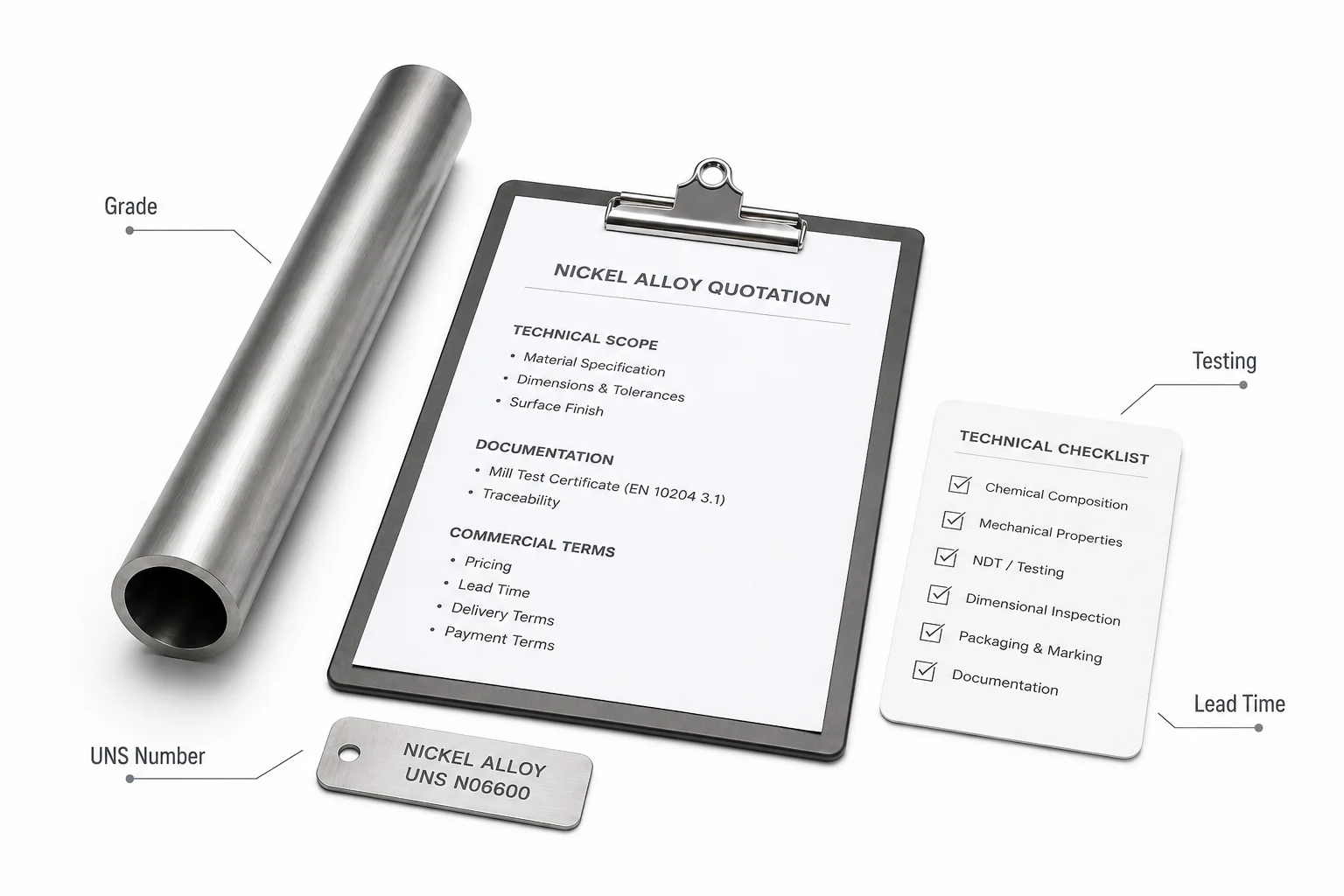
When I talk to customers, a common question comes up:
Which nickel alloy quote is best?
The answer is not always “the cheapest one.” For nickel alloy tubes, nickel alloy bars, and other high-performance alloy materials, the best quotation is the one that matches your application, quality requirements, inspection needs, delivery schedule, and documentation requirements.
A cheap quotation may look attractive at first. But if it does not clearly state the alloy grade, UNS number, standard, product form, test scope, MTR, heat number, surface finish, or delivery time, the buyer may face hidden risks later.
Quick Nickel Alloy Quote Comparison Checklist
Before comparing prices, buyers should first check whether all suppliers are quoting the same material and service scope.
| Quote Item | What You Should Confirm | Why It Matters |
|---|---|---|
| Alloy Grade | Inconel 625, Inconel 718, Alloy 825, Hastelloy C276, Monel 400, Nickel 200, etc. | Avoids confusion between different nickel alloys |
| UNS Number | N06625, N07718, N08825, N10276, N04400, N02200, etc. | Confirms exact material identity |
| Standard | ASTM, ASME, EN, ISO, AMS, NACE/ISO if applicable | Defines technical and testing requirements |
| Product Form | Seamless tube, welded tube, pipe, round bar, forged bar, rod, billet | Affects cost, performance, testing, and application |
| Size and Tolerance | OD, wall thickness, diameter, length, straightness, tolerance | Prevents machining or assembly problems |
| Manufacturing Method | Seamless, welded, hot rolled, cold drawn, forged, peeled, ground | Affects mechanical properties, surface finish, and delivery time |
| Heat Treatment | Annealed, solution annealed, aged, cold worked, stress relieved | Affects strength, hardness, corrosion behavior, and standard compliance |
| Testing Scope | Chemical, tensile, hardness, UT, ET, hydrostatic, PMI, dimensional inspection | Confirms whether project requirements are included |
| MTR / MTC | Material Test Report or Mill Test Certificate | Supports batch-level material verification |
| Heat Number | Heat number on MTR, product marking, and packing list | Links delivered material to production and test records |
| Surface Finish | Pickled, polished, bright annealed, peeled, ground, machined | Affects corrosion, cleanliness, appearance, and downstream processing |
| Packaging | Wooden case, bundle, plastic caps, waterproof film, anti-scratch protection | Reduces shipping damage |
| Lead Time | Stock, new production, inspection time, shipping time | Affects project schedule |
| Commercial Terms | Incoterms, payment terms, validity, warranty or nonconformity handling | Affects total purchasing risk |
If one quote is much lower than the others, do not reject it immediately. First ask why. It may be stock material, a simpler testing scope, a different product form, or a missing documentation requirement.
Why Is a Nickel Alloy Quote More Than Just a Price Tag?
A nickel alloy quote is not only a price list. It should be a clear technical and commercial document that tells the buyer exactly what is being supplied.
A reliable nickel alloy quotation should clearly state the alloy grade, UNS number, product standard, size, tolerance, product form, manufacturing route, heat treatment, testing scope, documentation, packaging, delivery time, and payment terms. Without these details, two quotes that look similar may actually represent very different materials.
For example, a quote that only says “nickel alloy pipe” is not enough. Nickel alloy may refer to Inconel 625, Inconel 600, Inconel 718, Alloy 825, Hastelloy C276, Hastelloy C22, Monel 400, Nickel 200, or other grades. Each alloy has different chemical composition, corrosion resistance, strength, temperature capability, and cost.
Even if two suppliers both quote “Inconel 625,” the details may still be different:
- seamless tube or welded tube
- ASTM B444 or another standard
- annealed or solution annealed condition
- stock size or custom production
- hydrostatic test included or excluded
- nondestructive electric test included or excluded
- MTR included or not included
- third-party inspection included or not included
- export wooden case included or not included
A quotation with unclear scope may become expensive later.
How Does Your Application Shape Nickel Alloy Quote Comparison?
A nickel alloy quotation should always be judged against the application. The same alloy may be over-specified for one project and insufficient for another.
Matching the nickel alloy to the application is critical because material selection should consider the working conditions, required properties, corrosion environment, fabrication method, service life, and cost. Buyers should not compare nickel alloy quotations only by price if the application environment is severe or safety-critical.
A buyer sourcing nickel alloy tubing for a heat exchanger should confirm tube-side and shell-side fluids, temperature, pressure, chloride level, corrosion risk, tube type, testing requirements, and project standard.
A buyer sourcing nickel alloy bars for pump shafts, valve stems, fasteners, or high-temperature components should confirm mechanical properties, heat treatment condition, straightness, surface finish, machining allowance, hardness, and inspection requirements.
Application Factors That Affect Quote Selection
| Application Factor | What to Confirm | Why It Affects the Quote |
|---|---|---|
| Operating Temperature | Normal temperature, maximum temperature, thermal cycling | Determines alloy grade, heat treatment, creep resistance, oxidation resistance |
| Corrosive Environment | Acids, alkalis, chlorides, seawater, H₂S, oxidizing/reducing media | Determines whether common or high-performance nickel alloy is needed |
| Pressure Requirement | Operating pressure, design pressure, pressure cycling | Affects wall thickness, tube standard, hydrostatic test, and mechanical properties |
| Mechanical Stress | Static load, vibration, fatigue, impact, wear | Affects bar grade, heat treatment, hardness, and NDT requirements |
| Fabrication Need | Welding, bending, machining, forming, threading | Affects product form, surface condition, tolerance, and delivery plan |
| Service Life Target | Expected lifetime and maintenance interval | Affects total cost of ownership |
| Regulatory / Project Standard | ASTM, ASME, EN, NACE/ISO, AMS, customer specification | Affects production route, testing, documentation, and cost |
| Inspection Level | Standard inspection, third-party inspection, customer witness | Affects lead time and quotation value |
For example, Inconel 625 is a nickel-based superalloy known for high strength, elevated-temperature resistance, corrosion resistance, and oxidation resistance. It is used in chemical processing, marine, nuclear, pumps, valves, and high-pressure equipment.
For cold-worked seamless Inconel 625 pipe and tube, ASTM B444 covers UNS N06625 and related nickel-chromium-molybdenum alloys. The ASTM abstract states that chemical testing, tensile testing, hydrostatic testing, and nondestructive electric testing are required.
For nickel alloy bars and forgings, ASTM B637 covers precipitation-hardening and cold-worked nickel alloy rod, bar, forgings, and forging stock for moderate or high-temperature service. The ASTM abstract states that chemical analysis, heat treatment, tension testing, hardness testing, and stress-rupture testing are included.
This means a quote for “nickel alloy tube” and a quote for “ASTM B444 UNS N06625 cold-worked seamless tube with MTR, hydrostatic test, and nondestructive electric test” are not the same quotation.
How Can You Verify Supplier Claims?
A supplier may say the material is “high quality,” “fully certified,” or “meets international standards.” Buyers should ask for documents, not only promises.
Supplier claims should be verified through Material Test Reports, heat number traceability, applicable standards, inspection reports, and quality management review. A Mill Test Report or Material Test Certificate certifies a metal product’s chemical and physical properties and states compliance with applicable standards. A heat number links the metal product to a specific batch or heat and supports traceability to composition, manufacturing process, and quality records.
A useful MTR should normally include:
- material grade
- UNS number
- heat number
- chemical composition
- mechanical properties
- product form
- size
- heat treatment condition
- applicable standard
- test results
- manufacturer or mill information
- inspection statement where required
The MTR should match the physical material marking, product label, packing list, purchase order, and inspection reports.
Supplier Verification Checklist
| Verification Area | What to Ask For | Why It Matters |
|---|---|---|
| Material Test Report / MTC | Chemical composition, mechanical properties, standard compliance | Confirms batch-level material data |
| Heat Number Traceability | Heat number on MTR, product marking, packing list | Links the delivered material to production records |
| Product Standard | ASTM, ASME, EN, ISO, AMS, or customer specification | Confirms the technical framework of supply |
| Testing Reports | Tensile, hardness, UT, ET, hydrostatic test, PMI, dimensional inspection | Confirms the inspection scope |
| Quality Management System | ISO 9001 or other applicable quality system | Shows structured process control, but does not replace product testing |
| Third-Party Inspection | SGS, BV, TUV, Lloyd’s, or customer-appointed inspector if required | Provides independent verification for critical orders |
| Production Capability | Manufacturing route, stock status, equipment, size range | Confirms whether the supplier can produce the required material |
| Lead Time Evidence | Stock photos, production schedule, raw material availability, inspection plan | Reduces delivery risk |
| Packaging Method | Export wooden case, bundle, caps, waterproof protection | Reduces transit damage risk |
| Nonconformity Handling | Correction, replacement, claim process, document correction support | Important if quality or documentation issues appear |
ISO 9001 is a globally recognized quality management standard that helps organizations establish, implement, maintain, and continually improve a quality management system. However, ISO 9001 certification is not the same as batch-level product certification. For nickel alloy products, buyers still need MTRs, heat number traceability, inspection reports, and project-specific acceptance criteria.
For inspection methods, ultrasonic testing is used to detect internal flaws or characterize materials, while eddy-current testing is used to detect and characterize surface and subsurface flaws in conductive materials.
Why Can Two Nickel Alloy Quotes Be Very Different?
Two quotes may both say “Inconel 625 tube,” but they may include different technical and commercial scopes. This is why buyers should compare quotations line by line.
Common Reasons for Nickel Alloy Price Differences
| Difference | Lower-Price Quote May Exclude | Higher-Price Quote May Include |
|---|---|---|
| Exact Grade / UNS | Vague alloy name | Clear alloy grade and UNS number |
| Standard | No standard or unclear standard | ASTM / ASME / EN / ISO clearly stated |
| Product Form | Different form or non-standard stock | Correct seamless, welded, forged, or cold-drawn form |
| Heat Treatment | Not specified | Annealed, solution annealed, aged, or project-required condition |
| Testing Scope | Basic chemical check only | Chemical, tensile, hardness, hydrostatic, UT, ET, PMI, dimensional inspection |
| MTR | Generic certificate or no batch-specific report | Batch-specific MTR matching heat number |
| Surface Finish | Rough, unprocessed, or unspecified | Pickled, polished, bright annealed, ground, peeled, or custom finish |
| Tolerance | Commercial tolerance only | Project-specific OD, WT, diameter, straightness, or length tolerance |
| Third-Party Inspection | Not included | Included or available as an option |
| Packaging | Basic packing | Export-grade packing with protection |
| Lead Time | Unclear or unrealistic | Confirmed stock or production schedule |
| Technical Support | Price only | Material review, standard review, document support |
| After-Sales Handling | Not stated | Clear nonconformity and document correction process |
A lower quote may still be suitable if the scope is clear and the application is simple. The problem is not low price itself. The problem is unclear scope.
What Hidden Costs Can a Cheap Nickel Alloy Quote Hide?
A low price looks attractive, but it can hide cost in delivery, quality, inspection, documentation, or future failure risk.
A cheap nickel alloy quote may increase total cost if it causes delays, rework, material rejection, missing documentation, production downtime, or premature failure. Total cost of ownership includes direct and indirect costs across a product or service life cycle, while whole-life cost includes acquisition, operation, maintenance, renewal, replacement, and disposal costs.
When evaluating nickel alloy quotations, buyers should think beyond price per kilogram.
Hidden Cost Factors
| Hidden Cost Factor | How It Appears | Impact on Your Project |
|---|---|---|
| Extended Lead Time | Material not in stock, raw material shortage, unclear production schedule | Project delay, late delivery, rescheduling cost |
| Inconsistent Quality | Batch-to-batch variation, off-spec chemistry, wrong heat treatment | Rework, rejection, re-testing, replacement |
| Missing MTR / Documents | No heat number, wrong certificate, incomplete inspection report | Audit failure, customs issue, project acceptance delay |
| Wrong Product Form | Welded tube quoted instead of seamless, wrong bar condition, wrong surface | Material cannot be used as intended |
| Poor Tolerance Control | OD, WT, diameter, straightness, or length outside requirement | Machining loss, assembly problems, rejection |
| Poor Surface Protection | Scratches, dents, contamination, damaged ends | Rework, customer complaint, replacement cost |
| Insufficient Testing | Missing UT, ET, hydrostatic, PMI, tensile, or hardness test | Higher risk in critical applications |
| Unrealistic Lead Time | Supplier promises fast delivery without stock or production capability | Procurement disruption |
| No Technical Support | Supplier cannot explain standards or application limitations | Wrong material selection or unclear documents |
| Large MOQ / Inventory Pressure | Buyer must purchase more than needed | Extra storage cost and tied-up capital |
Lead time is the time between the start and completion of a process. In manufacturing and supply chain management, it may include order preparation, production, inspection, documentation, packing, and shipping. For nickel alloy tubes and bars, lead time should not be understood as production time only.
How Should Buyers Compare Nickel Alloy Quotes Fairly?
To compare quotes fairly, buyers should make sure all suppliers are quoting the same technical and commercial scope.
Nickel Alloy Quote Comparison Table
| Comparison Item | Supplier A | Supplier B | Supplier C |
|---|---|---|---|
| Alloy grade and UNS number | |||
| ASTM / ASME / EN / ISO standard | |||
| Product form | |||
| Size and tolerance | |||
| Heat treatment condition | |||
| Surface finish | |||
| Chemical analysis included | |||
| Mechanical testing included | |||
| UT / ET / hydrostatic / PMI included | |||
| MTR / MTC included | |||
| Heat number traceability | |||
| Third-party inspection option | |||
| Packaging method | |||
| Lead time | |||
| Payment terms | |||
| Shipping terms | |||
| Technical support | |||
| Nonconformity handling | |||
| Total cost of ownership risk |
If one quote is much cheaper, ask these questions:
- Is the alloy grade exactly the same?
- Is the UNS number the same?
- Is the standard the same?
- Is it seamless or welded?
- Is the heat treatment condition the same?
- Are tests included or excluded?
- Is MTR included?
- Is heat number traceability included?
- Is third-party inspection included?
- Is packaging included?
- Is the lead time realistic?
- Is the material stock or new production?
Some differences are acceptable if the project allows them. Others may create serious risk.
What Questions Should You Ask Before Accepting a Nickel Alloy Quote?
A complete RFQ makes the quote clearer and easier to compare. If the buyer gives incomplete information, suppliers may quote based on different assumptions.
RFQ Checklist for Nickel Alloy Tubes and Bars
Before requesting a quotation, confirm:
| Area | What to Confirm |
|---|---|
| Material Grade | Inconel 625, Inconel 718, Alloy 825, Monel 400, Hastelloy C276, Nickel 200, or material to be recommended |
| UNS Number | N06625, N07718, N08825, N04400, N10276, N02200, etc. |
| Product Form | Seamless tube, welded tube, round bar, forged bar, rod, pipe, billet |
| Standard | ASTM, ASME, EN, ISO, AMS, NACE/ISO if applicable |
| Size | OD, wall thickness, diameter, length, tolerance |
| Quantity | Pieces, meters, kilograms, tons |
| Surface Finish | Pickled, polished, bright annealed, peeled, ground, machined |
| Heat Treatment | Annealed, solution annealed, aged, cold worked, stress relieved |
| Application | Heat exchanger, pump shaft, valve stem, chemical reactor, marine system, oil and gas, aerospace, power plant |
| Operating Environment | Temperature, pressure, fluid, pH, chloride, acid, alkali, H₂S, seawater |
| Testing | Chemical, tensile, hardness, UT, ET, hydrostatic, PMI, dimensional inspection |
| Documents | MTR, certificate of conformity, inspection report, packing list, third-party inspection |
| Packaging | Bundle, caps, wooden case, waterproof film, anti-scratch protection |
| Delivery Requirement | Stock or custom production, delivery time, destination port, shipping method |
| Commercial Terms | Incoterms, payment terms, validity period, warranty or nonconformity handling |
A good supplier should ask questions before quoting if the application is critical. If a supplier gives a price immediately without confirming grade, standard, size, quantity, testing, and application, the quote may not be reliable.
Example: Comparing Two Inconel 625 Tube Quotes
Imagine two suppliers quote Inconel 625 tubes.
| Item | Quote A | Quote B |
|---|---|---|
| Material | Inconel 625 | Inconel 625 / UNS N06625 |
| Standard | Not stated | ASTM B444 / ASME SB444 |
| Product Form | Tube | Cold-worked seamless pipe/tube |
| Heat Treatment | Not stated | Annealed or solution annealed as required |
| Testing | Not stated | Chemical, tensile, hydrostatic, nondestructive electric test |
| MTR | Available upon request | Included, heat-number traceable |
| Surface | Not stated | Pickled / polished as ordered |
| Packaging | Standard | Export wooden case, caps, waterproof protection |
| Lead Time | Fast delivery | Confirmed stock or production schedule |
| Price | Lower | Higher |
Quote A may still be acceptable for a non-critical application if details are later confirmed. But for pressure, corrosion, or project-critical service, Quote B is easier to verify because it clearly states the standard, test scope, and documentation.
What Should a Good Nickel Alloy Supplier Do Before Quoting?
A reliable supplier should not only give a price. For critical nickel alloy projects, a supplier should help confirm whether the requested material is technically suitable.
A good supplier should ask:
- What is the application?
- What fluid or environment will the material contact?
- What temperature and pressure will it face?
- Is the service corrosive, high-temperature, marine, sour, or pressure-related?
- Is seamless or welded tube required?
- Is bar stock for machining or final-use component production?
- What standard is required?
- Is MTR required?
- Is third-party inspection required?
- What is the delivery schedule?
- What packaging is required for export shipping?
If a supplier only quotes quickly without asking technical questions, the price may be incomplete.
How Can Emily PIPE Support Nickel Alloy Buyers?
At Emily PIPE, we supply nickel alloy tubes, nickel alloy bars, titanium alloy tubes, and titanium alloy bars for demanding industrial applications. For nickel alloy quotations, we can help customers review:
- material grade
- UNS number
- applicable standard
- tube or bar size
- seamless or welded requirement
- heat treatment condition
- surface finish
- testing requirements
- MTR and heat number traceability
- third-party inspection requirement
- packaging and delivery plan
We support standard and customized specifications according to drawings, technical requirements, and application environments.
Conclusion
Comparing nickel alloy quotations means much more than finding the lowest number. A reliable quote should clearly define the material grade, UNS number, standard, product form, manufacturing method, heat treatment, testing scope, MTR, heat number traceability, surface finish, packaging, lead time, and commercial terms.
The lowest price may be suitable if the scope is clear and the application is simple. But if a quote is vague, missing standards, lacking test reports, or unclear about lead time and traceability, it may create higher total cost and project risk.
The safest approach is to compare quotes line by line and make sure every supplier is quoting the same technical and commercial requirements.
If you are comparing nickel alloy quotations and are not sure which one is truly suitable, you can send us your material grade, size, standard, application environment, testing requirements, and delivery schedule. Our team can help review the quotation scope and provide a clear offer based on your real project needs.