
How to Specify Ultrasonic Testing for Nickel Alloy Tubes and Bars: A Buyer’s Guide
Are you concerned about hidden internal defects in nickel alloy tubes or bars? For high-performance alloy materials used in demanding applications, visual inspection alone may not be enough. A tube or bar may look acceptable on the surface, while internal discontinuities may still exist inside the material.
Ultrasonic testing is important for nickel alloy tubes and bars when buyers need to verify internal soundness. Ultrasonic testing is a non-destructive testing method based on ultrasonic wave propagation. It is commonly used to detect internal flaws or characterize materials. For metal pipe and tubing, ASTM E213 describes a procedure for detecting and locating significant discontinuities such as pits, voids, inclusions, cracks and splits using ultrasonic pulse-reflection methods.
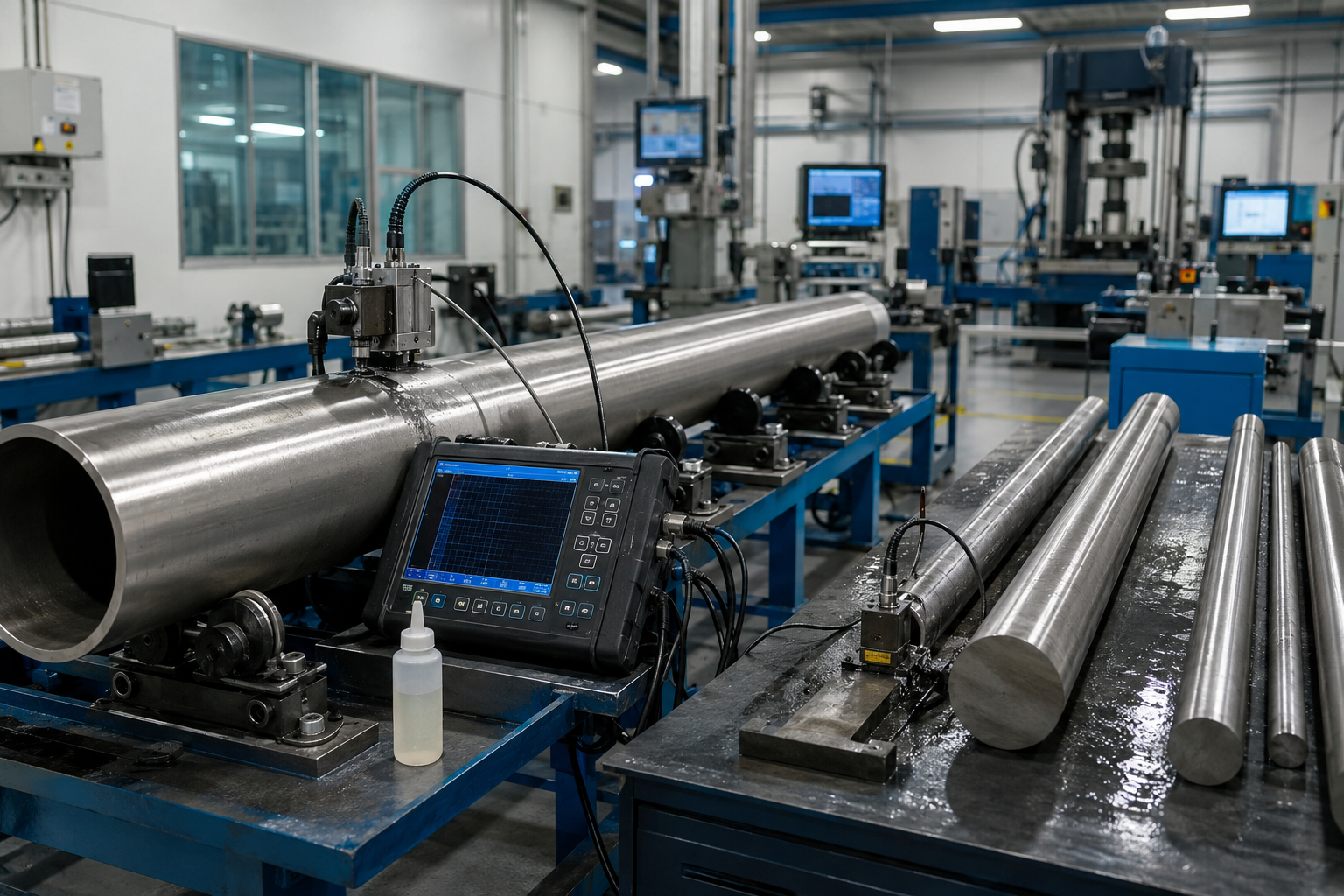
Nickel alloy products are often selected for harsh environments such as chemical processing, oil and gas, marine engineering, heat exchangers, power generation, aerospace equipment, valves, pumps and high-temperature systems. These applications may require corrosion resistance, high-temperature strength, pressure integrity, fatigue resistance and long-term reliability.
However, material quality is not only about chemical composition or tensile strength. For critical tubes and bars, buyers may also need to confirm whether there are internal cracks, laminations, voids, inclusions or other discontinuities that cannot be seen from the surface.
This is where ultrasonic testing becomes valuable. It helps buyers verify internal soundness before the material is machined, welded, installed or placed into service.
Quick Checklist: What Should Buyers Confirm Before Requesting UT?
Before ordering nickel alloy tubes or bars with ultrasonic testing, buyers should confirm the following points.
| Item to Confirm | Why It Matters |
|---|---|
| Material Grade | Different nickel alloys may have different acoustic behavior and inspection requirements |
| UNS Number | Confirms exact material identity, such as UNS N06625, N07718, N10276, N08825 |
| Product Form | Tube, pipe, round bar, forged bar, billet or cut blank may require different UT setups |
| Applicable Standard | ASTM, ASME, EN, ISO, AMS or customer specification may define inspection requirements |
| Tube / Bar Size | OD, wall thickness, diameter, length and geometry affect probe choice and scan coverage |
| Heat Treatment Condition | May affect microstructure, grain size and ultrasonic attenuation |
| Critical Defect Type | Cracks, voids, inclusions, laminations or wall loss may require different methods |
| Inspection Coverage | Full length, end zones, ID/OD access, bar volume or specific zones |
| Acceptance Criteria | Defines whether an indication is acceptable or rejectable |
| Reference Standard / Calibration | Calibration blocks or reference reflectors help standardize sensitivity |
| Operator Qualification | Important for reliable scanning and interpretation |
| UT Report Requirements | Report should include method, standard, equipment, calibration, sensitivity, coverage and results |
| Complementary Tests | MTR, PMI, dimensional inspection, visual inspection, ET or hydrostatic test may still be required |
A request such as “UT required” is not always enough. Buyers should define what product needs to be inspected, what defects are critical, what standard applies and what report format is required.
Why Can Nickel Alloy Tubes and Bars Have Hidden Internal Discontinuities?
Nickel alloys are selected because they can perform in difficult environments. But like other engineered metals, nickel alloy products may contain internal discontinuities depending on melting, hot working, forging, rolling, extrusion, welding, heat treatment or other processing steps.
Internal discontinuities may include voids, inclusions, cracks, splits or laminations. These may not be visible during visual inspection, but they can become risk points when the part is exposed to pressure, cyclic loading, high temperature, corrosive media or heavy machining.
For example:
- A nickel alloy bar used for machining a shaft may require internal soundness because deep machining can expose hidden discontinuities.
- A nickel alloy tube used in a pressure system or heat exchanger may need internal quality verification before installation.
- A forged or hot-worked bar used in a high-stress application may require UT to check for internal cracks or inclusions.
- A thick-section nickel alloy product may need volumetric inspection because surface tests cannot confirm internal quality.
Common Internal Discontinuities in Nickel Alloy Products
| Discontinuity Type | Description | Possible Source | Why It Matters |
|---|---|---|---|
| Voids / Porosity | Small empty spaces or gas-related internal cavities | Melting, casting, solidification or processing issues | May reduce load-bearing area or become crack initiation points |
| Inclusions | Non-metallic particles or trapped foreign material | Raw material, melting, refining or processing | May act as stress concentrators |
| Internal Cracks | Cracks inside the material that may not reach the surface | Thermal stress, forging, rolling, welding or improper processing | May grow under load, fatigue or thermal cycling |
| Laminations | Planar separations within the material | Rolling, forging or ingot-related defects | May weaken the material along a plane |
| Splits | Separation or tearing in the material | Hot working, extrusion or rolling issues | May reduce structural integrity |
| Pits / Wall Loss | Localized loss of material in pipe or tube | Corrosion, processing damage or service-related issues | May reduce pressure integrity |
ASTM E213 describes ultrasonic testing of metal pipe and tubing as a volumetric examination method and mentions discontinuities such as pits, voids, inclusions, cracks and splits.
What Exactly Does Ultrasonic Testing Detect?
Ultrasonic testing uses high-frequency sound waves to examine the inside of a material. In a common pulse-echo method, sound waves are introduced into the material. When the sound waves meet a boundary, back wall or discontinuity, part of the sound energy is reflected back to the transducer.
By analyzing the returned signal, the inspector can locate and evaluate indications inside the material.
UT Can Help Detect or Evaluate
| Inspection Target | Why It Matters |
|---|---|
| Internal Cracks | Important for high-stress bars, forgings and critical machined components |
| Voids / Porosity | May reduce internal soundness and mechanical reliability |
| Inclusions | May act as stress concentration points |
| Laminations | Important for bars, tubes and rolled products |
| Splits | May indicate processing-related internal separation |
| Wall Thickness | Ultrasonic thickness measurement can help monitor thickness or wall loss |
| Weld Indications | UT is widely used to detect flaws in welds |
| Internal Soundness | Supports acceptance of critical tubes, bars and forged materials |
UT does not mean every possible defect will always be detected. Detection depends on product geometry, grain structure, surface condition, probe selection, scanning technique, calibration, operator skill and acceptance criteria.
What Can UT Do and What Can It Not Do?
One common misunderstanding is that ultrasonic testing can “guarantee” material integrity. In reality, UT is a powerful inspection method, but it is not a universal guarantee.
| UT Can Help With | UT Cannot Automatically Guarantee |
|---|---|
| Detecting relevant internal discontinuities | That every possible defect has been found |
| Locating indications inside tubes or bars | That the material will never fail in service |
| Supporting internal soundness verification | That corrosion, fatigue or overload will not occur later |
| Providing documented inspection evidence | That the part design or application is correct |
| Comparing inspection scope between suppliers | That two UT reports are equal without checking method and acceptance criteria |
| Reducing acceptance risk for critical orders | That UT replaces MTR, PMI, dimensional inspection or hydrostatic testing |
A good UT requirement should clearly define inspection standard, coverage, calibration, sensitivity and acceptance criteria.
How Is Ultrasonic Testing Different from Other Inspection Methods?
No single inspection method covers all risks. Visual inspection, eddy current testing, radiographic testing, hydrostatic testing, PMI and ultrasonic testing each have different roles.
UT is especially useful when buyers need volumetric inspection of internal discontinuities. However, it should not automatically replace other tests. For many projects, UT should be combined with document review, dimensional inspection, surface inspection, PMI, hydrostatic testing or eddy current testing.
UT Compared with Other Inspection Methods
| Inspection Method | Main Use | Limitation | Role in Nickel Alloy Procurement |
|---|---|---|---|
| Visual Inspection | Surface defects, dents, scratches, marking, packaging | Cannot detect hidden internal defects | Good first step after delivery |
| Dimensional Inspection | OD, wall thickness, diameter, length, straightness | Does not verify internal soundness | Confirms drawing and PO requirements |
| PMI Test | Material grade verification | Does not detect internal flaws | Helps prevent material mix-up |
| Eddy Current Testing | Surface and near-surface flaws in conductive materials | Limited depth for conventional ET | Useful for tubes and surface-related inspection |
| Radiographic Testing | Internal volumetric flaws in some parts and welds | Sensitivity depends on thickness, geometry and flaw orientation | Useful in certain weld and casting inspections |
| Ultrasonic Testing | Internal discontinuities and volumetric inspection | Requires suitable technique, coupling, calibration and trained personnel | Strong choice for bars, forgings, tubes and critical internal quality checks |
| Hydrostatic Test | Pressure integrity of pipe or tube | Does not identify all internal discontinuities | Important for pressure-related tube or pipe orders |
| MTR / MTC Review | Chemical and mechanical properties | Document only; does not physically inspect every part | Confirms batch-level material data |
Eddy-current testing is an electromagnetic NDT method used for conductive materials and is commonly used to detect and characterize surface and subsurface flaws. UT and ET can complement each other: ET is often useful for surface or near-surface indications, while UT is often used for deeper internal inspection.
Which Standards Support UT for Nickel Alloy Tubes and Bars?
Standards help buyers define inspection method, product requirements and documentation expectations.
Standards and References Buyers Should Know
| Standard / Reference | What It Supports |
|---|---|
| ASTM E213 | Ultrasonic testing practice for metal pipe and tubing; detects and locates discontinuities using ultrasonic pulse-reflection methods |
| ASTM B637 | Nickel alloy rod, bar, forgings and forging stock for moderate or high-temperature service; includes chemical analysis, heat treatment, tension, hardness and stress-rupture testing |
| ASTM B444 | UNS N06625 and related nickel alloy seamless pipe and tube; includes chemical, tensile, hydrostatic and nondestructive electric testing |
| Ultrasonic Testing | General UT method and principle |
| Nondestructive Testing | General NDT concepts, including indications, flaws, defects and acceptance evaluation |
| Mill Test Report | Batch-level material chemical and physical property certification |
| Heat Number | Traceability from physical material to batch, composition, process and QA records |
For nickel alloy pipe and tube, ASTM E213 is especially useful when UT is required for tubular products. For nickel alloy bars and forgings, ASTM B637 helps define product form, heat treatment and mechanical testing requirements. For UNS N06625 seamless pipe and tube, ASTM B444 supports product standard and test requirements.
Why Acceptance Criteria Must Be Defined Clearly
One important detail buyers often overlook is that a UT standard may describe the inspection method, but the acceptance criteria may still need to be defined by the buyer, project specification or using party.
ASTM E213 states that the practice itself does not establish acceptance criteria. The acceptance criteria must be specified by the using party or parties.
This matters because two suppliers may both say “UT passed,” but they may be using different reference standards, reject levels or customer acceptance criteria.
What Buyers Should Define
| Requirement | Why It Matters |
|---|---|
| Inspection Standard | Defines the procedure or method |
| Reference Reflector / Calibration Block | Defines how sensitivity is set |
| Reject Level | Defines when an indication is unacceptable |
| Inspection Coverage | Defines whether full length or selected zones are inspected |
| Reporting Format | Defines what information appears in the UT report |
| Re-Test Rule | Defines what happens when an indication is found |
| Third-Party Witness | Defines whether an independent inspector must observe the test |
A clear purchase order should not only say “UT required.” It should say what UT method, coverage, acceptance criteria and report requirements are expected.
What Should Be Included in a UT Report?
A useful UT report should not only say “Pass.” Buyers should ask for enough information to understand what was inspected, how it was inspected and what acceptance criteria were used.
UT Report Checklist
| Report Item | What to Check |
|---|---|
| Material Grade | Inconel 625, Inconel 718, Alloy 825, Hastelloy C276, etc. |
| UNS Number | N06625, N07718, N08825, N10276, etc. |
| Product Form | Tube, pipe, round bar, forged bar, billet |
| Size | OD, wall thickness, diameter, length and quantity |
| Heat Number | Must match MTR/MTC, product marking and packing list |
| Applicable Standard | ASTM E213, customer specification, internal procedure or project standard |
| Inspection Method | Straight beam, angle beam, immersion, contact, phased array, etc. |
| Inspection Coverage | Full length, end zones, scanning direction, bar volume or specific areas |
| Equipment / Probe | Instrument, transducer, probe angle and frequency where required |
| Calibration / Reference Standard | Calibration block, reference notch, flat-bottom hole or agreed reflector |
| Sensitivity / Acceptance Criteria | Reject level, alarm level, specification limit or customer criteria |
| Operator Qualification | NDT Level I/II/III or other qualification if required |
| Result Summary | Accepted, rejected, repaired, re-tested or pending items |
| Date and Signature | Inspector, QA approval and document traceability |
The report should be linked to the same heat number shown on the MTR/MTC, product marking and packing list. This helps maintain traceability from the physical material to the inspection record.
When Should Buyers Specify Ultrasonic Testing?
Not every nickel alloy order needs UT. But buyers should strongly consider UT when internal soundness is important for performance, safety, machining or project acceptance.
Situations Where UT Is Often Important
| Situation | Why UT May Be Needed |
|---|---|
| Thick-Wall Tubes or Heavy Bars | Surface inspection cannot confirm internal soundness |
| Forged or Hot-Worked Bars | Internal discontinuities may affect machining or service performance |
| Pressure-Related Applications | Internal flaws may increase leakage or rupture risk |
| High-Temperature Service | Creep, thermal stress and fatigue may make internal quality important |
| Cyclic Loading or Vibration | Internal indications may become fatigue crack initiation points |
| Critical Machined Components | Machining may expose hidden discontinuities |
| Aerospace or Power Generation Parts | Traceability and internal quality requirements are stricter |
| Chemical Processing Equipment | Corrosion and pressure may make material integrity important |
| Oil and Gas / Marine Equipment | High pressure, seawater, chloride or harsh service may increase risk |
| Customer or Project Specification Requires UT | Compliance with PO and technical specification is mandatory |
The decision should be based on failure consequence, product form, size, application risk and project specification.
How Does Ultrasonic Testing Help Reduce Procurement Risk?
UT should be viewed as one part of a risk-control system. It does not replace material selection, MTR review, heat number traceability or proper engineering design.
Properly specified UT can help reduce the risk of accepting nickel alloy tubes or bars with relevant internal discontinuities. It supports quality control, project acceptance and supplier comparison when the method, calibration, coverage and acceptance criteria are clearly defined.
Risk Reduction Through UT
| Risk Area | How UT Helps | Important Limitation |
|---|---|---|
| Internal Defect Risk | Helps detect cracks, voids, inclusions, splits or laminations | Detection depends on method and sensitivity |
| Machining Risk | Helps reduce the chance of exposing internal defects during machining | UT does not replace machining allowance review |
| Pressure Service Risk | Helps verify internal soundness before use | Hydrostatic testing may still be needed |
| Project Acceptance Risk | Provides inspection evidence for QA files | Report must match project requirements |
| Supplier Comparison Risk | Helps compare quality scope between quotations | “UT included” is not enough without details |
| Hidden Cost Risk | Helps reduce rework, rejection and replacement risk | UT cost should be compared with application risk |
| Traceability Risk | UT report can be linked to heat number and MTR | Document matching must still be checked |
Nondestructive testing distinguishes between indications, flaws and defects. A defect is generally a flaw that does not meet acceptance criteria. This means buyers should not only ask whether an indication exists, but whether it is rejectable under the agreed specification.
What Questions Should Buyers Ask Before Ordering UT Nickel Alloy Materials?
Before ordering nickel alloy tubes or bars with ultrasonic testing, buyers should ask clear technical questions.
Supplier Questions
| Question | Why It Matters |
|---|---|
| Which UT standard or procedure will be used? | Confirms the inspection basis |
| Is the UT for tube, pipe, bar, forging or billet? | Different product forms require different scanning methods |
| What defect types is the inspection intended to detect? | Avoids assuming UT covers every risk |
| What is the inspection coverage? | Confirms whether full volume or only selected areas are inspected |
| What calibration block or reference reflector is used? | Shows how sensitivity is standardized |
| What acceptance criteria apply? | Defines whether an indication is acceptable or rejectable |
| Who performs the inspection? | Operator qualification affects reliability |
| Will the UT report show heat number and product size? | Supports traceability |
| Are end zones inspected or excluded? | Important for tube and bar orders |
| Is UT performed before or after heat treatment? | Inspection timing can affect relevance |
| Is UT enough, or should ET / hydrostatic / PMI also be required? | Helps build a complete inspection plan |
| Can third-party inspection witness the UT? | Useful for critical or project-based orders |
A good supplier should be able to explain not only that UT is available, but also how it is performed, what it is intended to detect and how results are documented.
RFQ Checklist for Nickel Alloy Tubes and Bars Requiring UT
To avoid misunderstanding, buyers should include UT requirements in the RFQ or purchase order.
| RFQ Item | Information to Provide |
|---|---|
| Material Grade | Inconel 625, Inconel 718, Hastelloy C276, Alloy 825, etc. |
| UNS Number | N06625, N07718, N10276, N08825, etc. |
| Product Form | Seamless tube, pipe, round bar, forged bar, billet |
| Standard | ASTM, ASME, EN, ISO, AMS, customer specification |
| Size | OD, wall thickness, diameter, length, tolerance |
| Quantity | Pieces, meters, kilograms or tons |
| Heat Treatment | Annealed, solution annealed, aged, stress relieved, cold worked |
| Application | Heat exchanger, shaft, valve, pump, pressure system, aerospace part, chemical equipment |
| UT Standard | ASTM E213, customer procedure or project standard |
| UT Coverage | Full length, end zones, full volume, selected areas |
| Acceptance Criteria | Reference reflector, reject level, customer acceptance requirement |
| Report Requirement | UT report, MTR/MTC, heat number traceability, third-party witness if required |
| Complementary Tests | ET, hydrostatic, PMI, dimensional inspection, visual inspection |
A complete RFQ helps suppliers quote the correct inspection scope and helps buyers compare quotations fairly.
How Can Emily PIPE Support Nickel Alloy Buyers?
Emily PIPE supplies nickel alloy tubes, nickel alloy bars, titanium alloy tubes and titanium alloy bars for global industrial applications. For nickel alloy buyers, we can help review inspection requirements before production and shipment.
We can support customers with:
- material grade confirmation
- UNS number confirmation
- ASTM / ASME / EN / ISO standard review
- tube OD, wall thickness and tolerance review
- bar diameter, length and straightness review
- heat treatment condition confirmation
- MTR / MTC and heat number traceability
- ultrasonic testing when required
- eddy current testing when required
- hydrostatic testing when required
- PMI and dimensional inspection when required
- third-party inspection support
- export packaging and documentation
We recommend defining UT requirements before placing the order, not after production is finished. This helps avoid misunderstanding between buyer, supplier, engineering team and end user.
Conclusion
Ultrasonic testing is an important inspection method for nickel alloy tubes and bars when internal quality must be verified. It helps detect and locate internal discontinuities such as cracks, voids, inclusions, splits and laminations when the method is properly specified and performed.
However, UT is not a universal guarantee. Buyers should confirm product form, alloy grade, UNS number, size, inspection standard, coverage, calibration, acceptance criteria, operator qualification and report requirements.
The safest approach is to combine UT with clear purchase specifications, MTR/MTC review, heat number traceability, dimensional inspection, visual inspection and any complementary NDT required by the project.
If you are sourcing nickel alloy tubes or bars and need ultrasonic testing, you can send us your material grade, UNS number, size, standard, application environment, required inspection scope and documentation requirements. Our team can help review the UT scope and provide a quotation based on your real project needs.