
What Data Should Buyers Check in a Mill Test Certificate?
Are you reviewing a Mill Test Certificate and wondering which data points really matter? For nickel alloy tubes, nickel alloy bars, titanium alloy tubes and titanium alloy bars, an MTC is not just a document to file away. It is one of the most important tools for checking whether the supplied material matches the purchase order, standard, heat number and project requirements.
To check a Mill Test Certificate effectively, buyers should compare the certificate against the purchase order, product standard, material grade, UNS number, heat number, chemical composition, mechanical properties, heat treatment condition, required tests, product marking and packing information. A Mill Test Report or Material Test Certificate certifies a metal product’s chemical and physical properties and states compliance with applicable standards, while a heat number links the metal product to a specific batch or heat for traceability.
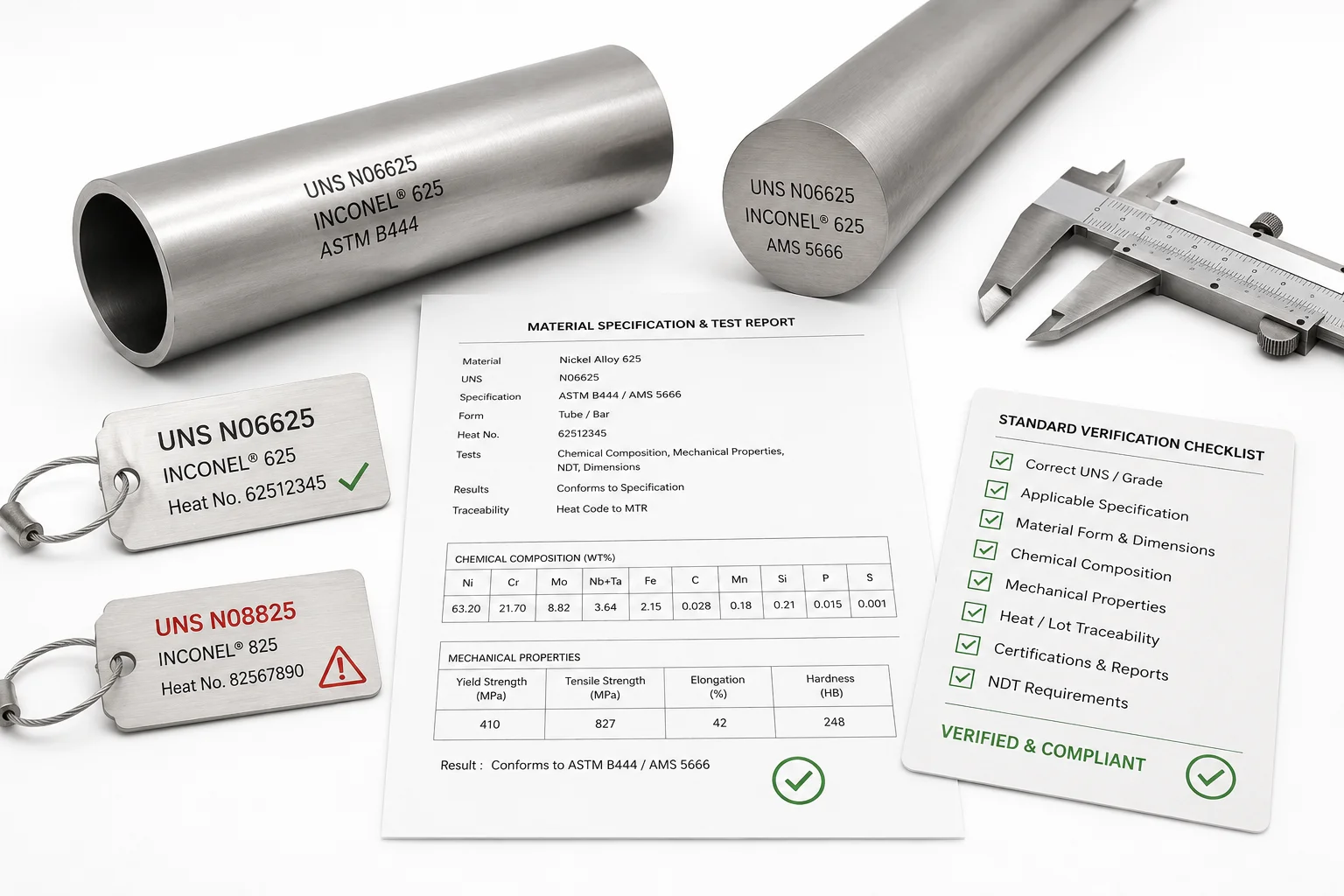
For industrial alloy buyers, the purpose of MTC review is not simply to see whether numbers are present. The real purpose is to confirm whether the material delivered is the material ordered, whether the test results meet the applicable standard, and whether the physical material can be traced back to the certificate.
This is especially important for chemical processing, oil and gas, marine engineering, aerospace, power generation, medical equipment, pressure equipment and high-temperature applications.
Quick MTC Review Checklist for Alloy Buyers
Before accepting nickel or titanium alloy tubes and bars, buyers should check the following MTC data.
| MTC Item | What Buyers Should Check | Why It Matters |
|---|---|---|
| Supplier / Mill Name | Issuer name, manufacturer name, address, stamp or signature | Confirms who issued the certificate |
| Customer / PO Reference | Purchase order number, project number, item number | Links MTC to your order |
| Material Grade | Inconel 625, Inconel 718, Hastelloy C276, Titanium Grade 2, Grade 5, etc. | Confirms material identity |
| UNS Number | N06625, N07718, N10276, R50400, R56400, etc. | Reduces trade-name confusion |
| Product Form | Seamless tube, welded tube, round bar, rod, billet, forged bar | Confirms the certificate matches the supplied form |
| Product Standard | ASTM, ASME, AMS, EN, ISO or customer specification | Defines required chemistry, properties and tests |
| Heat Number | Heat number on MTC, product marking, label and packing list | Supports batch traceability |
| Chemical Composition | Actual element values vs standard limits | Confirms alloy chemistry |
| Mechanical Properties | Tensile strength, yield strength, elongation, hardness, reduction of area if required | Confirms batch-level mechanical performance |
| Heat Treatment Condition | Annealed, solution annealed, aged, stress relieved, cold worked | Affects final properties |
| Supplementary Tests | UT, ET, hydrostatic, PMI, corrosion test, grain size, microstructure if required | Confirms additional project requirements |
| Actual vs Specified Values | Actual test results and standard minimum/maximum limits | Shows whether the batch meets acceptance limits |
| Inspection Certificate Type | EN 10204 3.1, 3.2, CoC or customer requirement | Supports project acceptance |
| Document Authenticity | Signature, date, revision, clear formatting, no suspicious alterations | Reduces document risk |
A good MTC review should always compare three things: the purchase order, the certificate and the physical material marking.
Why Is There No Universal “Best” MTC Checklist?
There is no single MTC checklist that fits every alloy order. The right checklist depends on product form, material grade, application risk and project requirement.
The most important MTC data points are determined by the application, product standard, purchase order and risk level. A non-critical stock order may require basic chemistry, mechanical properties and heat number. A pressure, aerospace, medical, nuclear or chemical processing project may require stricter traceability, inspection reports and supplementary testing.
For example:
- A nickel alloy tube used in a heat exchanger may require OD, wall thickness, hydrostatic test, eddy current test and heat number traceability.
- A nickel alloy bar used for high-temperature fasteners may require tensile properties, hardness, heat treatment condition and stress-rupture data if required by the standard.
- A titanium bar used for medical or aerospace parts may require strict grade verification, mechanical properties, surface condition, heat number traceability and additional inspection.
- A chemical processing project may require corrosion-related review, material grade confirmation and MTR/MTC consistency with the operating media.
This means buyers should not only ask, “Is the MTC complete?” They should ask, “Does this MTC prove the material meets my purchase order and application requirement?”
Application-Based MTC Focus
| Application | MTC Data to Focus On |
|---|---|
| Chemical Processing | Grade, UNS number, chemical composition, corrosion-related material standard, heat treatment, MTR/MTC traceability |
| Heat Exchanger Tubes | Tube standard, OD, WT, heat number, hydrostatic test, ET/UT if required, dimensional report |
| High-Temperature Fasteners | Bar standard, heat treatment condition, tensile strength, yield strength, hardness, stress-rupture if required |
| Aerospace Components | Material standard, heat treatment, mechanical properties, special process records, strict traceability |
| Medical Equipment | Titanium grade, chemistry, mechanical properties, surface condition, traceability and applicable medical standard |
| Marine Service | Grade, corrosion-resistance-related chemistry, heat number, surface condition and test scope |
| Pressure Equipment | Standard, wall thickness, mechanical properties, hydrostatic test, NDT and inspection certificate type |
A universal checklist is useful as a starting point, but the final MTC review must be tailored to the project.
What Can an MTC Prove — and What Can It Not Prove?
Many buyers either ignore the MTC or trust it too broadly. Both approaches create risk.
An MTC can support batch-level material verification, but it should not be treated as a complete service-life guarantee. It verifies reported chemistry, mechanical properties, standard compliance and required test results for the supplied batch, but final application suitability still depends on design, operating environment, fabrication, installation and maintenance.
MTC Can Help Verify
| MTC Evidence | What It Supports |
|---|---|
| Chemical Composition | Confirms actual element values for the reported heat or batch |
| Mechanical Properties | Confirms tested strength, ductility or hardness values |
| Standard Compliance | Shows the material was evaluated against a stated standard |
| Heat Treatment Condition | Confirms supplied condition if reported |
| Heat Number | Links material to a specific heat or batch |
| Supplementary Tests | Confirms UT, ET, hydrostatic, PMI or other tests if included |
| Certificate Type | Confirms inspection certificate level when required |
MTC Cannot Fully Prove
| Limitation | Why Buyers Should Be Careful |
|---|---|
| Actual service life | Service life depends on pressure, temperature, corrosion, stress, design and maintenance |
| All future failure modes | MTC does not predict every fatigue, corrosion, creep or installation-related problem |
| Correct installation | Welding, bending, machining and assembly can change performance |
| Every surface condition issue | Surface defects may need visual inspection or separate reports |
| Every dimensional issue | OD, WT, length, straightness and tolerance should be checked separately |
| Document-material match by itself | Heat number must match physical marking and packing list |
| Authenticity without review | Suspicious certificates should be verified with the supplier or third party |
This balanced view makes the article more credible and helps buyers use MTCs correctly.
How Do Chemical Composition and Mechanical Properties Help Verify Material?
Chemical composition and mechanical properties are the core sections of an MTC. They help buyers verify the material identity and batch-level properties.
Chemical composition helps confirm the alloy grade by showing actual element values. Mechanical properties help confirm whether the tested batch meets the required strength and ductility limits. However, MTC data supports material verification; it does not automatically guarantee service performance in every application.
Chemical Composition: What to Check
| Chemical Data | What Buyers Should Verify |
|---|---|
| Major Alloy Elements | Ni, Cr, Mo, Fe, Ti, Al, Nb, Cu, Co or other key elements |
| UNS Match | Whether the chemistry matches the specified UNS number |
| Minimum / Maximum Limits | Actual values must fall within the product standard limits |
| Restricted Elements | S, P, C, O, N, H or other elements controlled by the standard |
| Titanium Interstitials | Oxygen, nitrogen, carbon and hydrogen may be important for titanium grades |
| Grade Confusion | Similar trade names may not have the same chemistry |
| Actual Values | The MTC should show actual test results, not only “pass” |
For nickel alloy tubes such as UNS N06625, ASTM B444 covers cold-worked seamless pipe and tube and includes chemical testing, tensile testing, hydrostatic testing and nondestructive electric testing requirements.
For titanium and titanium alloy bars and billets, ASTM B348/B348M covers many titanium grades and requires covered grades to conform to chemical composition requirements and tensile property requirements.
Mechanical Properties: What to Check
| Mechanical Data | What It Means | Why It Matters |
|---|---|---|
| Tensile Strength | Maximum tensile stress before fracture | Important for load-bearing use |
| Yield Strength | Stress where permanent deformation begins | Important for design and structural integrity |
| Elongation | Ductility under tension | Important for forming, bending and toughness |
| Reduction of Area | Ductility and necking behavior | Often used with tensile test review |
| Hardness | Resistance to indentation | Useful for wear, machining and heat treatment verification |
| Stress-Rupture | Long-term rupture behavior under stress and temperature | Important for some high-temperature nickel alloy applications |
| Impact Test | Toughness under impact or low temperature if required | Important for some low-temperature or critical applications |
ASTM E8/E8M covers tension testing of metallic materials and includes determination of yield strength, tensile strength, elongation and reduction of area. It also notes that tension test results from selected specimens may not fully represent the entire end product or in-service behavior in different environments. This is why buyers should use MTC data as batch-level evidence, not as a full service-life guarantee.
What Role Do Standards and Specifications Play in MTC Verification?
An MTC must be checked against the correct standard. A material grade without a standard is often not enough.
Product standards define the material scope, chemistry limits, mechanical property requirements and required tests. Test-method standards define how specific tests are performed. Buyers should confirm that the MTC references the same standard required by the purchase order or project specification.
Common Standards and Documents for Alloy MTC Review
| Standard / Document | Why It Matters |
|---|---|
| ASTM B444 | Nickel alloy seamless pipe and tube such as UNS N06625; includes chemical, tensile, hydrostatic and nondestructive electric testing |
| ASTM B637 | Precipitation-hardenable nickel alloy rods, bars, forgings and forging stock for moderate or high-temperature service |
| ASTM B348/B348M | Titanium and titanium alloy bars and billets |
| ASTM E8/E8M | Tension testing method for metallic materials |
| EN 10204 3.1 / 3.2 | Inspection certificate types commonly required for metallic products |
| ASME / AMS / ISO / Customer Specification | May apply depending on industry and project |
| MTR / MTC | Batch-level chemical and physical property evidence |
| Heat Number | Links physical material to the certificate and batch records |
MTC vs Purchase Order Cross-Check
| Purchase Order Requirement | MTC Should Match |
|---|---|
| Material grade | Same grade shown on certificate |
| UNS number | Same UNS number shown on certificate |
| Product form | Tube, pipe, bar, billet or forging should match |
| Standard | Same ASTM / ASME / AMS / EN / ISO standard |
| Size | OD, WT, diameter, length or thickness should match order scope |
| Heat treatment | Same condition required by PO |
| Required tests | Test results or attached reports should be included |
| Certificate type | EN 10204 3.1 / 3.2 or other requirement should match |
| Quantity and heat | Packing list and heat number distribution should match |
If the MTC references a different standard from the purchase order, buyers should clarify before accepting the material.
Why Are Heat Treatment and Supplementary Tests Important?
Chemical and mechanical values are important, but they may not be the whole review. Heat treatment, NDT and supplementary tests may also be required.
Heat treatment and supplementary tests should be reviewed when required by the material standard, purchase order or application risk. These items help confirm that the material was processed and inspected according to the required scope.
Heat Treatment Condition
For nickel and titanium alloys, heat treatment condition can strongly affect strength, ductility, hardness, corrosion behavior and machinability.
Common conditions include:
- annealed
- solution annealed
- solution treated
- aged
- precipitation hardened
- stress relieved
- cold worked
- descaled, ground, polished or surface finished
For example, ASTM B637 covers precipitation-hardenable nickel alloy rods, bars, forgings and forging stock for moderate or high-temperature service. The standard description includes chemical analysis, recommended heat treatment, tension testing, hardness testing and stress-rupture testing requirements.
Supplementary Tests Buyers May Need
| Test / Inspection | What It Checks | When It May Be Required |
|---|---|---|
| UT – Ultrasonic Testing | Internal flaws or discontinuities | Bars, forgings, pressure or critical components |
| ET / ECT – Eddy Current Testing | Surface or near-surface flaws in conductive materials | Heat exchanger tubes, condenser tubes, tubing inspection |
| Hydrostatic Test | Pressure tightness and leakage | Tubes, pipes and pressure-related applications |
| PMI | Alloy grade verification | Incoming inspection or critical projects |
| Dye Penetrant / PT | Surface-breaking defects | Welded parts, machined parts, surface-critical items |
| Hardness Test | Heat treatment and strength indication | Bars, fasteners, machined components |
| Grain Size / Microstructure | Microstructural condition | Forming, high-temperature or critical applications |
| Corrosion Test | Specific corrosion-resistance requirement | Chemical processing or special project requirements |
| Dimensional Inspection | Size, OD, WT, diameter, length, tolerance | Tube and bar acceptance |
Ultrasonic testing is used to detect internal flaws or characterize materials. Eddy-current testing is an electromagnetic NDT method used for conductive materials and can detect or characterize surface and subsurface flaws. Dye penetrant inspection is used to detect surface-breaking defects in non-porous materials.
For independent laboratory testing, ISO/IEC 17025 is the international standard for testing and calibration laboratories and sets requirements for competence, impartiality and consistent operation.
How Does Traceability Support Material Integrity?
Traceability is one of the most important parts of MTC review. Without traceability, it is difficult to prove that the physical material and the certificate belong together.
Traceability data such as heat number, batch number, lot number, product marking and packing information helps link the delivered material to the MTC. This supports material identity, receiving inspection, quality investigation and project acceptance.
Key Traceability Data to Check
| Traceability Item | What Buyers Should Verify |
|---|---|
| Heat Number | Same heat number on MTC, material marking, label and packing list |
| Lot / Batch Number | Processing batch if applicable |
| Product Marking | Grade, heat number, size, standard and bundle number |
| Packing List | Quantity, weight, size and heat number distribution |
| MTC Number | Certificate number or document reference |
| Production Date | Useful for document control and project records |
| Material Form | Tube, bar, rod, billet or forging should match the shipment |
| Shipment Photos | Optional evidence showing labels, marking and packaging |
| Third-Party Report | Should match the same heat, size and quantity if required |
A heat number does not mean every piece has identical mechanical behavior in all conditions. It means the material can be linked to a specific heat or melt. Mechanical properties still depend on heat treatment, processing condition, test method and sampling location.
Why Traceability Matters
Traceability helps buyers:
- confirm that the material received matches the certificate
- identify affected material if a problem occurs
- separate mixed heats during receiving inspection
- support project audits
- investigate nonconformity
- avoid material mix-up
- maintain records for critical applications
For aerospace, nuclear, medical, pressure equipment and chemical processing applications, traceability may be a project requirement, not just a quality preference.
Beyond the Numbers: How Can Buyers Judge MTC Reliability?
MTC review is not only about chemistry and mechanical data. Buyers should also check whether the document itself looks complete, consistent and traceable.
Document format, issuer information, date, signature, standard reference, actual values, heat number consistency and absence of suspicious alterations are important review points. These items do not prove authenticity by themselves, but they help buyers identify red flags that require clarification.
Non-Numerical Items to Check
| Item | What to Check | Possible Red Flag |
|---|---|---|
| Issuer Name | Manufacturer or mill name clearly shown | Unknown issuer or missing company information |
| Document Number | Certificate number or report number | No reference number |
| Date of Issue | Certificate date shown | Missing date or inconsistent date |
| Signature / Stamp | Authorized signature, stamp or electronic approval | No approval information |
| Revision Status | Revision number if updated | Multiple versions without explanation |
| Standard Reference | Correct ASTM, ASME, AMS, EN or ISO standard | Standard missing or different from PO |
| Actual Test Results | Actual values shown, not only “OK” or “pass” | No actual chemistry or mechanical data |
| Specified Limits | Standard limits shown or referenced | Cannot compare results |
| Heat Number | Same heat number across MTC and material marking | Heat number mismatch |
| Format Consistency | Clear, professional document | Altered, overwritten or incomplete certificate |
| Attachment Consistency | NDT, PMI, dimensional reports match the same heat and size | Report refers to different material |
A suspicious MTC should not be accepted automatically. Buyers should ask the supplier for clarification, corrected documents, original mill certificate copy, additional test reports or third-party verification if required.
Common MTC Review Mistakes
Many MTC problems come from checking only one part of the document.
| Common Mistake | Possible Risk |
|---|---|
| Checking only alloy name | UNS number or standard may not match |
| Checking chemistry but ignoring mechanical properties | Material may not meet strength or ductility requirements |
| Checking mechanical data but ignoring heat treatment | Properties may not represent the required condition |
| Ignoring heat number | Certificate may not match physical material |
| Ignoring product marking | Traceability may be broken |
| Accepting “pass” without actual values | Buyer cannot independently compare results |
| Ignoring standard revision | Project may require a specific standard version |
| Not checking certificate type | EN 10204 3.1 / 3.2 requirement may be missed |
| Not checking NDT reports | UT, ET, hydrostatic or PMI may not have been performed |
| Ignoring packing list | Quantity and heat distribution may be unclear |
| Assuming MTC guarantees service life | MTC verifies batch data, not full application performance |
| Not comparing MTC with PO | Certificate may be technically valid but not match the order |
Practical MTC Review Workflow for Buyers
Buyers can use the following step-by-step workflow.
Step 1: Confirm Document Identity
Check certificate number, supplier name, date, PO number, project number and product description.
Step 2: Confirm Material Identity
Check grade, UNS number, product form, size, standard and heat number.
Step 3: Review Chemical Composition
Compare actual element values against the specified standard or purchase requirement.
Step 4: Review Mechanical Properties
Check tensile strength, yield strength, elongation, hardness and other required properties.
Step 5: Check Heat Treatment Condition
Confirm that the supplied condition matches the PO and standard.
Step 6: Check Supplementary Tests
Review UT, ET, hydrostatic, PMI, corrosion test, grain size, dimensional inspection or other required reports.
Step 7: Compare With Physical Material
Confirm that heat number, grade, size and marking match the supplied tubes or bars.
Step 8: Compare With Packing List
Check quantity, weight, size, heat number distribution and bundle information.
Step 9: Review Red Flags
Look for missing data, mismatched heat numbers, unclear issuer, altered document or generic certificate.
Step 10: Ask for Clarification Before Acceptance
If anything is unclear, ask the supplier before machining, welding, installing or reselling the material.
MTC Checklist for Nickel Alloy Tubes
| MTC Item | What to Confirm |
|---|---|
| Alloy Grade | Inconel 625, Alloy 825, Hastelloy C276, Monel 400, Alloy 600, etc. |
| UNS Number | N06625, N08825, N10276, N04400, N06600, etc. |
| Standard | ASTM B444, ASTM B163, ASME SB444, ASME SB163, customer standard |
| Product Form | Seamless tube, welded tube, pipe, heat exchanger tube |
| Size | OD, wall thickness, length, tolerance |
| Heat Number | Match certificate, marking and packing list |
| Chemical Composition | Actual values within standard limits |
| Mechanical Properties | Tensile strength, yield strength, elongation |
| Heat Treatment | Annealed, solution annealed or required condition |
| Hydrostatic Test | Required for many tube/pipe applications |
| ET / UT | Required if specified by standard or PO |
| PMI | Required if buyer requests material identification |
| Dimensional Report | Required for tight tolerance or project acceptance |
| Certificate Type | EN 10204 3.1 / 3.2 if required |
MTC Checklist for Nickel and Titanium Alloy Bars
| MTC Item | Nickel Alloy Bars | Titanium Alloy Bars |
|---|---|---|
| Common Grades | Inconel 718, Inconel 625, Alloy 600, Alloy 800H, Hastelloy C276 | Titanium Grade 2, Grade 5, Grade 23, Grade 7, Grade 12 |
| UNS Number | N07718, N06625, N06600, N08810, N10276 | R50400, R56400, R56407, R52400, R53400 |
| Standard | ASTM B637, ASTM B166, ASTM B408, AMS or customer standard | ASTM B348/B348M, AMS, ISO or customer standard |
| Product Form | Round bar, rod, forged bar, billet | Round bar, rod, billet |
| Heat Treatment | Solution treated, aged, annealed, stress relieved, cold worked | Annealed, solution treated, aged if applicable |
| Mechanical Properties | Tensile, yield, elongation, hardness, stress rupture if required | Tensile, yield, elongation, reduction of area if required |
| Chemical Composition | Nickel, chromium, molybdenum, niobium, titanium, aluminum, etc. | Titanium, aluminum, vanadium, oxygen, nitrogen, carbon, hydrogen, etc. |
| Testing | UT, PMI, hardness, tensile, dimensional inspection | UT, PMI, tensile, hardness, dimensional inspection |
| Traceability | Heat number, lot number, marking, packing list | Heat number, lot number, marking, packing list |
How Can Emily PIPE Support MTC Review for Alloy Buyers?
Emily PIPE supplies nickel alloy tubes, nickel alloy bars, titanium alloy tubes and titanium alloy bars for global industrial customers. We support standard and customized specifications according to drawings, technical requirements and application environments.
For MTC-related procurement, we can help provide or review:
- material grade and UNS number confirmation
- ASTM / ASME / EN / ISO / AMS standard requirements
- MTR / MTC
- heat number traceability
- chemical composition records
- mechanical property test results
- heat treatment condition
- UT, ET, hydrostatic, PMI and dimensional inspection reports when required
- EN 10204 3.1 / 3.2 certificate requirements when needed
- product marking and packing list consistency
- third-party inspection coordination
- export packaging and shipment documents
We recommend confirming MTC requirements at the RFQ or purchase order stage. This helps avoid missing documents, wrong certificate type, unclear heat number, inconsistent marking or project acceptance delays.
Conclusion
A Mill Test Certificate is one of the most important documents in nickel and titanium alloy procurement. It helps buyers verify material identity, chemical composition, mechanical properties, standard compliance, heat treatment, test scope and heat number traceability.
However, an MTC should not be treated as a simple paperwork formality. Buyers should compare the MTC with the purchase order, product standard, physical marking, packing list and inspection reports.
The safest approach is to define certificate requirements before ordering and review the MTC carefully before accepting, machining, welding or installing the material.
If you are sourcing nickel alloy tubes, nickel alloy bars, titanium alloy tubes or titanium alloy bars and need MTC support, you can send us your material grade, UNS number, standard, size, application environment, testing requirements and certificate type. Our team can help prepare a traceable material document package according to your project needs.