
ASTM, ASME, and EN Standards: What Alloy Buyers Should Know Before Purchasing
Are you confused by material standards such as ASTM, ASME, AMS, EN or ISO when sourcing nickel alloy tubes, nickel alloy bars, titanium alloy tubes or titanium alloy bars? Many buyers see a standard number on a quotation or Mill Test Certificate, but they are not always sure what that standard actually controls.
Understanding alloy standards is not about memorizing code numbers. It is about knowing which standard applies to your product form, application, pressure code, region, inspection requirement and certificate type. ASTM International develops and publishes voluntary consensus technical standards for materials, products, systems and services. The ASME Boiler and Pressure Vessel Code provides technical rules and data used in the manufacturing, construction and operation of boilers and pressure vessels. EN 10204 is commonly associated with inspection documents for metallic products, such as 3.1 and 3.2 certificates.
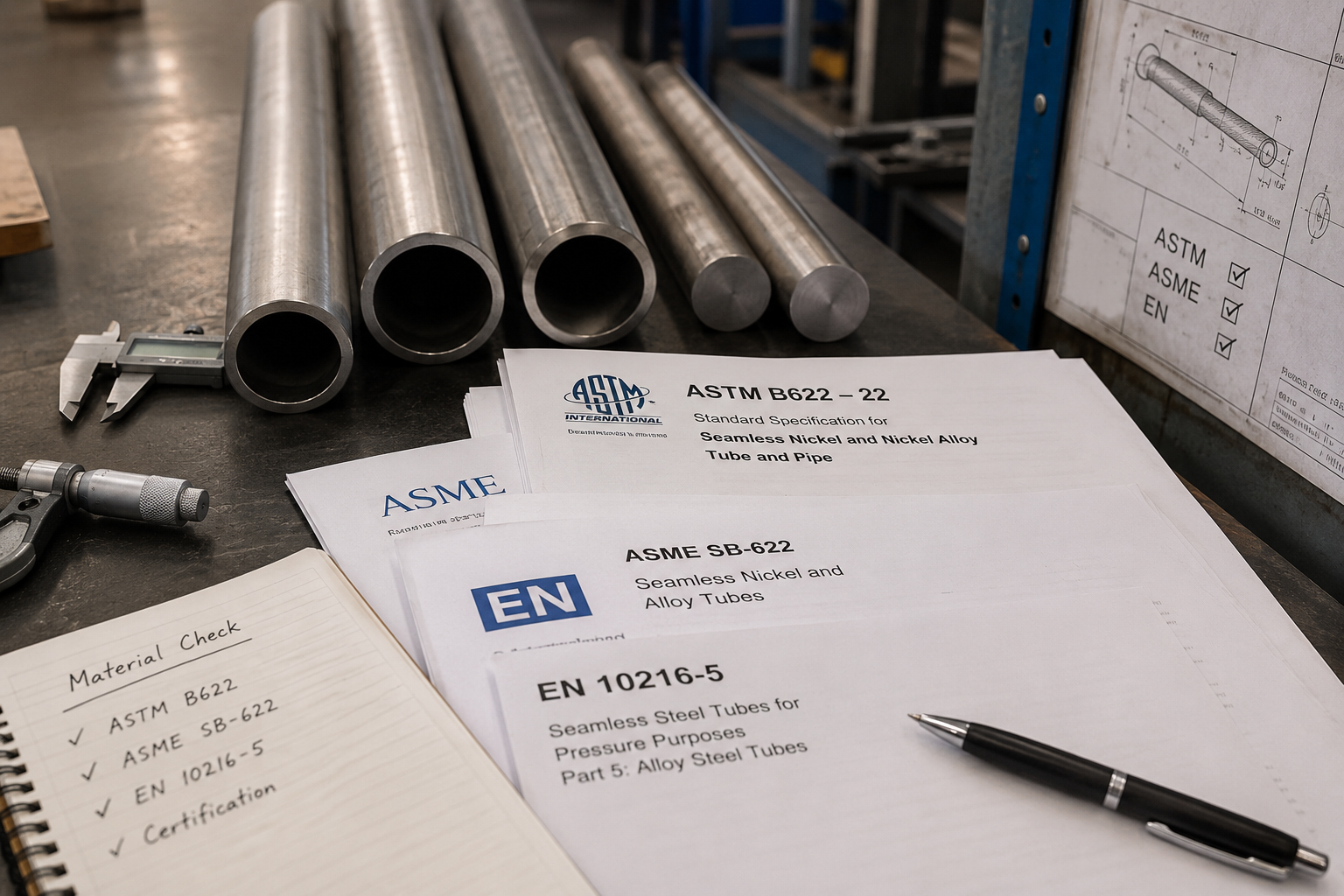
For alloy buyers, the key question is not only:
Which standard is better?
The better question is:
Which material standard, inspection certificate and test scope match my application, purchase order and project acceptance requirement?
This article explains how buyers can understand ASTM, ASME, EN and other standards from a practical purchasing perspective.
Quick Answer: What Should Buyers Confirm First?
Before comparing standards, buyers should define the real procurement requirement.
| Item to Confirm | Example | Why It Matters |
|---|---|---|
| Product Form | Seamless tube, welded tube, pipe, round bar, billet, forging | Different product forms follow different standards |
| Material Grade | Inconel 625, Inconel 718, Hastelloy C276, Titanium Grade 2, Titanium Grade 5 | Confirms the alloy family |
| UNS Number | N06625, N07718, N10276, R50400, R56400 | Reduces trade-name confusion |
| Application | Heat exchanger, chemical reactor, pressure equipment, marine system, aerospace part | Determines required performance and risk level |
| Operating Condition | Temperature, pressure, corrosive media, load, service life | Helps judge whether the base standard is enough |
| Project Code | ASME BPVC, EN, customer specification, AMS, ISO | May define design, inspection and acceptance rules |
| Material Standard | ASTM B444, ASTM B163, ASTM B637, ASTM B348, ASTM B338 | Defines product-specific chemistry, properties and tests |
| Certificate Type | MTR/MTC, EN 10204 3.1, EN 10204 3.2, CoC | Defines document and inspection level |
| Supplementary Tests | UT, ET, hydrostatic, PMI, corrosion test, grain size | May be required by project or purchase order |
| Physical Traceability | Heat number, marking, packing list, label | Connects the material to the certificate |
A standard number alone is not enough. The buyer must confirm whether the standard, grade, product form, certificate and application match.
ASTM vs ASME vs EN: What Is the Practical Difference for Buyers?
Many buyers treat ASTM, ASME and EN as interchangeable. They may be related in some cases, but they are not the same thing.
Practical Comparison
| Standard / Code | Main Role in Purchasing | Buyer Should Check |
|---|---|---|
| ASTM | Material specifications and test methods for products, materials and properties | Exact ASTM number, grade, UNS, product form, test requirements |
| ASME | Design, fabrication, inspection and certification rules for pressure equipment; includes material sections | Whether the project requires ASME code compliance and ASME material designation |
| EN | European standards for materials, products, testing or inspection documents | Exact EN material standard and EN 10204 certificate type |
| AMS | Aerospace material specifications | Whether the aerospace drawing or customer specification requires AMS |
| ISO | International standards for systems, tests, quality, medical or industrial applications | Whether ISO is required by customer, regulation or project |
| Customer Specification | Additional internal or project-specific requirements | Extra testing, tighter tolerance, documentation or approval requirement |
Simple Explanation
- ASTM material standards often define what the material must be: chemistry, mechanical properties, heat treatment, dimensions and required tests.
- ASME codes often define how materials are used safely in pressure equipment, including design, fabrication, inspection and certification rules.
- EN standards may define European material requirements, product requirements or inspection certificate types.
- EN 10204 3.1 / 3.2 is not a material grade. It is an inspection document type.
- ISO 9001 is a quality management system standard. It does not replace MTR/MTC, heat number or batch-level inspection records.
A buyer should not simply ask:
Do you have ASTM?
or:
Do you have EN?
The correct question is:
Which exact standard and certificate type does my project require?
How Does the Application Decide Which Standard You Need?
The suitable standard depends on application, product form, region, project code and risk level.
The right standard is not universal. It depends on the material form, operating environment, pressure or safety requirement, regulatory context, customer specification and acceptance criteria. A standard should be selected because it matches the project, not because it looks familiar.
Application-Based Standard Logic
| Application | Common Standard Consideration | What Buyers Should Confirm |
|---|---|---|
| Chemical Processing | Corrosion-resistant nickel alloy tube, pipe or bar standards | Exact media, temperature, concentration, grade and test requirements |
| Heat Exchanger Tubes | ASTM B163, ASTM B444, ASTM B338 or equivalent tube standards | OD, WT, length, tube type, hydrostatic/ET/UT requirement |
| Pressure Equipment | ASME BPVC and ASME/ASTM material specifications | Code requirement, allowable stress, certificate type, pressure tests |
| Aerospace Components | AMS, ASTM or customer aerospace specification | Heat treatment, mechanical properties, traceability, special testing |
| Marine Engineering | Nickel or titanium corrosion-resistant material standards | Chloride environment, seawater exposure, galvanic compatibility |
| Medical Equipment | ASTM/ISO medical or titanium standards if applicable | Biocompatibility-related standard, cleanliness, traceability |
| High-Temperature Parts | Nickel alloy bar/forging standards such as ASTM B637 | Heat treatment, tensile, hardness, stress rupture if required |
| General Industrial Use | ASTM or customer standard may be enough | Avoid over-specification if risk level is low |
For example, if the project requires UNS N06625 seamless pipe or tube, ASTM B444 may be relevant because it covers UNS N06625 and related nickel alloy cold-worked seamless pipe and tube. The ASTM summary states that chemical testing, tensile testing, hydrostatic testing and nondestructive electric testing are included.
If the project involves seamless nickel or nickel alloy condenser and heat-exchanger tubes, ASTM B163 may be relevant because it covers seamless tubes of nickel and nickel alloy for condenser and heat-exchanger service and includes outside diameter and average wall or minimum wall requirements.
If the project involves nickel alloy rods, bars, forgings or forging stock for moderate or high-temperature service, ASTM B637 may be relevant because it covers precipitation-hardenable nickel alloy rod, bar, forgings and forging stock and includes chemical analysis, heat treatment, tension testing, hardness testing and stress-rupture testing.
If the project involves titanium and titanium alloy bars or billets, ASTM B348/B348M may be relevant because it covers titanium and titanium alloy bars and billets, including chemical composition and tensile property requirements.
If the project involves titanium tubes for condensers and heat exchangers, ASTM B338 may be relevant because it covers seamless and welded titanium and titanium alloy tubes for condensers and heat exchangers.
Why Do Material Parameters Need Application Context?
A standard contains many numbers, but numbers alone do not define real-world suitability.
Chemical composition, tensile strength, yield strength, elongation, hardness, wall thickness, tolerance and test results should be interpreted in relation to the actual operating condition. A material may meet a standard but still be unsuitable if the standard does not cover the real corrosion, temperature, pressure, fatigue or service-life requirement.
Parameter vs Application Meaning
| Parameter in Standard | What It Shows | What Buyers Still Need to Ask |
|---|---|---|
| Chemical Composition | Whether the alloy chemistry falls within the specified range | Is this grade suitable for the exact media and temperature? |
| Tensile Strength | Strength under tensile testing conditions | Is the strength required at room temperature or service temperature? |
| Yield Strength | Permanent deformation limit under tensile loading | Is the component pressure-loaded, structural or machined? |
| Elongation | Ductility | Will the material be bent, formed, expanded or welded? |
| Hardness | Indication of strength or heat treatment condition | Does machining or wear resistance matter? |
| Stress-Rupture | Long-term high-temperature rupture behavior | Is the part under sustained load at elevated temperature? |
| Hydrostatic Test | Pressure-tightness test for tubes/pipes if required | Does the project require hydrostatic test report? |
| Nondestructive Test | UT, ET or other inspection for flaws | Does the PO require 100% testing or sampling? |
| Grain Size / Microstructure | Structural features of the metal | Is it required for forming, creep, aerospace or critical use? |
| Surface Finish | Pickled, polished, ground, bright annealed, etc. | Does corrosion, cleanliness or installation require a specific finish? |
A base standard is the starting point. It does not replace engineering review, corrosion review, pressure design or application-specific validation.
Standard Compliance vs Application Suitability
This is one of the most important points for alloy buyers.
A material can comply with a standard and still be wrong for the application if the selected grade, product form or testing scope does not match the real working conditions. Standards help define acceptance requirements, but they do not replace material selection.
What Standard Compliance Means
| It Usually Means | It Does Not Automatically Mean |
|---|---|
| The material was checked against a stated standard | The material is suitable for every corrosive environment |
| Chemistry meets the required limits | The alloy will resist every acid, chloride or gas exposure |
| Mechanical properties meet specified values | The material will perform under every temperature and fatigue condition |
| Required tests were performed according to the standard | No additional project-specific tests are needed |
| Certificate can support material acceptance | Service life is guaranteed |
| Heat number supports traceability | Installation, welding or machining will be correct |
This is why buyers should combine standards with application details, engineering judgment and supplier verification.
Common Misunderstandings About ASTM, ASME and EN Standards
Many procurement problems happen because buyers and suppliers use standard names too loosely.
| Misunderstanding | Why It Is Risky | Better Practice |
|---|---|---|
| “ASTM and ASME are the same.” | They may be related, but ASME code requirements can include design and pressure equipment rules | Confirm whether ASTM material spec or ASME code compliance is required |
| “EN 10204 3.1 is a material standard.” | It is an inspection certificate type, not an alloy grade | Specify both material standard and certificate type |
| “Equivalent grade means identical material.” | Equivalent grades may differ in limits, testing or acceptance | Compare chemistry, properties, heat treatment and test scope |
| “ISO 9001 means every batch is accepted.” | ISO 9001 is a quality management system, not batch-level material proof | Still require MTR/MTC, heat number and inspection reports |
| “Meeting a standard guarantees service life.” | Service life depends on design, environment, fabrication and maintenance | Use the standard as acceptance baseline, not service guarantee |
| “One standard is always better.” | Different standards serve different markets, products and applications | Choose based on project requirement |
| “Chemical composition is enough.” | Mechanical properties, heat treatment and tests also matter | Review full MTC/MTR |
| “Certificate alone is enough.” | Physical marking and packing list must match the certificate | Check heat number traceability |
How Can Buyers Verify Supplier Claims About Standards?
Supplier claims should be verified through documents, physical marking and test reports. A quotation saying “ASTM material” is not enough.
Buyers should verify the exact standard, grade, UNS number, product form, heat number, chemical composition, mechanical properties, heat treatment, required tests and certificate type. The MTC/MTR should match the purchase order, product marking and packing list.
Supplier Verification Checklist
| What to Check | What It Should Match |
|---|---|
| Quoted Standard | Same standard required by RFQ or drawing |
| Material Grade | Same alloy grade required by PO |
| UNS Number | Same UNS number required by specification |
| Product Form | Tube, pipe, bar, billet or forging must match order |
| Size and Tolerance | OD, WT, diameter, length, tolerance should match order |
| Heat Treatment | Annealed, solution annealed, aged or other required condition |
| MTR / MTC | Actual chemical and mechanical values should be shown |
| Heat Number | Same on MTC, material marking, label and packing list |
| Test Reports | UT, ET, hydrostatic, PMI or other reports if required |
| Certificate Type | EN 10204 3.1, 3.2, CoC or customer requirement |
| Third-Party Inspection | Required if project asks for independent inspection |
| Packing List | Quantity, weight, heat number distribution and bundle information |
A Mill Test Report or Material Test Certificate is a metals-industry quality document that certifies chemical and physical properties and states compliance with applicable standards. A heat number links the metal product to a specific batch or heat, helping buyers trace the material back to production and quality records.
Red Flags in Supplier Documentation
| Red Flag | Why It Matters |
|---|---|
| Standard number missing | Buyer cannot confirm acceptance criteria |
| Grade shown but UNS number missing | Trade-name confusion may occur |
| “Equivalent” stated without comparison | Equivalent may not meet project requirement |
| Actual test values missing | Buyer cannot compare results with limits |
| Heat number missing | Traceability is broken |
| Heat number does not match marking | Certificate may not belong to material |
| Wrong product form | Tube certificate may not support bar material, or vice versa |
| Certificate type unclear | EN 10204 requirement may not be met |
| NDT report missing | Required UT, ET or hydrostatic test may not be done |
| Altered or unclear certificate | Requires clarification before acceptance |
How Do Standards Help Reduce Project Risk?
Standards help reduce risk by defining a common basis for material acceptance. But they only work when applied correctly.
Correctly selected and verified standards can reduce commercial, safety and operational risks by aligning material requirements, testing scope, inspection documents and acceptance criteria. However, standards do not remove the need for proper design, application review and supplier verification.
Risk Reduction Through Standards
| Risk Type | How Correct Standards Help |
|---|---|
| Commercial Risk | Reduces quotation mismatch, rejected material, rework and wrong-document problems |
| Safety Risk | Helps confirm minimum properties and test scope for pressure or critical applications |
| Operational Risk | Reduces unexpected downtime caused by wrong material or missing tests |
| Quality Risk | Defines acceptance criteria and documentation requirements |
| Traceability Risk | Connects material to heat number, MTC/MTR and packing list |
| Inspection Risk | Clarifies whether UT, ET, hydrostatic, PMI or third-party inspection is needed |
| Cost Risk | Prevents over-specification and under-specification |
| Schedule Risk | Avoids last-minute certificate or standard mismatch |
Over-Specification vs Under-Specification
| Problem | Example | Result |
|---|---|---|
| Over-Specification | Buyer requests aerospace-level documentation for a low-risk general industrial part | Higher cost and longer lead time |
| Under-Specification | Buyer requests only “nickel alloy tube” without standard, test or certificate requirement | Wrong quotation scope or project rejection |
| Wrong Standard | Buyer requests a bar standard for a tube product | Certificate and inspection mismatch |
| Wrong Certificate Type | Buyer needs EN 10204 3.2 but requests only standard MTC | Acceptance delay or third-party inspection problem |
| Missing Supplementary Test | Buyer needs UT or hydrostatic test but does not specify it in PO | Test may not be included |
The safest approach is to define the correct standard at the RFQ stage, not after the material is produced.
Which Standards Are Commonly Relevant to Nickel and Titanium Alloy Tubes and Bars?
The correct standard depends on alloy grade, product form and application. The following table is a practical starting point for buyers.
| Product | Example Standard | Typical Use |
|---|---|---|
| Nickel Alloy Seamless Pipe / Tube | ASTM B444 | UNS N06625 and related nickel alloy seamless pipe and tube |
| Nickel Alloy Heat Exchanger Tubes | ASTM B163 | Seamless nickel and nickel alloy condenser and heat-exchanger tubes |
| Nickel Alloy Bars / Forgings | ASTM B637 | Precipitation-hardenable nickel alloy rods, bars and forgings for moderate or high-temperature service |
| Titanium Alloy Bars / Billets | ASTM B348/B348M | Titanium and titanium alloy bars and billets |
| Titanium Heat Exchanger Tubes | ASTM B338 | Seamless and welded titanium alloy tubes for condensers and heat exchangers |
| Inspection Documents | EN 10204 | Metallic product inspection certificate types |
| Pressure Equipment | ASME BPVC | Boiler and pressure vessel design, inspection and certification context |
| MTR / MTC | Mill Test Report | Batch-level chemical and physical property certification |
This table does not replace project engineering requirements. It helps buyers ask better questions when preparing RFQs.
What Should Buyers Include in an Alloy Standard RFQ?
A clear RFQ should state the exact standard and certificate requirement.
RFQ Checklist
| RFQ Item | Information to Provide |
|---|---|
| Material Family | Nickel alloy or titanium alloy |
| Alloy Grade | Inconel 625, Inconel 718, Hastelloy C276, Alloy 825, Titanium Grade 2, Titanium Grade 5 |
| UNS Number | N06625, N07718, N10276, N08825, R50400, R56400 |
| Product Form | Seamless tube, welded tube, pipe, round bar, rod, billet, forged bar |
| Standard | ASTM B444, ASTM B163, ASTM B637, ASTM B348, ASTM B338, ASME, AMS, EN or customer specification |
| Standard Version | Year/version if the project requires it |
| Size and Tolerance | OD, WT, diameter, length, tolerance, straightness |
| Heat Treatment Condition | Annealed, solution annealed, aged, stress relieved, cold worked |
| Surface Condition | Pickled, polished, ground, peeled, bright annealed, black surface |
| Application | Heat exchanger, pressure equipment, chemical processing, marine, aerospace, medical, power generation |
| Operating Conditions | Temperature, pressure, corrosive media, flow, load, service life |
| Required Tests | Chemical, tensile, hardness, hydrostatic, UT, ET, PMI, corrosion test, stress rupture |
| Certificate Type | MTC/MTR, EN 10204 3.1, EN 10204 3.2, CoC |
| Third-Party Inspection | Required or not required |
| Marking Requirement | Grade, standard, size, heat number, bundle number |
| Packing Requirement | Wooden case, bundle, separate heats, waterproof film, end caps |
| Delivery Requirement | Quantity, Incoterms, destination, delivery schedule |
A vague RFQ such as “need nickel alloy tube with certificate” is not enough for critical projects.
How Can Buyers Interpret “Equivalent” Standards?
Suppliers sometimes offer equivalent grades or equivalent standards. This can be useful, but buyers should review carefully.
What to Compare Before Accepting an Equivalent
| Item to Compare | Why It Matters |
|---|---|
| Chemical Composition | Element limits may not be identical |
| Mechanical Properties | Minimum tensile, yield, elongation or hardness may differ |
| Heat Treatment | Supplied condition may not match |
| Product Form | Tube, pipe, bar and forging standards are not interchangeable |
| Dimensions / Tolerances | OD, WT, diameter and length tolerances may differ |
| Testing Requirements | Hydrostatic, UT, ET, stress rupture or corrosion tests may not match |
| Certificate Type | MTC, EN 10204 3.1 or 3.2 may differ |
| Project Approval | Customer or engineering approval may be required |
| Regulatory Requirement | Pressure or regional code may not allow substitution |
If the project specification says “no substitution without approval,” the buyer should not accept an equivalent grade without written approval.
How Can Emily PIPE Support Buyers With Alloy Standards?
Emily PIPE supplies nickel alloy tubes, nickel alloy bars, titanium alloy tubes and titanium alloy bars for global industrial customers. We support standard and customized specifications according to drawings, technical requirements and application environments.
For alloy standards and procurement review, we can help confirm:
- material grade and UNS number
- ASTM / ASME / EN / ISO / AMS standard requirements
- product form: tube, pipe, bar, rod, billet or forging
- tube OD, wall thickness, length and tolerance
- bar diameter, length, tolerance and surface condition
- heat treatment condition
- MTR / MTC and heat number traceability
- EN 10204 3.1 / 3.2 certificate requirements
- UT, ET, hydrostatic, PMI, hardness and dimensional inspection requirements
- third-party inspection requirements
- marking, packaging and export documentation
We recommend sharing your application, project standard and certificate requirement at the RFQ stage. This helps us quote the correct material scope and avoid later document mismatch.
Conclusion
Understanding ASTM, ASME, EN and other alloy standards is not about memorizing numbers. It is about connecting the correct standard to the real product form, application, certificate type, inspection requirement and risk level.
ASTM standards often help define material and product requirements. ASME BPVC may apply when pressure equipment code rules are required. EN standards and EN 10204 certificate types may be important for European or contract-specific projects. MTR/MTC and heat number traceability help confirm that the delivered material matches the certificate and purchase order.
The safest approach is to define the standard before ordering, verify the MTC/MTR before acceptance, and confirm that the physical material marking matches the certificate and packing list.
If you are sourcing nickel alloy tubes, nickel alloy bars, titanium alloy tubes or titanium alloy bars and need help confirming ASTM, ASME, EN, ISO, AMS, MTC or EN 10204 requirements, you can send us your material grade, UNS number, product form, standard, size, application, testing requirements and certificate type. Our team can help review the material scope and provide a quotation based on your project needs.