
How Cut-to-Length Nickel and Titanium Alloy Tubes and Bars Reduce Waste and Rework
Buying nickel and titanium alloy tubes or bars is not only about choosing the correct grade. For many projects, the required length, cutting tolerance, end condition, marking, packaging and traceability can also affect cost, delivery and installation.
Cut-to-length alloy materials can help project purchasing by reducing unnecessary off-cuts, lowering buyer-side cutting work, improving fit-up consistency and making material preparation closer to the final application. However, cut-to-length supply should be specified clearly with alloy grade, UNS number, standard, cut length, length tolerance, end condition, inspection scope and documentation requirements. Material selection is an engineering process that balances performance requirements, material properties, cost and working conditions, while nesting and cutting optimization are used in manufacturing to reduce raw material waste, including for one-dimensional materials such as bars and pipes.
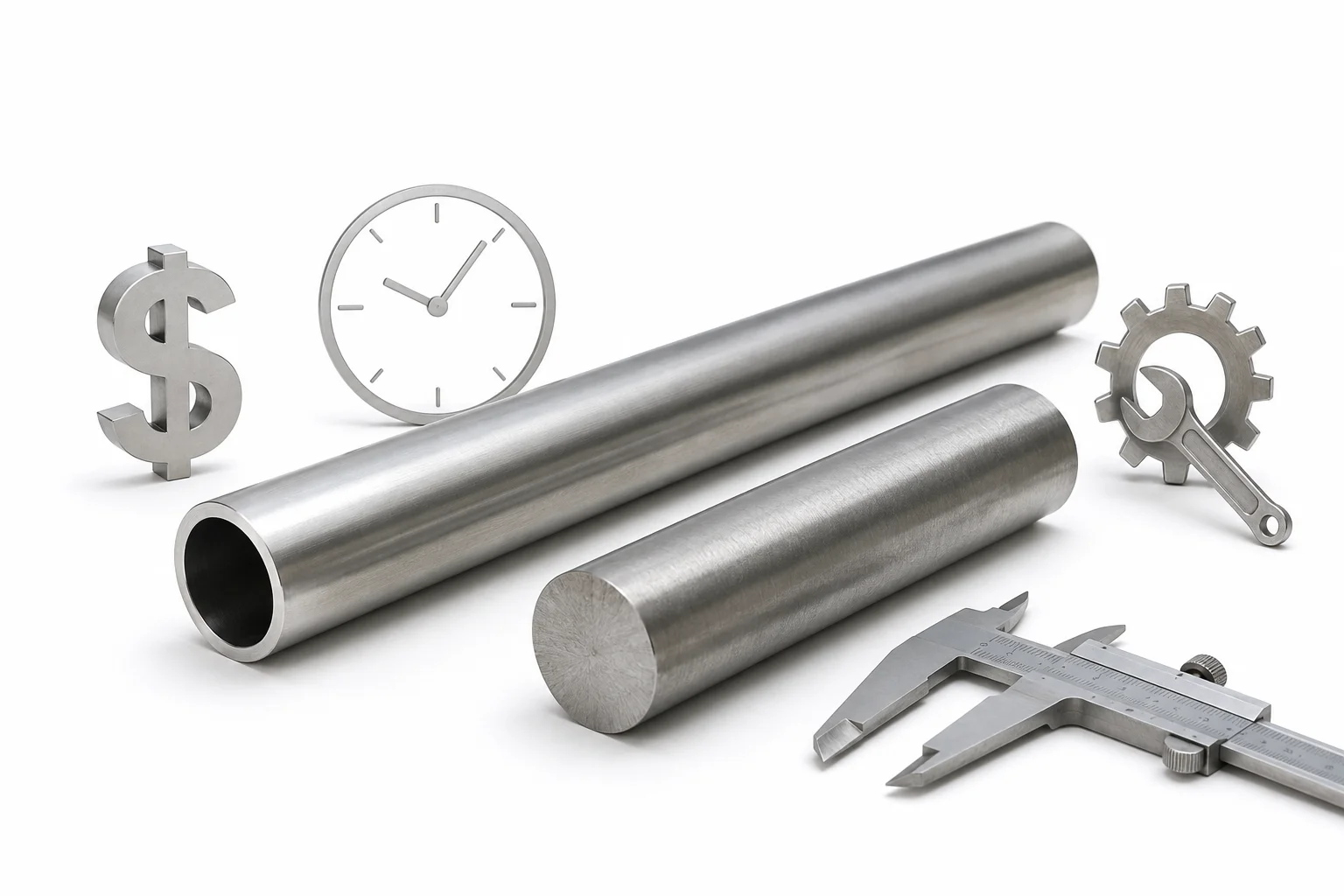
For nickel alloy tubes, nickel alloy bars, titanium alloy tubes and titanium alloy bars, cut-to-length supply can be valuable when the project requires fixed installation lengths, machined blanks, welding preparation, assembly-ready pieces or controlled packaging by heat number.
But cut-to-length is not automatically the best choice for every order. If the final design is not confirmed, if the buyer needs flexible stock, or if field cutting is expected, standard random lengths may still be more practical. The best purchasing method depends on the project.
Quick Answer: When Does Cut-to-Length Alloy Material Make Sense?
Cut-to-length material is useful when the buyer already knows the final or near-final length requirement and wants to reduce internal processing.
| Situation | Why Cut-to-Length May Help |
|---|---|
| Fixed-Length Installation | Tubes or bars can arrive closer to the required installation length |
| Machined Components | Bars can be supplied as blanks for shafts, fasteners, valve parts or pump parts |
| High-Value Alloys | Reducing off-cuts may help control material waste |
| Limited In-House Cutting Capacity | Buyer can reduce cutting, deburring and handling work |
| Tight Project Schedule | Pre-cut material may reduce preparation time before fabrication |
| Heat Number Control | Pieces can be marked, bundled and documented by heat number |
| Export Projects | Length can be matched to container, wooden case or handling limits |
| Inspection Before Shipment | Cut length, end condition and marking can be checked before dispatch |
Cut-to-length material is most useful when it is connected to a clear RFQ, not when it is treated as a vague request.
Is a “One-Size-Fits-All” Stock Length Always Cost-Effective?
Standard stock lengths can be convenient. They are useful when buyers need inventory flexibility, when final lengths are not yet known, or when the buyer has efficient in-house cutting capacity.
However, standard stock lengths are not always the most economical choice for fixed-length projects.
A standard-length purchasing approach may increase total project cost when it creates unnecessary cutting, off-cuts, handling, storage, deburring, machining or traceability work. Total cost of ownership considers both direct and indirect costs, not only the purchase price.
Hidden Costs of Standard Stock Lengths
| Hidden Cost | How It Happens | Why It Matters |
|---|---|---|
| Off-Cut Waste | Standard length does not divide efficiently into required part lengths | High-value nickel or titanium alloy scrap can be expensive |
| Extra Cutting Work | Buyer must cut long bars or tubes internally | Adds labor, equipment time and production scheduling |
| Deburring / End Finishing | Cut ends may need facing, chamfering, deburring or cleaning | Adds processing time before use |
| Traceability Risk | Small pieces may lose original marking after cutting | Heat number marking must be controlled |
| Storage Cost | Long stock or unused remnants require warehouse space | Increases handling and inventory complexity |
| Handling Risk | Long or heavy materials need more careful movement | May increase safety and damage risk |
| Inspection Delay | Buyer must recheck cut lengths and ends after internal cutting | Adds time before production |
| Scrap Management | Off-cuts need to be stored, reused, sold or scrapped | Creates additional inventory decisions |
The lowest per-meter or per-kilogram price does not always mean the lowest project cost. Buyers should compare standard-length supply and cut-to-length supply based on the total project process.
How Do Usage Scenarios Shape Cut-to-Length Alloy Requirements?
Cut-to-length supply is not only a length decision. It should be linked to how the material will be used.
The correct cut length, tolerance, surface condition and end preparation depend on the final application. A tube used in a heat exchanger, a bar used for machining fasteners, and a titanium tube used in marine service may require different length strategy, inspection scope and packaging method.
Application-Based Cut-to-Length Examples
| Usage Scenario | Typical Material Form | Cut-to-Length Concern |
|---|---|---|
| Heat Exchanger Tubes | Nickel alloy or titanium tubes | Fixed length, clean ends, OD/WT tolerance, bundle marking |
| Machined Fasteners | Nickel alloy or titanium round bars | Bar blank length, diameter tolerance, saw-cut allowance, heat treatment |
| Valve Stems / Shafts | Nickel alloy bars | Straightness, surface condition, machining allowance |
| Pump Components | Nickel alloy or titanium bars | Cut blanks, PMI, UT if required, dimensional inspection |
| Chemical Processing Tubes | Nickel alloy tubes | Corrosion environment, wall thickness, end protection |
| Marine Tubing | Titanium or nickel alloy tubes | Chloride environment, packaging protection, traceability |
| Aerospace Components | Nickel alloy or titanium bars | Tight traceability, heat treatment, mechanical data, special testing |
| Medical Equipment Materials | Titanium bars or tubes | Cleanliness, documentation, traceability and surface condition |
For example, a buyer purchasing titanium bar blanks for machining parts should specify not only the alloy grade, but also cut length, diameter tolerance, straightness, surface condition and certificate requirements. A buyer purchasing nickel alloy tubes for heat exchangers should specify OD, wall thickness, fixed length, tube standard, testing and packaging.
What Alloy and Standard Information Should Buyers Provide?
Cut-to-length supply should not be separated from material identity. The supplier needs to know exactly which alloy and standard apply.
Basic Material Information
| RFQ Item | Example |
|---|---|
| Material Family | Nickel alloy or titanium alloy |
| Alloy Grade | Inconel 625, Inconel 718, Alloy 825, Hastelloy C276, Titanium Grade 2, Titanium Grade 5 |
| UNS Number | N06625, N07718, N08825, N10276, R50400, R56400 |
| Product Form | Seamless tube, welded tube, round bar, forged bar, billet, cut blank |
| Standard | ASTM, ASME, AMS, EN, ISO or customer specification |
| Heat Treatment Condition | Annealed, solution annealed, aged, stress relieved, cold worked |
| Surface Condition | Pickled, polished, ground, peeled, black surface, bright finish |
| Application | Heat exchanger, fastener, shaft, valve, pump, marine system, aerospace part |
For nickel alloy seamless tubes such as UNS N06625, ASTM B444 covers selected nickel alloy cold-worked seamless pipe and tube and includes chemical, tensile, hydrostatic and nondestructive electric testing requirements.
For nickel alloy rods, bars, forgings and forging stock for moderate or high-temperature service, ASTM B637 includes chemical analysis, heat treatment, tension testing, hardness testing and stress-rupture testing requirements.
For titanium and titanium alloy bars and billets, ASTM B348/B348M covers chemical composition and tensile property requirements for many titanium grades, including Grade 2 and Grade 5.
What Cut-to-Length Details Should Be Included in the RFQ?
A good RFQ should make the cut-to-length requirement measurable and inspectable.
Cut-to-Length Specification Checklist
| Cut-to-Length Item | What to Specify | Why It Matters |
|---|---|---|
| Required Length | Exact cut length or length range | Defines cutting plan and quotation |
| Length Tolerance | ±0.5 mm, ±1 mm, ±3 mm, or project requirement | Controls acceptance criteria |
| Quantity per Length | Pieces per length size | Avoids confusion when multiple lengths are needed |
| Cut Method | Saw cutting, shearing, abrasive cutting, machining cut if required | Affects end quality and allowance |
| End Condition | As-cut, deburred, chamfered, faced, capped | Affects downstream machining or installation |
| Cutting Allowance | Extra length for facing, machining or welding | Prevents blanks from being too short |
| Burr Requirement | Deburred or burr-free if required | Important for assembly and safety |
| Surface Protection | Film, sleeve, anti-scratch wrapping, end caps | Prevents transit damage |
| Marking Requirement | Grade, heat number, length, bundle number | Maintains traceability after cutting |
| Heat Separation | Separate heats by bundle or box | Prevents material mix-up |
| Inspection Method | Length measurement, visual inspection, dimensional report | Defines quality evidence |
| Packing Method | Wooden case, bundle, pallet, separate labels | Supports logistics and receiving inspection |
For high-value alloys, buyers should also confirm whether off-cuts are included, returned, scrapped or charged. This avoids misunderstanding in quotation and production.
How Does Cut-to-Length Supply Affect Waste and Processing Cost?
Cut-to-length supply can reduce waste when the required lengths are known and the supplier can optimize the cut plan.
Cut-to-length planning is closely related to cutting optimization. In manufacturing, nesting or cutting optimization aims to arrange parts to reduce raw material waste. For one-dimensional materials such as bars and pipes, the same logic applies: better length planning can reduce off-cuts and improve material utilization.
Standard Length vs Cut-to-Length
| Factor | Standard Length Supply | Cut-to-Length Supply |
|---|---|---|
| Material Flexibility | Higher; buyer can cut later | Lower; final lengths should be known |
| Internal Cutting Work | Buyer handles cutting | Supplier handles cutting |
| Off-Cut Control | Buyer manages remnants | Supplier can optimize cutting plan |
| Lead Time | May be faster if stock is available | May need additional cutting time |
| Inspection | Buyer checks after cutting | Supplier can inspect before shipment |
| Traceability | Must be preserved after buyer cuts | Supplier can mark pieces after cutting |
| Packaging | Long material may need special handling | Pieces can be packed by length or heat |
| Cost Structure | Lower cutting cost from supplier, but more buyer-side work | Higher supplier-side processing, but less buyer-side work |
Cut-to-length supply is not automatically cheaper. It becomes valuable when reduced waste, lower internal processing, easier installation or better traceability offsets the cutting and handling cost.
How Should Buyers Verify Supplier Claims?
Supplier claims should be verified with documents, standards and inspection records. This is especially important for cut-to-length materials because cutting can separate pieces from original mill markings.
Buyers should verify alloy specifications through MTR/MTC, heat number traceability, product marking, inspection reports and applicable standards. A Mill Test Report or Material Test Certificate certifies chemical and physical properties and compliance with standards, while a heat number links the metal product to a specific batch or heat.
Documents and Evidence to Request
| Evidence | What It Confirms |
|---|---|
| MTR / MTC | Chemical composition, mechanical properties and standard compliance |
| Heat Number | Batch traceability |
| Product Marking | Grade, heat number, length, size and bundle identity |
| Packing List | Quantity, length breakdown, weight and heat distribution |
| Dimensional Report | Length, diameter, OD, WT, tolerance if required |
| Visual Inspection Record | Cut end condition, surface condition and packaging condition |
| PMI Report | Alloy grade verification if required |
| UT / ET Report | Nondestructive testing scope if required |
| Third-Party Inspection Report | Independent inspection result if required |
| EN 10204 3.1 / 3.2 | Inspection certificate type if required by project |
If the material is cut into many short pieces, buyers should ask how each piece or bundle will remain traceable to the original heat number. This is critical for aerospace, medical, pressure equipment, chemical processing and high-value engineering projects.
What Quality Checks Matter for Cut-to-Length Materials?
Cut-to-length materials should be checked against both material requirements and dimensional requirements.
Recommended Inspection Items
| Inspection Item | Tube | Bar | Why It Matters |
|---|---|---|---|
| Length Measurement | Yes | Yes | Confirms cut length and tolerance |
| OD / Diameter Measurement | OD | Diameter | Confirms fit-up or machining requirement |
| Wall Thickness | Yes | Not applicable | Important for tubes and pressure/flow requirements |
| Straightness | Yes | Yes | Important for long parts and machining |
| End Condition | Yes | Yes | Confirms burr, chamfer, facing or cap requirement |
| Surface Inspection | Yes | Yes | Checks scratches, dents, pits or contamination |
| PMI | If required | If required | Confirms alloy identity |
| UT | If required | If required | Checks internal discontinuities where specified |
| ET | Common for conductive tubes if required | Usually not primary for bars | Checks surface or near-surface flaws in tubes |
| Hardness / Tensile | If required | If required | Confirms mechanical properties |
| MTR Review | Yes | Yes | Confirms chemical and mechanical properties |
| Heat Number Check | Yes | Yes | Confirms traceability |
ISO/IEC 17025 is the international standard for testing and calibration laboratories. ISO explains that it sets requirements for laboratory competence, impartiality and consistent operation, supporting accuracy and reliability of test and calibration results. If independent testing is required, buyers may specify an ISO/IEC 17025 accredited laboratory.
When Is Cut-to-Length Not the Best Option?
Cut-to-length supply is useful, but it is not always necessary.
Situations Where Standard Length May Be Better
| Situation | Why Standard Length May Be Better |
|---|---|
| Final Design Is Not Confirmed | Buyer may need flexibility for later changes |
| Field Cutting Is Expected | Site conditions may require adjustment |
| Buyer Has Efficient Cutting Equipment | Internal cutting may be faster or cheaper |
| Stock Inventory Is Needed | Random lengths allow flexible future use |
| Urgent Requirement from Existing Stock | Standard stock may ship faster |
| Very Tight Final Length After Machining | Buyer may prefer to machine final length internally |
| Multiple Future Projects | Off-cuts or standard lengths may be useful for other parts |
A good supplier should explain both options. The buyer should compare standard length and cut-to-length based on total cost, lead time, flexibility and project risk.
How Can Cut-to-Length Supply Improve Project Purchasing?
Cut-to-length supply can improve project purchasing when it is planned properly.
The main benefit is not simply “shorter pieces.” The benefit is that material length, marking, packaging and inspection can be aligned with the buyer’s real production or installation process.
Practical Purchasing Benefits
| Benefit | How It Helps |
|---|---|
| Less Buyer-Side Cutting | Reduces internal preparation work |
| Better Material Utilization | May reduce off-cuts and scrap |
| Faster Fabrication Preparation | Material can go more quickly to machining or installation |
| Clear Length Breakdown | Easier receiving inspection and warehouse control |
| Improved Traceability | Pieces can be marked and bundled by heat number |
| Reduced Handling of Long Stock | Easier for small workshops or limited storage |
| Better Export Packing | Pieces can be packed according to project or destination needs |
| More Accurate Quotation Scope | Cutting, marking, inspection and packaging are included upfront |
For high-value nickel and titanium alloys, these benefits can be important because material waste, machining time, inspection delay and project downtime may cost more than the cutting service itself.
RFQ Checklist for Cut-to-Length Nickel and Titanium Alloy Materials
Buyers can use the following checklist when requesting cut-to-length alloy tubes or bars.
| RFQ Item | Information to Provide |
|---|---|
| Material Family | Nickel alloy or titanium alloy |
| Alloy Grade | Inconel 625, Inconel 718, Hastelloy C276, Alloy 825, Titanium Grade 2, Titanium Grade 5, etc. |
| UNS Number | N06625, N07718, N10276, N08825, R50400, R56400, etc. |
| Product Form | Seamless tube, welded tube, round bar, forged bar, billet, cut blank |
| Standard | ASTM B444, ASTM B637, ASTM B348, ASME, AMS, EN, ISO or customer specification |
| Size | Tube OD × WT; bar diameter; billet size |
| Cut Length | Exact cut length or length range |
| Length Tolerance | ± tolerance required |
| Quantity per Length | Number of pieces for each length |
| Cutting Allowance | Extra length for machining, facing, welding or installation |
| End Condition | As-cut, deburred, chamfered, faced, capped |
| Surface Condition | Pickled, polished, ground, peeled, black surface, bright surface |
| Heat Treatment | Annealed, solution annealed, aged, stress relieved, cold worked |
| Application | Heat exchanger, fastener, shaft, valve, pump, marine system, aerospace part |
| Testing | Chemical, tensile, hardness, UT, ET, PMI, dimensional inspection |
| Documents | MTR/MTC, heat number, EN 10204 3.1/3.2, inspection reports |
| Marking | Grade, heat number, size, length, bundle number |
| Packaging | Wooden case, bundle, end caps, waterproof film, separate heats |
| Delivery Terms | Incoterms, destination, delivery schedule |
The clearer the RFQ, the easier it is for the supplier to quote accurately and avoid later misunderstanding.
How Can Emily PIPE Support Cut-to-Length Alloy Material Projects?
Emily PIPE supplies nickel alloy tubes, nickel alloy bars, titanium alloy tubes and titanium alloy bars for global industrial customers. We support standard and customized specifications according to drawings, technical requirements and application environments.
For cut-to-length alloy material projects, we can help review:
- nickel alloy and titanium alloy grade options
- UNS number and equivalent grade confirmation
- ASTM / ASME / EN / ISO / AMS standard requirements
- tube OD, wall thickness, length and tolerance
- bar diameter, cut length, tolerance and machining allowance
- end condition, deburring, chamfering or facing requirements
- heat treatment condition
- MTR / MTC and heat number traceability
- UT, ET, PMI, hardness and dimensional inspection requirements
- third-party inspection requirements
- marking, packaging and export documentation
We recommend confirming cut length, tolerance, end condition, marking and packaging before production. This helps reduce waste, rework, traceability problems and shipment misunderstanding.
Conclusion
Cut-to-length alloy materials can help project purchasing when the buyer has clear length requirements, fixed installation needs, machining blanks, traceability requirements or limited internal processing capacity.
For nickel and titanium alloy tubes and bars, the value of cut-to-length supply comes from better material utilization, reduced buyer-side cutting work, clearer packaging, stronger traceability and closer alignment with the real project process.
However, cut-to-length is not automatically better for every order. If the design is not finalized or the buyer needs flexible stock, standard lengths may still be suitable.
If you are sourcing nickel alloy tubes, nickel alloy bars, titanium alloy tubes or titanium alloy bars and need cut-to-length supply, you can send us your material grade, UNS number, size, cut length, tolerance, end condition, testing requirements, certificate needs and delivery schedule. Our team can help review the material scope and provide a quotation based on your project needs.