
Choosing titanium tubing for seawater desalination equipment is not simply a material-name decision. Multi-Stage Flash (MSF), Multi-Effect Distillation (MED), reverse osmosis (RO), seawater cooling, brine concentration and chemical-cleaning systems expose materials to different combinations of chlorides, temperature, pressure, deposits, biofouling, flow velocity and crevice geometry.
Quick answer: Titanium tubes are widely considered for desalination condensers, evaporators and heat exchangers because commercially pure titanium has strong resistance in many seawater and neutral chloride environments, can be supplied in thin-wall tube designs, and has long operating experience in marine heat-transfer service. Titanium is not universally suitable, however. Grade, tube construction, water chemistry, temperature, crevice conditions, cleaning chemicals, inspection requirements and lifecycle cost must be evaluated for the exact equipment zone.
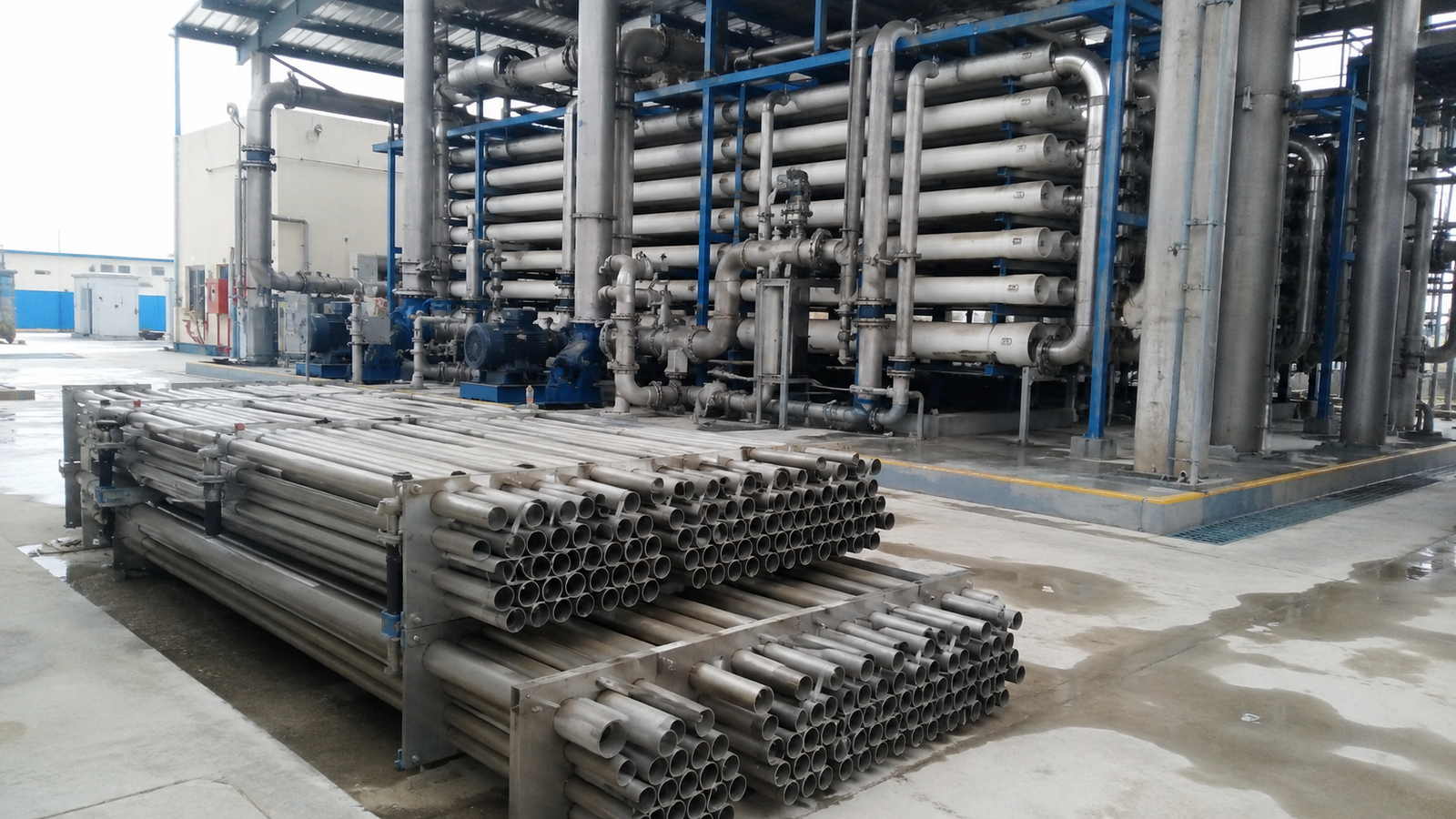
ASTM B338 covers seamless and welded titanium and titanium-alloy tubes intended for surface condensers, evaporators and heat exchangers. The standard distinguishes seamless tube made by cold reduction or cold drawing from welded tube made from flat-rolled product by an automatic arc-welding process.
TIMET’s Corrosion Resistance of Titanium explains that titanium generally has very low corrosion rates in chloride environments, while crevice corrosion can become the limiting factor under unfavorable local chemistry, temperature or geometry.
For buyers, the useful question is therefore not only “Is titanium corrosion resistant?” It is:
Is the selected titanium grade, product standard, tube construction, wall thickness, inspection plan and documentation package suitable for the real desalination process and equipment location?
At-a-Glance Buyer Answer
The table below is a screening guide, not a final material approval.
| Buyer Question | Practical Answer |
|---|---|
| Why use titanium tubes? | Strong resistance in many seawater and neutral chloride environments, useful thin-wall tube capability, low density and established heat-transfer service experience. |
| Where are they most relevant? | Condensers, evaporators, brine heaters, seawater coolers and heat exchangers in MSF, MED and associated utility systems. |
| Are they automatically suitable for RO plants? | No. RO plants use many product forms and materials. Titanium may be justified in selected seawater, brine, heat-exchanger, pump, valve or high-corrosion locations rather than throughout the membrane system. |
| Which grade is the usual starting point? | Grade 2 / UNS R50400 is a common starting point for many heat-exchanger tube applications, subject to the project specification. |
| When should enhanced grades be reviewed? | When temperature, crevice geometry, reducing chemistry or other service factors exceed the practical envelope of the selected commercially pure grade. |
| Which standard applies to heat-exchanger tubes? | ASTM B338 or ASME SB-338 when specified. ASTM B861 and B862 are pipe standards and should not be substituted automatically. |
| What are the main limitations? | Crevice corrosion, fluoride exposure, low-pH or reducing conditions, galvanic effects on coupled metals, deposits, abrasive solids, fouling and incompatible cleaning chemicals. |
| What should buyers verify? | Grade, UNS number, construction, dimensions, wall basis, heat treatment, tests, traceability, certificate type, packing and application conditions. |
Buyer Takeaway
Titanium tubes can be an excellent desalination choice, but the decision must be tied to the exact process, equipment zone and failure modes rather than to seawater exposure alone.
Where Are Titanium Tubes Used in Desalination Plants?
Titanium’s relevance depends on the process and the equipment location. Desalination is not one single environment. Multi-Stage Flash (MSF), Multi-Effect Distillation (MED) and Reverse Osmosis (RO) systems create different material challenges.
Desalination Process and Material Concerns
| Process / Area | Main Material Concern | Titanium Tube Relevance |
|---|---|---|
| MSF thermal desalination | Heated brine, evaporator/condenser tubes, scaling, corrosion, tube reliability. | Titanium tubes may be used in evaporator and heat transfer sections where seawater/brine corrosion resistance is important. |
| MED thermal desalination | Lower-temperature effects, tube bundles, seawater spraying, heat transfer, fouling. | Titanium tubes may be considered for evaporator/condenser tube bundles exposed to seawater. |
| RO desalination | High pressure, seawater intake, brine, pretreatment chemicals, membrane protection. | Titanium may be evaluated in selected high-corrosion piping, heat exchanger, pump/valve or special components, but RO membrane systems are not simply “titanium tube systems.” |
| Seawater intake / cooling | Raw seawater, marine growth, sand, silt, chlorides, velocity. | Titanium may be useful where seawater corrosion and erosion-corrosion risk are high. |
| Brine discharge / concentrate lines | Higher salinity, scaling, flow, possible chemical dosing. | Titanium suitability depends on concentration, temperature, crevices and chemical additives. |
| Heat exchangers / condensers | Seawater side corrosion, heat transfer, fouling and tube cleaning. | Titanium tubes are widely considered because ASTM B338 specifically covers titanium tubes for condensers, evaporators and heat exchangers. |
The high pressure and salt concentration present during the reverse osmosis stage of desalination can contribute to corrosion issues, so corrosion control and material selection still matter in RO systems. Source: ACS Omega / PMC — Corrosion Inhibitors in Desalination Systems
Buyer Takeaway
MSF, MED and RO should not be treated the same. Titanium tube selection should be tied to the exact equipment location, not only the word “desalination.”
Why Is Titanium Strong in Seawater and Chloride Environments?
Titanium’s corrosion resistance is linked to its stable passive oxide film.
The Royal Society of Chemistry notes that titanium forms a thin protective oxide layer, which helps explain why it does not corrode easily in many environments. Source: RSC — Titanium
TIMET also explains that titanium has excellent resistance to corrosion by neutral chloride solutions, even at relatively high temperatures. Source: TIMET — Corrosion Resistance of Titanium
Why This Matters in Desalination
| Seawater Challenge | Titanium Advantage |
|---|---|
| Chloride ions | Titanium generally has strong resistance in many chloride-containing environments. |
| Seawater exposure | Titanium has long experience in marine and heat exchanger service. |
| High salinity brine | Titanium may resist many chloride-related corrosion risks, but crevices must be reviewed. |
| Oxygenated seawater | Titanium’s passive oxide film is stable in many oxidizing or aerated environments. |
| Stress corrosion risk | Titanium has strong resistance to chloride stress corrosion cracking compared with many stainless steels. |
| Erosion-corrosion | Titanium can perform well in flowing seawater, but abrasive solids and high velocity still need review. |
Important Caution
Titanium is not corrosion-proof in every condition. Crevice corrosion, reducing acids, fluoride-containing environments, oxygen-depleted crevices, very low pH or high-temperature stagnant zones may require special review or a higher-performance titanium grade.
Buyer Takeaway
Titanium is strong in many seawater conditions, but crevice design and real water chemistry still matter.
Which Titanium Grades Are Commonly Considered?
Grade selection should be based on corrosion environment, design strength, forming requirements, temperature, crevice risk, availability and the governing specification. ASTM grade numbers should always be paired with the UNS designation in the RFQ and certificate review.
Titanium Grade Selection Table
| Titanium Grade | UNS | General Direction | Possible Desalination Relevance | Buyer Caution |
|---|---|---|---|---|
| Grade 1 | R50250 | Highest ductility among common commercially pure grades, with lower strength. | Formed, low-strength corrosion-resistant components and selected tube designs. | Confirm minimum mechanical properties and wall design. |
| Grade 2 | R50400 | Common commercially pure titanium with a practical balance of corrosion resistance, strength, formability and availability. | Condenser, evaporator and heat-exchanger tubes; seawater and marine service. | Review crevice conditions, temperature, deposits and cleaning chemistry. |
| Grade 3 | R50550 | Higher strength than Grade 2 with lower ductility. | Selected industrial tubing or piping where additional strength is required. | Confirm forming, expansion and fabrication requirements. |
| Grade 7 | R52400 | Grade 2-type titanium with palladium addition for improved resistance in some reducing and crevice-sensitive environments. | More demanding heat-exchanger or chemical-service zones when justified by process data. | Higher material cost; do not specify without a process need. |
| Grade 11 | R52250 | Lower-oxygen palladium-bearing commercially pure titanium. | Selected formed or lower-strength corrosion-resistant components. | Confirm product form, design strength and specification availability. |
| Grade 12 | R53400 | Ti-0.3Mo-0.8Ni alloy with improved strength and crevice-corrosion performance in some hot-brine conditions. | Higher-temperature or crevice-sensitive seawater and brine service. | Confirm design approval, weld procedure and availability. |
| Grade 16 / 17 | R52402 / R52252 | Lower-palladium corrosion-resistant titanium grades. | Selected projects seeking improved localized-corrosion resistance with lower palladium content. | Confirm project acceptance and supply route. |
| Grade 9 | R56320 | Ti-3Al-2.5V alloy with higher strength than commercially pure titanium. | Selected tubing where mechanical strength or forming route requires it. | It is not the default desalination heat-exchanger grade merely because it is stronger. |
ASTM B338 includes multiple commercially pure and alloyed titanium grades for condenser, evaporator and heat-exchanger tubing. TIMET identifies Grade 2-equivalent titanium as extensively used for seawater piping and heat exchangers, while its Grade 12 data sheet highlights improved performance over unalloyed titanium in some hot-brine and crevice-corrosion conditions.
Buyer Takeaway
Grade 2 is a common starting point, not an automatic final answer. More corrosion-resistant or higher-strength grades should be selected only when process data, design calculations and project specifications support the change.
Which Tube and Pipe Standards Apply?
Product form is critical. A condenser tube, a general-service seamless pipe and a welded process pipe are not interchangeable merely because they use the same titanium grade.
| Product Form | Common Standard | Scope Direction | Procurement Note |
|---|---|---|---|
| Seamless or welded condenser / heat-exchanger tube | ASTM B338 / ASME SB-338 | Tubes for surface condensers, evaporators and heat exchangers. | Confirm grade, seamless or welded construction, dimensions, wall basis, condition and required tests. |
| Seamless titanium pipe | ASTM B861 | Seamless pipe for general corrosion-resisting and elevated-temperature service. | Use only when pipe—not heat-exchanger tube—is required. |
| Welded titanium pipe | ASTM B862 | Welded pipe for general corrosion-resisting and elevated-temperature service. | Confirm weld process, examination, dimensions and project code. |
| Titanium welding fittings | ASTM B363 | Seamless and welded titanium and titanium-alloy welding fittings. | Match grade, schedule, dimensions and joining requirements to the piping system. |
| Project pressure-code material | ASME / EN / customer specification | Adds design, allowable-stress, fabrication, examination and acceptance requirements. | A material certificate alone does not establish equipment code compliance. |
ASTM’s current committee listing identifies ASTM B861-24 for seamless pipe and ASTM B862-23 for welded pipe, while ASTM B338 remains the relevant product standard for conventional condenser and heat-exchanger tubes.
Seamless vs Welded Tube
Both seamless and welded tubes can be acceptable when the standard, design and purchaser specification permit them.
| Review Point | Seamless Tube | Welded Tube |
|---|---|---|
| Manufacturing route | Produced from hollow billet through cold-reduction or cold-drawing operations. | Produced from flat-rolled material by an automatic welding process and subsequent finishing as required. |
| Key buyer concern | Dimensional consistency, surface condition, defects and test coverage. | Weld quality, weld-zone consistency, dimensional control and examination requirements. |
| Selection basis | Project specification, size availability, fabrication history, inspection level and total cost. | Project specification, approved welding route, test requirements, size availability and total cost. |
| Important caution | “Seamless” does not eliminate the need for inspection. | “Welded” should not be rejected automatically when it fully complies with the governing specification and project requirements. |
Buyer Takeaway
Write the correct product form and standard into the RFQ. Do not use ASTM B338, B861 and B862 as interchangeable labels.
Is There One “Best” Material for Desalination Tubing?
No. Titanium may be very strong in many seawater heat exchanger applications, but it is not always the only option.
Desalination equipment may also use:
- Copper-nickel alloys
- Stainless steels
- Super duplex stainless steels
- Super austenitic stainless steels
- Nickel alloys
- FRP or lined materials
- Coated or clad materials
- Titanium and titanium alloys
Material Selection Factors
| Factor | Why It Matters |
|---|---|
| Process type | MSF, MED and RO have different material demands. |
| Temperature | Higher temperature can increase corrosion and scaling risk. |
| Salinity / brine concentration | Concentrated brine can be more aggressive than raw seawater. |
| Crevice condition | Tube sheets, deposits, gaskets and stagnant zones can create local corrosion. |
| Biofouling | Marine growth can affect heat transfer and cleaning requirements. |
| Scaling | Deposits may reduce heat transfer and create localized chemistry. |
| Flow velocity | Low velocity can promote fouling; high velocity with solids can increase wear. |
| Chlorination / chemical dosing | Cleaning and pretreatment chemicals must be compatible with tube material. |
| Heat transfer design | Thermal conductivity, wall thickness, fouling factor and cleanliness all matter. |
| Initial cost | Titanium can cost more upfront than some alternatives. |
| Lifecycle cost | Longer service life and lower replacement risk may justify higher upfront cost. |
| Documentation | MTR/MTC, dimensional inspection, NDT and hydrostatic testing may be required. |
Buyer Takeaway
The “best” material is the one that meets corrosion, heat transfer, mechanical, cleaning, inspection and lifecycle requirements for the specific equipment.
What About Thermal Conductivity and Heat Transfer?
One common misunderstanding is that the material with the highest thermal conductivity is always the best heat exchanger tube material.
That is not always true.
Copper alloys may have higher thermal conductivity than titanium, but tube selection also depends on corrosion allowance, wall thickness, fouling, cleaning, service life and replacement risk.
Titanium has lower bulk thermal conductivity than copper alloys, but exchanger performance depends on the complete thermal-resistance system. TIMET’s Titanium Design and Fabrication Handbook explains that overall heat transfer also reflects fluid-side films, fouling and tube-wall resistance; thin-wall tube design and corrosion behavior can therefore matter as much as the base-metal conductivity value.
Heat Transfer Decision Factors
| Factor | Why It Matters |
|---|---|
| Thermal conductivity | Affects conductive heat transfer through the tube wall. |
| Tube wall thickness | Thin-wall titanium tube design may reduce wall resistance. |
| Fouling factor | Fouling can reduce heat transfer more than base-metal conductivity differences. |
| Cleaning interval | A tube that stays cleaner may maintain performance longer. |
| Corrosion allowance | Materials needing extra corrosion allowance may require thicker walls. |
| Tube failure risk | Leaks and retubing may cost more than small design efficiency differences. |
| System design | Heat exchanger area, velocity and cleaning method influence final performance. |
Buyer Takeaway
Do not select heat exchanger tubes by thermal conductivity alone. Evaluate corrosion, wall thickness, fouling, cleaning and total operating reliability together.
Is Titanium Resistant to Biofouling?
Titanium is not a magic anti-biofouling material.
Biofouling depends on seawater quality, temperature, nutrient level, flow velocity, chlorination strategy, cleaning schedule and system design.
A technical corrosion guide notes that chlorination is recommended for protecting titanium heat exchanger surfaces from biofouling when seawater velocities below 2 m/s are anticipated. Source: Corrosion Resistance of Titanium PDF
Biofouling Review Points
| Factor | Why It Matters |
|---|---|
| Seawater velocity | Low velocity may promote biological growth and deposition. |
| Pre-treatment | Filtration and chemical treatment reduce fouling risk. |
| Chlorination | May be used for biofouling control, but system limits must be followed. |
| Cleaning method | Mechanical or chemical cleaning must be compatible with titanium tubes. |
| Tube surface condition | Smooth, clean surfaces help reduce deposit retention. |
| Shutdown periods | Stagnant seawater can increase biofouling or deposit risk. |
Buyer Takeaway
Titanium can help reduce corrosion-related tube failure, but biofouling still requires water treatment, velocity control and cleaning strategy.
What Are the Limits of Titanium in Desalination?
Titanium has strong seawater corrosion resistance, but buyers should avoid overclaiming.
Titanium Limitation Checklist
| Limitation | Why It Matters |
|---|---|
| Crevice corrosion | Tube sheets, gaskets, deposits and low-flow areas may create local oxygen-depleted conditions. |
| Fluoride exposure | Fluoride-containing environments can be harmful to titanium depending on pH and temperature. |
| Reducing acids | Titanium may not perform well in some reducing acid conditions. |
| Very low pH | Acidic local conditions can challenge passivity. |
| High-temperature stagnant brine | Crevice and deposit conditions may become more aggressive. |
| Galvanic coupling | Titanium may accelerate corrosion of less noble metals when coupled in seawater. |
| Biofouling | Titanium still requires fouling control. |
| Abrasive particles | Sand or suspended solids can create wear depending on velocity and design. |
| Chemical cleaning | Cleaning chemicals must be verified for titanium compatibility. |
| Cost and lead time | Titanium tubes may need more planning and higher upfront budget. |
TIMET states that titanium can accelerate corrosion of other metals when galvanically coupled because it behaves nobly in many environments. Source: TIMET — Corrosion Resistance of Titanium
Buyer Takeaway
Titanium is highly useful, but not immune to every chemical or design problem.
How Should Buyers Verify Titanium Tube Quality?
For desalination equipment, buyers should verify both material identity and tube quality.
Useful Documents and Inspections
| Document / Check | Why It Matters |
|---|---|
| MTR / MTC | Confirms heat number, grade, chemistry, mechanical properties and standard. |
| EN 10204 3.1 certificate | Provides batch-specific test results and order compliance. |
| Dimensional report | Confirms OD, wall thickness, length, tolerance and straightness. |
| Hydrostatic / pneumatic test report | Confirms pressure-related tube integrity if required. |
| NDT report | UT, ET or other inspection if required by order or standard. |
| Surface inspection report | Checks scratches, dents, pits, discoloration or contamination. |
| PMI report | Confirms alloy identity if required. |
| Cleanliness report | Useful for heat exchanger, condenser or RO-related systems. |
| Third-party inspection report | Useful for critical projects or new supplier qualification. |
| Packing photos | Helps ensure tube ends, surface and bundles are protected. |
| ISO 9001 certificate | Supports supplier quality management system review. |
| ISO/IEC 17025 lab report | Useful when independent laboratory testing is needed. |
When EN 10204 Type 3.1 documentation is contractually required, the certificate package should contain the actual inspection and test results applicable to the supplied heat or lot, together with traceable product identification.
ISO 9001 defines requirements for establishing, implementing, maintaining and continually improving a quality-management system. It does not by itself certify that a particular tube is suitable for a desalination duty.
ISO/IEC 17025 addresses the competence, impartiality and consistent operation of testing and calibration laboratories. Buyers should still confirm that the requested test and method are within the laboratory’s accredited scope.
Important Caution
MTR/MTC and ISO 9001 do not prove that titanium tubes will perform perfectly in every desalination environment. They support material identity, traceability and quality management. Real suitability still depends on service conditions and validation.
Buyer Takeaway
For desalination projects, documentation is part of the product. Tubes without proper certificates and inspection records may be difficult to approve.
How Should Buyers Compare Initial Cost and Lifecycle Cost?
Titanium tubes may have a higher upfront cost than some alternatives. But lifecycle cost may be favorable when corrosion failure, tube plugging, leak repair, retubing, downtime and maintenance are considered.
Lifecycle Cost Factors
| Cost Factor | Why It Matters |
|---|---|
| Initial tube price | Titanium may cost more than some common materials. |
| Installation cost | Tube handling, welding, expansion and fabrication must be controlled. |
| Maintenance cost | Corrosion, fouling and cleaning schedule affect operating cost. |
| Retubing cost | Tube replacement can be expensive and time-consuming. |
| Downtime cost | Desalination equipment shutdown affects water production. |
| Leak risk | Tube leaks may contaminate streams or reduce plant output. |
| Cleaning frequency | Fouling and scaling increase cleaning cost and reduce efficiency. |
| Service life | Longer service intervals may justify higher material cost. |
| Lead time | Replacement titanium tubes may require planning. |
| Inspection cost | Testing and documentation should be included in procurement cost. |
NIST reports that manufacturing maintenance economics should include direct repair costs, unplanned downtime, lost sales due to delays and quality degradation from maintenance issues. Source: NIST — Economics of Manufacturing Machinery Maintenance
Buyer Takeaway
Do not compare titanium and alternative materials only by price per kilogram. Compare total cost of ownership over the expected equipment life.
RFQ Checklist for Titanium Tubes in Desalination Equipment
A good RFQ should describe the service environment, not only the tube size.
RFQ Information to Provide
| RFQ Item | What to Specify |
|---|---|
| Application | MSF, MED, RO-related piping, condenser, evaporator, heat exchanger, brine line, seawater intake or cooling system. |
| Product form | Seamless tube, welded tube, pipe, U-tube, straight tube, coil or fabricated part. |
| Titanium grade | Grade 2, Grade 7, Grade 12, Grade 16, Grade 17 or other required grade. |
| UNS number | R50400, R52400, R53400, R52402, etc. |
| Standard | ASTM B338, ASTM B861, ASTM B862, ASME SB338, customer drawing or project specification. |
| Tube dimensions | OD, ID, wall thickness, length and tolerance. |
| Wall requirement | Minimum wall or average wall. |
| Service water | Seawater, brine, concentrate, cooling water, treated water or mixed stream. |
| Temperature | Normal temperature, maximum temperature and shutdown/cleaning temperature. |
| Salinity / chloride | Normal and maximum chloride concentration. |
| pH | Normal pH and minimum pH. |
| Fluoride / chemicals | Fluorides, chlorine, biocide, antiscalant, acids or cleaning chemicals. |
| Flow velocity | Normal velocity, maximum velocity and suspended solids. |
| Fouling / scaling | Biofouling, scaling, sediment or deposit risk. |
| Crevice design | Tube sheet, gasket, deposits, clamps or stagnant zones. |
| Inspection | Hydrostatic, pneumatic, UT, ET, dimensional report, visual inspection, PMI. |
| Certificate | EN 10204 3.1 / 3.2, MTR/MTC, CoC or third-party inspection. |
| Packing | End caps, clean packing, seaworthy packing and bundle protection. |
| Quantity and lead time | Trial order, maintenance order, shutdown order or annual demand. |
Example RFQ Message
We need titanium tubes for seawater desalination heat exchanger service. Application: MED evaporator/condenser tube bundle. Material: Titanium Grade 2 / UNS R50400, ASTM B338 / ASME SB338. Size: OD 19.05 mm × WT 0.7 mm × length 6000 mm. Service medium: seawater/brine, chloride-rich environment, operating temperature 60–75°C, with scaling and biofouling control. Please quote seamless or welded tube options with EN 10204 3.1 MTC, heat number traceability, dimensional report, hydrostatic or pneumatic test, NDT availability, surface condition, end protection, MOQ, lead time and packing details.
Common Mistakes Buyers Should Avoid
1. Saying Only “Titanium Tube”
Always specify titanium grade, UNS number, standard, tube size, wall thickness and service environment.
2. Treating MSF, MED and RO the Same
Thermal desalination heat exchanger tubing and RO-related high-pressure/corrosion components have different requirements.
3. Ignoring Crevice Corrosion
Titanium performs well in many chloride environments, but crevices, deposits and stagnant zones still require review.
4. Assuming Titanium Is Anti-Fouling
Biofouling still needs water treatment, velocity control and cleaning strategy.
5. Choosing Grade 2 for Every Case
Grade 2 is widely used, but Grade 7, Grade 12, Grade 16 or Grade 17 may be considered in more severe crevice or temperature conditions.
6. Looking Only at Thermal Conductivity
Heat exchanger performance depends on wall thickness, fouling, cleaning, tube design and corrosion allowance, not only thermal conductivity.
7. Ignoring Cleaning Chemicals
Acids, biocides, chlorine, antiscalants or cleaning chemicals must be checked for compatibility.
8. Ignoring Galvanic Contact
Titanium coupled with less noble metals in seawater may increase corrosion risk for the other metal.
9. Accepting Tubes Without Proper Documentation
MTR/MTC, heat number traceability, dimensional reports and test reports are important for project approval.
10. Choosing Only by Initial Price
Maintenance, downtime, retubing, cleaning and service life should be included in total cost comparison.
FAQ: Titanium Tubes for Desalination Equipment
1. Why are titanium tubes used in desalination equipment?
Titanium tubes are used because they offer strong seawater corrosion resistance, useful strength-to-weight ratio and long experience in heat exchanger, condenser and evaporator service.
2. Which titanium grade is commonly used for desalination heat exchanger tubes?
Titanium Grade 2 is commonly considered for many seawater heat exchanger tube applications, but the final grade depends on temperature, crevice risk and project specification.
3. What standard applies to titanium heat exchanger tubes?
ASTM B338 covers seamless and welded titanium and titanium alloy tubes for surface condensers, evaporators and heat exchangers.
4. Is titanium suitable for MSF desalination?
Titanium has operating experience in MSF evaporator and heat transfer tube applications, but suitability still depends on brine chemistry, temperature, scaling and tube design.
5. Is titanium suitable for MED desalination?
Titanium tubes may be considered in MED evaporators and condensers where seawater exposure, heat transfer and corrosion resistance are important.
6. Is titanium used in RO desalination?
Titanium may be used in selected RO-related seawater/brine piping, heat exchangers, pumps, valves or special corrosive areas, but RO membrane systems have different material requirements from thermal desalination tube bundles.
7. Does titanium resist seawater corrosion?
Yes, titanium has excellent resistance to many seawater and neutral chloride environments, but crevice corrosion, deposits, low pH and chemical additives must still be evaluated.
8. Is titanium better than copper-nickel for desalination tubes?
It depends on corrosion risk, heat transfer design, lifecycle cost, tube wall thickness, fouling, cleaning, operating conditions and project budget. Titanium often has stronger seawater corrosion resistance, while copper alloys may have higher thermal conductivity.
9. What documents should buyers request?
Buyers should request MTR/MTC, EN 10204 3.1 if required, heat number traceability, dimensional report, hydrostatic or pneumatic test, NDT report if required and packing photos.
10. What information should buyers send to suppliers?
Send titanium grade, UNS number, standard, OD, wall thickness, length, application, water chemistry, temperature, pH, chloride level, flow velocity, inspection requirement and certificate requirement.
Conclusion
Titanium tubes are widely considered for seawater desalination equipment because they combine strong resistance in many seawater and neutral chloride environments with useful tube-manufacturing capability and established service in condensers, evaporators and heat exchangers.
The correct choice still depends on the equipment zone. MSF and MED heat-transfer bundles, RO-related seawater or brine components, seawater coolers, brine heaters and chemical-cleaning systems do not create identical material requirements. Buyers should evaluate temperature, salinity, pH, oxidizing or reducing conditions, fluorides, deposits, crevice geometry, biofouling, suspended solids, velocity, galvanic contacts, cleaning chemicals and shutdown conditions.
For many conventional heat-exchanger tube applications, Titanium Grade 2 / UNS R50400 under ASTM B338 or ASME SB-338 is a common starting point. Grade 7, Grade 12, Grade 16, Grade 17 or another project-approved material may be justified when the service environment requires enhanced localized-corrosion performance or different mechanical properties.
Before ordering, confirm:
- Titanium grade and UNS number
- Tube or pipe product form
- Applicable ASTM, ASME, EN or customer specification
- Seamless or welded construction
- OD, wall thickness, length, tolerance and wall basis
- Service chemistry and design temperature
- Required NDT, pressure or leak testing and dimensional inspection
- MTR/MTC, EN 10204 documentation and heat-number traceability
- Cleaning, end protection and export packaging requirements
Emily PIPE supplies titanium-alloy tubes and related alloy products for international industrial projects. For a technical and commercial review, send the grade, UNS number, product standard, construction, dimensions, quantity, operating chemistry, temperature, inspection requirements, destination and delivery schedule to emilymetalsh@163.com.