
How to Source Alloy Materials for Medical Device Prototype Parts
Sourcing alloy materials for medical device prototypes is not simply a smaller-volume version of production purchasing.
A prototype may be built to evaluate appearance, ergonomics, assembly, manufacturing feasibility, mechanical performance, biological safety, sterilization, design verification, design validation, or clinical use.
Each purpose requires a different level of material fidelity and documentation.
A visual concept model may not need the final implant alloy. A fatigue specimen, biocompatibility sample, or design-validation unit may need to represent the final material and manufacturing process much more closely.
Effective prototype sourcing begins by defining what the prototype must prove. The material standard, product form, heat treatment, manufacturing process, surface, documentation, traceability, and supplier controls should then be matched to that specific development stage.
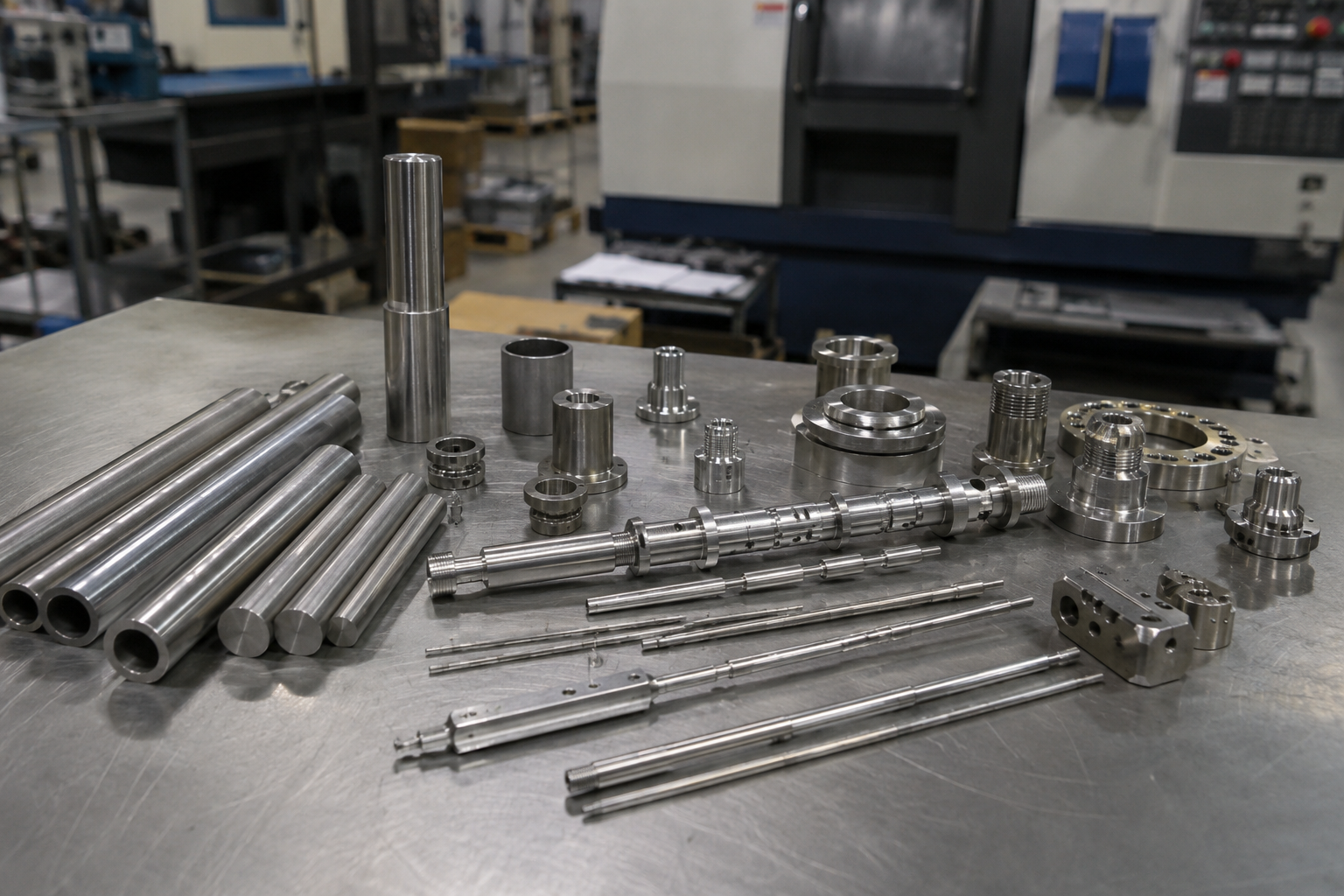
The first question should not be:
“Which medical-grade alloy can I buy in a small quantity?”
It should be:
“What decision or claim will this prototype support, and which material characteristics must be representative for that evidence to remain valid?”
Why Prototype Stage Matters
The term “prototype” may refer to very different development outputs.
| Prototype Stage | Main Purpose | Required Material Fidelity | Appropriate Use of Test Results |
|---|---|---|---|
| Visual concept model | Appearance, size, user discussion | Substitute material may be acceptable | No material-performance or biological claims |
| Form and fit prototype | Assembly, space, interfaces, ergonomics | Geometry and stiffness may need partial similarity | Assembly and usability learning only |
| Manufacturing-feasibility sample | Machining, forming, joining or finishing trials | Relevant alloy family and condition should be represented | Supports process development |
| Engineering-performance prototype | Load, motion, flow, wear or preliminary fatigue | Governing mechanical and physical properties should be representative | Preliminary engineering evidence |
| Design-verification unit | Demonstrate that design outputs meet inputs | Material and processing should match controlled design outputs or differences must be justified | Formal verification evidence |
| Biocompatibility sample | Biological-risk evaluation | Final material, processing, surface, cleaning and sterilization may be critical | Biological evaluation evidence |
| Sterilization or reprocessing sample | Validate effects of processing cycles | Final materials, assembly, surface and packaging should be represented | Processing-validation evidence |
| Design-validation unit | Confirm user needs and intended use | Initial production unit or documented equivalent | Formal validation evidence |
| Clinical or investigational device | Use involving human subjects | Controlled device configuration under the applicable regulatory pathway | Clinical evidence where authorized |
FDA design verification and validation information distinguishes verification from validation and explains that validation includes testing of production units under actual or simulated use conditions.
A prototype used only to confirm visual appearance should not automatically receive the same controls as a design-validation unit.
Conversely, an early model produced from an unrelated alloy should not be used to support fatigue, corrosion, biocompatibility, sterilization, or clinical claims for the final device.
Establish a Prototype Material-Fidelity Plan
Before ordering material, document which characteristics must match the proposed production device.
| Material or Process Attribute | Concept Prototype | Engineering Prototype | Verification or Validation Prototype |
|---|---|---|---|
| Alloy family | May differ | Usually representative | Should match or be technically justified |
| Exact grade and UNS | May differ | Match where performance depends on it | Normally match approved design output |
| Product standard | May be unnecessary | Should be identified | Required |
| Product form | May differ | Match where it affects properties | Should match production form |
| Heat treatment | May differ | Match for mechanical testing | Should match production condition |
| Melt or conversion route | Usually not critical | Review if it affects performance | Control where part of approved specification |
| Section size | Approximate may be acceptable | Representative section preferred | Worst-case or production-equivalent |
| Microstructure | Usually not evaluated | Relevant for fatigue or forming | Controlled where required |
| Raw surface | May differ | Relevant to manufacturing trials | Controlled if retained or performance-relevant |
| Machining process | May differ | Representative process preferred | Production or documented equivalent |
| Joining process | May differ | Representative for joint testing | Validated production process |
| Final surface treatment | Usually omitted | Include where performance depends on it | Match final device |
| Cleaning | Basic handling control | Representative where residues matter | Validated final process |
| Sterilization | Usually omitted | Include for relevant material screening | Match final device |
| Packaging | Usually omitted | Include where surface protection matters | Match production where applicable |
| Traceability | Basic identification | Heat or lot traceability | Full controlled traceability |
| Change control | Project-level | Formal review recommended | QMS-controlled |
This plan prevents two opposite errors:
- Applying expensive production controls to models that do not need them;
- using non-representative models to support formal performance or regulatory claims.
“Medical Grade” Is Not a Complete Specification
The phrase “medical grade” is commonly used in commercial discussions, but it does not define a purchasable product.
A complete specification may need to identify:
| Required Field | Why It Matters |
|---|---|
| Alloy or material family | Distinguishes titanium, stainless steel, cobalt alloy, Nitinol and other systems |
| UNS designation | Reduces ambiguity between similar commercial names |
| Product standard | Defines applicable chemical, mechanical and metallurgical requirements |
| Standard revision | Prevents different editions from being used |
| Product form | Bar, wire, tube, sheet, plate, forging and powder may follow different standards |
| Delivery condition | Annealed, cold worked, solution treated or age treated conditions may perform differently |
| Dimensions | Determines prototype yield, machining and testing |
| Surface condition | Affects machining, forming, inspection and retained surface |
| Melt or manufacturing route | May be important to cleanliness, microstructure or approved sourcing |
| Inspection requirements | Defines chemistry, mechanics, NDT, dimensions and other evidence |
| Documentation | Establishes how conformity and traceability will be demonstrated |
| Intended prototype use | Determines how representative the material needs to be |
A quotation stating only “medical titanium bar” or “implant nickel alloy tube” leaves too many requirements undefined.
Separate General Material Standards from Implant Standards
Materials with similar commercial descriptions may be supplied under different standards.
| Material Route | Example Standard | What the Standard Primarily Controls | What It Does Not Automatically Prove |
|---|---|---|---|
| Unalloyed implant titanium | ASTM F67 | Chemical, mechanical and metallurgical requirements for implant-product forms | Finished-device fatigue, biological safety or service life |
| Ti-6Al-4V ELI implant alloy | ASTM F136 | Wrought annealed Ti-6Al-4V ELI for surgical implant manufacture | Final implant performance or biocompatibility |
| Ti-6Al-4V implant alloy | ASTM F1472 | Wrought Ti-6Al-4V for surgical implant applications | Equivalence to F136 ELI |
| Implant stainless bar and wire | ASTM F138 | Implant-specific stainless steel material requirements | Finished corrosion, fatigue or biological performance |
| Wrought cobalt-chromium-molybdenum | ASTM F1537 | Implant alloy material requirements | Final articulating-system wear performance |
| Wrought Nitinol mill product | ASTM F2063 | Chemical, physical, mechanical and metallurgical requirements for specified product forms | Final shape setting, transformation behavior, fatigue or nickel release |
| General titanium bar and billet | ASTM B348 | General titanium bar and billet delivery requirements | Implant qualification |
| General industrial alloy product | Applicable ASTM, ASME, EN or other standard | Product-form conformity | Medical-device suitability |
The ASTM medical device and implant standards catalogue lists separate standards for different alloy families and product forms.
A general industrial standard may be suitable for:
- Non-patient-contact equipment;
- test fixtures;
- manufacturing-development trials;
- geometry models;
- project-approved non-implant parts.
It should not be substituted for an implant-material standard without formal engineering and regulatory review.
Define the Intended Device and Contact
Material requirements should start with the finished device.
| Question | Examples of Why It Matters |
|---|---|
| What is the final device? | Implant, guidewire, surgical tool, pump component, housing or diagnostic part |
| What is the component function? | Load bearing, sealing, cutting, flexing, conducting, shielding or supporting |
| Does it contact the patient? | No contact, direct contact or indirect contact |
| Which tissue does it contact? | Skin, blood, bone, tissue or circulating blood pathway |
| How long is the contact? | Transient, short-term, prolonged or permanent |
| Is the device reusable? | Cleaning and sterilization cycles may affect material and surface |
| Does it move or articulate? | Wear, galling, fretting and dimensional stability may govern |
| Is it implanted? | Implant-specific material and biological requirements may apply |
| Does it rely on elasticity or phase transformation? | Nitinol condition and temperature behavior may be critical |
| Is imaging compatibility relevant? | Magnetic behavior or radiopacity may affect selection |
| What is the regulatory pathway? | Evidence expectations may vary by device and market |
ISO 10993-1:2025 places biological safety evaluation within a risk-management process based on the actual device, its materials and its tissue contact.
ISO 14971:2019 provides the wider framework for identifying and controlling device risks throughout development and production.
Build a Material Requirements Matrix
A prototype project should convert intended use into measurable material requirements.
| Requirement Area | Questions to Answer | Possible Evidence |
|---|---|---|
| Strength | What static loads and safety factors apply? | Tensile data, component load testing |
| Stiffness | How much deflection is acceptable? | Elastic modulus, structural testing |
| Fatigue | What stress, strain and cycles are expected? | Material screening and final component fatigue |
| Fracture | Is crack tolerance important? | Fracture or damage-tolerance assessment |
| Corrosion | Which fluids, tissues or cleaning agents are present? | Relevant corrosion data and device-level assessment |
| Wear | Are there articulating or sliding interfaces? | Wear or fretting tests |
| Flexibility | Must the device bend, steer or recover? | Flexural or functional testing |
| Shape memory | Is recovery temperature important? | Transformation and functional tests |
| Manufacturability | Will the material be machined, formed, welded or laser cut? | Process trials and capability data |
| Surface | Which areas contact tissue, seals or mating parts? | Surface specifications and validation |
| Cleaning | Which residues may remain after processing? | Cleaning validation |
| Sterilization | Which method and number of cycles apply? | Sterilization compatibility testing |
| Supply | Can the same route be maintained for production? | Supplier and source qualification |
| Documentation | Which test results must be retained? | MTR, reports, traceability and design records |
A material should not be selected from strength alone.
A high-strength alloy may introduce:
- Difficult machining;
- lower ductility;
- joining problems;
- surface-processing challenges;
- longer lead times;
- restricted source availability.
Compare Candidate Material Families
The following table is a screening tool, not a device-approval table.
| Material Family | Potential Advantages | Important Limitations | Possible Prototype Context |
|---|---|---|---|
| Unalloyed titanium | Corrosion resistance, ductility, established implant standards | Lower strength than many titanium alloys | Selected implants, housings, low-to-moderate-load components |
| Ti-6Al-4V | High specific strength and broad processing experience | Machining difficulty, wear and galling concerns | High-strength structures and approved implant parts |
| Ti-6Al-4V ELI | Implant-specific ELI material route | Does not guarantee final fatigue or biological safety | Approved implant prototypes |
| Nitinol | Superelasticity, shape memory and kink resistance | Transformation, fatigue, processing and surface sensitivity | Flexible or deployable components |
| Implant stainless steel | Strength, stiffness, manufacturability and availability | Corrosion, magnetic, nickel and fatigue considerations depend on device | Fixation, instruments and selected implants |
| Cobalt-chromium alloys | Strength, hardness and wear capability | High stiffness, machining and material cost | Articulating and wear-sensitive components |
| Nickel- or cobalt-based specialty alloys | High strength or corrosion resistance in selected conditions | May lack a suitable implant standard for the intended use | Specialized device or equipment parts |
| General industrial alloys | Cost and availability | May lack the required medical standard or traceability | Concept and manufacturing trials only where approved |
The prototype plan should explain why the selected material is appropriate for the specific test.
Biocompatibility Is Not a Raw-Material Certificate
The FDA final-device biocompatibility guidance explains that FDA evaluates the complete device in its final finished form.
Relevant factors may include:
- Bulk alloy;
- trace elements;
- machining;
- heat treatment;
- welding;
- coatings;
- polishing;
- electropolishing;
- blasting;
- cleaning;
- manufacturing aids;
- particles;
- packaging;
- sterilization.
The evidence hierarchy should be understood clearly.
| Evidence | What It May Demonstrate | What It Does Not Prove by Itself |
|---|---|---|
| Material standard | Raw material meets stated product requirements | Finished-device biological safety |
| MTR | Batch chemistry, mechanics and specified test results | Final surface, residues or biocompatibility |
| Historical material data | Existing knowledge about an alloy family | Equivalence of a changed process or surface |
| Chemical characterization | Extractables, leachables or material chemistry under defined conditions | Every possible biological response |
| Biological testing | Selected biological endpoints for representative samples | Mechanical performance |
| Cleaning validation | Controlled removal of defined process residues | Alloy mechanical conformity |
| Sterilization validation | Sterilization-process performance | Long-term fatigue or corrosion |
| Final-device risk assessment | Integration of biological evidence and uncertainties | Automatic approval in every market |
A prototype made from the correct alloy but processed with a different lubricant, polish, coating, cleaner or sterilization method may not be representative of the final device.
Decide When Substitute Materials Are Acceptable
Using substitute material is not automatically wrong.
It becomes a problem when the substitution is not linked to the intended test.
| Prototype Purpose | Substitute Material May Be Acceptable? | Conditions |
|---|---|---|
| Visual appearance | Yes | Clearly identified and segregated |
| Basic size and ergonomics | Often | Mass and stiffness differences should be considered |
| Assembly-space study | Often | Interface dimensions must remain representative |
| Machining fixture development | Sometimes | Cutting behavior may not be transferable |
| Structural load test | Usually not without justification | Strength, stiffness and failure mode must be equivalent |
| Fatigue test | Generally high risk | Alloy, condition, surface and process must be representative |
| Corrosion test | Generally inappropriate | Exact alloy and surface are normally essential |
| Biocompatibility test | Generally inappropriate | Final finished materials and processing should be represented |
| Sterilization test | Generally inappropriate | Final materials, assembly and packaging should be represented |
| Design validation | Only as documented equivalent | Equivalence to production units must be established |
| Human use | Not as an informal engineering substitute | Applicable regulatory and ethical controls are required |
Every substitution should record:
- Original material;
- substitute material;
- test purpose;
- known differences;
- effect on results;
- limitations;
- approval;
- future retesting requirement.
Product Form Can Change Prototype Performance
The same alloy may be supplied as:
- Bar;
- wire;
- seamless tube;
- welded and drawn tube;
- sheet;
- plate;
- forging stock;
- forging;
- casting;
- additive powder.
Product form can influence:
- Grain flow;
- microstructure;
- residual stress;
- section-size properties;
- surface;
- straightness;
- formability;
- inspectability;
- machining allowance.
A bar-machined prototype may not represent a production forging if the forging route materially affects grain flow or mechanical performance.
A solid Nitinol rod may not represent a thin-wall Nitinol tube used in the final device.
Heat Treatment and Cold Work Must Be Controlled
Material condition can strongly affect:
- Strength;
- ductility;
- hardness;
- fatigue;
- formability;
- machining;
- residual stress;
- transformation behavior.
The RFQ should identify whether material is:
- Annealed;
- solution treated;
- age hardened;
- cold worked;
- stress relieved;
- shape set;
- supplied in another approved condition.
The words “per standard” may be insufficient when the standard permits more than one delivery condition.
Nitinol Requires Additional Prototype Controls
Nitinol function cannot be defined from nominal chemistry alone.
Relevant controls may include:
| Nitinol Characteristic | Why It Matters |
|---|---|
| Transformation temperature | Determines behavior at storage, room, test and body temperature |
| Thermomechanical condition | Influences plateau stress, recovery and fatigue |
| Cold work | Changes mechanical and transformation behavior |
| Shape-setting cycle | Defines final recovered geometry |
| Final surface | Influences fatigue, corrosion and nickel release |
| Inclusion population | Can influence fatigue initiation |
| Test temperature | Changes measured superelastic response |
| Strain range | Strongly affects fatigue life |
| Joining and laser processing | May create local thermal and surface changes |
ASTM F2063 is a starting-material standard. It does not establish the complete performance of a finished Nitinol component after shape setting and surface processing.
Manufacturability Should Be Tested Early
A material that meets the final mechanical requirement may still create an impractical manufacturing route.
| Manufacturing Process | Material-Related Questions |
|---|---|
| CNC machining | Cutting force, tool wear, heat, burrs and residual stress |
| Swiss turning | Bar straightness, diameter consistency, chip control and surface |
| Grinding | Material removal, burning, residual stress and dimensional control |
| Cold forming | Ductility, springback, cracking and work hardening |
| Forging | Starting stock, temperature window, grain flow and scale |
| Laser cutting | Heat-affected region, recast layer and surface finishing |
| EDM | Recast layer, residue and dimensional effects |
| Welding | Filler, heat input, microstructure, distortion and cleanliness |
| Brazing | Filler compatibility and biological risks |
| Additive manufacturing | Powder quality, build orientation, porosity and post-processing |
| Polishing | Material removal, final dimensions and residues |
| Electropolishing | Surface removal, chemistry and edge effects |
| Coating | Adhesion, thickness, dimensions and biological evaluation |
Prototype development should capture:
- Tooling requirements;
- process parameters;
- rejection modes;
- dimensional capability;
- surface outcome;
- repeatability;
- scale-up risks.
A single successful handcrafted prototype does not prove that the process can be transferred to stable production.
Match Prototype Dimensions to Available Stock
Small prototype quantities often create an avoidable mistake: specifying an exact finished dimension as the raw-material size.
The buyer should distinguish:
| Dimension Type | Example |
|---|---|
| Finished component size | Final machined diameter |
| Raw-stock size | Bar or tube size before machining |
| Machining allowance | Material intentionally removed |
| Straightness requirement | Needed for stable feeding or machining |
| Cut length | Blank length before machining |
| Test specimen allowance | Extra stock needed for incoming or qualification testing |
| Retained sample allowance | Material reserved for investigation or future comparison |
A slightly larger standard stock size may reduce lead time without affecting the final design.
A custom melt or conversion route may be necessary when:
- No suitable standard size exists;
- section size controls properties;
- prototype testing requires exact product form;
- the final product will use a custom tube, wire or forging.
Prototype Quantity Planning
Prototype buyers should consider more than the immediate number of parts.
| Quantity Element | Why It Should Be Included |
|---|---|
| Engineering samples | Initial concept or performance parts |
| Setup material | Machine and process setup |
| Destructive test material | Chemistry, tensile, corrosion or metallography |
| Rejected or iteration allowance | Design changes and process learning |
| Verification samples | Formal testing |
| Retained samples | Future investigation or comparison |
| Supplier qualification samples | Incoming verification |
| Production-reference stock | Maintain continuity into later stages |
| Contingency | Delivery loss or unexpected failure |
Ordering exactly enough material for one prototype build can force a new heat or new supplier to be introduced during verification.
Same-Heat and Future-Supply Strategy
Maintaining the same heat may be useful when:
- Comparing process iterations;
- investigating prototype failures;
- reducing material variability;
- conducting verification tests;
- bridging toward pilot production.
It may not always be practical or necessary.
A same-heat strategy should answer:
| Question | Required Decision |
|---|---|
| How much material will be reserved? | Defined quantity |
| Who owns the reserved material? | Buyer or supplier |
| How long will it be held? | Written retention period |
| How will it be identified? | Heat and project segregation |
| Can it be sold to another customer? | Contractual control |
| What happens after expiry? | Release or extension process |
| Is the same conversion lot required? | Heat alone may not be sufficient |
| Does the later production route remain unchanged? | Formal confirmation |
Using the same heat cannot replace proper production qualification.
It can only reduce one source of variation.
Evaluate Long-Term Availability Before Design Freeze
A prototype material may be technically excellent but difficult to source at production scale.
Review:
- Number of qualified mills;
- available product forms;
- standard diameters and wall thicknesses;
- minimum mill quantities;
- melt frequency;
- lead time;
- testing capacity;
- geographical concentration;
- export restrictions;
- approved alternate standards;
- change-notification capability.
A rare alloy should not be rejected automatically.
Its supply risk should be visible before the design becomes difficult to change.
Supplier Evaluation Matrix
| Review Area | Evidence to Request | Warning Signs |
|---|---|---|
| Legal supplier identity | Registered company and facility information | Unclear seller or factory relationship |
| Original mill | Mill name and original MTR | Recreated certificates without original source |
| Material scope | Exact alloys, forms and sizes | Broad claims without product evidence |
| Medical experience | Relevant material standards and controlled orders | “Medical grade” used without exact standards |
| Quality system | Current certificate with site and scope | Certificate covers only unrelated activity |
| Traceability | Heat, lot, cut-piece and packaging linkage | Re-marking not controlled |
| Testing | Methods, laboratories and reports | Only pass/fail claims |
| Laboratory competence | ISO/IEC 17025 scope where required | Certificate does not include the method |
| Subcontractors | Approved process and testing locations | Undisclosed heat treatment or testing |
| Change control | Written source and process notification | Mill can change without notice |
| Small-quantity control | Cutting and segregation procedures | Prototype stock mixed with unidentified remnants |
| Documentation | MTR, CoC and supplementary reports | Documents issued after shipment from incomplete data |
| Nonconformance | Quarantine, investigation and disposition | Material replaced without root-cause review |
| Scalability | Pilot and production capacity | Prototype source cannot support production |
| Communication | Technical clarification and deviation process | Verbal substitutions without written approval |
ISO 13485 Should Be Interpreted Correctly
ISO 13485:2016 establishes medical-device-sector quality-management requirements.
A raw-material supplier may hold:
- ISO 9001;
- ISO 13485;
- both;
- another customer-approved quality system.
Whether ISO 13485 is required depends on:
- Supplier role;
- outsourced responsibility;
- material criticality;
- customer purchasing controls;
- applicable regulatory strategy.
The certificate should be checked for:
- Legal organization;
- manufacturing location;
- scope;
- product or activity;
- validity;
- certification body.
An ISO 13485 certificate does not prove that a specific heat of titanium or Nitinol meets the purchase order.
The FDA Quality Management System Regulation became effective in 2026 and incorporates ISO 13485:2016 into the U.S. medical-device quality-system framework.
This does not create an “FDA-certified raw material.”
Documentation Matrix
| Document | Typical Purpose | Important Limitation |
|---|---|---|
| Original mill MTR | Heat chemistry, mechanical properties and specified material tests | Does not prove final-device suitability |
| Certificate of Conformance | Supplier declaration of order conformity | May not include actual data |
| EN 10204 document | Defined metallic-product inspection-document type | Not a medical-device approval |
| Heat-treatment record | Furnace cycle and batch linkage | Does not prove final part performance |
| Dimensional report | Actual stock or part dimensions | Does not prove chemistry |
| NDT report | Results under a defined method and acceptance level | Does not prove absence of every discontinuity |
| Microstructure report | Defined metallographic condition | Must match product location and acceptance criteria |
| Surface report | Roughness, defects or surface condition | Does not prove cleanliness or biological safety |
| Transformation-temperature report | Nitinol transformation data | Method and specimen state must be stated |
| Corrosion report | Performance under defined exposure | May not reproduce final device conditions |
| Cleaning report | Controlled removal of defined residues | Applies only to the tested process |
| Biological evaluation | Biological-risk evidence for a representative device | Does not replace mechanical testing |
| Supplier QMS certificate | Organizational system scope | Not a batch product certificate |
| Deviation approval | Authorized departure from the specification | Applies only to stated items and lots |
| Change notification | Disclosure of source or process change | Requires impact evaluation |
BS EN 10204 inspection documents define metallic-product inspection-document categories.
The requested document type should match the purchasing system rather than being treated as a universal medical certificate.
Review the MTR Line by Line
An MTR review should verify:
| Review Item | Question |
|---|---|
| Supplier | Does the seller match the approved supplier? |
| Original manufacturer | Is the mill clearly identified? |
| Standard | Is the exact specification and revision stated? |
| Grade | Does it match the purchase order? |
| UNS | Is the alloy identity unambiguous? |
| Product form | Does the report cover the delivered bar, tube, sheet or wire? |
| Heat number | Does it match physical markings and packaging? |
| Chemistry | Are actual results shown? |
| Mechanical properties | Are actual values, specimen orientation and condition clear? |
| Heat treatment | Is the delivered state identified? |
| Dimensions | Are they in a separate report if not included? |
| Additional testing | Are customer-specific tests reported? |
| Authorized signature | Is document authorization controlled? |
| Alteration | Are corrections or transferred documents traceable? |
A certificate that looks professional may still be inadequate if it cannot be linked to the physical material.
Verify Laboratory Scope
ISO/IEC 17025 addresses laboratory competence, impartiality and consistent operation.
Where laboratory accreditation is required, confirm:
| Check | Reason |
|---|---|
| Legal laboratory name | Prevents confusion with affiliated organizations |
| Test location | Accreditation may be site-specific |
| Accreditation body | Confirms the issuing organization |
| Certificate validity | Prevents use of expired scope |
| Exact test method | Not every test is included |
| Product or material range | Scope may be limited |
| Sampling responsibility | Sample integrity affects results |
| Report authorization | Ensures controlled issue |
| Traceability | Links the sample to the supplied heat or lot |
A laboratory accredited for chemical analysis may not be accredited for fatigue, Nitinol transformation testing, metallography or corrosion.
Incoming Inspection by Prototype Stage
| Prototype Risk Level | Possible Incoming Controls |
|---|---|
| Visual concept | Material identification and basic dimensions |
| Fit and assembly | Dimensions, stiffness-relevant properties and identification |
| Manufacturing trial | MTR, dimensions, condition, straightness and surface |
| Engineering test | Full certificate review, traceability and risk-based verification |
| Formal design verification | Approved source, controlled specification, actual reports and lot traceability |
| Biocompatibility or sterilization | Final-material and process comparability review |
| Design validation | Production-unit or documented-equivalent controls |
| Clinical or investigational use | Full applicable QMS, regulatory and device-release controls |
Additional verification may include:
- PMI;
- product chemistry;
- mechanical retesting;
- dimensional measurement;
- surface inspection;
- UT or ET;
- metallography;
- transformation testing;
- third-party inspection.
Testing should address identified risks rather than being added indiscriminately.
Control Prototype Material Segregation
Prototype materials should be clearly separated by:
- Alloy;
- standard;
- heat;
- condition;
- product form;
- project;
- intended test use.
Labels may identify:
- Prototype only;
- not for human use;
- not for verification;
- not production-equivalent;
- verification-controlled material;
- retained sample;
- nonconforming or pending review.
Physical segregation helps prevent:
- Concept material entering formal testing;
- mixed heats;
- unapproved substitutes;
- expired or unidentified remnants;
- engineering samples entering clinical inventory.
Control Changes During Development
Prototype projects change frequently.
Changes that may affect test validity include:
- Alloy grade;
- material standard;
- original mill;
- heat;
- product form;
- bar or tube size;
- heat treatment;
- cold work;
- machining process;
- joining;
- surface treatment;
- cleaning;
- sterilization;
- packaging.
Every change should be evaluated for its effect on:
- Previous test results;
- biological evidence;
- mechanical performance;
- manufacturing capability;
- supplier qualification;
- regulatory documentation;
- need for retesting.
A change that appears minor commercially may be significant technically.
Prototype-to-Production Bridging
Before moving into production, compare the prototype and production configurations.
| Comparison Area | Prototype | Proposed Production | Required Action |
|---|---|---|---|
| Alloy and standard | Recorded value | Final specification | Confirm match or justify |
| Original mill | Prototype source | Production source | Qualify changes |
| Product form | Bar, tube, sheet or other | Final form | Evaluate property differences |
| Heat treatment | Prototype condition | Final condition | Confirm equivalence |
| Size | Prototype stock | Production stock | Review section-size effects |
| Machining | Development process | Production process | Validate transfer |
| Joining | Prototype method | Final method | Verify joint performance |
| Surface | Development finish | Final finish | Repeat relevant tests |
| Cleaning | Laboratory process | Production process | Validate |
| Sterilization | Prototype cycle | Final cycle | Validate representative device |
| Packaging | Development protection | Final packaging | Evaluate surface and sterility impacts |
| Supplier controls | Development purchase | Approved production supplier | Complete qualification |
| Documentation | Prototype file | Production records | Close evidence gaps |
This comparison should occur before relying on prototype test results for production decisions.
Practical Sourcing Workflow
| Step | Action | Output |
|---|---|---|
| 1 | Define prototype stage and test purpose | Prototype-use statement |
| 2 | Identify patient contact and device function | Intended-use and risk inputs |
| 3 | List material-dependent performance requirements | Material requirements matrix |
| 4 | Select candidate alloy families | Screening comparison |
| 5 | Select exact standard, UNS, form and condition | Draft material specification |
| 6 | Review manufacturability and availability | Feasibility assessment |
| 7 | Decide which production attributes must be represented | Fidelity plan |
| 8 | Define quantity, testing and retained material | Quantity plan |
| 9 | Qualify supplier and original source | Supplier evidence file |
| 10 | Issue controlled RFQ and drawing | Procurement package |
| 11 | Review MTR and incoming material | Acceptance record |
| 12 | Record all prototype processing | Prototype history record |
| 13 | Evaluate test results and limitations | Verification report |
| 14 | Compare prototype with production configuration | Bridging assessment |
| 15 | Control changes and required retesting | Approved change record |
Common Sourcing Mistakes
| Mistake | Consequence | Better Practice |
|---|---|---|
| Ordering “medical-grade titanium” | Ambiguous grade and standard | Specify alloy, UNS, standard and form |
| Using F136 for every medical prototype | Unnecessary cost and restricted supply | Match the standard to the intended device |
| Using industrial alloy for formal implant testing | Non-representative evidence | Use controlled final material |
| Treating MTR as biocompatibility evidence | Incomplete biological assessment | Evaluate final finished device |
| Treating ISO 13485 as a material certificate | False confidence in batch conformity | Review actual MTR and reports |
| Selecting material from strength alone | Manufacturing or surface problems | Use a multi-factor matrix |
| Ignoring product form | Prototype properties may not represent production | Match bar, forging, wire or tube route |
| Ignoring heat treatment | Mechanical behavior may change | Specify and document condition |
| Ignoring surface processing | Corrosion, fatigue or biological evidence may be invalid | Represent final surface where relevant |
| Ordering only exact part quantity | No setup, testing or iteration material | Include development and retained stock |
| Mixing heats across test groups | Adds uncontrolled variability | Segregate heat and lot |
| Changing the supplier during verification | Test comparability may be lost | Conduct change and equivalency review |
| Accepting rewritten certificates | Original source may be obscured | Request original mill documentation |
| Assuming a small lot needs no QMS controls | Formal evidence may become unusable | Match controls to prototype purpose |
| Qualifying only the distributor | Manufacturing source remains unknown | Map the full supply chain |
| Choosing a rare alloy without scale-up review | Production shortage and redesign risk | Assess availability before design freeze |
| Using one handcrafted sample as capability proof | Production may be unstable | Evaluate repeatability and scale-up |
| Failing to label substitute materials | Incorrect samples may enter formal testing | Use controlled segregation |
| Letting the supplier approve final material | Responsibility becomes unclear | Keep approval in the device design system |
| Assuming prototype success equals regulatory acceptance | Evidence may not represent final device | Complete verification, validation and risk review |
RFQ Checklist for Medical Device Prototype Alloy Materials
| Category | Information to Provide |
|---|---|
| Project | Project name, confidentiality, target market and development schedule |
| Prototype stage | Concept, fit, engineering, verification, biological, validation or clinical |
| Test purpose | What the sample must demonstrate |
| Device | Device and component description |
| Contact | Patient-contact nature and duration |
| Use | Implantable, reusable, single-use or external |
| Material | Alloy, grade and UNS |
| Standard | ASTM, ISO, EN or customer specification and revision |
| Product form | Bar, wire, tube, sheet, plate, forging or powder |
| Condition | Annealed, cold worked, solution treated, age treated, shape set or other |
| Source | Approved mill, melt route or geographical restrictions |
| Dimensions | Diameter, wall, width, thickness, length and tolerances |
| Straightness | Method and permitted deviation |
| Surface | Pickled, ground, peeled, polished or other condition |
| Machining allowance | Required additional stock |
| Quantity | Parts, setup stock, testing stock, retained stock and contingency |
| Chemistry | Standard limits and any tighter project limits |
| Mechanical properties | Required tensile, yield, elongation, hardness or other properties |
| Microstructure | Grain, phase, inclusion or metallographic requirements |
| Nitinol | Transformation temperature, test method and thermomechanical condition |
| NDT | UT, ET, PT or other methods and acceptance criteria |
| Corrosion | Test medium, temperature, surface and acceptance criteria |
| Dimensions report | Actual values required or pass/fail |
| Documentation | Original MTR, CoC, EN 10204 type and supplementary reports |
| Traceability | Heat-to-piece or lot-to-piece requirements |
| Laboratory | ISO/IEC 17025 requirements and applicable scope |
| Inspection | Buyer, supplier or third-party witness points |
| Segregation | Prototype status and human-use restrictions |
| Packaging | Surface protection, clean wrapping and material segregation |
| Retained stock | Quantity, ownership and retention duration |
| Change control | Required source and process notifications |
| Deviations | Written approval before use |
| Production continuity | Expected future volume and source requirements |
| Record retention | Required period and electronic format |
Frequently Asked Questions
Must every medical prototype use the final production alloy?
No. A concept or form-and-fit model may use a substitute material when the substitution does not invalidate the intended evaluation. Formal mechanical, biological, sterilization and validation evidence usually requires much closer representation of the final device.
Can commercial-grade titanium be used for an early prototype?
It may be used for geometry, assembly or manufacturing learning when clearly identified and approved. It should not automatically be used to support implant-material, fatigue, corrosion or biological claims.
What does “production-equivalent prototype” mean?
It means that the sample is sufficiently representative of the intended production device for the purpose of the test. The organization should document equivalence in material, manufacturing, surface, assembly and other performance-relevant attributes.
Does ASTM F136 prove that a prototype is biocompatible?
No. ASTM F136 establishes raw-material requirements for Ti-6Al-4V ELI used in surgical-implant manufacture. Biological safety must be evaluated for the final finished device.
Does an MTR prove that the material is suitable for the device?
An MTR demonstrates the stated batch-level material results. Device suitability also depends on design, manufacturing, surface, cleaning, sterilization and finished-device testing.
Is ISO 13485 mandatory for every prototype-material supplier?
Not universally. It may be required by the device manufacturer’s supplier controls. The supplier’s role, facility, activities and certificate scope should be reviewed.
Should prototype and production material come from the same heat?
It may improve comparability during development, but it is not always required or sufficient. The need depends on test sensitivity, availability and the planned production-qualification strategy.
Should prototype buyers reserve extra material?
Usually, yes. Setup, destructive testing, design iterations, retained samples and later verification can require more stock than the initial part count suggests.
Can a supplier substitute a similar alloy?
Not without review. Similar commercial names may have different standards, UNS designations, chemistry, processing and regulatory histories. Substitutions should follow a documented deviation process.
Can a material supplier approve the final medical-device material?
The supplier can provide material and manufacturing information. Final approval belongs to the medical-device manufacturer’s controlled engineering, quality, biological-safety and regulatory processes.
Conclusion
Sourcing alloy materials for medical device prototype parts is a stage-based engineering and risk-management activity.
A defensible sourcing strategy must connect:
- Prototype purpose;
- intended device use;
- patient contact;
- mechanical and biological risks;
- exact alloy;
- material standard;
- product form;
- heat treatment;
- microstructure;
- manufacturing route;
- surface condition;
- cleaning and sterilization;
- quantity planning;
- documentation;
- traceability;
- supplier qualification;
- change control;
- prototype-to-production bridging.
Concept models do not always require final implant material.
Formal verification, biological evaluation and design validation cannot rely casually on unrelated substitute materials.
The objective is not to apply maximum regulatory controls to every early model.
The objective is to apply the correct level of material fidelity and evidence at each development stage, so that prototype results remain technically meaningful and can support an efficient transition into controlled production.