
How to Source Nickel and Titanium Alloy Bars for Aerospace Prototypes
Sourcing nickel and titanium alloy bars for aerospace prototypes is not a simple material purchase. A prototype may be used for machining trials, structural testing, thermal testing, vibration testing, qualification preparation, or design validation. In these situations, the bar material must match the engineering assumptions behind the prototype.
A material that looks acceptable on a basic datasheet may still create problems if the product standard, heat treatment condition, grain structure, traceability, inspection documents, or supplier process control is not clearly confirmed.
For aerospace prototype manufacturers, sourcing nickel and titanium alloy bars means connecting material selection with application requirements, standards, processing history, supplier credibility, documentation, and risk control.
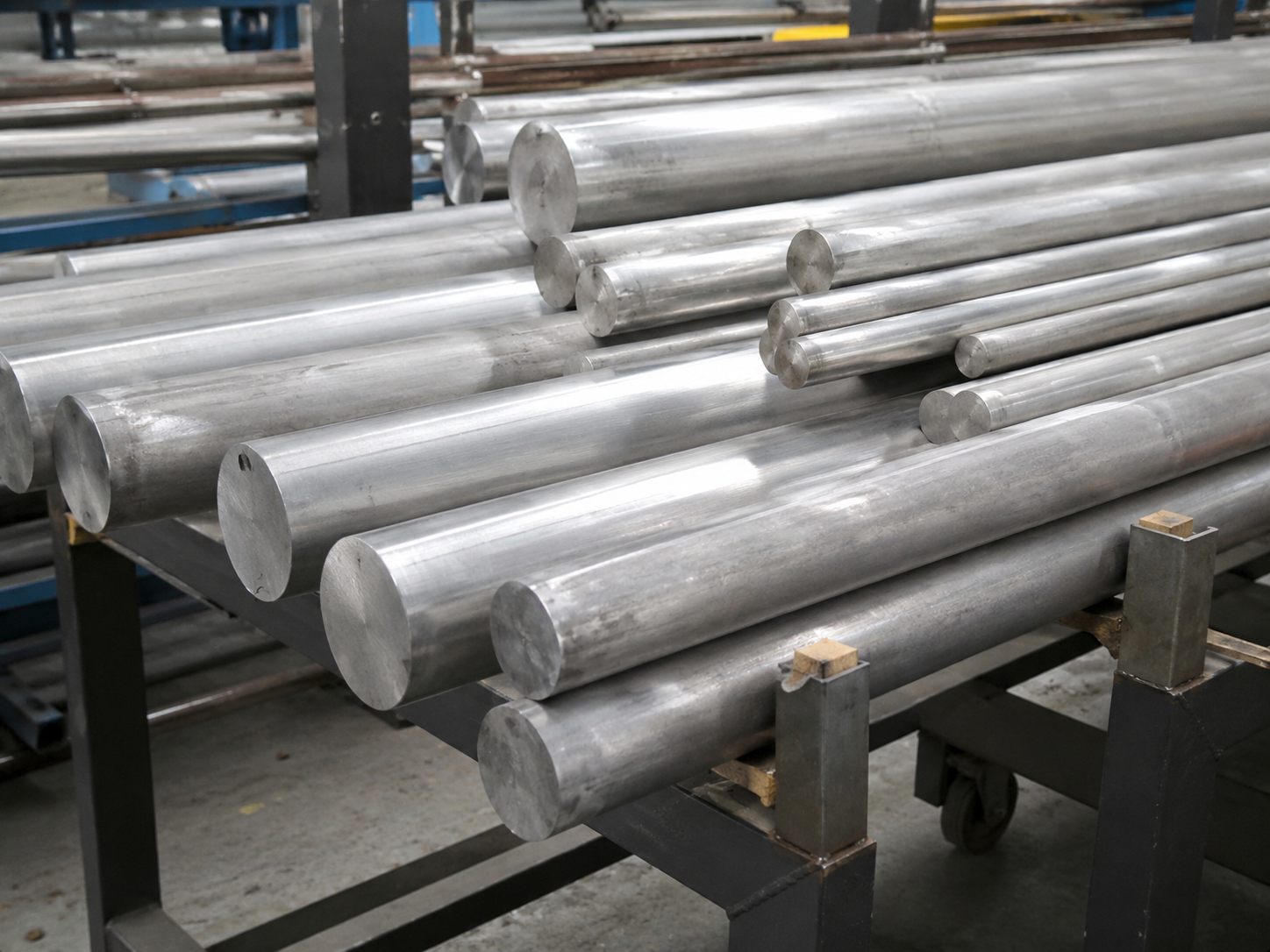
The goal is not to find one “best” alloy. The goal is to select a material that fits the prototype’s function, operating environment, machining plan, testing objective, and future production path.
Why Aerospace Prototype Bar Sourcing Is Different
Aerospace prototypes are often built before the final production route is fully fixed. This makes material sourcing more complex than normal stock purchasing.
For a simple trial part, the buyer may focus on machinability and delivery time. For a flight-relevant or qualification-related prototype, the buyer may need stricter control over material standard, heat number, mechanical properties, ultrasonic inspection, heat treatment, source traceability, and documentation.
A prototype can also influence later design decisions. If the wrong material condition is used during early testing, the test result may not represent the final production part. This can create confusion during design review, process validation, or supplier qualification.
Prototype Sourcing Questions Buyers Should Ask
| Question | Why It Matters |
|---|---|
| What is the prototype used for? | A visual model, machining trial, structural test, thermal test, and qualification prototype may need different material control. |
| Is the prototype flight-relevant? | Flight-relevant parts usually require stricter traceability, standards, and inspection documents. |
| Will the prototype data influence final design? | If yes, material condition and processing history should match the intended production material as closely as possible. |
| What standard is specified on the drawing? | ASTM, AMS, ASME, EN, or customer-specific standards should be clearly stated before ordering. |
| Is heat treatment condition critical? | Mechanical properties, fatigue behavior, creep resistance, and machinability may depend on heat treatment. |
| Is NDT required? | Ultrasonic testing or other NDT may be needed for bars used in critical machined parts. |
| Will the supplier support repeat orders? | Prototype success may lead to pilot or batch production, so repeatability matters. |
The FAA’s receiving inspection guidance for aircraft parts and materials emphasizes traceability, inspection, identification, documentation, and procedures to prevent unsuitable articles or materials from entering inventories. FAA receiving inspection guidance
This is a useful reminder for aerospace material buyers: receiving inspection and documentation should be planned before the material arrives.
Are Basic Material Parameters Enough?
Basic material parameters are important, but they are not enough.
A datasheet may show chemical composition, tensile strength, yield strength, elongation, hardness, or density. These values are useful, but they do not fully explain how the bar will behave during machining, testing, heat exposure, cyclic loading, or long-term service simulation.
For aerospace prototypes, buyers should look deeper into the relationship between processing, microstructure, and final properties.
What Basic Parameters May Miss
| Basic Parameter | What It Shows | What It May Not Show |
|---|---|---|
| Chemical composition | Whether the alloy matches a grade range | Melt route, impurity control, interstitial elements, segregation, or batch variation |
| Tensile strength | Strength under a defined test condition | Fatigue behavior, notch sensitivity, creep resistance, or thermal cycling response |
| Hardness | Approximate resistance to indentation | Machining behavior, fracture toughness, grain structure, or heat treatment quality |
| Elongation | Basic ductility | Low-temperature toughness, fatigue performance, or forming response |
| Corrosion resistance | General material behavior | Actual behavior in the prototype’s environment, temperature, stress, and surface condition |
| Standard compliance | Whether the material meets a specification | Whether it fits the exact prototype function and test objective |
ISO 9001 supply chain guidance warns that a product may meet stated requirements and still be wrong for the intended application. For aerospace prototype sourcing, this point is very important. The buyer should define not only the material grade, but also the intended use, risk level, and confidence needed in the supplier.
Why Processing History Matters
Two bars with the same alloy name may not perform the same way.
Processing history can affect grain structure, inclusion level, residual stress, mechanical properties, machinability, fatigue behavior, and dimensional stability. For aerospace prototypes, this is especially important when the bar will be machined into a load-bearing component or tested under temperature, vibration, pressure, or cyclic stress.
Processing Factors to Review
| Processing Factor | Why It Matters |
|---|---|
| Melting and refining route | May affect cleanliness, gas content, segregation, and inclusion level. |
| Forging or rolling reduction | Influences grain flow, internal soundness, and mechanical consistency. |
| Heat treatment | Controls microstructure, strength, ductility, stress relief, and corrosion behavior. |
| Cooling method | May affect precipitation, residual stress, and final properties. |
| Bar straightness and size control | Important for machining yield, fixture stability, and dimensional accuracy. |
| Surface condition | Surface cracks, laps, scale, or defects may affect machining and inspection. |
| Ultrasonic testing | Helps detect internal discontinuities when required. |
| Grain size or microstructure evidence | May be required for critical aerospace or customer-specific applications. |
For example, titanium alloy bars may need careful control of interstitial elements such as oxygen, nitrogen, and hydrogen because these can influence strength and ductility. Nickel alloys may require attention to heat treatment condition, precipitation behavior, high-temperature strength, or corrosion resistance depending on the alloy family and intended application.
This does not mean every aerospace prototype needs the most expensive or most controlled material route. It means the material route should match the prototype’s purpose.
Can One Alloy Fit All Aerospace Prototype Needs?
There is no single nickel or titanium alloy that fits every aerospace prototype.
A prototype for a high-temperature engine-related part has different requirements from a prototype for a lightweight bracket, cryogenic test fixture, fastener, support structure, or machined test coupon.
The right alloy depends on function first.
Application-Based Material Thinking
| Prototype Application | Key Material Concerns | Materials to Review |
|---|---|---|
| Lightweight structural bracket | Strength-to-weight ratio, fatigue resistance, machinability | Titanium alloys such as Ti-6Al-4V may be reviewed when specified by design |
| Engine-related test part | High-temperature strength, oxidation resistance, creep behavior | Nickel alloys such as Alloy 718 or Alloy 625 may be reviewed depending on temperature and requirement |
| Cryogenic test fixture | Low-temperature toughness, dimensional stability, compatibility | Specific titanium or nickel alloys may be reviewed based on test conditions |
| High-temperature fastener or spacer | Stress relaxation, strength retention, oxidation resistance | Nickel alloys or high-temperature stainless alloys may be reviewed |
| Corrosion-sensitive prototype | Chemical exposure, oxidation, surface condition | Nickel alloys, titanium alloys, or stainless alloys should be checked against actual media |
| Machining trial bar | Machinability, size availability, cost, surface condition | Material may not need full aerospace process control if the trial is non-functional |
| Qualification-related prototype | Traceability, standard compliance, inspection, repeatability | Material should match the intended production specification as closely as possible |
The important point is not whether titanium is “better” than nickel alloy, or whether one well-known grade can solve every problem. The important point is whether the material matches the prototype’s load, temperature, environment, machining plan, test objective, and documentation requirement.
What Standards Should Buyers Confirm?
Aerospace prototype manufacturers should avoid ordering only by a broad material name. A purchase order should clearly define the material grade, standard, product form, condition, size, tolerance, inspection requirement, and certificate type.
Common Standards and Documents to Review
| Item | Example Source | What It Helps Confirm |
|---|---|---|
| Titanium alloy bars and billets | ASTM B348 titanium bar requirements | Chemical composition and tensile testing requirements for titanium and titanium alloy bars and billets |
| Nickel alloy rod and bar | ASTM B446 nickel alloy rod and bar requirements | Product form, alloy designation, heat treatment condition, composition, and mechanical requirements for certain nickel alloys |
| Ti-6Al-4V aerospace material | SAE AMS4928 Ti-6Al-4V aerospace material specification | Aerospace specification example for annealed Ti-6Al-4V product forms |
| Inspection documents | BS EN 10204 inspection documents | Inspection document types used to authenticate metallic materials |
| Laboratory testing | ISO/IEC 17025 laboratory competence | Laboratory competence, impartiality, and consistent operation |
| Aerospace receiving inspection | FAA receiving inspection guidance | Receiving inspection, documentation review, identification, and traceability guidance |
Standards help define the material, but they do not replace engineering review. A bar can meet a standard and still be unsuitable if the standard does not match the prototype’s function, operating environment, heat treatment, inspection requirement, or future qualification plan.
How Should Buyers Review MTRs and Certificates?
A Material Test Report or Material Test Certificate is not a formality. For aerospace prototype materials, it is one of the most important documents in the purchasing process.
A general datasheet tells buyers what a material grade typically offers. An MTR tells buyers what the actual supplied batch shows.
What to Check in an MTR / MTC
| MTR Item | Why It Matters |
|---|---|
| Material grade and UNS / alloy designation | Confirms that the supplied bar matches the requested material. |
| Heat number / lot number | Provides traceability back to a specific melt or batch. |
| Product form | Confirms whether the material is bar, billet, rod, forging stock, or another form. |
| Product standard | Shows whether the material was supplied to ASTM, AMS, EN, ASME, or customer specification. |
| Chemical composition | Confirms alloying elements and impurity limits. |
| Mechanical properties | Confirms tensile strength, yield strength, elongation, hardness, or other required properties. |
| Heat treatment condition | Critical for properties, machining, microstructure, and future testing. |
| Test methods | Shows how properties were measured. |
| NDT results | Useful when ultrasonic testing or other inspections are required. |
| Size and tolerance | Confirms diameter, length, straightness, and other dimensional requirements. |
| Inspection authority | Shows whether the document was issued by mill, manufacturer, supplier, or third-party body. |
| Certificate type | EN 10204 3.1 or other certificate type may be required by the project. |
BS EN 10204 inspection documents are widely used to authenticate materials and prove specified chemical and mechanical properties. For aerospace prototype materials, certificate type should be confirmed before ordering, not after delivery.
If independent testing is required, buyers should also confirm the laboratory’s competence. ISO/IEC 17025 laboratory competence can be useful when test results are important for acceptance or customer approval.
How Can Buyers Evaluate Supplier Credibility?
Supplier credibility should be evaluated through evidence, not only through marketing claims.
For aerospace prototype bars, the supplier should be able to explain the material route, confirm standards, provide batch documents, support inspection requirements, protect traceability, and communicate clearly when questions arise.
Supplier Evaluation Checklist
| Supplier Area | What to Check |
|---|---|
| Application understanding | Does the supplier ask about prototype function, temperature, stress, machining, and inspection requirements? |
| Material knowledge | Can the supplier explain the difference between grade, condition, product form, and standard? |
| Standards support | Can the supplier provide material according to ASTM, AMS, EN, ASME, or customer specifications when required? |
| MTR quality | Are heat number, chemistry, mechanical properties, standard, and condition clearly shown? |
| Traceability | Can the supplier trace the bar to heat number, lot number, and certificate? |
| Inspection support | Can the supplier support PMI, UT, dimensional inspection, surface inspection, or third-party inspection if required? |
| Special process control | If heat treatment, NDT, or chemical processing is involved, are relevant process approvals or accreditations required? |
| Packaging and marking | Are bars marked, protected, and packed to prevent damage or mix-up? |
| Non-conformance process | Can the supplier explain how quality issues are handled? |
| Repeatability | Can the supplier support later pilot or batch orders with consistent documentation? |
For critical aerospace supply chains, buyers may need to check whether relevant special processes are Nadcap accredited. Nadcap critical process accreditation covers important process areas such as heat treating, nondestructive testing, chemical processing, materials testing laboratories, and measurement and inspection.
This does not mean every prototype bar supplier must hold every accreditation. It means project-specific requirements should be confirmed early, especially when a prototype may move toward qualification or production.
How Can Manufacturers Reduce Sourcing Risk?
Risk control should start before the purchase order is placed.
For aerospace prototypes, material sourcing risk may come from incorrect grade selection, incomplete documents, unsuitable heat treatment, long lead time, poor packaging, supplier inconsistency, or lack of replacement material for the next test phase.
Common Sourcing Risks and Controls
| Risk | How It Can Affect the Project | Practical Control |
|---|---|---|
| Wrong material condition | Test results may not represent final design assumptions | Specify grade, standard, heat treatment, and product form clearly |
| Incomplete MTR | Incoming inspection or customer review may be delayed | Confirm document requirements before order |
| Internal defects | Machined parts may fail inspection or testing | Require UT or other NDT if needed |
| Poor traceability | Root-cause analysis becomes difficult | Require heat number, lot number, marking, and certificate matching |
| Supplier inconsistency | Repeat prototype builds may differ | Qualify supplier and confirm repeat-order capability |
| Long lead time | Prototype schedule may slip | Check stock, production schedule, and backup options early |
| Material substitution | Unapproved material may affect testing validity | Require written approval for substitutions |
| Packaging damage | Bars may arrive scratched, bent, corroded, or mixed | Specify packaging, marking, and inspection at receiving |
| Price-only sourcing | Low initial cost may lead to rework, retesting, or redesign | Compare total project risk, not only unit price |
The FAA receiving inspection guidance highlights the importance of identification, documentation, traceability, packaging condition, and inspection procedures when receiving aircraft parts and materials. FAA receiving inspection guidance
For prototype projects, this thinking is also useful. Even when the part is still in the prototype stage, poor material control can affect testing, engineering confidence, and future qualification work.
Why Long-Term Supply Planning Matters
Aerospace prototype sourcing should not be treated as a one-time transaction if the project may continue into repeated testing, pilot production, or final production.
A material that is available today may not be available in the same size, condition, heat treatment, or documentation package later. If the prototype succeeds, the manufacturer may need the same material route again. This is why supplier stability and repeatability matter.
Questions for Prototype-to-Production Planning
| Question | Why It Matters |
|---|---|
| Can the supplier repeat the same grade and condition? | Helps reduce variation between prototype and pilot production. |
| Can the same standard and certificate type be supplied again? | Supports future customer review or qualification needs. |
| Is the size range stable? | Prevents redesign or machining yield changes later. |
| Are lead times predictable? | Supports testing schedules and project milestones. |
| Can backup sources be qualified? | Reduces supply chain risk. |
| Can the supplier support documentation over multiple orders? | Helps maintain traceability across development stages. |
| Can the supplier support different bar sizes or custom cuts? | Useful when prototype geometry changes during development. |
| Can quality issues be corrected quickly? | Reduces schedule impact during testing phases. |
The lowest price is not always the lowest project cost. A material that delays testing, fails incoming inspection, requires replacement, or cannot be repeated later may cost more than a better-documented material from a more stable supplier.
Practical Checklist Before Ordering Aerospace Prototype Bars
Before confirming nickel or titanium alloy bars for aerospace prototypes, buyers can review the following checklist:
- What is the prototype used for: machining trial, fit-up, structural test, thermal test, vibration test, or qualification preparation?
- Is the part flight-relevant or only for non-functional evaluation?
- What material grade and UNS designation are required?
- What standard is specified: ASTM, AMS, ASME, EN, or customer standard?
- What product form is needed: bar, rod, billet, forging stock, or cut blank?
- What diameter, length, tolerance, straightness, and surface condition are required?
- What heat treatment condition is required?
- Are fatigue, creep, fracture toughness, corrosion, or high-temperature properties important?
- Is ultrasonic testing or other NDT required?
- Is grain size, microstructure, or macrostructure evidence required?
- What certificate type is required: MTR, EN 10204 3.1, third-party certificate, or customer-specific document?
- Is heat number traceability required from raw material to finished bar?
- Are PMI, mechanical retest, chemical retest, or independent lab testing needed?
- Are special process approvals such as Nadcap required for heat treatment, NDT, or other processing?
- What packaging and marking are required to avoid damage or material mix-up?
- Can the supplier support repeat orders if the prototype moves forward?
- Is there a backup supplier or alternate approved source?
- Has the material selection been reviewed by the engineering team against the prototype’s real operating conditions?
Conclusion
Sourcing nickel and titanium alloy bars for aerospace prototypes requires more than comparing basic specifications or choosing a familiar alloy name.
The right material decision depends on prototype function, operating temperature, stress level, machining plan, environmental exposure, product standard, heat treatment condition, inspection requirement, documentation, and supplier reliability.
There is no universal nickel or titanium alloy for every aerospace prototype. Buyers should first define the prototype’s purpose and risk level, then confirm the alloy grade, bar condition, standard, MTR, traceability, inspection requirements, and long-term supply plan.
When the prototype may influence future qualification or production decisions, material sourcing should be treated as part of the engineering risk-control process, not only as a purchasing task.