
How to Select Nickel and Titanium Alloys for Fine Chemical Equipment
Selecting alloys for fine chemical equipment is not a simple comparison of corrosion-resistance tables.
Fine chemical processes may involve concentrated or dilute acids, alkalis, solvents, oxidizing agents, reducing agents, catalysts, salts, intermediates, impurities, water, dissolved gases, and cleaning chemicals. The chemistry may also change between startup, steady operation, shutdown, cleaning, and batch changeover.
A material that performs well in a pure laboratory solution may behave differently when the real process contains trace chlorides, fluorides, oxidizing contaminants, metal ions, residual water, suspended solids, or process by-products.
The correct material is therefore not the alloy with the strongest marketing claim or the lowest published corrosion rate. It is the material, product form, fabrication route, equipment design, inspection plan, and evidence package that match the complete process environment.
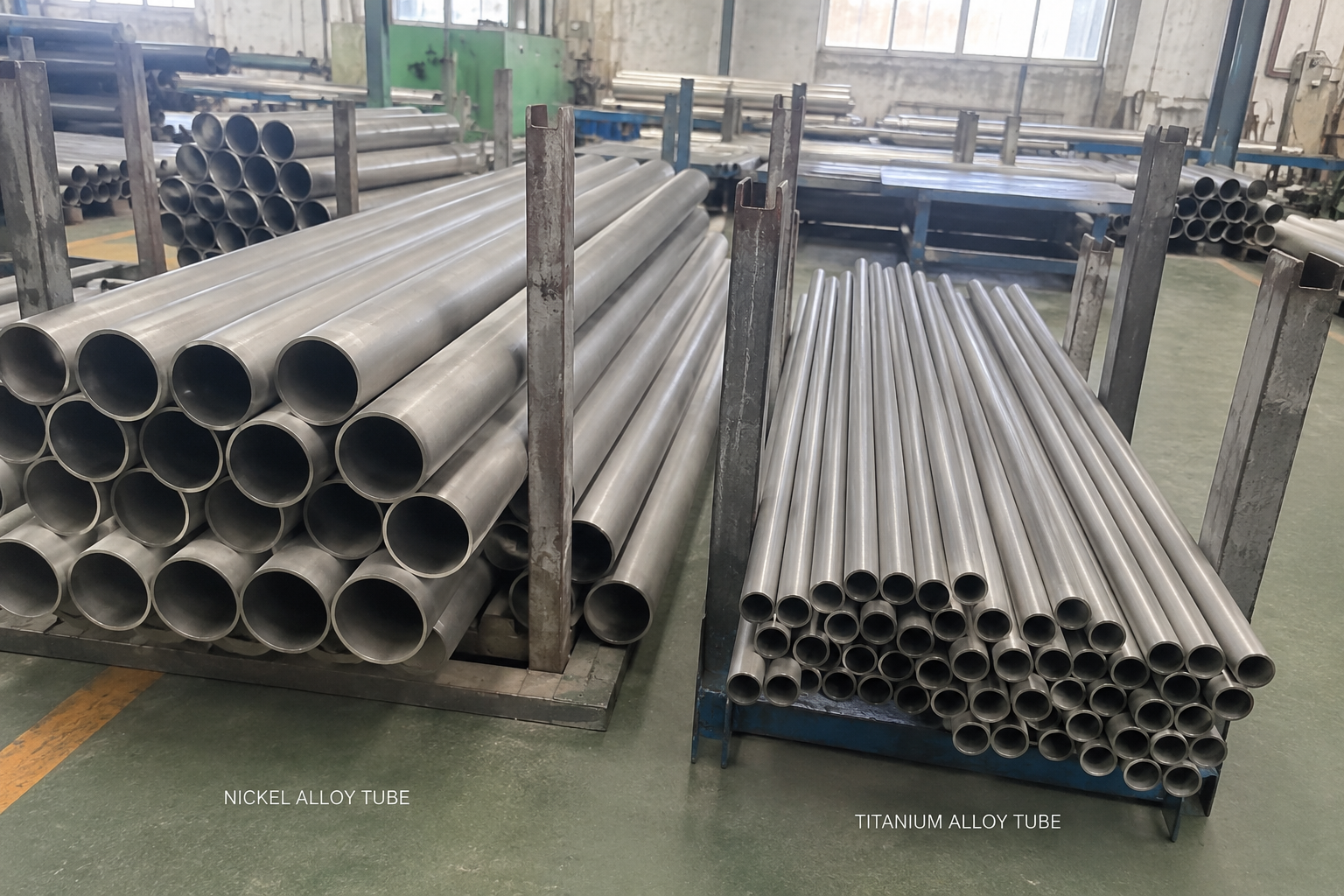
Nickel and titanium alloys can be valuable candidates for demanding fine chemical equipment. However, they should be compared with stainless steels, non-metallic linings, glass-lined equipment, fluoropolymers, ceramics, and other material systems before a final decision is made.
Why Fine Chemical Equipment Needs Application-Specific Material Selection
Fine chemical manufacturing is often more difficult to evaluate than a single-product bulk chemical process.
A reactor or transfer line may handle several recipes. Concentration can change as a reaction proceeds. Solvents may be recovered. Water may enter during cleaning. Trace impurities may accumulate through recycling. Batch operations can create repeated heating, cooling, draining, washing, and drying cycles.
These changes can alter corrosion behavior even when the main chemical name remains the same.
Fine Chemical Conditions That Can Change Material Performance
| Process Variable | Why It Matters |
|---|---|
| Main chemical species | Establishes the basic corrosion environment |
| Concentration range | Dilute and concentrated solutions can behave differently |
| Minimum and maximum temperature | Corrosion, strength, passivation, and reaction rate can change with temperature |
| Pressure or vacuum | Influences containment design, boiling, gas release, and mechanical loading |
| Water content | May stabilize or destabilize a passive film and alter chemical activity |
| Dissolved oxygen | Can change oxidation-reduction conditions and passivation |
| Oxidizing or reducing potential | Affects whether an alloy remains passive or becomes active |
| Trace impurities | Small amounts of chloride, fluoride, sulfur species, iron, copper, or other contaminants may change corrosion behavior |
| Process intermediates | Temporary species may be more aggressive than feed or final product |
| Catalyst | May influence electrochemical reactions or product-contamination limits |
| Flow velocity | Can affect mass transfer, erosion, turbulence, and passive-film stability |
| Solids or crystals | May cause abrasion, deposits, blockage, or under-deposit corrosion |
| Gas phase | Condensation zones and vapor spaces may have different chemistry from the liquid phase |
| Startup and shutdown | Dilution, condensation, aeration, or temperature change can create a more aggressive condition |
| Cleaning chemistry | CIP, flushing, pickling, sterilization, or solvent cleaning may control the material choice |
| Batch changeover | Residual chemicals can create an unexpected mixed environment |
| Expected service life | Influences corrosion allowance, inspection, and replacement strategy |
| Product-purity requirement | Metal ions, particles, extractables, color, or catalytic contamination may matter |
A technically useful inquiry should define the full operating envelope rather than list only the main chemical and normal temperature.
Is There One Best Alloy for Fine Chemical Equipment?
No.
AMPP materials selection guidance states that no material is resistant to every corrosive situation and that possible solutions include metals, plastics, fiberglass, concrete, and other non-metallic materials.
That principle is especially important in fine chemical manufacturing.
A high-performance nickel alloy may be appropriate for one reactor but unnecessary for an external support. Titanium may be a strong candidate in one passive-film-compatible environment but unsuitable in another chemistry that destabilizes its protective surface. Stainless steel may be sufficient for a utility line but not for a mixed-acid process. A fluoropolymer lining may provide better direct-contact purity, while a metal shell provides pressure strength.
The correct question is not:
“Is C276 better than titanium?”
A more useful set of questions is:
- Which equipment surfaces contact the process?
- What is the most aggressive credible chemistry?
- What failure mode is most likely?
- Is corrosion resistance or product purity the controlling requirement?
- Is the material required for pressure containment, heat transfer, mechanical support, or direct chemical contact?
- Can a lining, coating, cladding, or non-metallic wetted surface reduce risk?
- What evidence is needed before the material is approved?
Separate Equipment Functions Before Selecting Materials
Not every part of a fine chemical system requires the same alloy.
Equipment Function Matrix
| Equipment Area | Main Material Concerns |
|---|---|
| Reactor shell | Pressure, temperature, corrosion allowance, welding, inspection |
| Reactor lining | Direct chemical compatibility, defects, permeability, repairability |
| Agitator shaft | Strength, fatigue, corrosion, wear, galvanic coupling |
| Impeller | Flow, cavitation, erosion, corrosion, product contamination |
| Heat-exchanger tube | Corrosion, heat transfer, velocity, deposits, tube-to-tubesheet joint |
| Process piping | Chemistry, pressure, welds, dead legs, drainage, cleaning |
| Small-bore tubing | Internal surface, blockage, cleanliness, tolerance, connection integrity |
| Valve body | Corrosion, pressure, casting or forging quality, crevices |
| Valve trim | Wear, galling, velocity, local chemistry |
| Fasteners | Galvanic compatibility, SCC, preload, external environment |
| Gaskets and seals | Chemical compatibility, temperature, permeation, extractables |
| Instrument connection | Crevices, dead volume, leakage, cleaning, contamination |
| Structural support | Mechanical load and external atmosphere rather than process corrosion |
| Storage tank | Long exposure, vapor zone, water bottoms, cleaning, drainage |
| Filter housing | Differential pressure, crevices, product purity, frequent opening |
| Sampling system | Representative flow, contamination, cleaning and small dead volume |
Using the most expensive alloy for every component can increase cost without controlling the dominant risk.
Using one alloy throughout the system may also create unnecessary galvanic, fabrication, heat-transfer, or supply problems.
Uniform Corrosion Rate Is Only One Part of the Decision
Published corrosion rates are useful for early screening, but they can create false confidence when used alone.
ASTM G31 immersion corrosion testing identifies many variables that influence laboratory corrosion results, including solution composition, temperature, gas sparging, fluid motion, solution volume, specimen support, exposure duration, cleaning, and result interpretation.
A corrosion rate such as 0.05 mm/year is incomplete unless the buyer knows:
- Exact chemical composition;
- Concentration;
- Temperature;
- Test duration;
- Aeration or gas environment;
- Flow condition;
- Surface preparation;
- Heat treatment;
- Welded or unwelded condition;
- Method used to calculate mass loss;
- Whether localized attack occurred;
- Whether the specimen represents the final product.
Why a Low Average Corrosion Rate Can Still Be Misleading
A specimen may lose little total mass while developing one deep pit.
A welded joint may remain sound in the base metal but experience attack in the heat-affected zone.
A crevice under a gasket may develop chemistry that is more aggressive than the bulk process liquid.
A material may resist general dissolution but crack under simultaneous tensile stress and chemical exposure.
A low uniform corrosion rate therefore does not prove that the equipment is protected from localized or environmentally assisted damage.
Identify the Relevant Corrosion Mode
Uniform Corrosion
Uniform corrosion produces relatively even material loss.
Important questions include:
- Is the reported rate based on the exact process medium?
- Does temperature vary?
- Is a corrosion allowance permitted?
- Could thinning contaminate the product?
- Will the equipment be inspected frequently enough?
Uniform corrosion may be comparatively predictable, but it is not always acceptable in high-purity or catalyst-sensitive products.
Pitting Corrosion
Pitting creates highly localized cavities.
A small pit can penetrate a thin tube or create a leak while total metal loss remains low.
ASTM G48 pitting and crevice testing provides methods for comparing stainless steels and related alloys under specified ferric-chloride conditions.
Its results are useful for ranking materials within those test conditions. They should not be treated as direct proof of compatibility with every fine chemical process.
Crevice Corrosion
Crevice corrosion can occur under:
- Gaskets;
- Flanges;
- Deposits;
- Lap joints;
- Tube-to-tubesheet joints;
- Fastener heads;
- Insulation;
- Instrument fittings;
- Stagnant zones.
The chemistry inside a crevice may become different from the bulk fluid because of restricted mass transfer, local acidity, oxygen depletion, or concentration of aggressive species.
A material that performs well on an open coupon may therefore behave differently inside a real equipment crevice.
Stress Corrosion Cracking
Stress corrosion cracking requires a susceptible material, a relevant environment, and tensile stress.
Stress may come from:
- Applied pressure;
- Bolting;
- Forming;
- Cold work;
- Welding;
- Grinding;
- Machining;
- Thermal expansion;
- Residual stress.
AMPP forms of corrosion explains that environmental cracking can involve applied or residual stresses and that cracking may occur at stresses below those required to fracture the material in a non-corrosive environment.
A normal tensile test on an MTR does not prove SCC resistance.
Intergranular Corrosion
Processing, welding, heat treatment, or grain-boundary precipitation may reduce local corrosion resistance.
ASTM G28 intergranular corrosion testing is used to detect susceptibility in certain wrought nickel-rich, chromium-bearing alloys.
ASTM also notes that performance in the test does not automatically establish behavior in every service environment. The actual environment must still be evaluated separately.
Corrosion Fatigue
Repeated loading and a corrosive environment can work together.
Potential sources include:
- Agitator vibration;
- Pump pulsation;
- Pressure cycling;
- Thermal cycling;
- Mixing loads;
- Repeated startup and shutdown;
- Flow-induced vibration.
A material with good mechanical fatigue performance in dry air may behave differently in a corrosive process.
Erosion-Corrosion
High velocity, suspended solids, droplets, bubbles, turbulence, and abrupt flow changes can damage a protective film and accelerate metal loss.
Areas to review include:
- Pump outlets;
- Elbows;
- Reducers;
- Control valves;
- Injection points;
- Impellers;
- Heat-exchanger inlets;
- Misaligned welds;
- Tube-end burrs.
Hardness alone does not prove resistance to erosion-corrosion. Flow geometry and process design remain important.
Galvanic Corrosion
Dissimilar materials connected in a conductive process liquid may form a galvanic couple.
The risk depends on:
- Material combination;
- Electrolyte;
- Surface-area ratio;
- Electrical contact;
- Temperature;
- polarization behavior;
- coatings;
- joint design.
A small anodic component connected to a large cathodic area can experience concentrated attack.
Fine Chemical Purity Adds Another Selection Layer
A material may resist visible corrosion and still be unsuitable for the product.
Fine chemicals may have strict limits for:
- Iron;
- nickel;
- chromium;
- molybdenum;
- copper;
- titanium;
- particles;
- color;
- organic residues;
- catalyst poisons;
- cross-contamination;
- extractables;
- leachables.
This creates an important distinction:
Corrosion resistance does not automatically prove product compatibility.
A low corrosion rate may still release an unacceptable amount of a specific element into a high-value product. Surface residues from polishing, cleaning, pickling, passivation, lubricants, welding, or packaging may also affect purity.
Product-Compatibility Questions
- Which elements or particles are restricted in the finished product?
- What detection limits apply?
- Is metal-ion release measured under actual process conditions?
- Is an extraction or soak test required?
- Does the process contain a sensitive catalyst?
- Could the alloy change color, odor, stability, or reaction selectivity?
- Does the equipment handle several products?
- How is cross-contamination controlled?
- What cleaning chemicals are used?
- What surface condition is required after fabrication?
Terms such as “high purity” or “chemical-grade surface” should be converted into measurable acceptance criteria.
Translate Process Conditions into a Material Requirement
Process-to-Material Matrix
| Process Information | Material Question |
|---|---|
| Exact chemistry | Which alloy or lining remains stable in the full composition? |
| Concentration range | Does dilution or concentration create a more aggressive condition? |
| Temperature profile | Is the material compatible at startup, operation, cleaning, and shutdown temperatures? |
| Pressure or vacuum | What mechanical properties and design code apply? |
| Oxidation-reduction state | Will the alloy remain passive? |
| Dissolved gases | Could oxygen, hydrogen, chlorine, sulfur species, or other gases change corrosion? |
| Trace impurities | Could small contaminant levels control localized attack? |
| Flow velocity | Is passive-film removal or erosion possible? |
| Solids | Are abrasion, deposits, or under-deposit attack possible? |
| Welding | Is the weld metal and HAZ compatible? |
| Crevices | Can the design avoid stagnant or shielded regions? |
| Thermal cycling | Could fatigue, differential expansion, or condensation occur? |
| Cleaning | Is the cleaning chemistry more aggressive than the process? |
| Product purity | Are metal ions, particles, residues, or extractables restricted? |
| Maintenance | Can the equipment be inspected, repaired, relined, or replaced? |
| Service life | What degradation rate and inspection interval are acceptable? |
A supplier cannot responsibly identify the final material from a chemical name alone.
How to Screen Material Families Without Over-Recommending
The following comparison is a screening framework, not a compatibility approval table.
Austenitic and Higher-Alloy Stainless Steels
Potential advantages:
- Broad availability;
- mature fabrication;
- lower cost than many nickel alloys;
- established pressure-equipment experience;
- good cleanability in suitable conditions.
Important limitations:
- Localized corrosion may occur in aggressive halide environments;
- SCC may control some combinations of environment, temperature, and stress;
- weld and heat-affected-zone condition matter;
- not suitable for every reducing, oxidizing, or mixed-acid service.
Stainless steel should remain part of the comparison instead of being dismissed automatically.
Nickel-Chromium-Molybdenum Alloys
Potential advantages:
- Useful resistance across many aggressive chemical environments;
- candidates for mixed or variable process conditions;
- good fabrication options when procedures are controlled;
- available in plate, sheet, pipe, tube, bar, fittings, and forgings.
Important limitations:
- No grade is resistant to every chemical;
- alloy families are not interchangeable;
- temperature, impurities, redox condition, welding, and crevices matter;
- higher cost and density;
- machining and welding procedures require control;
- metal-ion contribution may matter for some products.
Alloys such as UNS N10276 or N06022 may enter a candidate list, but they should not be approved solely from a general corrosion chart.
ASTM B575 nickel alloy plate and sheet defines product requirements for several low-carbon nickel-chromium-molybdenum alloy plate, sheet, and strip products. It does not provide application-specific corrosion approval.
Nickel-Chromium-Molybdenum-Niobium Alloys
Materials such as UNS N06625 may be evaluated where a project requires a combination of corrosion resistance, mechanical strength, fabrication, or elevated-temperature capability.
However, Alloy 625 should not be described as the default answer for all fine chemical equipment.
The buyer should verify:
- Exact process chemistry;
- temperature;
- weld condition;
- required mechanical strength;
- whether a lower-cost alloy is sufficient;
- whether another nickel alloy offers better chemistry-specific resistance;
- whether product contamination matters.
Commercially Pure Titanium and Titanium-Palladium Grades
Titanium may be a candidate where its passive surface remains stable under the actual process conditions.
Potential advantages include:
- low density;
- good resistance in selected passive environments;
- availability as tube, pipe, plate, bar, forging, and fittings;
- useful heat-exchanger applications in suitable media.
Important limitations include:
- compatibility depends strongly on chemistry and passive-film stability;
- reducing conditions, fluoride-containing environments, certain acids, high-temperature crevices, and mixed chemicals require careful verification;
- galling and fabrication practices matter;
- titanium is not automatically suitable because chlorides are present;
- hydrogen pickup and contamination control may be relevant in some situations.
ASTM B338 titanium heat-exchanger tubes defines requirements for seamless and welded titanium and titanium-alloy tubes used in condensers and heat exchangers. It does not prove compatibility with a specific process fluid.
Nickel 200 and Nickel 201
Commercially pure nickel grades may be considered for specialized chemical environments where their chemistry and temperature capability are appropriate.
They should not be treated as general-purpose high-corrosion-resistance materials.
The selection must review:
- oxidizing contaminants;
- sulfur species;
- temperature;
- carbon-related grade differences;
- welding;
- product purity;
- stress and fabrication.
Non-Metallic and Lined Systems
Possible options include:
- Glass-lined steel;
- fluoropolymer linings;
- polymer piping;
- graphite;
- ceramics;
- rubber linings;
- fiber-reinforced polymers;
- clad or bonded structures.
Potential advantages:
- strong resistance in selected chemicals;
- reduced metal-ion contamination;
- lower alloy consumption;
- replaceable or repairable wetted layer.
Important limitations:
- permeability;
- temperature and pressure limits;
- thermal shock;
- mechanical damage;
- lining defects;
- nozzle and flange details;
- inspection and repair;
- differential expansion;
- static electricity;
- product extractables.
A hybrid design may be more effective than a single solid alloy.
Design Can Be as Important as Alloy Grade
AMPP corrosion-control guidance emphasizes that system design should consider process and construction parameters, drainage, geometry, and avoidance of unfavorable conditions.
Design Features to Review
- Eliminate unnecessary crevices;
- minimize dead legs;
- provide full drainage;
- avoid trapped liquid after shutdown;
- reduce abrupt flow changes;
- align welded pipe sections;
- remove burrs;
- control injection points;
- avoid small anodic areas connected to large cathodic surfaces;
- separate incompatible dissimilar metals;
- provide access for inspection;
- avoid deposits and stagnant zones;
- control gasket geometry;
- design replaceable wear components;
- avoid excessive residual stress;
- consider thermal expansion;
- define corrosion allowance only where uniform loss is expected.
A corrosion allowance is not a reliable solution for pitting, SCC, cracking, or product contamination.
Welding and Fabrication Must Be Included in the Assessment
Corrosion data for unwelded laboratory coupons may not represent a fabricated reactor or piping system.
Fabrication can affect:
- Heat-affected-zone microstructure;
- residual stress;
- weld-metal chemistry;
- oxide scale;
- surface contamination;
- distortion;
- crevice geometry;
- root penetration;
- internal roughness;
- heat tint;
- pickling and cleaning requirements.
Fabrication Questions
- Which welding process will be used?
- Is matching or over-alloyed filler required?
- Is autogenous welding permitted?
- How will shielding and purge gas be controlled?
- Is post-weld heat treatment required or prohibited?
- How will heat tint or scale be removed?
- Is pickling, passivation, or another surface treatment specified?
- Will the corrosion test include a representative weld?
- Is the HAZ included in the acceptance evaluation?
- What NDT method and acceptance criteria apply?
- Can the internal weld surface be inspected and cleaned?
- Are repairs and local grinding controlled?
For critical service, welded coupons or representative fabricated test pieces may provide more useful evidence than base-metal coupons alone.
A Better Corrosion Qualification Strategy
A reliable selection process usually moves through several levels.
Level 1: Literature and Database Screening
Use:
- Published handbooks;
- alloy producer data;
- corrosion charts;
- iso-corrosion curves;
- previous service history;
- research papers;
- standard test data.
Purpose:
- Eliminate clearly unsuitable candidates;
- identify likely material families;
- define information gaps.
Limitation:
- Data may not represent the actual chemistry, impurities, welding, flow, or geometry.
Level 2: Application-Specific Laboratory Testing
ASTM G31 immersion corrosion testing can provide a framework for controlled laboratory exposure.
The test should reproduce, as far as practical:
- Actual composition;
- realistic impurities;
- minimum and maximum concentration;
- temperature;
- aeration or gas atmosphere;
- agitation or flow;
- exposure duration;
- heat treatment;
- surface condition;
- welded and unwelded specimens;
- crevice formers where relevant.
Record both mass loss and localized attack.
Level 3: Welded and Fabricated Coupon Testing
Include:
- Base metal;
- weld metal;
- heat-affected zone;
- intended filler metal;
- representative surface treatment;
- design crevices;
- actual cleaning procedure.
Level 4: Pilot or Side-Stream Exposure
Where practical, expose test coupons or a pilot component to real process conditions.
This may reveal:
- unexpected impurities;
- reaction intermediates;
- deposition;
- flow effects;
- startup and shutdown chemistry;
- batch variation.
Level 5: Inspection and Monitoring Plan
Material selection does not end when the equipment is commissioned.
Possible controls include:
- corrosion coupons;
- thickness monitoring;
- visual inspection;
- UT;
- eddy current testing;
- surface inspection;
- leak testing;
- product contamination monitoring;
- planned replacement;
- review after process changes.
What Supplier Documents Should Buyers Request?
Core Batch Documents
| Document | What It Can Support | What It Does Not Prove |
|---|---|---|
| CoC | Supplier declaration of conformity | Actual batch corrosion resistance |
| MTR/MTC | Heat chemistry, mechanical properties, condition, traceability | Suitability for the process |
| EN 10204 certificate | Defined inspection-document type | Final equipment performance |
| Dimensional report | Size, wall, length, tolerance | Corrosion compatibility |
| NDT report | Examination under stated method and acceptance level | Absence of every possible defect |
| Heat-treatment record | Supplied metallurgical condition | Correct final fabrication |
| Surface report | Roughness or visual condition when specified | Product cleanliness unless separately defined |
| Cleaning record | Completion of a defined cleaning process | Compatibility with every product |
| Packing record | Protection and identification during shipment | Condition after unpacking or fabrication |
| Third-party report | Independent test result | Relevance unless method and sample match the project |
BS EN 10204 inspection documents define inspection-document types for metallic products.
The buyer should verify that:
- The heat number matches the physical material;
- the product standard and revision are correct;
- the form and condition match the order;
- the reported tests are required by the purchase order;
- any deviations are approved;
- documents remain linked after cutting or repacking.
ISO 9001 Does Not Prove Material Compatibility
ISO 9001 supply-chain guidance explains that ISO 9001 does not define the technical requirements of the product being purchased.
An ISO 9001-certified supplier may have an established quality management system. The buyer must still specify:
- Alloy grade;
- product standard;
- dimensions;
- heat treatment;
- inspection;
- corrosion testing;
- surface;
- cleaning;
- packaging;
- documentation;
- application requirements.
Quality-system certification is useful, but it is not an application-compatibility certificate.
Why Laboratory Scope Matters
ISO/IEC 17025 laboratory competence addresses laboratory competence, impartiality, and consistent operation.
When corrosion, chemistry, metallography, mechanical, or surface testing affects material acceptance, buyers should confirm:
- Laboratory identity and location;
- accreditation body;
- certificate validity;
- scope of accreditation;
- exact test method;
- sample identity;
- sampling responsibility;
- test conditions;
- measurement uncertainty where relevant;
- authorized report approval.
A laboratory may hold ISO/IEC 17025 accreditation while the specific corrosion or chemical method remains outside its accredited scope.
Supplier Questions That Reveal Real Capability
Application Understanding
- What process information do you need before discussing materials?
- Do you distinguish continuous, batch, cleaning, startup, and shutdown conditions?
- Can you identify what information is still missing?
- Will you clearly state when application suitability requires customer engineering approval?
Material and Product Standards
- What exact alloy and UNS designation are offered?
- What product form and specification apply?
- What specification revision will appear on the MTR?
- Is the offered material an exact match or an alternative?
- What heat-treatment and surface condition are included?
- Are there size-dependent property or testing requirements?
Traceability and Quality
- Who is the original mill or manufacturing source?
- Can every delivered piece be traced to the heat?
- How are cut lengths re-marked?
- How are different grades and heats segregated?
- What documents are supplied before shipment?
- How are deviations and substitutions controlled?
- How are nonconformities investigated?
Testing
- Which tests are required by the product standard?
- Which additional tests are available?
- Can corrosion testing use the actual process chemistry?
- Can welded specimens be tested?
- Can crevice or flow conditions be represented?
- Which laboratory performs the test?
- Is the method inside the laboratory’s accredited scope?
- How are test samples linked to the supplied heat?
Fabrication and Surface
- What welding and filler-metal information is available?
- Can representative welded coupons be supplied?
- What pickling, passivation, cleaning, or polishing processes are available?
- How is surface roughness measured?
- How are internal tube surfaces inspected?
- How is material packed after cleaning?
- Which activities are outsourced?
Supply Continuity
- Can the same material route be repeated?
- What is the normal lead time?
- Are alternative approved sources available?
- Will the buyer be notified of source or process changes?
- How long are records retained?
A supplier does not need to own every process. It should clearly identify who performs each activity and how responsibility and traceability are maintained.
Evaluate Total Cost Instead of Alloy Price Alone
A higher-cost alloy is not automatically the lowest-risk choice.
An over-specified alloy can increase:
- Raw-material cost;
- machining time;
- welding complexity;
- inspection burden;
- lead time;
- source dependence;
- repair difficulty;
- replacement cost.
An under-specified material can increase:
- Inspection frequency;
- contamination risk;
- unplanned maintenance;
- lining repair;
- component replacement;
- production interruption;
- cleaning effort;
- requalification work.
Practical Evaluated-Cost Model
Evaluated cost = material + fabrication + testing + cleaning + inspection + maintenance + downtime exposure + replacement + requalification
The comparison should use realistic service and maintenance assumptions.
It should not assume that the highest-alloyed material automatically provides the lowest lifecycle cost.
Common Mistakes in Fine Chemical Alloy Selection
1. Selecting by Chemical Name Alone
“HCl service,” “chloride service,” or “solvent service” is not enough. Concentration, water, temperature, impurities, gases, and flow must be defined.
2. Using One Corrosion Rate as Final Approval
A uniform corrosion rate does not address pits, crevices, cracking, welds, erosion, or contamination.
3. Treating All Nickel Alloys as Equivalent
C276, C22, 625, 825, Alloy 20, Nickel 200, and other grades have different chemistry and performance limits.
4. Assuming Titanium Is Always Suitable for Chlorides
Titanium performance depends on passive-film stability, temperature, pH, crevices, impurities, and other chemical species.
5. Ignoring Startup, Shutdown, and Cleaning
The most aggressive condition may occur outside normal production.
6. Ignoring Trace Impurities
A minor impurity can control corrosion even when the main chemical is unchanged.
7. Testing Only Unwelded Base Metal
The final equipment includes weld metal, HAZ, residual stress, oxides, repairs, and surface treatment.
8. Assuming an ASTM Product Standard Proves Service Suitability
A product standard defines delivery requirements. It does not approve the application.
9. Treating an MTR as a Corrosion Certificate
An MTR normally provides chemistry, mechanical properties, heat treatment, and traceability—not process-specific corrosion data.
10. Treating ISO 9001 as Product Certification
ISO 9001 supports quality-system control but does not define the alloy or test requirement.
11. Ignoring Non-Metallic Options
Glass-lined, fluoropolymer, ceramic, clad, and composite systems may be better in some direct-contact services.
12. Selecting the Most Expensive Alloy to Reduce Risk
Over-specification can create new fabrication, supply, cost, and maintenance risks.
13. Ignoring Product Contamination
A material may remain structurally sound but release unacceptable ions, particles, or residues.
14. Ignoring Equipment Geometry
Poor drainage, dead legs, crevices, flow impingement, and deposits can defeat a good alloy.
15. Reviewing Documents After Production
Missing corrosion tests, heat-treatment records, or traceability may not be recoverable correctly later.
RFQ Checklist for Fine Chemical Equipment Materials
Before requesting a quotation, provide:
- Equipment type;
- wetted and non-wetted components;
- main chemical names;
- full composition where possible;
- minimum and maximum concentration;
- minimum and maximum temperature;
- operating and design pressure;
- vacuum conditions if applicable;
- water content;
- dissolved oxygen or gas environment;
- oxidation-reduction conditions;
- trace impurities;
- catalysts;
- reaction intermediates;
- solids or crystals;
- expected flow velocity;
- agitation;
- startup conditions;
- shutdown conditions;
- cleaning chemistry;
- cleaning temperature;
- batch-changeover conditions;
- expected service life;
- permitted corrosion rate;
- localized-corrosion restrictions;
- SCC requirements;
- product-purity limits;
- restricted metal ions;
- particle or residue limits;
- applicable design code;
- alloy grade and UNS designation;
- product form;
- ASTM, ASME, EN, ISO, or project specification;
- specification revision;
- heat-treatment condition;
- dimensions and tolerances;
- seamless or welded construction;
- filler metal;
- surface condition;
- roughness requirement;
- cleaning and packaging requirement;
- MTR/MTC requirement;
- EN 10204 document type;
- PMI requirement;
- UT, ET, hydrostatic, PT, RT, or other NDT;
- corrosion test method;
- welded-coupon requirement;
- third-party inspection;
- laboratory accreditation requirement;
- deviation and substitution controls.
Frequently Asked Questions
Is Hastelloy C276 always the best alloy for fine chemical equipment?
No. UNS N10276 may be a strong candidate in many aggressive environments, but its suitability depends on the exact chemical mixture, temperature, impurities, welding, equipment design, product purity, and cost.
Is titanium always suitable for chloride-containing processes?
No. Titanium performance depends on the full chemistry, temperature, pH, crevices, impurities, redox conditions, and passive-film stability. The presence of chloride alone is not enough to approve or reject titanium.
Does a low corrosion rate prove that the material is safe?
No. Average corrosion rate may not reveal pitting, crevice corrosion, SCC, corrosion fatigue, erosion, weld attack, or product contamination.
Does an MTR prove corrosion resistance?
Normally, no. An MTR usually provides batch chemistry, mechanical properties, heat treatment, product standard, and traceability. Process-specific corrosion testing must be separately defined.
Should every critical application use the highest-alloyed material?
No. The correct material should provide sufficient verified performance without adding unnecessary fabrication, supply, mass, maintenance, or qualification burden.
Are non-metallic linings acceptable for fine chemical equipment?
They can be useful in selected services, but temperature, pressure, permeability, thermal shock, mechanical damage, repairability, extractables, and lining inspection must be evaluated.
Should corrosion testing use a welded coupon?
When welding may affect the final corrosion behavior, representative welded specimens can provide more relevant evidence than base metal alone.
Can a material supplier make the final application decision?
A supplier can provide material data, standards, documents, testing support, and technical clarification. Final approval should come from the customer’s process, materials, mechanical, corrosion, quality, and safety teams.
Conclusion
Selecting nickel and titanium alloys for fine chemical equipment requires more than comparing alloy names and published corrosion rates.
The decision must connect:
- Complete process chemistry;
- concentration and temperature ranges;
- impurities and redox conditions;
- flow, solids, and deposits;
- startup, shutdown, and cleaning;
- uniform and localized corrosion;
- stress and fatigue;
- welds and heat-affected zones;
- product-purity limits;
- equipment geometry;
- fabrication and inspection;
- supplier documents and test evidence;
- lifecycle cost and supply risk.
Nickel alloys, titanium alloys, stainless steels, glass-lined systems, fluoropolymers, ceramics, and other materials can all be appropriate when matched to the correct function.
The strongest or most expensive alloy is not automatically the best choice.
A reliable selection process should begin with a complete process envelope, identify the credible damage mechanisms, compare multiple material systems, test representative conditions where necessary, verify supplier evidence, and obtain final engineering approval before production.
For fine chemical equipment, the goal is not to find a miracle alloy.
The goal is to build a material, fabrication, design, inspection, and maintenance strategy that remains compatible with the real process throughout its intended service life.