
How to Avoid Grade and Standard Mistakes When Buying Nickel and Titanium Alloy Materials
Choosing the wrong alloy grade or standard can create serious procurement problems. A material may look correct by name, but still fail to meet the real project requirement if the UNS number, ASTM/ASME/EN standard, product form, heat treatment, testing scope, MTR, or heat number traceability is not confirmed.
To avoid alloy material procurement mistakes, buyers should not select nickel alloy or titanium alloy materials by grade name, price, or basic datasheet values alone. A reliable procurement decision should confirm material grade, UNS number, applicable standard, product form, heat treatment condition, operating environment, performance requirements, testing scope, MTR, heat number traceability, supplier quality system, and total cost of ownership. Material selection should consider material properties, performance goals, working conditions, and cost—not only one number on a datasheet.
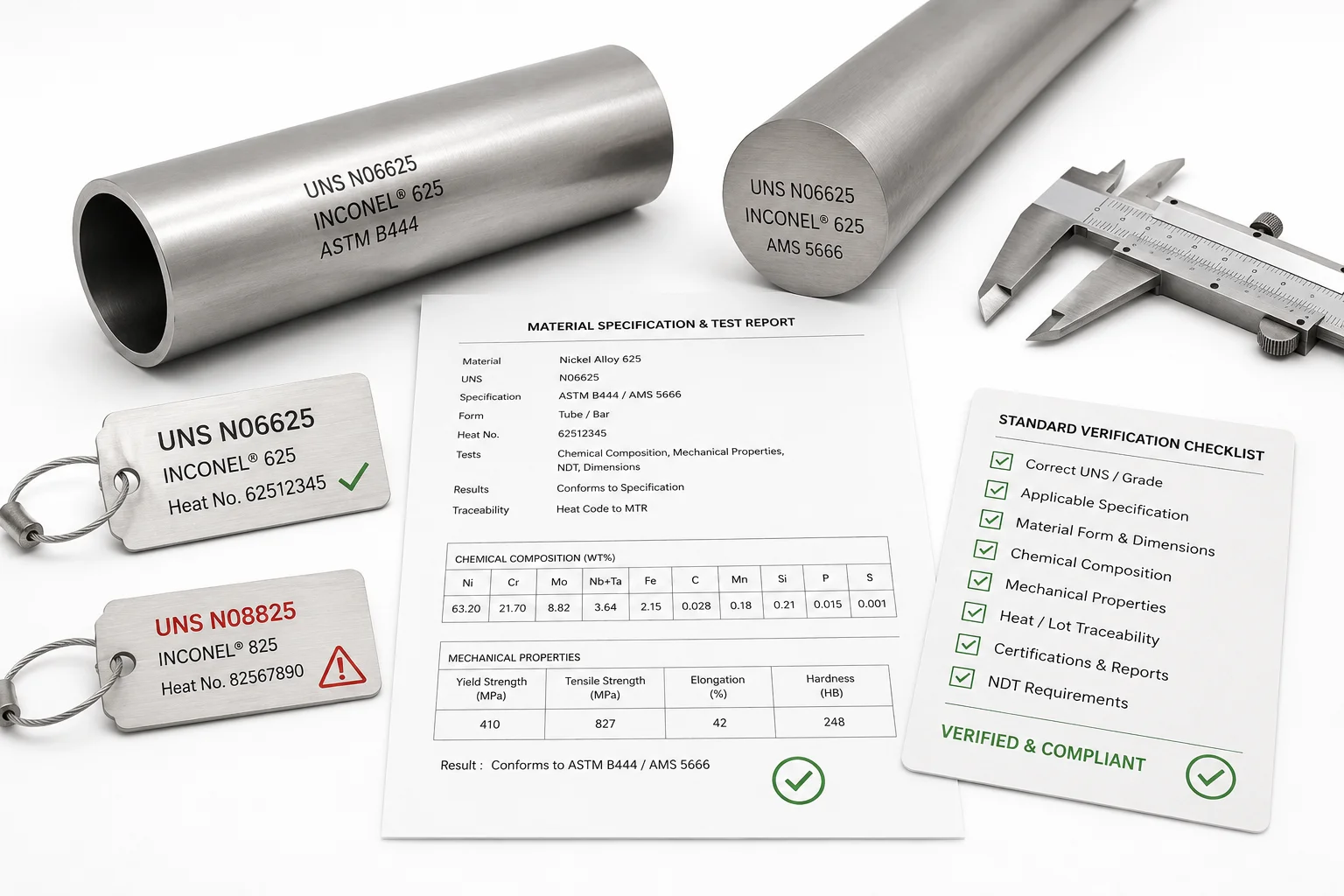
As a manufacturer of nickel alloy tubes, nickel alloy bars, titanium alloy tubes, and titanium alloy bars, Emily PIPE often sees buyers facing difficult material decisions. Some buyers compare only grade names. Some compare only prices. Some only check tensile strength or chemical composition. But alloy procurement requires a deeper review.
For example, a buyer may ask for “nickel alloy pipe,” but the real requirement may be UNS N06625 seamless tube according to ASTM B444. Another buyer may ask for “titanium bar,” but the project may require ASTM B348 Grade 2, Grade 5, or Grade 23 material with specific chemical composition, tensile properties, surface condition, and MTR.
In alloy procurement, the key question is not only:
Which alloy is strong enough?
The better question is:
Which alloy grade, UNS number, standard, condition, testing scope, and documentation package best match the real application?
Quick Checklist: How to Avoid Alloy Grade and Standard Mistakes
Before placing an order for nickel alloy or titanium alloy tubes and bars, buyers should confirm the following items.
| Item to Confirm | Why It Matters |
|---|---|
| Material Grade | Avoids confusion between general alloy families and exact grades |
| UNS Number | Confirms exact material identity, such as N06625, N07718, N10276, R56400 |
| Product Form | Tube, pipe, round bar, forged bar, billet, rod, or custom cut length |
| Applicable Standard | ASTM, ASME, EN, ISO, AMS, NACE/ISO, or customer specification |
| Heat Treatment Condition | Affects strength, hardness, corrosion behavior, machinability, and service performance |
| Operating Environment | Temperature, pressure, acid, chloride, seawater, H₂S, alkali, abrasion |
| Performance Requirement | Strength, fatigue, creep, corrosion resistance, wear resistance, weldability |
| Testing Scope | Chemical, tensile, hardness, UT, ET, hydrostatic, PMI, corrosion test |
| MTR / MTC | Confirms chemical and mechanical properties for the supplied batch |
| Heat Number Traceability | Links the delivered material to production and quality records |
| Surface Finish | Pickled, polished, bright annealed, peeled, ground, machined |
| Tolerance and Size | Prevents machining, assembly, or inspection problems |
| Supplier Quality System | Supports process control, but does not replace batch-level material proof |
| Total Cost of Ownership | Helps compare long-term risk, not only purchase price |
If any of these points are unclear, the buyer may receive material that looks correct on paper but does not fully meet the real project requirement.
Are You Sure You Understand What “Material Parameters” Really Mean?
Material datasheets are useful, but numbers without context can be misleading. Tensile strength, yield strength, hardness, elongation, density, and corrosion resistance are all important. However, they do not fully predict how the material will perform in the real application.
The actual performance of an alloy goes beyond simple numbers on a specification sheet. Buyers should understand how material properties interact with temperature, pressure, corrosive media, cyclic loading, creep, fatigue, fabrication, surface condition, and service life.
For example, a material with high tensile strength at room temperature may not be the best choice for high-temperature service if creep resistance is not sufficient. A material with good general corrosion resistance may still be at risk of stress corrosion cracking, pitting, crevice corrosion, or corrosion fatigue in a specific environment.
Why Basic Parameters Are Only the Starting Point
| Parameter Often Seen | Basic Meaning | Deeper Understanding Needed | Potential Risk If Misunderstood |
|---|---|---|---|
| Tensile Strength | Maximum stress before breaking | Temperature, fatigue, stress concentration, loading duration | Unexpected failure under cyclic load or high temperature |
| Yield Strength | Stress where plastic deformation begins | Design stress, pressure, safety factor, heat treatment | Deformation or dimensional instability |
| Hardness | Resistance to indentation | Brittleness, machinability, wear, impact resistance | Cracking, machining difficulty, or premature wear |
| Elongation | Ductility in tensile test | Formability, bending, toughness, fabrication process | Cracking during forming or bending |
| Corrosion Rate | Material loss in a test medium | Actual fluid, pH, concentration, temperature, flow, oxygen, contaminants | Rapid degradation in real service |
| Chemical Composition | Element percentages | Microstructure, impurities, heat treatment, phase balance | Wrong performance, poor weldability, or reduced service life |
| Density | Weight per volume | Strength-to-weight ratio and design constraints | Overweight design or wrong material choice |
| Thermal Conductivity | Heat transfer ability | Thermal cycling, heat exchanger use, machining heat | Thermal stress or processing difficulty |
| Creep Resistance | Long-term deformation resistance under stress and heat | Service temperature, load duration, rupture behavior | Deformation or rupture in high-temperature service |
Creep is deformation under long-term stress, especially important at high temperature. Fatigue is crack initiation and propagation caused by cyclic loading. Corrosion fatigue occurs when fatigue happens in a corrosive environment under the joint action of corrosion and cyclic loading.
These mechanisms show why one datasheet number is not enough for alloy procurement.
Is Your Application Context Truly Driving Your Material Choice?
There is no universal “best alloy” for every project. The correct alloy depends on the specific application, environment, design, fabrication process, inspection requirement, and risk level.
The correct alloy material is not a universal answer. It depends on the specific application scenario, environmental factors, performance requirements, product form, applicable standard, and expected service life.
A buyer may request a nickel alloy because similar equipment uses nickel alloy. But small differences in the application can change the material decision.
For example:
- A heat exchanger tube may need chloride resistance, pressure integrity, clean internal surface, and hydrostatic testing.
- A pump shaft may need strength, straightness, surface finish, fatigue resistance, and corrosion resistance.
- A valve stem may need galling resistance, hardness, corrosion resistance, and dimensional stability.
- A chemical reactor part may need resistance to a specific acid concentration and temperature.
- A high-temperature component may need creep resistance and stress-rupture data.
- A medical component may need biocompatibility, cleanliness, surface finish, and documentation.
- An aerospace part may need strict traceability, approved standards, and quality system controls.
Contextual Factors Buyers Should Confirm
| Factor | Key Questions to Ask | Why It Matters | Possible Mistake |
|---|---|---|---|
| Application | What is the component’s exact function? | Determines critical properties such as strength, flexibility, wear, or corrosion resistance | Choosing a high-strength alloy when formability or corrosion resistance is more important |
| Environment | What chemicals, temperature, pressure, oxygen level, chloride, or H₂S will it face? | Determines corrosion resistance, thermal stability, and cracking risk | Selecting an alloy for acid service without checking concentration and temperature |
| Mechanical Load | Static load, cyclic load, vibration, impact, or thermal cycling? | Affects fatigue, creep, fracture, and deformation risk | Ignoring fatigue life in vibrating parts |
| Processing | Will the material be welded, bent, machined, forged, polished, or heat treated? | Affects material form, temper, allowance, and post-processing | Choosing a material condition that is difficult to machine or weld |
| Service Life Target | How long must it perform before planned maintenance or replacement? | Helps balance upfront cost and lifecycle risk | Buying the lowest price material for critical long-term service |
| Standard Requirement | Which ASTM, ASME, EN, ISO, AMS, or customer standard applies? | Defines chemical, mechanical, dimensional, and test requirements | Buying material by trade name without standard confirmation |
| Inspection Requirement | Is UT, ET, hydrostatic, PMI, hardness, or corrosion testing required? | Reduces acceptance and service risk | Discovering missing tests after delivery |
| Documentation Requirement | Is MTR, CoC, heat number, EN 10204 3.1/3.2, or third-party inspection required? | Supports audit, acceptance, and traceability | Receiving generic documents not linked to the delivered batch |
Grade, UNS Number, and Standard: What Is the Difference?
One common procurement mistake is treating grade name, UNS number, and standard as the same thing. They are related, but they are not identical.
Grade vs UNS vs Standard
| Item | Meaning | Example | Why It Matters |
|---|---|---|---|
| Trade Name / Alloy Name | Common market name | Inconel 625, Inconel 718, Monel 400, Hastelloy C276 | Useful for communication but may not be enough for purchase control |
| UNS Number | Unified material identification number | UNS N06625, N07718, N04400, N10276, R56400 | Helps avoid confusion between similar alloy names |
| Standard | Technical specification defining requirements | ASTM B444, ASTM B637, ASTM B348, ASME SB444 | Defines product form, chemical limits, mechanical properties, tests, and condition |
| Product Form | Shape supplied | Seamless tube, welded tube, round bar, forging, billet | Different standards apply to different product forms |
| Condition | Heat treatment or processing state | Annealed, solution annealed, aged, cold worked, stress relieved | Affects mechanical properties, machining, corrosion, and service performance |
A purchase order that only says “Inconel 625” may not be enough. A more complete requirement may say:
ASTM B444 UNS N06625 cold-worked seamless tube, Grade 1 annealed or Grade 2 solution annealed, with MTR, heat number traceability, hydrostatic test and nondestructive electric test.
Which Standards Help Reduce Procurement Mistakes?
Standards help buyers define exactly what material is being purchased. They also help compare quotations from different suppliers.
Common Standards for Nickel and Titanium Alloy Tubes and Bars
| Product Type | Example Standard | What It Helps Define |
|---|---|---|
| Nickel Alloy Seamless Pipe / Tube | ASTM B444 | UNS N06625 and related alloys, product form, heat treatment, chemical testing, tensile testing, hydrostatic testing, nondestructive electric testing |
| Nickel Alloy Bars / Forgings | ASTM B637 | Precipitation-hardenable nickel alloy rod, bar, forgings, forging stock, heat treatment, tension testing, hardness testing, stress-rupture testing |
| Titanium Bars / Billets | ASTM B348/B348M | Titanium and titanium alloy bars and billets, chemical composition, tensile properties, grade and UNS identification |
| Quality Management System | ISO 9001 | Quality management system requirements, process control, continual improvement |
| Inspection Documents | EN 10204 3.1 / 3.2 where required | Material inspection documents and declaration of conformity |
| Oil and Gas / Sour Service | NACE MR0175 / ISO 15156 where applicable | Material suitability in H₂S-containing oil and gas environments |
For UNS N06625 pipe and tube, ASTM B444 covers cold-worked seamless pipe and tube and includes tensile testing, hydrostatic testing, and nondestructive electric testing.
For nickel alloy bars and forgings, ASTM B637 covers precipitation-hardening and cold-worked nickel alloy rod, bar, forgings, and forging stock for moderate or high-temperature service.
For titanium and titanium alloy bars and billets, ASTM B348/B348M covers annealed titanium and titanium alloy bars and billets and includes chemical composition and tensile property requirements.
How Do You Scrutinize Alloy Material Suppliers Effectively?
Supplier evaluation should go beyond price, brochure claims, and general certificates. Buyers should verify whether the supplier can provide the correct material, standard, testing, documentation, traceability, and technical support for the specific order.
Effective supplier scrutiny means systematically evaluating supplier claims, certificates, test reports, traceability, production capability, inspection capability, and document control. A Mill Test Report or Material Test Certificate certifies a metal product’s chemical and physical properties and states compliance with applicable standards. A heat number links the metal product to a specific batch or heat, supporting traceability to composition, manufacturing process, and quality records.
Supplier Verification Checklist
| Area | What to Ask / Check | Why It Matters | Warning Sign |
|---|---|---|---|
| Material Grade | Exact alloy grade and UNS number | Confirms correct material identity | Vague alloy name only |
| Applicable Standard | ASTM, ASME, EN, ISO, AMS, customer standard | Defines technical and inspection requirements | Supplier avoids standard confirmation |
| MTR / MTC | Chemical and mechanical data for the specific heat | Confirms batch-level material properties | Generic MTC or no heat number |
| Heat Number Traceability | Heat number on MTR, label, marking and packing list | Links delivered material to production records | Documents do not match material marking |
| Testing Scope | Chemical, tensile, hardness, UT, ET, hydrostatic, PMI | Confirms required inspection is included | “Standard test only” without details |
| Quality System | ISO 9001 or other relevant system certificate | Supports process control and document discipline | Expired certificate or irrelevant scope |
| Production Capability | Size range, product form, heat treatment, surface finish | Confirms ability to meet real requirement | Supplier only resells without clarity |
| Inspection Capability | Internal QC, third-party inspection, equipment | Reduces acceptance risk | No documented inspection process |
| Nonconformity Handling | Correction, replacement, document revision, claim process | Important if issue occurs | No clear responsibility |
| Technical Support | Ability to discuss material limits and application needs | Helps avoid wrong grade or standard | Only gives price, no technical review |
Important Note About ISO 9001
ISO 9001 is a globally recognized quality management standard. It helps organizations improve performance, meet customer expectations, and establish, implement, maintain, and continually improve a quality management system.
However, ISO 9001 certification is not the same as batch-level material proof. For alloy tubes and bars, buyers still need MTR, heat number traceability, inspection reports, product standards, and project-specific acceptance criteria.
Are You Truly Mitigating Risk in Alloy Procurement?
Material problems are not always caused by bad luck. Many problems can be traced back to unclear specifications, wrong grade selection, missing standards, incomplete testing, weak supplier verification, or poor communication.
Proper alloy procurement is a risk management process. It should reduce the risk of material failure, non-compliance, project delay, rework, replacement, and unexpected cost by using clear specifications, verified documents, traceability, supplier evaluation, and lifecycle cost review.
Common Procurement Risks and How to Reduce Them
| Risk Area | How It Happens | Mitigation Strategy |
|---|---|---|
| Grade Mistake | Buyer uses trade name only, no UNS number | Confirm grade, UNS number, standard and product form |
| Standard Mistake | Wrong ASTM/ASME/EN standard selected | Match standard to product form and application |
| Wrong Heat Treatment | Condition not stated in PO | Define annealed, solution annealed, aged, cold worked, or stress relieved condition |
| Missing Testing | Required tests not included in quote | List chemical, tensile, hardness, UT, ET, hydrostatic, PMI or corrosion tests |
| Document Mismatch | MTR does not match heat number or shipment | Check MTR, marking, label and packing list |
| Application Mismatch | Material chosen without temperature, media, pressure or stress review | Provide operating environment and service conditions before quote |
| Supplier Overclaim | Supplier claims compliance without proof | Request standards, MTR, test reports, certificates and traceability |
| Hidden Cost | Low price excludes testing, inspection, packaging or documents | Compare total quotation scope, not only unit price |
| Delivery Risk | Lead time promised without stock or production plan | Confirm stock, production route, inspection and shipping schedule |
Failure Modes Buyers Should Consider
| Failure / Degradation Mode | Why It Matters |
|---|---|
| Stress Corrosion Cracking | Stress corrosion cracking can occur when tensile stress and a specific corrosive environment act together |
| Fatigue | Fatigue involves crack initiation and propagation under cyclic loading |
| Corrosion Fatigue | Corrosion fatigue occurs under the combined action of corrosion and cyclic loading |
| Creep | Creep is long-term deformation under stress, especially at high temperature |
| Pitting / Crevice Corrosion | Localized corrosion may create crack initiation points |
| Erosion / Abrasion | Moving fluids or particles may damage protective surfaces |
| Galvanic Corrosion | Dissimilar metals in an electrolyte may create preferential corrosion |
| Weld-Related Problems | Heat affected zones, residual stress or improper filler selection may reduce reliability |
The goal is not to predict every possible failure. The goal is to identify the most relevant risks and select the correct material, standard, test scope, and supplier control plan.
How Does Total Cost of Ownership Affect Alloy Material Procurement?
The lowest material price is not always the lowest project cost. A cheaper alloy may become more expensive if it causes rejection, rework, downtime, maintenance, replacement, or compliance problems.
Total cost of ownership includes direct and indirect costs across a product or service life cycle. Whole-life cost includes acquisition, operation, maintenance, renewal, replacement, and disposal costs.
Cost Factors Beyond Purchase Price
| Cost Factor | Why It Matters |
|---|---|
| Material Price | Visible cost in quotation |
| Testing Cost | UT, ET, hydrostatic, PMI, tensile, hardness, corrosion test |
| Documentation Cost | MTR, CoC, EN 10204 3.1/3.2, third-party inspection |
| Machining Cost | Wrong condition or tolerance may increase machining time |
| Welding / Fabrication Cost | Wrong grade or condition may complicate fabrication |
| Rework Cost | Off-spec material may require correction or replacement |
| Downtime Cost | Late delivery or material failure may delay production |
| Replacement Cost | Premature failure creates new purchase and labor cost |
| Inventory Cost | Large MOQ or wrong stock increases storage and capital pressure |
| Compliance Cost | Missing documents may delay project acceptance |
| Reputation Risk | Material failure may affect customer trust |
When comparing materials, buyers should not only ask:
Which alloy is cheaper?
They should ask:
Which material provides the lowest risk and best value over the full project life?
RFQ Checklist: What Buyers Should Send Before Requesting Alloy Materials
A complete RFQ helps suppliers quote correctly and reduces the chance of grade, standard, or documentation mistakes.
Alloy Material RFQ Checklist
| Area | Information to Provide |
|---|---|
| Material Grade | Inconel 625, Inconel 718, Hastelloy C276, Monel 400, Alloy 825, Nickel 200, titanium grade, etc. |
| UNS Number | N06625, N07718, N10276, N04400, N08825, N02200, R50400, R56400, etc. |
| Product Form | Seamless tube, welded tube, pipe, round bar, forged bar, rod, billet |
| Standard | ASTM, ASME, EN, ISO, AMS, NACE/ISO, customer specification |
| Size | OD, wall thickness, diameter, length, tolerance, straightness |
| Quantity | Pieces, meters, kilograms, tons |
| Heat Treatment | Annealed, solution annealed, aged, cold worked, stress relieved |
| Surface Finish | Pickled, polished, bright annealed, peeled, ground, machined |
| Application | Heat exchanger, pump shaft, valve stem, reactor, marine system, aerospace part, medical equipment |
| Operating Environment | Temperature, pressure, fluid, pH, chloride, seawater, acid, alkali, H₂S |
| Performance Requirement | Strength, fatigue, creep, corrosion resistance, wear resistance, machinability, weldability |
| Testing | Chemical, tensile, hardness, UT, ET, hydrostatic, PMI, corrosion test |
| Documents | MTR, CoC, heat number, inspection report, third-party inspection |
| Packaging | Bundle, plastic caps, waterproof film, wooden case, anti-scratch protection |
| Delivery Requirement | Stock, custom production, lead time, destination port, shipping method |
| Commercial Terms | Incoterms, payment terms, quotation validity, nonconformity handling |
The more complete the RFQ, the more accurate the quotation will be.
Practical Example: Same Grade Name, Different Procurement Result
Imagine two buyers request “Inconel 625 tube.”
| Item | Incomplete Request | Better Request |
|---|---|---|
| Material | Inconel 625 tube | UNS N06625 nickel alloy seamless tube |
| Standard | Not stated | ASTM B444 / ASME SB444 |
| Product Form | Tube | Cold-worked seamless pipe and tube |
| Heat Treatment | Not stated | Annealed Grade 1 or solution annealed Grade 2 as required |
| Testing | Not stated | Chemical, tensile, hydrostatic, nondestructive electric test |
| Documents | Certificate if available | MTR, heat number, inspection report |
| Surface | Not stated | Pickled / polished / bright annealed as required |
| Application | Not stated | Heat exchanger / chemical processing / marine service |
| Risk Level | Unclear | Easier to verify and compare |
Both requests may look similar, but the second one is much easier for a supplier to quote correctly and for the buyer to inspect.
How Can Emily PIPE Help Buyers Avoid Alloy Procurement Mistakes?
At Emily PIPE, we supply nickel alloy tubes, nickel alloy bars, titanium alloy tubes, and titanium alloy bars for global industrial customers. We support standard and customized specifications according to drawings, technical requirements, and application environments.
For alloy material procurement, we can help customers review:
- material grade
- UNS number
- product standard
- tube or bar product form
- size and tolerance
- heat treatment condition
- surface finish
- application environment
- corrosion and temperature requirements
- testing scope
- MTR and heat number traceability
- third-party inspection
- packaging and delivery plan
We do not recommend selecting alloy materials by grade name or price alone. We help customers connect material properties, standards, application needs, documentation, and supplier capability.
Conclusion
Avoiding grade and standard mistakes in alloy material procurement means looking beyond the obvious. Buyers should not rely only on grade names, datasheet numbers, supplier promises, or the lowest price.
A reliable procurement decision should confirm material grade, UNS number, standard, product form, heat treatment, operating environment, performance requirements, testing, MTR, heat number traceability, quality system, and total cost of ownership.
The safest approach is to combine clear specifications, verified documents, supplier scrutiny, and risk planning before placing the order.
If you are sourcing nickel alloy tubes, nickel alloy bars, titanium alloy tubes, or titanium alloy bars and are not sure which grade or standard is suitable, you can send us your material grade, size, drawing, application environment, testing requirements, and delivery schedule. Our team can help review the material scope and provide a quotation based on your real project needs.