
How Equipment Manufacturers Should Buy Alloy Tubes and Bars According to Part Drawings
Are you an equipment manufacturer sourcing alloy tubes or bars according to a part drawing? A drawing is important, but it may not tell the full procurement story. It may define the shape, dimensions, tolerances, material callout, and surface requirements, but it may not fully explain the operating environment, service life expectation, corrosion risk, testing scope, documentation needs, or supplier verification requirements.
Buying alloy tubes and bars goes beyond simply reading a part drawing. Equipment manufacturers should review the drawing together with application environment, material grade, UNS number, standard, manufacturing process, heat treatment, surface finish, testing requirements, MTR, heat number traceability, packaging, lead time, and total cost of ownership. An engineering drawing communicates geometry, dimensions, tolerances, material and finish, while design for manufacturability considers raw material, material form, dimensional tolerances, and secondary processing such as finishing.
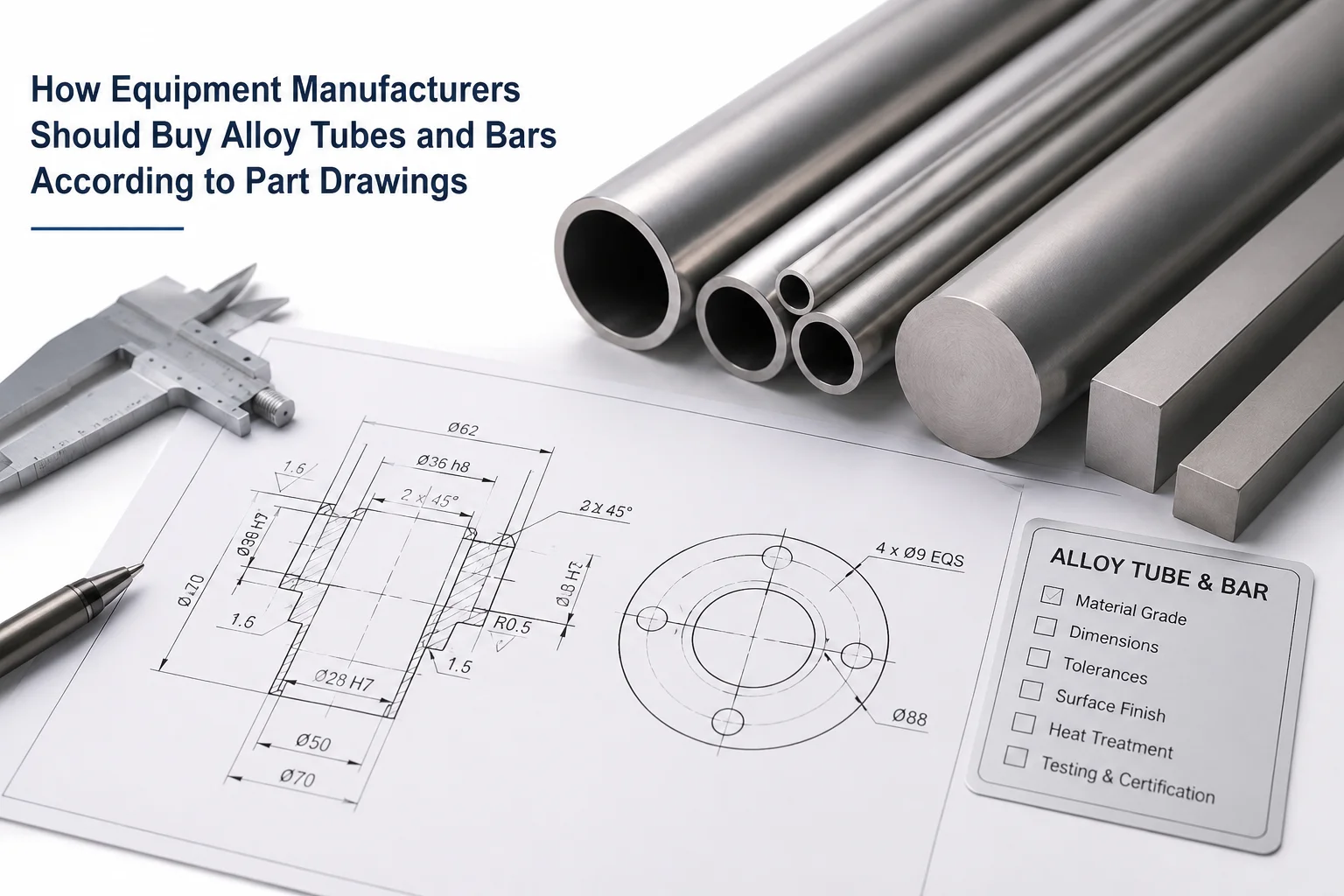
From my experience working with equipment manufacturers, many buyers say they “buy to spec.” This makes sense at first. You receive a drawing, check the dimensions, confirm the material callout, and ask suppliers for prices.
But for nickel alloy tubes, nickel alloy bars, titanium alloy tubes, and titanium alloy bars, the drawing should be treated as the starting point—not the full purchasing decision.
A drawing may say “Inconel 625 tube,” “titanium alloy bar,” or “nickel alloy round bar.” However, the buyer may still need to confirm:
- exact alloy grade
- UNS number
- ASTM / ASME / EN / ISO standard
- seamless or welded tube
- bar condition
- heat treatment
- surface finish
- machining allowance
- testing scope
- MTR / MTC
- heat number traceability
- third-party inspection
- packaging and delivery plan
Without these details, two suppliers may quote the “same drawing” but deliver very different technical and commercial scopes.
Quick Checklist: What Drawings Show and What Buyers Still Need to Confirm
A part drawing is essential, but it does not always show all material selection and procurement risks.
| Area | Usually Shown on Drawing | Often Needs Extra Confirmation |
|---|---|---|
| Geometry | Shape, holes, grooves, ends, bends | Manufacturability, machining allowance, forming feasibility |
| Dimensions | OD, wall thickness, diameter, length | Final tolerance after machining, bending, cutting or heat treatment |
| Tolerances | Size tolerance, GD&T, straightness, roundness | Inspection method and acceptance criteria |
| Material | Alloy name or general material callout | UNS number, exact grade, standard, heat treatment |
| Surface Finish | Roughness or finish note if specified | Pickled, polished, bright annealed, peeled, ground, contamination control |
| Application | Usually not fully described | Fluid, temperature, pressure, corrosion, wear, service life |
| Testing | Sometimes listed | UT, ET, hydrostatic, PMI, hardness, tensile, corrosion test |
| Documents | Sometimes listed | MTR, CoC, heat number, inspection report, packing list |
| Quality System | Usually not shown | ISO 9001, AS9100, ISO 13485, third-party inspection if required |
| Packaging | Usually not detailed | Export wooden case, caps, waterproof film, anti-scratch protection |
Geometric dimensioning and tolerancing is used to define and communicate engineering tolerances on drawings and 3D models. This helps define geometry and acceptable variation, but buyers still need to connect those drawing requirements with material performance, manufacturing process, testing, and documentation.
What Hidden Variables Are Important When Selecting Alloy Materials?
Part drawings show dimensions and material callouts, but they rarely show the full service environment. Ignoring hidden variables can increase the risk of wrong material selection, fabrication problems, delayed delivery, or premature failure.
Hidden variables are the critical details about how a part will be used, processed, inspected, and maintained. These include operating environment, performance requirements, manufacturing process, service life expectation, regulatory compliance, testing scope, and supplier traceability.
For example, a drawing may specify “titanium alloy.” But if the component will be used in chemical processing, buyers still need to confirm:
- titanium grade
- corrosive media
- acid type and concentration
- chloride level
- operating temperature
- surface finish
- welding or machining requirement
- inspection scope
- applicable standard
A drawing may specify “Inconel 625,” but buyers still need to confirm whether the requirement is for UNS N06625, whether the product is tube or bar, whether ASTM B444 or ASTM B637 applies, whether the material is annealed or solution annealed, and whether MTR and heat number traceability are included.
Key Hidden Variables to Consider
| Hidden Variable | What to Confirm | Why It Affects Material Choice |
|---|---|---|
| Operating Environment | Temperature, pressure, chemical exposure, chloride, H₂S, seawater, abrasion | Determines corrosion resistance, high-temperature strength, fatigue and wear risk |
| Performance Requirements | Strength, ductility, hardness, toughness, fatigue, creep, conductivity, magnetic behavior | Influences alloy grade, heat treatment and test requirements |
| Manufacturing Process | Welding, machining, bending, forming, heat treatment, surface finishing | Affects workability, weldability, final integrity and cost |
| Service Life Expectation | Expected life, maintenance interval, failure consequence | Helps compare initial cost with lifecycle risk |
| Regulatory Compliance | Aerospace, medical, pressure equipment, oil and gas, customer standards | Determines certification, traceability and approved material requirements |
| Inspection Requirements | UT, ET, hydrostatic, PMI, tensile, hardness, dimensional inspection | Confirms product conformity and reduces acceptance risk |
| Documentation Requirements | MTR, CoC, heat number, packing list, inspection report | Supports audit, traceability and project acceptance |
| Supplier Capability | Size range, production route, testing ability, stock or custom production | Affects lead time, consistency and supply reliability |
Why Can’t We Always Rely on Simple Answers for Material-Application Fit?
It is easy to think there is one right alloy for every job. In reality, similar drawings can require different materials, heat treatments, surface finishes or test scopes depending on the exact end-use.
There is no single correct answer for material selection based only on a general alloy category. Material selection should consider performance goals, working conditions, material properties, cost, fabrication, durability and application-specific requirements.
For example, a drawing may only say “nickel alloy bar.” But the final application could be:
- a pump shaft in seawater
- a valve stem in chemical service
- a high-temperature fastener
- a heat exchanger component
- a medical equipment part
- an aerospace machined component
- a mining wear component
Each application may require a different alloy grade, standard, heat treatment, surface finish, testing method and documentation level.
Why Similar Specifications May Need Different Solutions
| General Requirement | Deeper Application Question | Why It Matters |
|---|---|---|
| Good corrosion resistance | What fluid? Acid, seawater, chloride, alkali, H₂S, or mixed chemicals? | Different media may require stainless steel, titanium, Alloy 400, Inconel 625, Hastelloy C276 or another alloy |
| High strength | At room temperature, high temperature, cryogenic temperature, or cyclic loading? | High room-temperature strength does not always mean high fatigue, creep or rupture performance |
| Needs bending | What bend radius, wall thickness and forming method? | Alloy ductility, temper and wall thickness affect cracking risk |
| Must be weldable | Which welding process, filler metal, heat input and post-weld treatment? | Welding may affect properties, corrosion behavior and inspection requirements |
| Smooth finish | For appearance, sealing, hygiene, fatigue, anti-fouling, or machining? | Different finish requirements affect cost and process route |
| Meets standard | Which ASTM, ASME, EN, ISO, AMS or customer standard? | Different standards may require different tests, tolerances and documents |
| Fast delivery | Is it stock size or custom production? | Lead time depends on raw material, heat treatment, testing and packing |
How Do Product Form and Manufacturing Process Affect Procurement?
For equipment manufacturers, the material form is just as important as the material grade. The same alloy can be supplied as seamless tube, welded tube, round bar, forged bar, rod, billet or machined blank.
Product Form Comparison
| Product Form | What Buyers Should Confirm | Typical Concern |
|---|---|---|
| Seamless Tube | OD, wall thickness, length, tolerance, heat treatment, hydrostatic/ET/UT | Pressure, corrosion, cleanliness, dimensional accuracy |
| Welded Tube | Weld quality, heat treatment, weld inspection, surface finish | Weld integrity, corrosion behavior, application approval |
| Round Bar | Diameter, straightness, length, surface, heat treatment, UT | Machining allowance, shaft use, strength, internal defects |
| Forged Bar | Forging ratio, heat treatment, mechanical properties, UT | High strength, grain structure, critical components |
| Rod / Billet | Grade, size, condition, processing route | Further machining, forging or component manufacturing |
| Custom Cut Length | Cutting tolerance, end finish, marking, packing | Reduces customer machining and handling work |
For nickel alloy pipe and tube such as UNS N06625, ASTM B444 covers nickel-chromium-molybdenum-columbium alloys in cold-worked seamless pipe and tube form. The ASTM abstract includes chemical testing, tensile testing, hydrostatic testing and nondestructive electric testing.
For nickel alloy bars and forgings used in moderate or high-temperature service, ASTM B637 covers precipitation-hardening and cold-worked nickel alloy rod, bar, forgings and forging stock. The ASTM abstract includes chemical analysis, heat treatment, tension testing, hardness testing and stress-rupture testing.
For titanium bars and billets, ASTM B348/B348M covers titanium and titanium alloy bars and billets. The ASTM abstract states that covered grades should conform to chemical composition requirements and that tensile properties are determined from machined tension specimens.
These standards help buyers compare quotations and supplier offers more clearly.
What Should Equipment Manufacturers Verify When Assessing a Supplier?
Suppliers may say they can meet the drawing, but buyers should verify the claim with documents, standards, inspection records and production capability.
Supplier assessment should include material certification, heat number traceability, quality system certification, process capability, inspection capability and technical communication. A Mill Test Report or Material Test Certificate certifies a metal product’s chemical and physical properties and states compliance with applicable standards. A heat number links the metal product to a specific batch or heat, supporting traceability to composition, manufacturing process and quality records.
A useful MTR should normally include:
- material grade
- UNS number
- heat number
- chemical composition
- mechanical properties
- heat treatment condition
- product form
- size
- applicable standard
- test results
- manufacturer or mill information
- inspection statement where required
The MTR should match the physical material marking, product label, packing list, purchase order and inspection reports.
Supplier Verification Checklist
| Verification Point | What to Ask / Check | Why It Matters |
|---|---|---|
| Material Certifications | MTR / MTC with chemical and mechanical data for the specific heat | Confirms batch-level material data |
| Heat Number Traceability | Heat number on MTR, bar/tube marking and packing list | Links delivered material to production records |
| Quality System Certifications | ISO 9001, AS9100, ISO 13485 if applicable | Shows structured quality management, but does not replace product testing |
| Process Capabilities | Tube production, bar processing, heat treatment, cutting, polishing, grinding | Confirms whether the supplier can meet the drawing and processing requirement |
| Inspection Capabilities | UT, ET, hydrostatic test, PMI, hardness, tensile, dimensional inspection | Reduces quality and acceptance risk |
| Traceability System | Raw material input to finished product tracking | Important for audits, recalls and quality investigations |
| Technical Support | Ability to discuss application, standard, material limits and alternatives | Helps avoid material mismatch |
| Third-Party Inspection | SGS, BV, TUV, Lloyd’s, customer-appointed inspector if required | Adds independent verification for critical projects |
| Packaging Control | Caps, waterproof film, anti-scratch protection, wooden case | Reduces shipping damage |
| Nonconformity Handling | Replacement, correction, document revision, claim process | Important when quality or paperwork issues appear |
Quality System Certifications
ISO 9001 is a globally recognized quality management system standard that supports structured process control and continual improvement.
For aerospace applications, AS9100 is a quality management system standard for aviation, space and defense organizations. It is based on ISO 9001 and adds aerospace-related requirements such as quality, safety, defect prevention and risk management.
For medical device applications, ISO 13485 is the internationally recognized quality management system standard for the design and manufacture of medical devices. It helps organizations meet customer and regulatory requirements for safety and efficacy.
However, these certifications do not replace batch-level material proof. For alloy tubes and bars, buyers still need MTRs, heat number traceability, inspection reports and project-specific acceptance criteria.
What Testing Should Be Discussed Before Ordering Alloy Tubes and Bars?
Testing requirements should be discussed before purchase, not after material arrives. Some tests may be standard, while others may require additional cost and lead time.
Common Testing and Inspection Items
| Test / Inspection | What It Checks | Why It Matters |
|---|---|---|
| Chemical Analysis | Alloy composition | Confirms correct grade and UNS number |
| Tensile Test | Tensile strength, yield strength, elongation | Confirms mechanical performance |
| Hardness Test | Hardness condition | Important for machining, wear, sour service or heat treatment verification |
| PMI Test | Positive material identification | Helps prevent material mix-up |
| Ultrasonic Testing | Internal flaws in bars, tubes or forgings | Important for critical components |
| Eddy Current Testing | Surface and near-surface flaws in conductive materials | Common for tubes and conductive alloy products |
| Hydrostatic Test | Pressure integrity of tubes or pipes | Important for pressure-related service |
| Dimensional Inspection | OD, wall thickness, diameter, length, straightness | Confirms drawing and order requirements |
| Surface Inspection | Scratches, dents, cracks, contamination | Important for corrosion, fatigue, sealing and appearance |
| Third-Party Inspection | Independent verification | Useful for project-critical or regulated applications |
Ultrasonic testing is a non-destructive testing method used to detect internal flaws or characterize materials. Eddy-current testing is an electromagnetic NDT method used to detect and characterize surface and subsurface flaws in conductive materials.
How Can Informed Procurement Minimize Long-Term Risk?
Informed procurement is not only about today’s price. It is a risk-management process that helps equipment manufacturers avoid material mismatch, production delays, quality problems, compliance issues and unexpected service failures.
A lower-cost material may become more expensive if it causes rework, rejection, downtime, maintenance, replacement or compliance problems. Total cost of ownership includes direct and indirect costs across a product or service life cycle, while whole-life cost includes acquisition, operation, maintenance, renewal, replacement and disposal costs.
Risks Reduced by Informed Procurement
| Risk Area | Impact of Unclear Procurement | Benefit of Informed Procurement |
|---|---|---|
| Equipment Failure | Unexpected breakdown, leakage, safety risk | Material matched to application and service conditions |
| Production Delays | Rework, late delivery, material rejection | Clear standard, size, test and documentation requirements |
| Quality Issues | Wrong grade, wrong heat treatment, inconsistent properties | MTR, heat number, inspection and traceability |
| Compliance Problems | Missing documents, failed audits, project rejection | Standards and certificates confirmed before order |
| Supplier Reliability | Late delivery, unclear communication, inconsistent quality | Supplier capability and lead time verified |
| Cost Overruns | Hidden testing, rework, replacement, downtime | Total cost reviewed beyond material price |
| Manufacturing Problems | Material hard to bend, weld, machine or finish | DFM and processing route reviewed early |
A slightly higher upfront price may be more cost-effective if it includes correct standard, proper testing, traceable documentation, reliable packaging and realistic lead time.
RFQ Checklist for Equipment Manufacturers
If you want an accurate quotation for alloy tubes or bars based on a drawing, send more than the drawing alone. A complete RFQ helps suppliers quote correctly and reduce misunderstanding.
Alloy Tube and Bar RFQ Checklist
| Area | Information to Provide |
|---|---|
| Drawing | PDF / CAD drawing, revision number, tolerance, surface note |
| Product Form | Seamless tube, welded tube, round bar, forged bar, rod, billet |
| Material Grade | Inconel 625, Inconel 718, Hastelloy C276, Monel 400, Alloy 825, Nickel 200, titanium grade, etc. |
| UNS Number | N06625, N07718, N10276, N04400, N08825, N02200, R50400, R56400, etc. |
| Standard | ASTM, ASME, EN, ISO, AMS, NACE/ISO if applicable |
| Size | OD, wall thickness, diameter, length, tolerance, straightness |
| Quantity | Pieces, meters, kilograms, tons |
| Application | Heat exchanger, pump shaft, valve stem, reactor, marine equipment, aerospace part, medical device |
| Operating Environment | Temperature, pressure, fluid, pH, chloride, seawater, acid, alkali, H₂S |
| Manufacturing Process | Welding, bending, machining, threading, polishing, grinding, cutting |
| Heat Treatment | Annealed, solution annealed, aged, cold worked, stress relieved |
| Surface Finish | Pickled, polished, bright annealed, peeled, ground, machined |
| Testing | Chemical, tensile, hardness, UT, ET, hydrostatic, PMI, dimensional inspection |
| Documents | MTR, CoC, inspection report, packing list, third-party inspection |
| Packaging | Plastic caps, waterproof film, wooden case, anti-scratch protection |
| Delivery Requirement | Stock, custom production, lead time, destination port, shipping method |
| Commercial Terms | Incoterms, payment terms, quotation validity, nonconformity handling |
A good supplier should ask questions if the drawing is incomplete. If a supplier only quotes a price without checking standard, material grade, heat treatment, testing and application, the quotation may not cover the real requirement.
Practical Example: Same Drawing, Different Procurement Results
Imagine an equipment manufacturer sends a drawing for a nickel alloy bar. The drawing includes diameter, length and “Inconel 625” material note.
| Item | Basic Quote | More Complete Quote |
|---|---|---|
| Material | Inconel 625 | Inconel 625 / UNS N06625 |
| Product Form | Round bar | ASTM B637 nickel alloy bar |
| Heat Treatment | Not stated | Annealed / solution annealed as required |
| Size | Diameter and length | Diameter, length, tolerance, straightness |
| Surface | Not stated | Peeled / ground / polished as ordered |
| Testing | Not stated | Chemical, tensile, hardness, UT if required |
| Documents | Certificate available | MTR, heat number, inspection report |
| Packaging | Standard | Waterproof protection, wooden case |
| Lead Time | Fast | Stock or production schedule confirmed |
| Risk Level | Unclear | Easier to verify |
The basic quote may look cheaper, but the complete quote is easier to compare, inspect and accept.
What Should a Good Alloy Material Supplier Ask Before Quoting?
A reliable supplier should not only quote according to dimensions. For alloy tubes and bars used in demanding equipment, the supplier should help confirm whether the material scope is complete.
A good supplier should ask:
- What is the final application?
- What alloy grade and UNS number are required?
- Which standard applies?
- Is the product seamless tube, welded tube, round bar, forged bar or billet?
- What heat treatment condition is required?
- What surface finish is required?
- What operating temperature and pressure will the part face?
- What fluid, gas or corrosive medium will contact the material?
- Is the part welded, bent, machined, threaded or polished after delivery?
- What tests are required?
- Is MTR and heat number traceability required?
- Is third-party inspection required?
- What packaging and delivery schedule are required?
If the supplier asks these questions, it usually means they are trying to understand the real requirement, not only the drawing size.
How Can Emily PIPE Support Equipment Manufacturers?
At Emily PIPE, we supply nickel alloy tubes, nickel alloy bars, titanium alloy tubes and titanium alloy bars for global industrial equipment manufacturers. We support standard and customized specifications according to drawings, technical requirements and application environments.
For equipment manufacturers, we can help review:
- drawing requirements
- material grade and UNS number
- ASTM / ASME / EN / ISO / AMS standard
- tube or bar product form
- size and tolerance
- heat treatment condition
- surface finish
- machining or fabrication requirements
- operating environment
- testing scope
- MTR and heat number traceability
- third-party inspection
- packaging and delivery plan
We do not recommend buying alloy tubes and bars by drawing dimensions alone. We help customers connect the drawing with real operating conditions, material performance, standards, inspection and delivery requirements.
Conclusion
Buying alloy tubes and bars according to part drawings requires more than matching dimensions. A drawing is essential, but it may not fully describe the application environment, manufacturing process, material limitations, testing requirements, documentation needs or long-term risk.
Equipment manufacturers should review hidden variables such as temperature, pressure, corrosion, vibration, fatigue, welding, machining, heat treatment, surface finish, service life, standards and traceability.
The safest approach is to combine the drawing with a complete technical RFQ, verify the supplier’s documentation, confirm the applicable standards and evaluate total cost of ownership—not only purchase price.
If you are sourcing nickel alloy tubes, nickel alloy bars, titanium alloy tubes or titanium alloy bars according to a part drawing, you can send us your drawing, material grade, size, standard, application environment, testing requirements and delivery schedule. Our team can help review the material scope and provide a quotation based on your real equipment requirements.