
How to Choose Heat Exchanger Tubes for Flue Gas and Scrubber Systems
Choosing heat exchanger tubes for flue gas and scrubber systems is not a simple “best material” decision. These systems may involve hot flue gas, wet scrubbers, acid gas scrubbers, FGD systems, acidic condensate, sulfur compounds, chlorides, fluorides, deposits, wet/dry cycling, temperature changes, flow velocity, particulate erosion, cleaning chemicals, and long maintenance intervals.
A poor tube material choice may increase corrosion risk, leakage risk, heat-transfer loss, maintenance work, repair cost, downtime risk, or lifecycle cost. However, the solution is not simply to choose the most expensive alloy. Buyers should confirm the real flue gas composition, acid dew point, condensate chemistry, temperature profile, scrubber liquid chemistry, heat exchanger design, product standard, testing scope, supplier documentation, and lifecycle risk before ordering.
EPA documentation explains that gas absorbers used to remove SO₂ from flue gas are commonly called flue gas desulfurization systems, and systems used to control HCl and other acidic gases are called acid gas scrubbers: EPA Wet and Dry Scrubbers for Acid Gas Control.
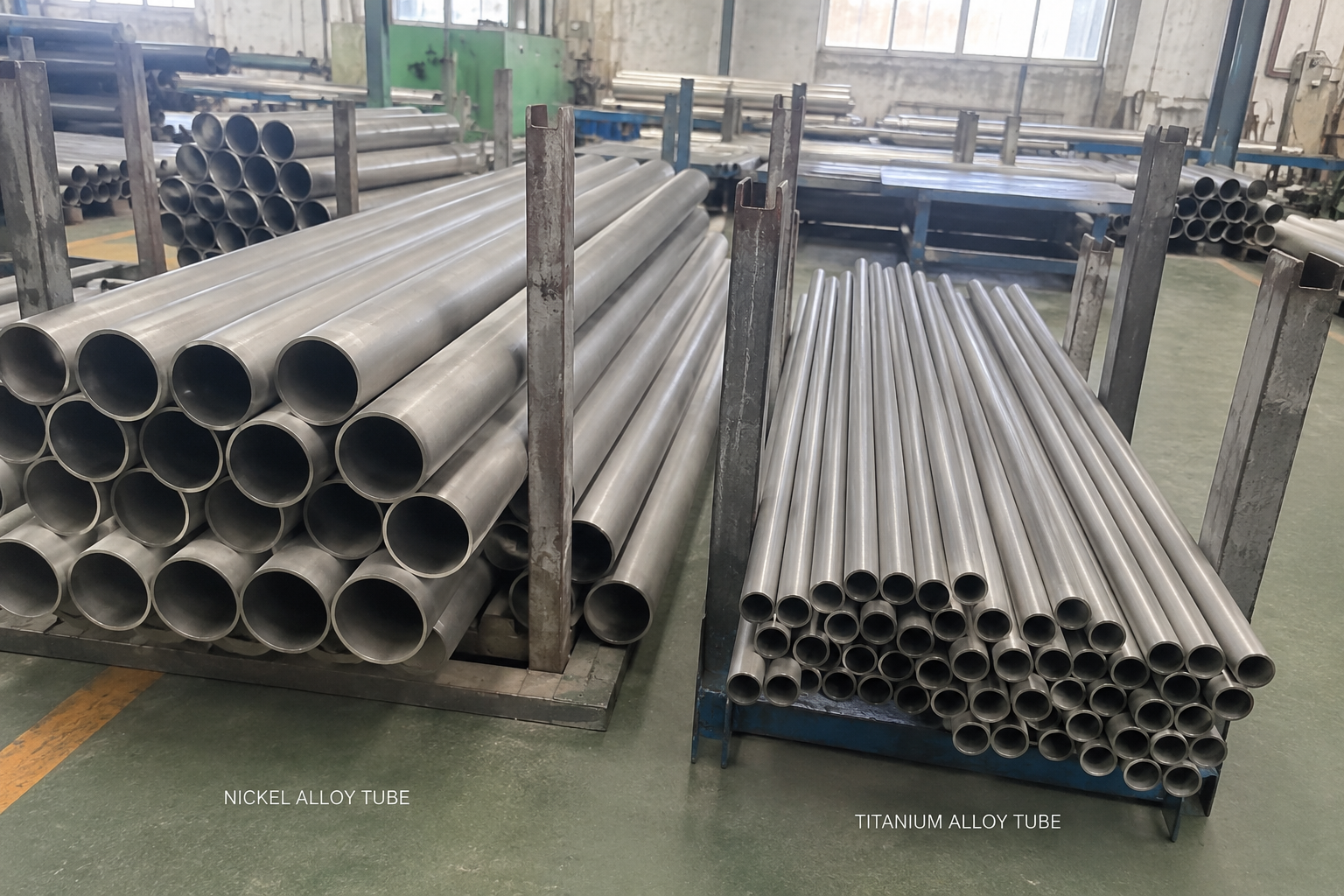
For engineers and procurement teams, the key question is not “Which alloy is best for scrubber systems?” The better question is “Which tube material is suitable for this flue gas composition, this acid condensate, this chloride level, this fluoride risk, this temperature profile, this wet/dry cycle, this heat exchanger design, and this inspection requirement?”
Why Flue Gas and Scrubber Environments Are Difficult
Flue gas and scrubber systems are challenging because corrosion risk is rarely controlled by one factor. Temperature, moisture, sulfur oxides, hydrochloric acid, hydrofluoric acid, nitrogen oxides, oxygen, chlorides, fluorides, deposits, pH, flow velocity, and wet/dry cycling may interact.
The National Research Council explains that acid gases are flue-gas constituents that form acids when they combine with water vapor, condense, or dissolve in water. It lists acid gases including NOx, SOx, HCl, hydrogen bromide, hydrogen fluoride, and hydrogen iodide: Incineration Processes and Environmental Releases.
This means “flue gas service” is not enough information for material selection.
Buyers should confirm:
- Fuel type or waste stream
- Flue gas source
- SO₂ / SO₃ content
- HCl content
- HF or fluoride risk
- NOx level
- Oxygen level
- Water vapor content
- Dust or particulate content
- Metal salts and deposits
- Normal gas temperature
- Minimum metal surface temperature
- Acid dew point
- Wet/dry cycling
- Condensate pH
- Chloride level in condensate or scrubber liquor
- Fluoride level
- Scrubber liquid chemistry
- Cleaning chemicals
- Tube side and shell side media
- Heat exchanger design
- Inspection and documentation requirements
Acid Dew Point and Low-Temperature Corrosion
Many failures in flue gas heat recovery or scrubber-adjacent heat exchangers are not caused only by peak temperature. They may occur when the metal surface temperature falls below the acid dew point and acidic condensate forms.
A review of flue gas acid dew point explains that acid dew point is the temperature at which acid vapor, normally sulfuric acid, begins to condense, and that acid condensation can result in low-temperature corrosion: Review of Flue Gas Acid Dew-Point and Related Low-Temperature Corrosion.
A DOE/UNT report on recovering water from boiler flue gas also notes that acids are a particular concern for low-temperature flue gas heat exchangers because of the potential for heat exchanger tube corrosion: Recovery of Water from Boiler Flue Gas Using Condensing Heat Exchangers.
For tube selection, buyers should confirm:
- What is the normal gas inlet temperature?
- What is the gas outlet temperature?
- What is the lowest tube wall temperature?
- Is condensation expected during normal operation?
- Is condensation expected during startup or shutdown?
- What is the acid dew point?
- What is the condensate pH?
- Are H₂SO₄, HCl, HF, HNO₃ or mixed acids expected?
- Are there deposits that hold acidic moisture?
- Are there wet/dry cycles that concentrate salts?
A material that performs well in dry hot gas may not perform well in acidic condensate.
Deposits, Chlorides and Wet/Dry Cycling
Deposits can make flue gas corrosion more severe because they may trap moisture, concentrate chlorides, create local acidic chemistry, and form under-deposit corrosion sites.
A study on desulfurized flue gas corrosion coupled with deposits found that steel surface temperature affected the deposition and corrosion process, and corrosion first increased as Cl⁻ concentration in deposits increased before later changing when electrolyte availability decreased: Desulfurized Flue Gas Corrosion Coupled with Deposits.
Buyers should review:
- Deposit composition
- Chloride concentration in deposits
- Sulfate and sulfite deposits
- Fly ash carryover
- Particulate erosion
- Wet/dry cycles
- Salt concentration during drying
- Cleaning frequency
- Wash water chemistry
- Stagnant areas
- Crevice areas
- Tube support design
- Drainability
Do not select tube material only from clean laboratory corrosion data. Deposit chemistry can be very different from bulk gas chemistry.
Common Corrosion Mechanisms to Review
Flue gas and scrubber heat exchanger tubes may face multiple corrosion mechanisms at the same time.
| Mechanism | Why It Matters | What Buyers Should Check |
|---|---|---|
| Acid dew point corrosion | Acid condenses on metal surfaces below dew point | SO₃, water vapor, metal surface temperature, H₂SO₄ condensation |
| General acid corrosion | Acidic condensate can cause wall loss | Condensate pH, acid species, temperature |
| Pitting corrosion | Small pits can become leakage points | Chlorides, fluorides, oxidizers, deposits |
| Crevice corrosion | Can occur under deposits, gaskets, joints and stagnant zones | Crevice design, fouling, wet/dry cycles |
| Under-deposit corrosion | Deposits create local chemistry different from bulk gas | Deposit composition, cleaning schedule |
| Stress corrosion cracking | Tensile stress plus corrosive environment may cause cracking | Residual stress, welds, chlorides, temperature |
| Erosion-corrosion | Dust, ash, droplets or high velocity may damage protective films | Gas velocity, particles, droplets, inlet design |
| Intergranular corrosion | May occur if heat treatment or welding is unsuitable | Alloy condition, welding, ASTM G28 if specified |
| Galvanic corrosion | Dissimilar metals may interact in conductive condensate | Tube, tube sheet, shell, fasteners and supports |
| Fluoride / HF attack | HF can attack some passive materials severely | HF, free fluoride, pH, temperature, material family |
A heat exchanger tube may need resistance to both acidic corrosion and mechanical damage.
Titanium in Flue Gas and Scrubber Systems: Useful but Limited
Titanium may be considered in selected chloride-containing or wet chlorine-related environments. However, titanium is not a universal material for flue gas and scrubber systems.
The key warning is fluoride and hydrofluoric acid.
TIMET’s titanium corrosion manual states that titanium is rapidly attacked by hydrofluoric acid of even very dilute concentrations and is not recommended for hydrofluoric acid solutions: Corrosion Resistance of Titanium.
An NRC-hosted titanium corrosion document also notes that free fluorides in acid aqueous environments can lead to hydrofluoric acid formation and rapid attack on titanium: Corrosion Resistance of Titanium.
This means titanium tube selection should be reviewed carefully when the system may contain:
- HF
- Free fluorides
- Low pH condensate
- Reducing acids
- Acidic chloride-fluoride mixtures
- Scrubber liquid with fluoride accumulation
- Cleaning chemicals containing fluoride
- Crevice areas
- Galvanic coupling
Titanium can be useful in some environments, but it should not be recommended without checking fluoride and pH conditions.
Nickel Alloy Tubes in Flue Gas and Scrubber Service
Nickel alloys may be reviewed where stainless steels face high corrosion risk from acid condensate, chlorides, low pH, deposits, oxidizing/reducing mixtures, or wet scrubber environments.
ASTM B163 covers seamless nickel and nickel alloy tubes for condenser and heat-exchanger service: ASTM B163.
Depending on the project, relevant nickel alloy tube standards may include:
| Standard | Typical Scope | Common Relevance |
|---|---|---|
| ASTM B163 | Seamless nickel and nickel alloy tubes for condenser and heat-exchanger service | Nickel alloy heat exchanger tubes |
| ASTM B444 | UNS N06625 and related nickel-chromium-molybdenum seamless pipe and tube | Alloy 625 pipe and tube |
| ASTM B622 | Seamless pipe and tube of nickel and nickel-cobalt alloys | C-276, C-22 and related nickel alloy tubes |
| ASTM B829 | General requirements for nickel and nickel alloy seamless pipe and tube | General seamless nickel alloy tube requirements |
| ASTM G28 | Intergranular corrosion testing for nickel-rich chromium-bearing alloys | Intergranular corrosion evaluation when specified |
| ASTM G48 | Pitting and crevice corrosion comparison under ferric chloride conditions | Localized corrosion comparison when specified |
Useful references:
These standards help define product, testing or documentation requirements. They do not prove that one alloy is suitable for every flue gas or scrubber system.
Stainless Steel, Duplex and High-Alloy Options
Stainless steels, duplex stainless steels, super duplex stainless steels, titanium and nickel alloys may all be considered in different flue gas or scrubber-related systems. However, they should not be selected only by material name.
A corrosion chapter on flue gas desulfurization systems provides material-selection guidelines for stainless steels and nickel alloys based on chloride levels and pH values: Corrosion of Flue Gas Desulfurization Systems.
This supports an important procurement point: material selection must be linked to pH, chloride level, temperature, deposits, and system location.
| Material Family | Why Buyers May Consider It | Important Caution |
|---|---|---|
| Carbon steel / coated steel | Low initial cost; may be used in mild or protected areas | Coating damage, acid condensate and wet zones can create high risk |
| 304 / 316 stainless steel | Available and cost-effective in mild conditions | Chlorides, low pH, crevices, deposits and wet/dry cycling may limit use |
| Duplex / super duplex stainless steel | Higher strength and improved chloride resistance in selected conditions | Low pH, high chloride, welding, deposits and temperature must be reviewed |
| Titanium Grade 2 / 7 / 12 | May be reviewed in selected chloride-containing or oxidizing wet environments | HF, free fluorides, low pH, crevices and galvanic effects must be reviewed |
| Alloy 625 | May be reviewed where strength and corrosion resistance are both required | Not universal; acid species, temperature and deposits must be checked |
| Alloy C-276 / C-22 type alloys | May be reviewed for severe mixed acid, chloride-containing or low-pH service | Cost, fabrication, welding and actual condensate chemistry must be confirmed |
| Alloy 825 / Alloy 20 type alloys | May be reviewed for selected acidic or chloride-containing environments | Acid concentration, oxidizing/reducing condition and temperature must be checked |
No material family is automatically correct. The process data must control the selection.
Why Datasheets Are Not Enough
Material datasheets are useful, but they do not fully describe scrubber and flue gas heat exchanger service.
A datasheet may include:
- Chemical composition
- Mechanical properties
- Density
- Thermal conductivity
- Maximum temperature
- General corrosion resistance
- Product standards
- Heat treatment
But real service may involve:
- Acid dew point crossing
- Condensate pH fluctuation
- Mixed H₂SO₄ / HCl / HF / HNO₃ chemistry
- Chloride accumulation
- Fluoride accumulation
- Wet/dry cycles
- Salt deposits
- Fouling and plugging
- Fly ash erosion
- Local hot spots or cold spots
- Oxygen variation
- Startup and shutdown chemistry
- Cleaning chemicals
- Welded areas
- Crevices
- Tube-to-tube sheet joints
- Stresses from fabrication or installation
A material may look suitable on paper but still require application review for the actual operating envelope.
Questions Buyers Should Ask Before Selecting Tubes
Before choosing heat exchanger tubes for flue gas or scrubber systems, buyers should ask detailed diagnostic questions.
| Category | Key Questions |
|---|---|
| Flue gas source | Is the gas from coal, biomass, waste incineration, chemical processing, metal processing, boiler exhaust, furnace exhaust or another source? |
| Acid gas composition | What are SO₂, SO₃, HCl, HF, NOx and CO₂ levels? |
| Condensation | Is the system operated above or below acid dew point? Are startup/shutdown conditions different? |
| Condensate chemistry | What is the pH? Are chlorides, fluorides, sulfates, nitrates or metal salts present? |
| Scrubber liquid | What is the pH, chloride level, fluoride level, suspended solids and chemical treatment? |
| Temperature profile | What are gas inlet, gas outlet, tube wall, minimum and maximum temperatures? |
| Wet/dry cycling | Does the surface alternate between wet and dry operation? |
| Deposits | What deposits are expected? Are fly ash, salts, sulfates or chlorides present? |
| Flow and erosion | What gas velocity, liquid velocity, particle load and droplet impingement exist? |
| Cleaning | What wash water, chemicals, frequency and temperature are used? |
| Heat exchanger design | Is it shell-and-tube, gas-to-liquid, heat recovery unit, condenser, cooler or custom design? |
| Tube side / shell side | Which side sees flue gas, condensate, scrubber liquor, cooling water or process fluid? |
| Past failures | Were there leaks, pits, cracks, erosion, plugging or deposit problems? |
| Inspection | What NDT and pressure tests are required? |
| Documentation | What MTC, EN 10204 certificate, third-party inspection or traceability is required? |
Without this information, any material recommendation is incomplete.
Hidden Risks in “Correct” Tube Specifications
A tube may meet the requested alloy grade and dimensions, but hidden risks can remain.
| Hidden Risk | Why It Matters | What Buyers Should Check |
|---|---|---|
| Wrong environment assumption | “Scrubber service” may mean very different chemistries | Confirm gas and liquid chemistry |
| Acid dew point ignored | Condensation can create low-temperature acid corrosion | Confirm minimum tube wall temperature |
| Fluoride overlooked | HF or free fluoride can attack some passive materials | Confirm HF / fluoride level |
| Deposit chemistry ignored | Deposits may concentrate chlorides and acid | Analyze deposits if past failures occurred |
| Wet/dry cycling ignored | Drying can concentrate salts | Confirm operating cycles |
| Tube side/shell side unclear | Wrong side may be specified for corrosion allowance | Define both sides clearly |
| Welding and heat treatment unclear | Poor fabrication may reduce corrosion margin | Confirm heat treatment, weld condition and NDT |
| Surface damage | Scratches, dents or contamination may initiate attack | Require surface inspection and packing control |
| Testing not specified | ECT, UT or pressure testing may be omitted | Define testing in the purchase order |
| Certificate mismatch | MTC may not match heat number, size or order | Verify marking, heat number and certificate |
The purchase specification should describe service conditions, not only alloy grade.
What Documents Should Buyers Request?
For heat exchanger tubes used in flue gas and scrubber systems, buyers may request:
- Material Test Certificate / Mill Test Report
- EN 10204 Type 3.1 or Type 3.2 certificate if required
- Heat number or batch number traceability
- Chemical composition report
- Mechanical properties report
- Heat treatment record if required
- Dimensional inspection report
- Surface inspection report
- Eddy current testing report if required
- Ultrasonic testing report if required
- Hydrostatic or pneumatic test report if required
- PMI report if required
- ASTM G48 or G28 corrosion test report if specified
- Intergranular corrosion test report if specified
- Third-party inspection report if required
- Packing and marking records
EN 10204 defines inspection documents for metallic products. Type 3.1 is an inspection certificate in which the manufacturer declares that the products supplied comply with the order and provides test results: EN 10204 Inspection Documents.
Buyers should verify that certificates match the physical tubes: heat number, grade, standard, OD, wall thickness, length, test values, quantity, marking and purchase order.
Useful Testing and Inspection Methods
Testing requirements depend on product form, tube size, wall thickness, material grade, project standard and service risk.
| Test / Inspection | Purpose |
|---|---|
| Chemical analysis | Confirms alloy composition |
| Mechanical testing | Confirms tensile strength, yield strength, elongation or hardness if required |
| Dimensional inspection | Confirms OD, wall thickness, length, tolerance and straightness |
| Surface inspection | Checks scratches, pits, dents, cracks, scale or contamination |
| PMI testing | Helps verify alloy identity |
| Eddy current testing | Commonly used for heat exchanger tube inspection |
| Ultrasonic testing | Helps detect discontinuities in suitable products |
| Hydrostatic / pneumatic testing | Helps verify pressure integrity when required |
| ASTM G48 | May support pitting / crevice corrosion comparison when specified |
| ASTM G28 | May support intergranular corrosion evaluation for nickel-rich chromium-bearing alloys when specified |
| Third-party inspection | Adds independent verification for critical orders |
ASNT explains that eddy current testing is commonly used to inspect heat exchanger tubes and detect wall-thickness changes or defects: ASNT Electromagnetic Testing.
ISO 9001 Is Useful, but Not Enough
ISO 9001 can support supplier evaluation, but it should not be treated as proof that a specific batch of tubes is suitable for a specific flue gas or scrubber heat exchanger.
ISO explains that ISO 9001 is a globally recognized quality management standard that helps organizations improve performance and quality management: ISO 9001 Quality Management Systems.
For scrubber and flue gas heat exchanger tubes, buyers should still verify:
- Alloy grade
- Product standard
- Heat number
- Chemical composition
- Mechanical properties
- Heat treatment condition
- Tube size and tolerance
- Surface condition
- Inspection reports
- MTC / MTR
- Flue gas and condensate compatibility
- Third-party inspection if required
Quality management certification is helpful, but batch-level material verification and service-condition review are still necessary.
Lifecycle Cost: Why Initial Price Is Not Enough
The lowest purchase price is not always the lowest lifecycle cost. In flue gas and scrubber heat exchanger systems, the real cost may include inspection, installation, corrosion monitoring, cleaning, plugging, leakage risk, emergency repair, replacement tubes, shutdown risk, environmental controls, spare parts and logistics.
NIST’s Life Cycle Cost Manual explains that lifecycle cost is the total cost of owning, operating, maintaining and disposing of a system over a given study period: NIST Life Cycle Cost Manual.
When comparing tube options, buyers should consider:
- Initial tube cost
- Alloy grade
- Product standard
- Testing and inspection cost
- Documentation requirement
- Acid dew point risk
- Chloride and fluoride risk
- Deposit and fouling risk
- Cleaning and maintenance cost
- Leakage consequence
- Replacement difficulty
- Downtime risk
- Lead time
- Packing and shipping protection
- Spare tube strategy
- Failure consequence
A higher-cost alloy may be more economical in severe service if it reduces corrosion risk, leakage risk, inspection uncertainty or replacement frequency. A lower-cost material may be acceptable in mild service. The correct decision depends on actual risk and lifecycle cost.
Practical RFQ Checklist for Flue Gas and Scrubber Heat Exchanger Tubes
Before sending an inquiry, buyers can prepare the following information:
- System type: FGD, wet scrubber, dry scrubber, acid gas scrubber, waste incineration flue gas treatment, boiler flue gas heat recovery, furnace exhaust or other
- Equipment type: heat exchanger, condenser, cooler, heater, gas-to-liquid exchanger, shell-and-tube exchanger or custom unit
- Tube side medium
- Shell side medium
- Flue gas source: coal, biomass, waste, chemical process, metal processing, boiler, furnace or other
- SO₂ / SO₃ level
- HCl level
- HF or fluoride level
- NOx level
- Oxygen level
- Water vapor content
- Dust, ash or particulate content
- Normal gas temperature
- Maximum gas temperature
- Minimum tube wall temperature
- Acid dew point
- Condensate pH
- Chloride level in condensate or scrubber liquor
- Fluoride level in condensate or scrubber liquor
- Scrubber liquid chemistry and pH
- Wet/dry cycling condition
- Deposit composition if known
- Flow velocity and erosion risk
- Cleaning chemicals and cleaning frequency
- Heat exchanger design: straight tube, U-tube, tube sheet joint, welded or expanded joints
- Tube sheet material and galvanic compatibility
- Crevice areas, stagnant zones or dead legs
- Required alloy grade and UNS number if known
- Required standard: ASTM B163, B338, B444, B622, B829, ASME, EN or customer specification
- Seamless or welded tube requirement
- OD, wall thickness, length, tolerance and quantity
- Heat treatment condition
- Surface finish and internal cleanliness requirement
- Required testing: ECT, UT, hydrostatic, pneumatic, PMI, G48, G28, dimensional, surface inspection or third-party inspection
- Required certificate type: EN 10204 3.1 or 3.2
- Packing, end caps, marking and delivery requirement
A clear RFQ helps the supplier recommend a suitable heat exchanger tube instead of quoting a general “scrubber tube” or “flue gas heat exchanger tube.”
Conclusion
Heat exchanger tube selection for flue gas and scrubber systems should be based on flue gas composition, acid dew point, condensate chemistry, chloride and fluoride risk, temperature profile, deposits, wet/dry cycling, heat exchanger design, alloy grade, product standard, testing scope, supplier documentation and lifecycle cost.