
Getting an accurate heat exchanger tube quotation is not only about asking for a price. A useful quotation depends on how clearly the buyer defines the tube material, standard, size, operating environment, testing requirement, documentation requirement, delivery schedule, and project conditions.
If the RFQ information is incomplete, suppliers may quote different assumptions. One supplier may quote a standard commercial tube, another may include ASTM requirements, and another may include eddy current testing, hydrostatic testing, MTR, special packaging, or third-party inspection. This is why prices can look very different even when the product name looks similar.
Quick Answer:
To get a more accurate heat exchanger tube quotation, buyers should provide tube material, grade, standard, OD, wall thickness, length, tolerance, quantity, tube-side medium, shell-side medium, temperature, pressure, flow condition, corrosion risk, fouling risk, surface finish, testing requirement, MTR / MTC, heat number traceability, inspection requirement, packaging, destination, and delivery schedule. The more complete the RFQ information, the easier it is for suppliers to confirm material suitability, manufacturing route, testing scope, lead time, and price.
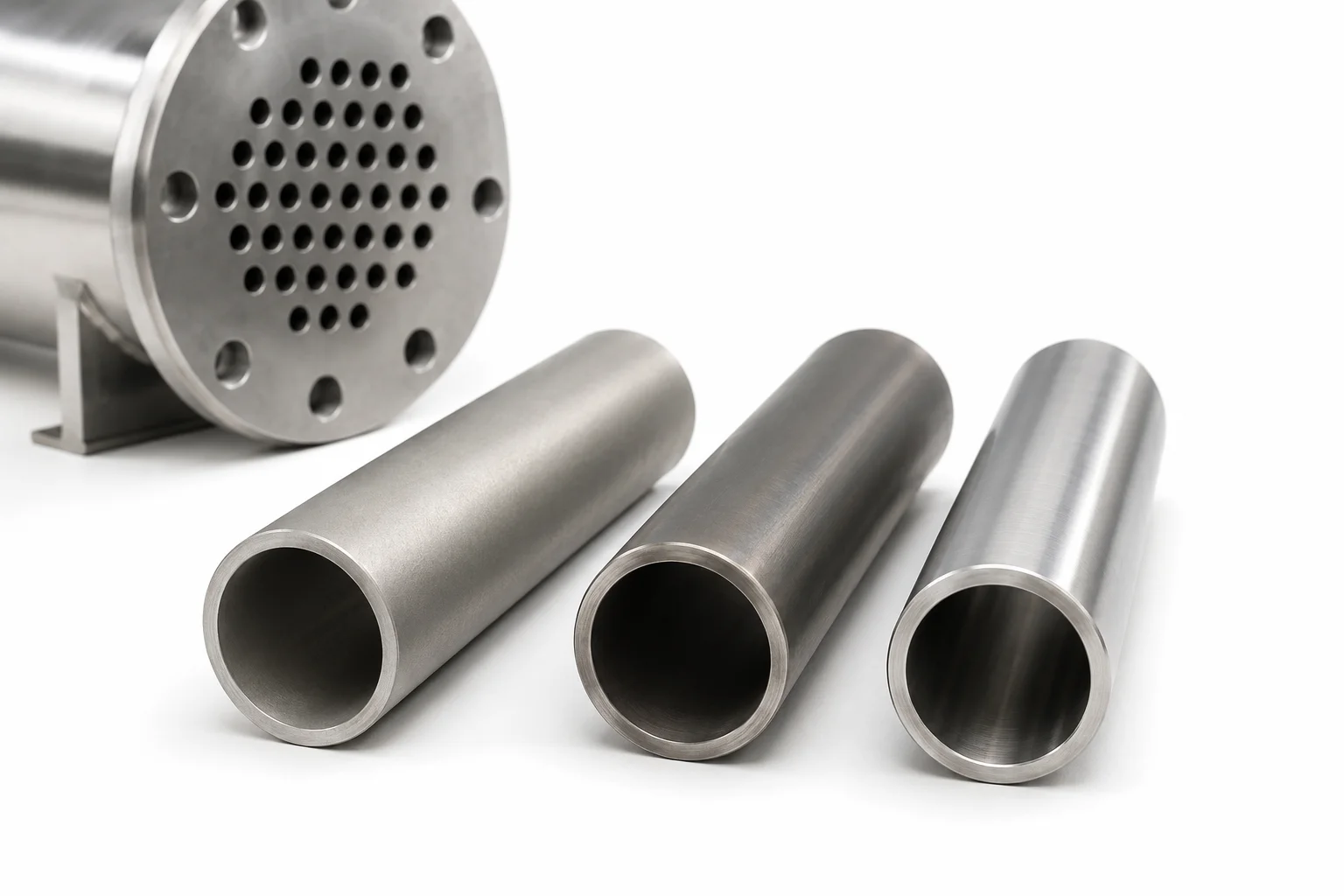
AMPP explains that material selection is influenced by corrosion resistance in the environment, design and test data, mechanical properties, cost, maintainability, compatibility, life expectancy, and reliability: AMPP Materials Selection and Design for Corrosion Control.
The NIST corrosion performance database also shows that corrosion observations are tied to specific environments, including concentration and temperature: NIST Corrosion Performance Databases.
This is why heat exchanger tube quotation should begin with real application information, not only product name.
Why Are Operating Conditions Important for Tube Selection?
Operating conditions are one of the most important parts of a heat exchanger tube RFQ.
A buyer may ask for “titanium tubes,” “nickel alloy tubes,” or “stainless steel tubes,” but the material family alone does not tell the supplier whether the tube is suitable.
Operating conditions matter because tube material performance depends on process fluid, cooling medium, temperature, pressure, flow velocity, fouling, chloride level, pH, contaminants, cleaning chemicals, and expected service life.
The UK Health and Safety Executive covers corrosion and the selection of materials of construction as part of process safety technical measures: HSE Corrosion / Selection of Materials.
For heat exchanger tubes, buyers should provide both tube-side and shell-side conditions. The material may contact different fluids on each side, and both can affect corrosion, fouling, and mechanical risk.
Key Operating Parameters to Provide
| Parameter | Why It Matters | Example Impact |
|---|---|---|
| Tube-Side Medium | The fluid inside the tube may cause corrosion, fouling, erosion or scaling | Seawater, brine, acid, steam, gas, cooling water or process fluid all require different review |
| Shell-Side Medium | The external fluid can be just as important as the internal medium | Steam, cooling water, chemical media or air may affect corrosion and temperature |
| Chemical Composition | Determines material compatibility | Chlorides, acids, alkalis, sulfur compounds or oxidizers can change alloy behavior |
| Temperature Range | Affects corrosion rate, strength, creep, scaling and cleaning risk | Maximum, minimum, startup, shutdown and cleaning temperatures should be stated |
| Pressure | Affects wall thickness, tube integrity and testing needs | Operating pressure, design pressure and pressure surge should be provided |
| Flow Rate / Velocity | Affects heat transfer, erosion, vibration, fouling and pressure drop | High velocity with solids may increase erosion risk |
| pH | Important for corrosion and scaling | Acidic or alkaline conditions can change material suitability |
| Chloride Content | Important for pitting, crevice corrosion and SCC review in susceptible materials | Chloride level should be provided for cooling water, brine and chemical media |
| Contaminants | Suspended solids, scale, oil or aggressive ions may change risk | Fouling or erosion may increase |
| Cleaning Method | Cleaning chemicals can be more aggressive than normal process fluid | Mechanical or chemical cleaning should be included in RFQ |
| Service Life Target | Helps compare material options and life-cycle cost | Critical systems may justify stricter testing or more resistant alloys |
Better RFQ Example
Instead of writing:
“Please quote titanium heat exchanger tubes.”
Write:
“Please quote ASTM B338 Grade 2 titanium seamless tubes, OD 25.4 mm × WT 1.2 mm × 6000 mm, for seawater condenser service. Tube-side medium: natural seawater; shell-side medium: steam condensate; operating temperature: 35–70°C; design pressure: 1.2 MPa; flow velocity: 1.8 m/s; chloride-containing seawater; fouling possible; pickled surface; MTC, heat number, dimensional report and eddy current test required.”
The second request gives the supplier enough information to review material, standard, testing, surface finish, packaging, lead time, and quotation more accurately.
What Mechanical Details Should Buyers Provide?
Mechanical details affect manufacturing cost, material weight, inspection, installation and suitability.
Buyers should provide OD, wall thickness, length, tolerance, tube type, straightness, surface finish, end condition, bending requirement, and whether the tube is seamless, welded, straight or U-bent.
Mechanical and Dimensional Information
| Specification | Why It Matters | Impact on Quote |
|---|---|---|
| Outside Diameter | Determines fit in tube sheet and affects flow area | Affects raw material, tooling and inspection |
| Wall Thickness | Affects pressure capacity, material weight and heat transfer | Thicker walls increase material usage and cost |
| Length | Affects installation, cutting, packaging and logistics | Custom lengths may affect yield and production planning |
| Tube Type | Seamless, welded, straight tube or U-tube | Different production routes have different cost and lead time |
| Tolerance | Affects fit, sealing, expansion and assembly | Tighter tolerances may increase inspection and processing cost |
| Straightness | Important for tube bundle assembly | Stricter straightness may require extra control |
| Roundness | Affects tube sheet fit and expansion | Out-of-round tubes may create assembly problems |
| Surface Finish | Influences cleaning, fouling, pressure drop and inspection | Polished or special surfaces may increase cost |
| End Condition | Plain, cut, deburred, beveled or capped | Affects installation and packaging |
| U-Bend Requirement | Important for U-tube heat exchangers | Requires bend radius, leg length and heat treatment review |
| Quantity | Affects raw material planning and production scheduling | Larger or smaller quantities may change unit price |
Surface Finish and Pressure Drop
Surface finish should be stated when it matters for cleaning, fouling, corrosion control or pressure drop.
Springer’s heat exchanger fouling reference explains that fouling reduces heat transfer rate and increases pressure drop: Heat Exchangers Fouling, Cleaning, and Maintenance.
This is why buyers should not use vague words such as “smooth” or “good surface” when the surface requirement is important. It is better to specify:
- Pickled surface
- Polished surface
- Bright annealed surface
- Clean ID / OD
- Ra value if required
- No visible cracks, folds, deep scratches or heavy scale
- Surface inspection report if required
What Standards Should Be Stated in the RFQ?
Standards help define material, manufacturing method, testing, tolerance and acceptance requirements.
If the buyer does not state the required standard, suppliers may quote different standards or commercial requirements. This can make price comparison inaccurate.
Buyers should specify the required ASTM, ASME, EN, ISO or customer standard clearly in the RFQ.
Common Standards for Heat Exchanger Tubes
| Standard | Material Family | Scope |
|---|---|---|
| ASTM B338 | Titanium and titanium alloy tubes | Seamless and welded tubes for surface condensers, evaporators and heat exchangers |
| ASTM B163 | Nickel and nickel alloy tubes | Seamless tubes for condenser and heat-exchanger service |
| ASTM A213 | Ferritic and austenitic steel tubes | Seamless boiler, superheater and heat-exchanger tubes |
ASTM B338 covers 28 grades of seamless and welded titanium alloy tubes for surface condensers, evaporators and heat exchangers: ASTM B338.
ASTM B163 covers seamless tubes of nickel and nickel alloys for condenser and heat-exchanger service: ASTM B163.
ASTM A213 covers seamless ferritic and austenitic steel boiler, superheater and heat-exchanger tubes: ASTM A213.
Standard Information Buyers Should Provide
| RFQ Item | Example |
|---|---|
| Product Standard | ASTM B338, ASTM B163, ASTM A213, ASME SB338, ASME SB163 |
| Material Grade | Titanium Grade 2, Grade 7, Grade 12, Alloy 625, C276, Alloy 825, Nickel 200 |
| Product Form | Seamless tube, welded tube, U-tube, straight tube |
| Size Standard | OD and WT tolerance according to standard or customer drawing |
| Certificate Requirement | MTC / MTR, EN 10204 3.1, EN 10204 3.2 if required |
| Inspection Requirement | Internal inspection, customer inspection, or third-party inspection |
| Testing Requirement | Eddy current, ultrasonic, hydrostatic, tensile, hardness, PMI |
Standards do not replace application review. A tube can meet ASTM requirements and still be unsuitable if the material grade does not match the operating environment.
What Testing and Certification Requirements Affect the Quote?
Testing and certification requirements can affect cost, lead time and production planning.
If the buyer needs eddy current testing, ultrasonic testing, hydrostatic testing, PMI, third-party inspection or EN 10204 certificates, these should be stated before quotation.
Testing requirements should be defined early because they affect inspection scope, production process, documentation and final price.
Common Tests and Documents
| Test / Document | What It Confirms |
|---|---|
| MTC / MTR | Batch-specific chemical composition and mechanical properties |
| Heat Number | Traceability to the production batch |
| Chemical Analysis | Confirms alloy composition |
| Tensile Test | Confirms yield strength, tensile strength and elongation |
| Hardness Test | Confirms hardness if required |
| Eddy Current Test | Helps detect discontinuities in tubular products |
| Ultrasonic Test | Helps detect volumetric discontinuities in pipe and tubing |
| Hydrostatic Test | Helps verify pressure integrity when required |
| PMI / Grade Verification | Helps reduce material mix-up risk |
| Dimensional Inspection | Confirms OD, wall thickness, length and tolerance |
| Surface Inspection | Confirms visible surface condition |
| Third-Party Inspection | Adds independent verification for critical projects |
ASTM E426 is a standard practice for electromagnetic eddy current examination of seamless and welded tubular products: ASTM E426.
ASTM E213 covers ultrasonic testing of metal pipe and tubing: ASTM E213.
ASTM E8/E8M covers tension testing of metallic materials, including yield strength, tensile strength, elongation and reduction of area: ASTM E8/E8M.
ASTM E1476 provides guidance for nondestructive identification and sorting of metals: ASTM E1476.
ISO explains that the ISO 9000 family helps organizations improve product and service quality and consistently meet customer expectations: ISO 9000 Family.
However, ISO certification does not replace batch-specific MTC, heat number, inspection records or project-required testing.
Why Should Buyers Provide Performance Requirements?
Some buyers only provide grade and size. For standard replacement orders, that may be enough. But for new projects or critical equipment, performance requirements can help suppliers identify possible issues before quoting.
Performance requirements such as heat transfer target, pressure drop limit, fouling concern, cleaning method and service life expectation can help suppliers understand whether the requested tube specification is complete.
Performance Information to Share
| Performance Item | Why It Helps |
|---|---|
| Heat Transfer Requirement | Helps review material, wall thickness and surface condition |
| Pressure Drop Limit | Helps review ID, roughness, flow velocity and fouling risk |
| Fouling Allowance | Helps review surface finish and cleaning requirement |
| Cleaning Frequency | Helps review material and surface condition |
| Expected Service Life | Helps compare material and life-cycle cost |
| Shutdown Sensitivity | Helps decide whether stricter testing or documentation is needed |
| Safety Requirement | Helps define inspection and certification level |
| Previous Failure History | Helps identify corrosion, fouling, erosion or fatigue risk |
If the buyer has a heat exchanger drawing, datasheet or previous failure report, these should be shared when possible.
A technically correct quote can still become inaccurate if project details are missing.
Delivery schedule, destination, packaging and inspection requirements may all affect price and lead time.
A complete heat exchanger tube quotation should include both technical requirements and commercial project details.
Project and Commercial Information
| Information | Why It Matters |
|---|---|
| Quantity | Affects raw material planning, production route and unit price |
| Required Delivery Date | Affects production scheduling and logistics planning |
| Destination Port / Address | Needed for freight estimate and delivery planning |
| Shipping Method | Sea, air, rail or truck affects cost and lead time |
| Packaging Requirement | Wooden case, bundle, end caps, plastic sleeve or seaworthy packing affects cost |
| Inspection Location | Mill inspection, pre-shipment inspection or destination inspection changes planning |
| Third-Party Inspection | Requires scheduling with inspection agency |
| Payment Terms | Affects commercial quotation |
| Incoterms | FOB, CIF, CFR, DAP or EXW changes cost structure |
| Project Name | Helps track documents and communication |
| End User / Industry | Provides application context when allowed |
| Urgency | Helps supplier check stock, production slot or alternative options |
Packaging Information
Heat exchanger tubes can be damaged by poor packaging, especially thin-wall tubes, polished tubes, long tubes or tubes with strict surface requirements.
Buyers should specify:
- Wooden case or bundle
- Plastic end caps
- Plastic sleeve or wrapping
- Moisture protection
- Export seaworthy packing
- Maximum bundle weight
- Labeling requirement
- Heat number marking
- Special handling requirement
Packaging should not be treated as an afterthought if surface condition, cleanliness, or installation schedule is important.
What Information Should Be Included in a Complete RFQ?
A complete RFQ helps suppliers quote faster and more accurately.
Heat Exchanger Tube RFQ Checklist
| RFQ Item | What to Provide |
|---|---|
| Product Name | Heat exchanger tube, condenser tube, evaporator tube, U-tube |
| Material Family | Nickel alloy, titanium alloy, stainless steel, copper alloy, or open to recommendation |
| Material Grade | Inconel 625, Incoloy 800H, Alloy 825, Hastelloy C276, Titanium Grade 2, Grade 7, etc. |
| Standard | ASTM B338, ASTM B163, ASTM A213, ASME, EN, ISO, customer standard |
| Product Type | Seamless tube, welded tube, straight tube, U-tube |
| Size | OD, wall thickness, length |
| Tolerance | Standard or custom tolerance |
| Quantity | Pieces, meters, kilograms, or tons |
| Tube-Side Medium | Seawater, brine, acid, steam, gas, process fluid, cooling water |
| Shell-Side Medium | Cooling water, steam, gas, chemical, process fluid |
| Temperature | Normal, maximum, startup, shutdown, cleaning temperature |
| Pressure | Operating pressure, design pressure, pressure surge |
| Flow Condition | Flow velocity, turbulence, stagnant zones, solids |
| Corrosion Risk | Chloride, pitting, crevice corrosion, SCC, oxidation, reducing acid |
| Fouling Risk | Scale, biological fouling, suspended solids, deposits |
| Cleaning Method | Mechanical cleaning, chemical cleaning, cleaning frequency |
| Surface Condition | Pickled, polished, bright annealed, clean ID / OD |
| Heat Transfer Requirement | Thermal duty, if available |
| Pressure Drop Limit | If required by design |
| Fabrication | Welding, bending, tube expansion, flanging |
| Testing | PMI, eddy current, UT, hydrostatic, tensile, hardness |
| Documentation | MTC / MTR, heat number, certificate, inspection report |
| Inspection | Internal, customer, or third-party inspection |
| Packaging | Standard export packing, wooden case, end caps, special protection |
| Delivery | Required delivery date, destination, shipping method |
| Incoterms | EXW, FOB, CFR, CIF, DAP, etc. |
This checklist helps reduce repeated communication and makes it easier to compare supplier quotations on the same basis.
Example RFQ Template for Heat Exchanger Tubes
Buyers can use the following format:
Product: Heat exchanger tubes
Material: Titanium Grade 2 / Nickel Alloy 625 / Hastelloy C276 / other
Standard: ASTM B338 / ASTM B163 / ASTM A213 / ASME / customer standard
Type: Seamless / welded / straight tube / U-tube
Size: OD × WT × Length
Quantity: Pieces / meters / kg
Tube-side medium:
Shell-side medium:
Temperature: Normal / maximum / cleaning
Pressure: Operating / design
Flow velocity:
Corrosion risk: Chloride / acid / seawater / brine / SCC / pitting / crevice
Fouling risk: Scale / biological / suspended solids / deposits
Surface condition: Pickled / polished / bright / clean ID / OD
Testing: Eddy current / UT / hydrostatic / PMI / tensile / hardness
Documents: MTC / MTR / heat number / inspection report / EN 10204 if required
Inspection: Internal / customer / third-party
Packaging: Standard / seaworthy / wooden case / end caps
Destination:
Required delivery date:
Incoterms:
This type of RFQ allows suppliers to check material suitability, production feasibility, inspection cost, documentation scope, packaging cost and delivery schedule more efficiently.
How Emily PIPE Supports Heat Exchanger Tube Buyers
Emily PIPE is a China-based manufacturer and exporter specializing in nickel alloy tubes, nickel alloy bars, titanium alloy tubes and titanium alloy bars. We support customers across chemical processing, marine engineering, power generation, oil and gas, heat exchangers, desalination, and other corrosion-resistant or high-temperature applications.
For heat exchanger tube projects, we can support:
- Nickel alloy seamless tubes
- Nickel alloy welded tubes
- Titanium seamless tubes
- Titanium welded tubes
- ASTM B338 titanium tube requirements
- ASTM B163 nickel alloy tube requirements
- Custom OD, wall thickness, length, tolerance and surface condition
- MTC / MTR and heat number traceability
- Dimensional and surface inspection
- PMI, eddy current, UT, hydrostatic, tensile, hardness and other testing support when required
- Third-party inspection support
- Export packaging and logistics support
Our role is not only to quote a price. Our role is to help buyers clarify tube material, standard, size, working environment, testing, documentation and delivery requirements before production.
If you are requesting heat exchanger tube quotations, please send your grade, standard, size, quantity, tube-side medium, shell-side medium, temperature, pressure, flow condition, corrosion risk, fouling risk, cleaning method, testing requirement, documentation requirement, packaging requirement and destination. Our team can help review your requirements and provide a suitable quotation.
FAQ: Heat Exchanger Tube Quotation Information
1. What information is needed for a heat exchanger tube quotation?
Buyers should provide material grade, standard, OD, wall thickness, length, quantity, operating media, temperature, pressure, flow condition, surface finish, testing, documentation, packaging and delivery requirements.
2. Why is operating medium important?
The operating medium determines corrosion, fouling, erosion and cleaning risks. Different fluids may require different tube materials even if size and pressure are the same.
3. Why should I provide both tube-side and shell-side media?
Both sides of the tube can affect material performance. The tube may be suitable for one side but not for the other if the corrosion or temperature condition is different.
4. Do I need to specify ASTM or ASME standards?
Yes, if your project requires them. Standards such as ASTM B338, ASTM B163 and ASTM A213 define material and tube requirements. Without a standard, suppliers may quote different assumptions.
5. Why do testing requirements affect price?
Testing such as eddy current, ultrasonic, hydrostatic, PMI or third-party inspection adds inspection work, documentation and scheduling requirements. These should be stated before quotation.
6. What is MTC or MTR?
MTC or MTR is a material test certificate or material test report. It usually includes batch-specific chemical composition and mechanical properties. Buyers should also request heat number traceability.
7. Why does packaging affect the quote?
Long, thin-wall, polished or high-cleanliness tubes may need special packaging to prevent bending, surface damage or contamination during transportation.
8. Can a supplier recommend material if I do not know the grade?
A supplier can provide material options only if the buyer provides enough application information, including media, temperature, pressure, corrosion risk, fouling risk, cleaning method and service requirements.
Conclusion
A good heat exchanger tube quotation starts with complete information.
Buyers should not only provide material name and size. They should also provide operating media, temperature, pressure, flow condition, corrosion risk, fouling risk, surface finish, standard, testing, documentation, packaging, delivery schedule and commercial requirements.
Complete RFQ information helps suppliers quote more accurately, reduce material mismatch risk, avoid repeated clarification, and support smoother production and delivery.
For nickel alloy and titanium heat exchanger tubes, the most useful RFQ is one that describes the real application clearly and defines the required standard, inspection and documentation before production begins.