
Some buyers expect one simple inspection checklist for all heat exchanger tubes. In reality, inspection requirements should be selected according to material, tube standard, manufacturing route, operating environment, application risk, documentation requirement and buyer specification.
A titanium tube for a seawater condenser, a nickel alloy tube for a chemical heat exchanger, and a stainless steel tube for boiler or superheater service may all require different inspection scopes.
Quick Answer:
Common heat exchanger tube inspections may include visual inspection, dimensional inspection, chemical analysis, mechanical testing, hardness testing, eddy current testing, ultrasonic testing, hydrostatic or leak testing, surface inspection, PMI / grade verification, MTR / MTC review, heat number traceability, corrosion testing, cleanliness checks and third-party inspection. However, these inspections are not universal. The correct inspection scope depends on tube material, ASTM / ASME / EN standard, seamless or welded type, operating media, temperature, pressure, corrosion risk, failure consequence and project specification.
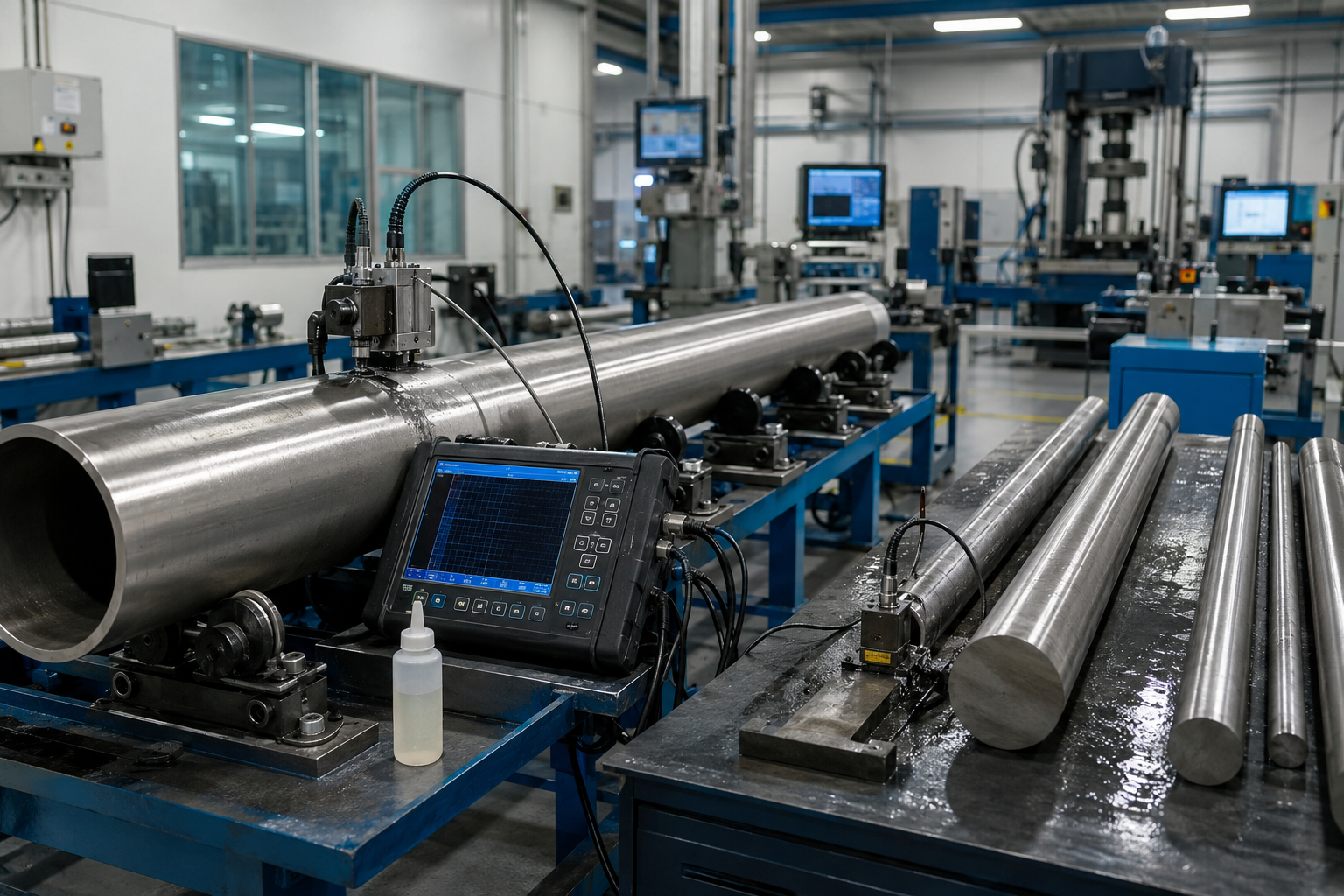
The UK Health and Safety Executive lists corrosion, maintenance faults, leak detection, overpressurisation, structural failure and vibration as heat exchanger risk areas: HSE Heat Exchangers.
AMPP explains that materials selection is influenced by corrosion resistance in the environment, design and test data, mechanical properties, cost, maintainability, compatibility, life expectancy and reliability: AMPP Materials Selection and Design for Corrosion Control.
The NIST corrosion performance database shows that corrosion observations are tied to particular environments, including concentrations and temperatures: NIST Corrosion Performance Databases.
This is why heat exchanger tube inspection should not be separated from material selection and operating conditions.
Why Can’t Buyers Use One Standard Inspection List for All Tubes?
There is no universal inspection list that fits every heat exchanger tube project.
Inspection requirements vary because heat exchanger tubes differ in:
- Material family
- Alloy grade
- Product standard
- Seamless or welded manufacturing route
- Tube size and wall thickness
- Heat treatment condition
- Surface finish
- Tube-side medium
- Shell-side medium
- Temperature and pressure
- Corrosion mechanism
- Fouling and cleaning method
- Failure consequence
- Documentation requirement
A generic inspection list may miss project-specific risks or add unnecessary cost when certain tests are not relevant.
Material and Standard Matter
Different product standards define different tube requirements.
ASTM B338 covers seamless and welded titanium alloy tubes for surface condensers, evaporators and heat exchangers: ASTM B338.
ASTM B163 covers seamless tubes of nickel and nickel alloys for condenser and heat-exchanger service: ASTM B163.
ASTM A213 covers seamless ferritic and austenitic steel boiler, superheater and heat-exchanger tubes: ASTM A213.
These standards help define product requirements, but the buyer should still confirm which inspections are included in the quotation and purchase order.
What Are the Common Inspection Categories?
The following inspection categories are commonly discussed in heat exchanger tube procurement. They should be selected according to the project requirement, not copied blindly.
| Inspection Category | What It Checks | Why It Matters |
|---|---|---|
| Visual Inspection | Surface defects, dents, scratches, cracks, scale, contamination | Helps identify obvious surface quality problems |
| Dimensional Inspection | OD, wall thickness, length, straightness, roundness, tolerance | Confirms fit with tube sheet and bundle design |
| Chemical Analysis | Alloy composition | Confirms material grade and standard compliance |
| Mechanical Testing | Tensile strength, yield strength, elongation | Confirms mechanical properties |
| Hardness Testing | Hardness value if required | Helps verify condition or processing consistency |
| Surface Inspection | Pickled, polished, bright, clean ID / OD, Ra if required | Supports cleaning, fouling and corrosion risk review |
| Eddy Current Testing | Surface or near-surface discontinuities in tubes | Useful for many tubular product inspections |
| Ultrasonic Testing | Volumetric discontinuities in metal pipe and tubing | Useful for internal flaw detection when required |
| Hydrostatic / Leak Testing | Pressure integrity or leak resistance when required | Important for pressure or leak-sensitive applications |
| PMI / Grade Verification | Material identity and grade sorting | Helps reduce material mix-up risk |
| MTR / MTC Review | Batch-specific chemistry and mechanical test results | Supports material traceability |
| Heat Number Traceability | Link between tube and production batch | Helps root-cause review and quality control |
| Corrosion Testing | IGC, pitting, crevice or application-specific tests | Used when project or environment requires it |
| Cleanliness Inspection | Residue, contamination or special cleanliness level | Important for high-purity or oxygen-related service |
| Third-Party Inspection | Independent witness or verification | Used for critical projects or buyer requirements |
How Does Material Type Affect Inspection Focus?
Material type affects inspection focus because different alloys face different risks in different environments.
This does not mean one material always needs the same inspection list. It means the buyer should match inspection scope to both material and service environment.
Possible Inspection Focus by Material Family
| Material Family | Possible Inspection Focus | Important Buyer Note |
|---|---|---|
| Nickel Alloy Tubes | Chemical analysis, MTR / MTC, heat number, dimensional inspection, ECT / UT, tensile test, hardness, surface inspection, corrosion test if required | Exact inspection depends on ASTM standard, alloy grade, chemical environment and project specification |
| Titanium Alloy Tubes | Chemical analysis, MTR / MTC, heat number, dimensional inspection, surface condition, ECT / UT, flattening / flaring if required, cleanliness if required | Surface condition, contamination control and project-specific corrosion risk should be reviewed |
| Stainless Steel Tubes | Chemical analysis, mechanical test, dimensional inspection, hydrostatic / NDT if required, IGC testing if specified | Chlorides, sensitization, temperature and service environment affect inspection needs |
| Duplex / Super Duplex Tubes | Chemical analysis, mechanical test, dimensional inspection, ferrite / phase balance if required, corrosion testing if specified | Welding, heat treatment and phase balance may be important |
| Copper Alloy Tubes | Chemical analysis, dimensional inspection, mechanical tests, eddy current or leak testing if required | Water chemistry, velocity, ammonia, sulfides and fouling should be reviewed |
Nickel Alloy Tube Example
For nickel alloy heat exchanger tubes, buyers may request:
- Chemical analysis
- MTR / MTC
- Heat number traceability
- Dimensional inspection
- Surface inspection
- Tensile test
- Hardness test
- Eddy current testing
- Ultrasonic testing if required
- Hydrostatic or leak testing if required
- Corrosion testing if required
- Third-party inspection if required
ASTM B163 defines seamless nickel and nickel alloy condenser and heat-exchanger tubes, but the buyer should still confirm the testing and documentation scope in the purchase order.
Titanium Tube Example
For titanium heat exchanger tubes, buyers may request:
- Chemical analysis
- MTR / MTC
- Heat number traceability
- Dimensional inspection
- Surface inspection
- Eddy current testing
- Ultrasonic testing if required
- Flattening or flaring test if required by standard or project
- Cleanliness control if required
- Packaging protection
- Third-party inspection if required
ASTM B600 covers descaling and cleaning procedures for titanium and titanium alloy surfaces, including removal of shop soils, oxides, scales and surface contaminants: ASTM B600.
Which NDT Methods Are Common for Heat Exchanger Tubes?
NDT means non-destructive testing. It helps detect certain defects without destroying the tube.
Common NDT methods for heat exchanger tubes include eddy current testing and ultrasonic testing. Other methods may be used depending on material, wall thickness, tube condition and project requirements.
Eddy Current Testing
ASTM E426 is intended as a guide for eddy current examination of both seamless and welded tubular products: ASTM E426.
For buyers, ECT may be relevant when the project needs to check for certain surface or near-surface discontinuities in conductive tubes.
Ultrasonic Testing
ASTM E213 covers a procedure for detecting discontinuities in metal pipe and tubing during volumetric examination using ultrasonic methods: ASTM E213.
UT may be relevant when internal or volumetric discontinuity detection is required.
Mechanical Testing
ASTM E8/E8M covers tension testing of metallic materials, including yield strength, tensile strength, elongation and reduction of area: ASTM E8/E8M.
Mechanical testing helps confirm whether the tube material meets required mechanical properties.
Grade Verification
ASTM E1476 provides guidance for nondestructive identification and sorting of metals: ASTM E1476.
PMI or grade verification can help reduce material mix-up risk, especially for projects involving several alloy grades.
How Do Application and Risk Drive Inspection Choices?
Inspection should match application risk.
A tube used in a low-risk utility water system may not need the same inspection scope as a tube used in a high-pressure chemical process, refinery, offshore system, power plant, seawater condenser or critical shutdown-sensitive unit.
Risk-Based Inspection Considerations
| Application | Key Risks to Review | Possible Inspection Priorities |
|---|---|---|
| Chemical Processing | Acid corrosion, pitting, SCC, leakage, contamination | Chemical analysis, surface inspection, ECT / UT, corrosion testing if required, MTR / MTC |
| Oil & Gas | Pressure, chlorides, sour service, SCC, leakage, fire or environmental risk | MTR / MTC, heat number, PMI, ECT / UT, hydrostatic / leak test if required, third-party inspection |
| Power Generation | High temperature, pressure, creep, fatigue, thermal cycling | Mechanical testing, dimensional inspection, UT, surface inspection, heat treatment verification |
| Marine / Seawater | Chlorides, crevice corrosion, fouling, deposits | Surface inspection, dimensional inspection, ECT, cleanliness, MTR / MTC, material grade verification |
| Desalination | Seawater, brine, fouling, crevice risk | Titanium grade review, surface condition, ECT / UT if required, dimensional and cleanliness checks |
| High-Purity Process | Contamination, surface residue, cleanliness | Cleanliness inspection, surface finish, packaging, MTR / MTC |
| Replacement Tube Project | Unknown failure cause, material mismatch, old drawing issues | Previous failure review, PMI, dimensional inspection, NDT, MTR / MTC, surface inspection |
Important Point
“High risk” does not automatically mean every test is required. It means the inspection scope should be defined clearly by the project standard, failure consequence, operating environment and buyer requirement.
What Corrosion Tests May Be Needed?
Corrosion testing is not automatically required for every heat exchanger tube order. It is usually specified when the project, standard, customer, industry or service environment requires it.
Possible corrosion-related tests include:
- Intergranular corrosion testing
- Pitting corrosion testing
- Crevice corrosion testing
- SCC-related testing
- Customer-specified corrosion test
- Service-specific laboratory evaluation
ASTM A262 covers standard practices for detecting susceptibility to intergranular attack in austenitic stainless steels: ASTM A262.
This does not mean ASTM A262 applies to all heat exchanger tubes. It applies to specific materials and situations. Buyers should avoid copying corrosion tests from one project to another without confirming material and service relevance.
When Does Cleanliness Inspection Matter?
Cleanliness may be important when tubes are used in oxygen-related systems, high-purity processes, medical-related equipment, semiconductor-related systems, or applications where residue and contamination can create risk.
ASTM G93 covers selection of methods and apparatus for cleaning materials and equipment intended for oxygen-enriched environments: ASTM G93/G93M.
For general industrial heat exchanger tubes, standard surface inspection and packaging may be enough. For high-purity or oxygen-related service, cleanliness requirements should be written clearly in the purchase order.
What Documents Should Buyers Request?
Inspection is not only about physical testing. Documentation is also important.
Buyers should confirm what documents are included before placing the order.
Common Documents
| Document | What It Shows |
|---|---|
| Quotation Scope | Which tests and documents are included |
| MTR / MTC | Batch-specific chemical and mechanical data |
| Heat Number | Traceability to production batch |
| Product Standard | ASTM / ASME / EN / ISO / customer standard |
| Chemical Analysis Report | Alloy composition |
| Mechanical Test Report | Tensile, hardness or other properties |
| Dimensional Report | OD, WT, length and tolerance |
| Surface Inspection Report | Visual and surface condition |
| NDT Report | ECT, UT or other NDT result if required |
| Hydrostatic / Leak Test Report | Pressure or leak test result if required |
| PMI / Grade Verification Report | Material identity check |
| Third-Party Inspection Report | Independent inspection when required |
| Packing List / Marking Record | Shipment and traceability details |
ISO explains that the ISO 9000 family helps organizations improve product and service quality and consistently meet customer expectations: ISO 9000 Family.
However, ISO certification does not replace batch-specific MTR, heat number traceability, inspection reports or buyer-required testing.
What About EN 10204 3.1 and 3.2?
Some projects require EN 10204 inspection documents.
A Type 3.1 certificate is commonly used for manufacturer-issued batch-specific inspection results. A Type 3.2 certificate adds independent verification when required by the buyer, project or regulation.
ABS explains that EN 10204 Type 3.2 certification may involve a third-party surveyor performing visual examination, sample dimensional checks, material traceability confirmation and witnessing mechanical tests: ABS EN 10204 Type 3.2 Certification.
LRQA also describes EN 10204 Type 3.2 certification as helping prove that materials meet defined chemical and mechanical properties: LRQA EN 10204 Type 3.2 Certification.
Not every order needs Type 3.2. Buyers should specify the certificate level before production, because it can affect inspection planning, lead time and cost.
What Role Does Supplier Communication Play?
Clear supplier communication helps define the correct inspection scope.
A supplier cannot select the correct inspection plan if the buyer only provides grade, size and quantity. The supplier also needs to understand the application, media, temperature, pressure, corrosion risk, testing requirement and documentation requirement.
Information Buyers Should Share
| Information Category | Details to Provide | Why It Affects Inspection |
|---|---|---|
| Application | Condenser, evaporator, heater, cooler, chemical exchanger, seawater system | Helps define risk level and inspection scope |
| Material | Grade, UNS number, ASTM / ASME standard | Determines chemical, mechanical and product requirements |
| Tube Type | Seamless, welded, straight tube, U-tube | Affects manufacturing and inspection needs |
| Size | OD, WT, length, tolerance | Defines dimensional inspection |
| Tube-Side Medium | Seawater, acid, brine, steam, cooling water, process fluid | Affects corrosion and cleanliness review |
| Shell-Side Medium | Steam, water, gas, chemical, air | May also affect corrosion or temperature risk |
| Temperature | Normal, maximum, cleaning, shutdown | Affects material and corrosion risk |
| Pressure | Operating and design pressure | Affects wall thickness and pressure test needs |
| Flow Condition | Velocity, solids, turbulence, stagnant zones | Affects erosion, fouling and deposit risk |
| Fouling Risk | Scale, biofilm, suspended solids, deposits | Affects surface and cleaning requirements |
| Cleaning Method | Mechanical or chemical cleaning | Cleaning chemicals may affect material suitability |
| Standard | ASTM, ASME, EN, ISO, customer specification | Defines mandatory tests and documentation |
| Certificate | MTR / MTC, EN 10204 3.1 or 3.2 | Defines documentation and witness requirements |
| Inspection | Internal, customer, or third-party inspection | Affects schedule, cost and release process |
| Packaging | End caps, wooden case, special cleanliness | Protects tube surface and traceability |
A good supplier should ask technical questions before quoting if the application is critical or the inspection scope is unclear.
Heat Exchanger Tube Inspection Checklist for Buyers
Before placing an order, buyers can use the following checklist.
| Checklist Item | Confirmed? |
|---|---|
| Product standard is clearly stated | |
| Material grade and UNS number are stated | |
| Seamless or welded type is stated | |
| OD, wall thickness, length and tolerance are stated | |
| Surface condition is defined | |
| Tube-side and shell-side media are provided | |
| Temperature and pressure are provided | |
| Corrosion, fouling and cleaning risks are shared | |
| Required visual inspection is defined | |
| Required dimensional inspection is defined | |
| Chemical analysis and mechanical testing are defined | |
| ECT / UT / hydrostatic testing is defined if required | |
| PMI / grade verification is defined if required | |
| Corrosion testing is defined if required | |
| MTR / MTC and heat number traceability are required | |
| EN 10204 3.1 / 3.2 is specified if required | |
| Third-party inspection is specified before production | |
| Packaging and marking requirements are defined |
This checklist helps buyers compare quotations on the same basis.
Example Inspection Requirement Wording
Buyers can write inspection requirements like this:
“ASTM B338 Titanium Grade 2 seamless tubes, OD 25.4 mm × WT 1.2 mm × 6000 mm, pickled surface. MTR / MTC and heat number traceability required. Visual inspection, dimensional inspection, chemical analysis, mechanical test, eddy current testing and surface inspection required. Third-party inspection option to be quoted separately.”
For nickel alloy tubes:
“ASTM B163 Alloy 625 seamless heat exchanger tubes, OD 19.05 mm × WT 1.65 mm × 6000 mm, annealed and pickled. MTR / MTC, heat number traceability, chemical analysis, tensile test, dimensional inspection, surface inspection and hydrostatic or NDT testing as required by purchase order. EN 10204 3.1 certificate required.”
This is clearer than simply writing:
“Please quote heat exchanger tubes with inspection.”
How Emily PIPE Supports Heat Exchanger Tube Buyers
Emily PIPE is a China-based manufacturer and exporter specializing in nickel alloy tubes, nickel alloy bars, titanium alloy tubes and titanium alloy bars. We support customers across chemical processing, oil and gas, marine engineering, aerospace, power generation, medical equipment, heat exchangers, desalination and other corrosion-resistant or high-temperature applications.
For heat exchanger tube projects, we can support:
- Nickel alloy seamless tubes
- Nickel alloy welded tubes
- Titanium seamless tubes
- Titanium welded tubes
- ASTM B163 nickel alloy tube requirements
- ASTM B338 titanium tube requirements
- ASTM A213 stainless / alloy steel tube requirements when applicable
- Custom OD, wall thickness, length, tolerance and surface condition
- MTR / MTC and heat number traceability
- Dimensional and surface inspection
- PMI, eddy current, UT, hydrostatic, tensile, hardness and other testing support when required
- EN 10204 3.1 / 3.2 support when required by project
- Third-party inspection support
- Export packaging and logistics support
Our role is not to claim that one inspection list fits every project. Our role is to help buyers clarify material, standard, application, inspection, documentation and delivery requirements before production.
If you are preparing a heat exchanger tube order, please send your material grade, standard, size, quantity, tube-side medium, shell-side medium, temperature, pressure, corrosion risk, fouling risk, cleaning method, testing requirement, certificate requirement, inspection requirement and destination. Our team can help review your requirements and provide a suitable quotation.
FAQ: Heat Exchanger Tube Inspections
1. Is there one standard inspection list for all heat exchanger tubes?
No. Inspection requirements depend on material, product standard, application, operating environment, risk level and buyer specification.
2. What inspections are commonly used for heat exchanger tubes?
Common inspections may include visual inspection, dimensional inspection, chemical analysis, tensile testing, hardness testing, ECT, UT, hydrostatic or leak testing, surface inspection, PMI, MTR / MTC review and heat number traceability.
3. Do all tubes need eddy current testing?
Not always. Eddy current testing should be specified according to the tube standard, material, service risk and buyer requirement.
4. Do all tubes need ultrasonic testing?
No. Ultrasonic testing is useful for certain volumetric discontinuity checks, but it should be required only when relevant to the product standard, wall thickness, service risk or purchase order.
5. Is ISO 9001 enough to prove tube quality?
No. ISO quality management certification is useful, but buyers still need batch-specific MTR / MTC, heat number traceability, inspection records and test reports when required.
6. What is the difference between EN 10204 3.1 and 3.2?
Type 3.1 is generally manufacturer-issued batch-specific inspection documentation. Type 3.2 adds independent verification when required by the buyer, project or regulation.
7. Should corrosion testing always be required?
No. Corrosion testing should be specified when required by standard, project, material, environment or customer specification.
8. What should buyers tell suppliers before confirming inspection requirements?
Buyers should provide application, media, temperature, pressure, material grade, standard, tube type, corrosion risk, fouling risk, cleaning method, documentation requirements and third-party inspection needs.
Conclusion
Heat exchanger tube inspection is not a generic checklist. It is a context-driven decision based on material, standard, manufacturing route, application, operating environment and failure consequence.
A clear inspection scope helps reduce quotation ambiguity, missed tests, material mix-up, documentation gaps and quality disputes.
For nickel alloy and titanium heat exchanger tubes, buyers should define inspection requirements before production, including MTR / MTC, heat number traceability, dimensional inspection, surface inspection, NDT, mechanical testing, corrosion testing and third-party inspection when required.