
How EPC Buyers Should Prepare Alloy Material Lists for Industrial Projects
An alloy material list is often treated as a purchasing spreadsheet containing material grades, sizes, quantities, and standards.
That may be enough for early estimating.
It is not enough for controlled engineering procurement.
In a complex industrial project, a dependable material decision must connect the process environment, credible damage mechanisms, equipment function, design code, product form, manufacturing condition, welding system, inspection level, documentation, and supplier source.
A list that contains only “Alloy 625 pipe,” “C276 tube,” or “Titanium Grade 2 bar” leaves many important questions unanswered.
A reliable EPC alloy material list should not attempt to replace the materials-selection report, equipment specification, material requisition, material take-off, inspection plan, or supplier-document requirements. It should connect these documents through one controlled and traceable materials register.
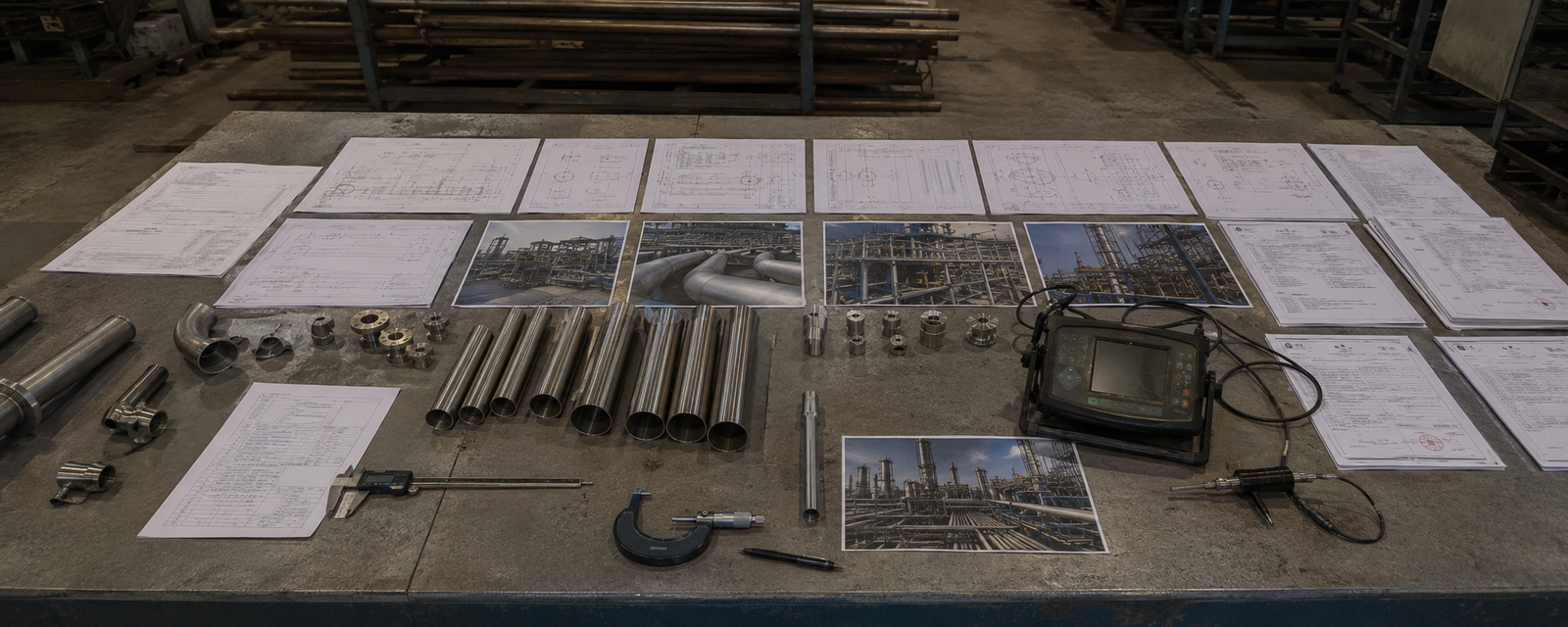
The practical objective is not to create the longest spreadsheet.
It is to make sure that every selected material can be traced back to an approved service condition and forward to an unambiguous purchase requirement.
What Is an Alloy Material List?
The term “alloy material list” is not used identically by every owner, EPC contractor, or industry.
It may refer to:
- A preliminary list of corrosion-resistant alloys;
- a project materials-of-construction table;
- a piping material-class summary;
- an equipment materials register;
- a material take-off;
- a bill of materials;
- a procurement package index;
- a vendor quotation comparison sheet.
These documents do not serve the same purpose.
Before preparing the list, the EPC team should define whether it is intended to record:
- Material-selection decisions;
- technical purchase requirements;
- item quantities;
- supplier and delivery status;
- inspection and documentation requirements;
- all of the above through linked references.
A useful master register may contain summary information from all these areas, but the detailed requirements should remain in their controlled source documents.
Separate the Main EPC Materials Documents
Document names vary between clients and EPC organizations, but the underlying functions should remain separate.
| Document | Primary Purpose | What It Should Not Be Used to Replace |
|---|---|---|
| Design Basis | Defines codes, design life, environmental assumptions and project philosophy | Detailed item specification |
| Process Design Basis | Defines fluids, operating cases, pressure, temperature and compositions | Corrosion assessment |
| Corrosion Control Philosophy | Establishes corrosion prevention, monitoring and mitigation strategy | Product MTR |
| Materials Selection Report | Explains why materials were selected for each service | Quantity take-off |
| Damage Mechanism Register | Identifies credible corrosion, aging, wear and cracking mechanisms | Final procurement specification |
| Materials Selection Diagram | Visually assigns materials to process systems and boundaries | Detailed component standard |
| Materials of Construction Table | Summarizes selected materials by equipment or system | Full equipment datasheet |
| Piping Material Specification / Class | Defines permitted piping components within stated design limits | Equipment internals specification |
| Material Data Sheet | Defines detailed material, heat treatment, testing and delivery requirements | Vendor production records |
| Equipment Datasheet | Defines process, mechanical, material and inspection requirements for equipment | General project material philosophy |
| Material Requisition | Forms the contractual technical package for quotation and purchase | Final vendor document package |
| MTO / BOM | Defines quantities and item identification | Material suitability justification |
| Inspection and Test Plan | Defines inspections, tests, witness points and document review | Materials-selection decision |
| Vendor Document Requirement | Defines what records must be submitted and when | Physical material inspection |
The most important distinction is:
Materials selection explains the decision. Procurement specifications define the requirement. MTO and BOM define the quantity. Inspection records demonstrate conformity.
Build the List from the Project Design Basis
The material list should not begin with alloy names.
It should begin with controlled project inputs.
Applicable Project Basis
Confirm:
- Project location;
- applicable laws and regulations;
- owner specifications;
- EPC specifications;
- design code;
- code edition and addenda;
- design life;
- availability target;
- inspection philosophy;
- maintenance strategy;
- environmental conditions;
- approved vendor requirements;
- local content requirements;
- restrictions on material substitutions.
The latest published code edition is not automatically the contractual edition.
The project should explicitly identify which editions apply and how conflicts are resolved.
Process Basis
For each service, define:
- Fluid name;
- complete composition;
- normal concentration;
- maximum concentration;
- trace contaminants;
- water content;
- solids;
- dissolved gases;
- pH;
- oxidation-reduction conditions;
- operating pressure;
- design pressure;
- operating temperature;
- design temperature;
- minimum temperature;
- wall temperature;
- flow velocity;
- phase;
- startup;
- shutdown;
- cleaning;
- regeneration;
- depressurization;
- credible upset conditions.
A material selected only for normal steady operation may be unsuitable during cleaning, shutdown, concentration, condensation, or loss of process control.
Create a Service-by-Service Operating Envelope
A useful material list should be system-based rather than alloy-based.
Instead of grouping all Alloy 625 items together, first group components by the environment they experience.
Example Service Definition
| Field | Example Entry |
|---|---|
| System | Acid-recovery overhead |
| Service | Wet acidic condensate |
| Normal temperature | Project value |
| Maximum temperature | Project value |
| Design temperature | Project value |
| Pressure | Project value |
| Main chemicals | Defined by process data |
| Chloride range | Minimum to maximum |
| Water content | Defined operating range |
| Condensation | Continuous or intermittent |
| Solids | Present or absent |
| Oxygen condition | Aerated, deaerated or variable |
| Cleaning medium | Defined cleaning chemistry |
| Credible upset | Loss of neutralization |
| Damage mechanisms | Pitting, crevice corrosion, SCC and erosion as applicable |
| Selected material | Approved project selection |
| Selection basis | Materials-selection report reference |
| Verification | Test, operating experience or owner approval |
This structure preserves the engineering logic behind the final alloy grade.
Identify Damage Mechanisms Before Selecting Materials
ISO 21457 materials-selection guidance provides one industry example of identifying corrosion mechanisms and relevant parameters before completing material selection.
API RP 571 damage-mechanism guidance provides another example for fixed equipment in refining service.
The applicable mechanisms depend on the project, but may include:
Corrosion Mechanisms
- Uniform corrosion;
- pitting;
- crevice corrosion;
- galvanic corrosion;
- intergranular corrosion;
- corrosion under insulation;
- microbiologically influenced corrosion;
- under-deposit corrosion;
- erosion-corrosion;
- high-temperature oxidation;
- sulfidation;
- carburization;
- metal dusting;
- molten-salt corrosion.
Environmentally Assisted Cracking
- Chloride stress corrosion cracking;
- caustic cracking;
- sulfide stress cracking;
- hydrogen-induced cracking;
- stress-oriented hydrogen-induced cracking;
- ammonia-related cracking;
- polythionic-acid SCC;
- primary-water or other service-specific SCC.
Mechanical and Time-Dependent Damage
- Mechanical fatigue;
- corrosion fatigue;
- thermal fatigue;
- creep;
- creep–fatigue;
- vibration;
- cavitation;
- fretting;
- abrasion;
- brittle fracture;
- thermal embrittlement.
The list should identify the mechanism that each material decision is intended to control.
“Corrosion resistant” is not a sufficiently precise selection basis.
Distinguish Design Requirements from Product Requirements
A selected alloy must satisfy two different questions:
1. Is the material suitable for the service?
This may depend on:
- Corrosion data;
- service history;
- laboratory testing;
- temperature;
- stress;
- fluid chemistry;
- product purity;
- design life;
- inspection access;
- corrosion allowance;
- maintenance.
2. Does the supplied product conform to the purchase requirement?
This may depend on:
- Product specification;
- UNS or grade;
- product form;
- dimensions;
- heat treatment;
- chemical composition;
- mechanical properties;
- NDT;
- inspection document;
- marking;
- traceability;
- packaging.
A product-standard certificate answers the second question.
It does not automatically answer the first.
Product Form Must Be Explicit
The same nominal alloy may be supplied as:
- Plate;
- sheet;
- strip;
- seamless pipe;
- welded pipe;
- heat-exchanger tube;
- bar;
- billet;
- forging;
- fitting;
- flange;
- casting;
- wire;
- welding consumable.
Each form may follow a different standard and manufacturing route.
Examples include:
- ASTM B444 nickel alloy pipe and tube;
- ASTM B622 nickel alloy pipe and tube;
- ASTM B574 nickel alloy bar;
- ASTM B348 titanium bar.
These links illustrate product-form separation. The project must verify and specify the applicable current or contractually required revision.
Why Product Form Matters
Product form can affect:
- Heat treatment;
- grain structure;
- sampling;
- allowable dimensions;
- test frequency;
- surface condition;
- NDT;
- dimensional tolerance;
- mechanical-property requirements;
- welding and fabrication.
An alloy designation alone is therefore incomplete.
Define the Exact Material Condition
A technically complete material entry may need to identify:
- Grade;
- UNS designation;
- ASTM, ASME, EN or other specification;
- specification revision;
- annealed, solution-annealed, age-hardened or cold-worked condition;
- grade or class within the standard;
- seamless or welded construction;
- hot-finished, cold-finished, peeled, turned or ground surface;
- pickled, bright-annealed or polished finish;
- grain-size requirement;
- hardness limits;
- impact requirements;
- supplementary testing;
- special chemistry restrictions.
For example, two products with the same UNS number may have different mechanical properties because they are supplied in different heat-treatment conditions.
Define Material Boundaries
Many EPC material errors occur at interfaces rather than within major equipment.
The materials-selection diagram or register should identify boundaries at:
- Process-unit battery limits;
- equipment nozzles;
- piping-class breaks;
- buried-to-aboveground transitions;
- lined-to-solid-alloy transitions;
- wet-to-dry gas boundaries;
- hot-to-cold zones;
- utility tie-ins;
- temporary connections;
- vents and drains;
- sampling points;
- instrument connections;
- package-unit interfaces.
The boundary should be based on the actual environment and design responsibility—not only the P&ID line number.
Build Piping Material Classes from the Approved Selection
ASME B31.3 process-piping requirements cover materials, components, design, fabrication, examination, inspection and testing for process piping.
A piping material class should typically define:
- Design pressure-temperature range;
- base pipe material;
- seamless or welded construction;
- schedule or wall selection;
- fittings;
- flanges;
- branch connections;
- valves;
- bolting;
- gaskets;
- corrosion allowance;
- end connections;
- welding consumables;
- heat treatment;
- impact requirements;
- NDT;
- service restrictions;
- prohibited components;
- supplementary requirements.
It should not be created by copying a previous project class without checking the current service and code basis.
Pressure Vessels Need Equipment-Specific Material Control
ASME Section VIII pressure-vessel requirements connect pressure-vessel materials with design, fabrication, inspection, testing and certification.
A vessel materials entry may need separate requirements for:
- Shell;
- heads;
- nozzles;
- reinforcement;
- flanges;
- internals;
- support skirt;
- clips;
- trays;
- distributors;
- cladding;
- weld overlay;
- lining;
- bolting;
- gaskets;
- attachments.
“C276 reactor” is therefore not a complete material definition.
The vessel may use solid alloy, clad steel, weld overlay, lining, or several materials in different zones.
Heat Exchangers Need Separate Fluid-Side Evaluation
A heat exchanger contains at least two service environments.
The material list should distinguish:
- Tube-side medium;
- shell-side medium;
- tubes;
- tubesheet;
- shell;
- channel;
- bonnet;
- baffles;
- tie rods;
- tube-to-tubesheet joint;
- gasket;
- bolting;
- impingement protection.
The tube-wall temperature may differ from both bulk-fluid temperatures.
Local concentration, fouling, deposits, condensation and cleaning must also be considered.
Tube and tubesheet compatibility should include:
- Galvanic behavior;
- differential expansion;
- joint method;
- crevice corrosion;
- weldability;
- inspection;
- repairability.
Rotating Equipment Requires Function-Based Materials
Pump and compressor materials should not be copied directly from piping classes.
Separate requirements may apply to:
- Casing;
- impeller;
- shaft;
- shaft sleeve;
- wear rings;
- bearings;
- fasteners;
- mechanical-seal parts;
- diaphragms;
- valve internals.
The selection should address:
- Corrosion;
- strength;
- fatigue;
- stiffness;
- galling;
- wear;
- cavitation;
- erosion;
- dimensional stability;
- magnetic requirements;
- surface finish.
The raw-material form may also differ between cast casings, forged shafts and bar-machined components.
Include Welding Consumables in the Material System
The base metal alone does not define the fabricated material system.
The list or linked material data sheet should identify:
- Welding process;
- filler-metal classification;
- matching or over-alloyed filler;
- autogenous welding restrictions;
- heat input;
- interpass temperature;
- purge requirements;
- post-weld heat treatment;
- repair welding;
- ferrite or phase requirements where applicable;
- weld-metal corrosion requirements;
- weld and HAZ testing.
A supplier should not substitute filler metal because it is described as “equivalent.”
Define Corrosion Allowance Correctly
Corrosion allowance can be useful where predictable uniform loss is credible.
It is not an effective solution for:
- Pitting;
- crevice corrosion;
- SCC;
- hydrogen cracking;
- brittle fracture;
- galvanic attack;
- product contamination;
- liner failure;
- localized weld attack.
The material list should state:
- Corrosion allowance;
- basis;
- applicable surfaces;
- whether machining allowance is separate;
- whether erosion allowance is separate;
- whether clad or overlay thickness is structural;
- remaining minimum thickness criteria.
Include Linings, Cladding and Weld Overlay
A high-alloy solid material is not the only construction option.
The project may evaluate:
- Solid alloy;
- clad plate;
- weld overlay;
- loose lining;
- bonded lining;
- fluoropolymer lining;
- rubber lining;
- glass lining;
- ceramic lining;
- composite construction.
The list should specify:
- Substrate;
- wetted material;
- lining or clad thickness;
- bonding method;
- weld details;
- inspection;
- holiday testing where applicable;
- repair procedures;
- temperature and pressure limits;
- nozzle transition details.
Establish a Master Alloy Materials Register
A practical master register may include the following fields.
Identification
- Project number;
- unit;
- area;
- system;
- equipment or line tag;
- component;
- service;
- P&ID or drawing reference;
- responsible discipline;
- document revision.
Operating Environment
- process medium;
- complete composition reference;
- phase;
- normal pressure;
- design pressure;
- normal temperature;
- design temperature;
- minimum temperature;
- wall temperature;
- flow velocity;
- solids;
- chloride;
- sulfur species;
- oxygen or oxidizers;
- pH;
- water content;
- cleaning medium;
- upset case;
- external environment;
- insulation.
Engineering Assessment
- design life;
- applicable damage mechanisms;
- corrosion-rate basis;
- localized-corrosion concern;
- SCC concern;
- fatigue or creep concern;
- product-purity requirement;
- corrosion allowance;
- inspection access;
- monitoring strategy.
Material Definition
- selected material family;
- alloy grade;
- UNS designation;
- product form;
- material specification;
- specification revision;
- ASME or ASTM designation;
- heat-treatment condition;
- seamless or welded;
- surface condition;
- lining or cladding;
- weld overlay;
- filler metal;
- bolting material;
- gasket material.
Manufacturing and Inspection
- dimensional requirements;
- impact test;
- hardness limit;
- grain or microstructure requirement;
- heat-treatment record;
- PMI;
- UT;
- ET;
- RT;
- PT;
- hydrostatic or pneumatic testing;
- corrosion testing;
- third-party witness;
- hold points;
- inspection-document type.
Procurement and Approval
- material requisition reference;
- MDS reference;
- piping class or equipment datasheet;
- MTO/BOM reference;
- approved manufacturer requirement;
- original mill requirement;
- traceability level;
- substitution status;
- technical-query status;
- approval status;
- responsible approver;
- final vendor;
- delivery status;
- final dossier reference.
Not every project requires every field in one spreadsheet.
The key is ensuring that every field is controlled somewhere and linked clearly.
Use Status Codes to Control Incomplete Decisions
During FEED and early detailed design, some data will be incomplete.
The register should distinguish between:
- Approved;
- approved with conditions;
- preliminary;
- pending process data;
- pending corrosion test;
- pending owner approval;
- vendor to confirm;
- not permitted for procurement;
- superseded.
A blank cell should not be interpreted as approval.
Unknown data should be visible and assigned to a responsible party.
Control Standard Versions
The material list should record the exact revision of:
- Design code;
- material specification;
- dimensional standard;
- valve or fitting standard;
- welding standard;
- NDT method;
- inspection-document standard;
- owner specification.
The project should also define a hierarchy of requirements.
A typical hierarchy might consider:
- Applicable law and regulation;
- contract and owner requirements;
- design code;
- project specifications;
- material data sheet;
- material requisition;
- referenced product standards;
- approved vendor documents.
The actual hierarchy must be defined by the contract.
When two requirements conflict, the supplier should raise a technical query rather than select the easier requirement.
Do Not Accept “Equivalent Material” Without Engineering Review
Two materials may appear equivalent because they have:
- Similar chemistry;
- the same common trade name;
- similar tensile strength;
- cross-reference-table correspondence;
- the same UNS designation.
This does not automatically establish equivalence.
The review may need to compare:
- Product standard;
- code listing;
- allowable stress;
- heat treatment;
- dimensions;
- toughness;
- hardness;
- corrosion resistance;
- welding;
- product form;
- NDT;
- operating history;
- availability;
- regulatory approval.
Every substitution should be documented through an approved deviation or material-equivalency process.
Define the Required Inspection Documents
BS EN 10204 inspection documents defines different metallic-product inspection-document categories.
The purchase order should specify the required document rather than state only “material certificate required.”
MTR or MTC
May provide:
- Heat number;
- material grade;
- chemistry;
- mechanical properties;
- heat treatment;
- product specification;
- selected test results.
Does not normally prove:
- Application suitability;
- corrosion life;
- finished-equipment conformity;
- compliance with every project requirement.
Certificate of Conformance
Confirms that the supplier declares conformity with stated order requirements.
It does not replace objective test reports where those reports are required.
EN 10204 3.1
Supports specific inspection documentation validated by the manufacturer’s authorized inspection representative independent of the manufacturing department, as defined by the standard.
It is not automatically an independent third-party certificate.
EN 10204 3.2
Involves validation by the manufacturer’s authorized representative and either the purchaser’s representative or an officially designated inspection representative, according to the applicable requirement.
The project should define who performs the validation and what is witnessed.
Build an Inspection and Test Plan
The ITP should identify:
- Activity;
- acceptance criteria;
- governing procedure;
- responsible organization;
- document to be generated;
- review point;
- witness point;
- hold point;
- sampling frequency;
- final approval.
Possible activities include:
- Raw-material receipt;
- chemistry;
- mechanical testing;
- heat treatment;
- dimensions;
- surface inspection;
- PMI;
- UT;
- ET;
- RT;
- PT;
- pressure testing;
- corrosion testing;
- marking;
- packing;
- final dossier review.
“100% inspection” is incomplete unless the method, sensitivity, coverage and acceptance criteria are defined.
Verify Laboratory Capability
ISO/IEC 17025 laboratory competence provides the framework used to assess testing and calibration laboratory competence.
The EPC buyer should verify:
- Laboratory legal name;
- test location;
- accreditation body;
- certificate validity;
- accredited scope;
- exact method;
- equipment;
- sample identity;
- report authorization;
- subcontracted testing.
A laboratory may hold ISO/IEC 17025 accreditation while the required corrosion, fatigue, chemical, or NDT method is outside its scope.
ISO 9001 Does Not Replace Technical Qualification
ISO 9001 quality management addresses an organization’s quality-management system.
It can support evaluation of:
- Process control;
- documented information;
- nonconformance;
- corrective action;
- internal audit;
- continual improvement.
It does not prove:
- The offered alloy is correct;
- the heat treatment is correct;
- the material meets the MTR;
- corrosion performance;
- project-standard compliance;
- product traceability for the order.
The certificate should also be checked for:
- Company name;
- manufacturing address;
- scope;
- certification body;
- accreditation;
- validity.
Map the Complete Supply Chain
The quoted supplier may not perform every operation.
The supply chain may include:
- Melt producer;
- ingot producer;
- forging or extrusion mill;
- tube mill;
- bar finisher;
- heat-treatment facility;
- machining company;
- testing laboratory;
- stockist;
- exporter;
- third-party inspector.
The EPC buyer should identify:
- Who owns the material at each stage?
- Who performs each process?
- Which site appears on the MTR?
- Which processes are subcontracted?
- How are subcontractors approved?
- How is the heat number preserved?
- Who can authorize changes?
- Who is responsible for nonconformance?
- Which organization issues the final CoC?
A trading company is not automatically unsuitable.
A manufacturer is not automatically qualified.
The decision depends on control, traceability, capability, approval status, and contractual responsibility.
Verify Heat-to-Piece Traceability
Traceability should remain intact through:
- Original melt;
- heat treatment;
- hot or cold processing;
- cutting;
- straightening;
- machining;
- testing;
- marking;
- packing;
- delivery.
For cut bars, tubes, or pipes, the procedure should explain:
- How heat numbers are transferred;
- who performs re-marking;
- what records link the original and cut pieces;
- how mixed heats are prevented;
- how damaged markings are restored;
- how labels correspond to certificates.
“Full traceability” should be converted into a documented procedure.
Review Supplier Claims Critically
Avoid relying on statements such as:
- Nuclear grade;
- aerospace quality;
- zero corrosion;
- universal chemical resistance;
- identical to;
- better than;
- 100% defect free;
- certified material;
- full inspection.
Instead, request:
- Exact standard;
- exact revision;
- actual mill;
- actual manufacturing route;
- actual certificate;
- actual test method;
- actual acceptance criteria;
- actual certificate scope;
- actual project reference.
A supplier claim is useful only when it can be converted into a verifiable purchase requirement.
Control Technical Deviations
A deviation process should cover proposed changes to:
- Material grade;
- original manufacturer;
- product form;
- heat treatment;
- standard revision;
- dimensions;
- surface condition;
- melting route;
- test method;
- NDT frequency;
- laboratory;
- certificate type;
- delivery condition.
A proper deviation request should include:
- Original requirement;
- proposed alternative;
- reason;
- technical comparison;
- risks;
- affected documents;
- schedule and cost impact;
- required approvals;
- final disposition.
Commercial urgency should not bypass technical approval.
Use Risk-Based Procurement Levels
Not every item requires the same evidence package.
| Procurement Level | Typical Example | Possible Control Level |
|---|---|---|
| Low-criticality non-wetted item | External bracket or support | Grade, dimensions and basic certificate |
| Standard utility item | Non-aggressive service pipe | Product standard, MTR and routine inspection |
| Corrosion-resistant process item | Nickel-alloy pipe or titanium tube | Full heat traceability, MTR, dimensions, PMI and specified NDT |
| Pressure boundary | Vessel, piping or exchanger component | Code compliance, approved manufacturer, ITP and complete records |
| Severe-service component | High-temperature, sour, toxic or mixed-chemical service | Additional testing, source surveillance and restricted substitution |
| Safety- or license-critical item | Project-defined critical equipment | Enhanced QA, approved sources, hold points and long-term records |
| New material or new application | Material without sufficient project history | Formal qualification program and design-authority approval |
Risk level should be established by the project—not by material price alone.
Evaluate Total Cost Without Automatically Over-Specifying
The lowest purchase price is not always the lowest project cost.
The highest-alloyed material is not automatically the lowest-risk solution.
Under-Specification May Increase
- Corrosion monitoring;
- repair;
- replacement;
- inspection;
- downtime exposure;
- product contamination;
- requalification;
- emergency procurement.
Over-Specification May Increase
- Material cost;
- machining time;
- welding complexity;
- inspection burden;
- lead time;
- source dependence;
- spare-part cost;
- construction difficulty.
A practical evaluated-cost model can include:
Evaluated cost = material + fabrication + inspection + testing + installation + maintenance + replacement exposure + supply risk
The material should be sufficient for the approved design basis without adding unsupported complexity.
EPC Workflow from FEED to Project Handover
FEED Stage
Develop:
- Materials-selection philosophy;
- preliminary corrosion assessment;
- preliminary MSD;
- candidate alloy families;
- critical data-gap register;
- preliminary cost and availability review.
Detailed Engineering
Complete:
- Process operating envelope;
- damage mechanism register;
- materials-selection report;
- final MSD;
- piping classes;
- equipment materials;
- MDS;
- corrosion allowance;
- welding and inspection requirements.
Procurement
Issue:
- Material requisition;
- approved specifications;
- quantity and dimensions;
- ITP;
- vendor-document requirements;
- approved manufacturer requirements;
- deviation procedure;
- certificate and traceability requirements.
Vendor Evaluation
Review:
- Technical compliance;
- deviations;
- actual manufacturer;
- product form;
- heat treatment;
- inspection;
- documentation;
- capacity;
- schedule;
- subcontractors;
- supply-chain risk.
Manufacturing
Control:
- Approved procedures;
- material identification;
- process sequence;
- heat treatment;
- testing;
- inspection;
- nonconformance;
- change control;
- document generation.
Construction
Verify:
- Received material;
- marking;
- certificate linkage;
- storage;
- segregation;
- PMI;
- field substitutions;
- welding consumables;
- preservation.
Handover
Compile:
- Final MTRs;
- CoCs;
- NDT;
- heat-treatment records;
- test reports;
- weld records;
- deviation approvals;
- as-built material register;
- final dossier index.
Common Mistakes When Preparing Alloy Material Lists
1. Starting with Alloy Names
Start with service conditions and damage mechanisms.
2. Combining Selection, Quantity, and Inspection into One Uncontrolled Spreadsheet
Link the documents but preserve their separate functions.
3. Using Only Normal Operating Conditions
Include design, startup, shutdown, cleaning, upset, and external exposure.
4. Writing Only a Commercial Alloy Name
Include UNS, product standard, form, condition, and revision.
5. Assuming the Same UNS Is Interchangeable Across Forms
Tube, bar, plate, forging, and casting requirements differ.
6. Copying Material Classes from an Earlier Project
Previous classes may have different fluids, codes, corrosion allowance, or owner requirements.
7. Using MTO as the Materials-Selection Record
MTO defines quantity, not technical justification.
8. Treating an MTR as Application Approval
It normally proves stated batch properties, not service life.
9. Treating ISO 9001 as Product Certification
It describes the supplier’s management system.
10. Requesting EN 10204 3.1 Without Understanding It
The document type must match the actual inspection and validation requirement.
11. Accepting “Equivalent” Materials from Cross-Reference Tables
Formal engineering review is still required.
12. Omitting Welding Consumables
The fabricated weld system may not match the base-metal behavior.
13. Ignoring Small-Bore, Vent, Drain, and Instrument Connections
These are common material-boundary and dead-leg locations.
14. Leaving Standard Revisions Unspecified
The supplier may quote a different edition from the project basis.
15. Auditing Only the Sales Company
Verify the actual manufacturing and testing locations.
16. Reviewing Documents Only After Shipment
Document requirements should be reviewed before manufacturing and at defined hold points.
EPC Alloy Material List Review Checklist
Before approving the list, confirm:
- Is the project design basis referenced?
- Are applicable regulations and codes identified?
- Are code editions and addenda defined?
- Is the project design life stated?
- Are all process services identified?
- Is the complete fluid composition available?
- Are trace contaminants included?
- Are normal, design, minimum and upset temperatures defined?
- Are pressure cycles and thermal cycles considered?
- Are startup and shutdown conditions included?
- Are cleaning and regeneration media included?
- Is the external environment included?
- Are credible damage mechanisms listed?
- Is the corrosion allowance justified?
- Are localized-corrosion risks addressed?
- Are SCC and hydrogen risks addressed?
- Are creep and fatigue relevant?
- Is product purity relevant?
- Is each material boundary defined?
- Is every equipment component assigned a material?
- Are tube-side and shell-side environments separated?
- Are internals, fasteners and gaskets included?
- Is product form identified?
- Is the exact alloy and UNS stated?
- Is the material standard stated?
- Is the standard revision stated?
- Is the heat-treatment condition stated?
- Is seamless or welded construction stated?
- Is surface finish stated?
- Are dimensions and tolerances linked?
- Are welding consumables specified?
- Are PWHT and heat-treatment requirements included?
- Are lining, cladding and overlay requirements included?
- Are PMI and NDT requirements defined?
- Are acceptance criteria stated?
- Are laboratory requirements stated?
- Is the EN 10204 document type defined?
- Is original-mill traceability required?
- Are approved manufacturers identified?
- Are subcontracted processes controlled?
- Is the deviation process defined?
- Are substitutions prohibited without approval?
- Are hold and witness points defined?
- Is the MTO linked to the technical specification?
- Is final dossier content defined?
- Is the approval status of every item visible?
- Are unresolved data gaps recorded?
- Is one discipline responsible for final materials coordination?
Frequently Asked Questions
Is an alloy material list the same as an MTO?
No. An MTO records item quantities and descriptions. The materials-selection basis and detailed technical requirements should be controlled in separate linked documents.
Is a material data sheet enough for procurement?
It can define detailed material requirements, but the purchase package may also need drawings, equipment data sheets, codes, MTO, ITP, vendor-document requirements, and project QA clauses.
Can one alloy material list cover piping and equipment?
A master register can summarize both, but detailed piping classes, vessel specifications, exchanger data, and rotating-equipment requirements should remain equipment-specific.
Does ASTM compliance prove the material is suitable for the process?
No. It demonstrates compliance with the applicable product standard when properly verified. Process suitability requires a separate materials and corrosion assessment.
Is the newest standard edition always required?
No. The contract, owner, regulator, or design basis may specify a particular edition. The applicable edition should be stated explicitly.
Is EN 10204 3.1 a third-party certificate?
Not necessarily. It is a specific-inspection document validated in accordance with the roles defined by EN 10204. Independent purchaser or officially designated validation is associated with 3.2 where applicable.
Does ISO 9001 prove the supplied material is correct?
No. It supports assessment of the organization’s quality-management system. Batch conformity still requires order-specific material and inspection evidence.
Should all alloy materials receive PMI?
Not universally. PMI should be based on project risk, code, client specification, material mix-up risk, and applicable QA procedures.
Can a distributor provide acceptable project material?
Yes, when the project allows it and the distributor maintains approved sources, original documents, traceability, storage control, re-marking control, and contractual responsibility.
Can a supplier propose an equivalent alloy?
A supplier may propose one, but it should not be used until the project’s formal technical-deviation or material-equivalency process approves it.
Should EPC buyers rely on supplier corrosion recommendations?
Supplier data may support screening and clarification. Final material selection should remain under the project’s authorized process, materials, corrosion, mechanical, and safety engineering functions.
Conclusion
Preparing alloy material lists for industrial projects is not a clerical exercise.
It is a controlled process that connects:
- Process design;
- corrosion and damage mechanisms;
- equipment function;
- design codes;
- product forms;
- material standards;
- heat treatment;
- welding;
- inspection;
- traceability;
- supplier capability;
- quantity;
- project approval.
A strong EPC materials system should separate four questions:
- Why was the material selected?
- What exactly must be purchased?
- How much is required?
- What evidence must prove conformity?
Materials-selection reports answer the first question.
Material classes, data sheets and requisitions answer the second.
MTOs and BOMs answer the third.
MTRs, inspection reports, test records and final dossiers answer the fourth.
The goal is not to create a material list containing the largest number of alloy grades.
The goal is to create a traceable decision chain in which every alloy item can be linked backward to its approved service conditions and forward to a complete, verifiable procurement and inspection requirement.