
Does Tube Cutting End Quality Affect Later Welding?
Tube cutting end quality is often treated as a small preparation detail, but for welded nickel alloy and titanium alloy tube assemblies, it can directly affect joint fit-up, weld penetration, cleanliness, defect risk, inspection results, and long-term service reliability.
Tube cutting end quality can affect later welding because squareness, burrs, surface cleanliness, roughness, ovality, and end-face damage all influence weld fit-up and weld pool behavior. The actual impact depends on the alloy type, welding method, tube size, wall thickness, service environment, and final inspection requirements.
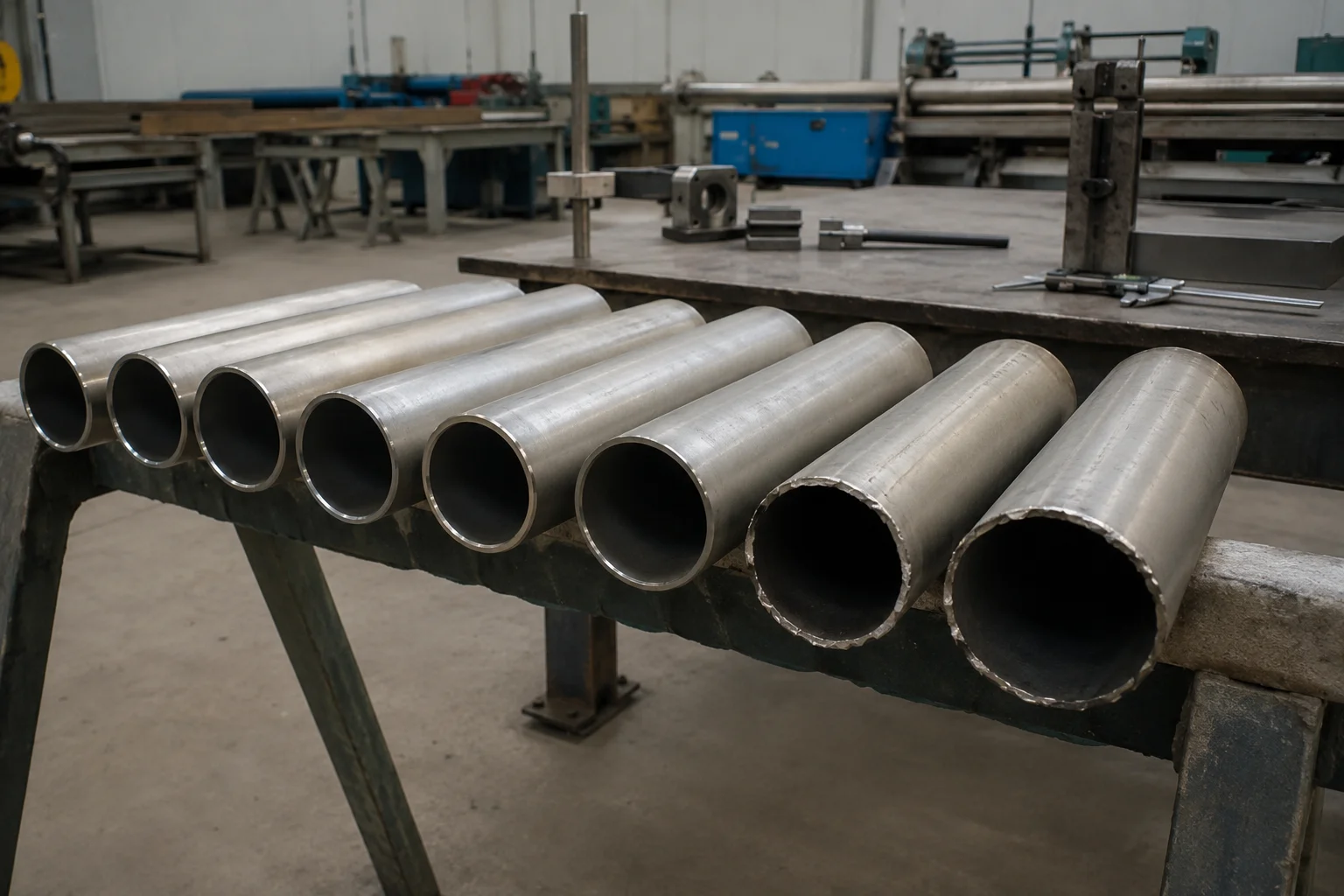
For industrial buyers, the question is not only “Can the tube be cut to length?” A better question is: Can the tube end be prepared well enough for the welding process and final application?
This is especially important for nickel alloy tubes and titanium alloy tubes used in chemical processing, heat exchangers, marine engineering, oil and gas, aerospace, power generation, medical equipment, pressure systems, and precision welded components.
Quick Answer: How Does Tube End Quality Affect Welding?
Tube end quality affects welding mainly through fit-up, cleanliness, and surface condition. If the tube end is not square, the root gap may become uneven. If burrs, cutting oil, oxide, or particles remain on the end face, they may increase the risk of weld defects. If the cut surface is rough or damaged, it may be harder to achieve stable fusion and consistent bead shape.
TWI explains that, in pipe welding, the edges to be joined need to be clean and straight; otherwise, problems such as lack of fusion, slag entrapment, and hydrogen inclusion can occur. Source: TWI — What Is Pipe Welding?
| Tube End Issue | Welding Impact | Possible Result |
|---|---|---|
| Out-of-square cut | Uneven root gap or poor alignment | Inconsistent penetration, lack of fusion, burn-through risk |
| Burrs on ID/OD | Interferes with fit-up and cleanliness | Inclusions, unstable arc, local defects |
| Rough cut face | Traps oil, dust, oxide, or particles | Porosity, poor fusion, inconsistent bead |
| Cutting oil or contamination | Enters weld zone during heating | Porosity, contamination, discoloration |
| Ovality or distortion | Poor contact between tube ends | Uneven weld bead, incomplete fusion |
| Excessive heat damage from cutting | Alters surface condition | Extra cleaning or facing may be required |
| Poor deburring | Leaves sharp edges or loose particles | Stress concentration, inclusions, inspection risk |
Why Is Tube End Preparation Important Before Welding?
Welding quality is not determined only by the welding machine, filler metal, shielding gas, or welder skill. The joint preparation before welding is also critical.
A good tube end helps provide:
- More consistent root gap
- Better alignment
- Cleaner weld zone
- More stable arc behavior
- More predictable heat distribution
- Lower risk of contamination
- Better repeatability in manual or orbital welding
- Easier inspection after welding
TWI notes that single-sided joints require dimensionally accurate weld preparations and fit-up to ensure full penetration welds with acceptable root contour. Source: TWI — Design Part 4
Buyer Takeaway
When ordering cut-to-length tubes for welding, buyers should confirm more than length tolerance. They should also confirm:
- End squareness
- ID/OD burr condition
- Surface cleanliness
- Tube ovality
- Wall thickness
- Cutting method
- Whether facing is required
- Whether degreasing is required
- Whether the end must be protected during packing
- Whether the tube will be manually welded, orbital welded, laser welded, or plasma welded
Does Alloy Type Change How Much Cut Quality Matters?
Yes. Different alloys react differently during welding. Nickel alloys and titanium alloys both require good preparation, but titanium is especially sensitive to atmospheric contamination at welding temperatures.
Nickel Alloy Tubes
Nickel alloys are widely used because of corrosion resistance, heat resistance, and strength. However, nickel alloy welding still requires clean surfaces and careful preparation.
TWI explains that nickel and nickel alloys are readily welded, but the surface must be cleaned immediately before welding. It also lists common welding imperfections such as porosity, oxide inclusions, lack of inter-run fusion, solidification cracking, and microfissuring. Source: TWI — Weldability of Materials: Nickel and Nickel Alloys
Poor tube end preparation can increase the risk of:
- Surface contamination
- Oxide entrapment
- Poor fusion
- Unstable root gap
- Local stress concentration
- Extra grinding or repair
- Higher inspection rejection risk
Titanium Alloy Tubes
Titanium alloys require even stricter cleanliness and shielding control during welding. TWI explains that titanium weld imperfections include weld metal porosity, embrittlement, and contamination cracking. It also states that joint and surrounding surface areas should be cleaned, surface oxide should be removed, and care should be taken not to touch the surface before welding. Source: TWI — Weldability of Materials: Titanium and Titanium Alloys
For titanium tube welding, a rough, oily, burred, oxidized, or poorly prepared tube end can become a serious quality risk.
Nickel vs. Titanium Tube Welding Preparation
| Factor | Nickel Alloy Tubes | Titanium Alloy Tubes |
|---|---|---|
| Sensitivity to contamination | High cleanliness is required, especially to avoid oxides and harmful contaminants. | Very high; oxygen, nitrogen, hydrogen, oils, moisture, and fingerprints can create serious weld problems. |
| Typical welding methods | TIG/GTAW, MIG/GMAW, orbital welding, laser welding, plasma welding depending on application. | TIG/GTAW, orbital welding, laser welding, plasma welding, usually with strict inert gas protection. |
| Cut-end requirement | Clean, square, burr-free, and suitable for required fit-up. | Very clean, square, burr-free, oxide-free, and protected from contamination. |
| Main risk from poor end quality | Porosity, lack of fusion, oxide inclusion, cracking risk, inconsistent bead. | Porosity, embrittlement, contamination cracking, discoloration, lack of fusion. |
| Buyer priority | Confirm surface cleaning, fit-up, standard, MTC, and welding requirement. | Confirm cleaning, shielding, end preparation, handling, packaging, and traceability. |
How Do Welding Methods Change End Quality Requirements?
The required tube cutting end quality depends strongly on the welding method.
A manual TIG weld may allow a skilled welder to compensate for small fit-up variations. However, automated orbital welding, autogenous welding, laser welding, and precision tube welding usually require much more consistent end preparation.
Common Welding Methods and Cut-End Requirements
| Welding Method | End Quality Requirement | Why It Matters |
|---|---|---|
| Manual TIG / GTAW | Clean, square, deburred, consistent gap | Welder can adjust technique, but poor preparation still increases defect risk. |
| Orbital TIG welding | Very consistent squareness, burr-free ID/OD, controlled gap | Automated process depends on repeatable fit-up and stable tube geometry. |
| Autogenous welding | Very precise fit-up and clean ends | No filler metal means gap variation can strongly affect penetration. |
| Laser welding | Tight fit-up, clean surface, controlled gap | High-energy process can be sensitive to gap, surface condition, and alignment. |
| Plasma welding | Clean preparation and stable joint geometry | Penetration and bead profile depend on fit-up and process control. |
| MIG / GMAW | Clean surface and appropriate joint preparation | More tolerant in some cases, but contaminants and poor fit-up still cause defects. |
For orbital tube welding, publicly available training material notes that fit-up may require square butt welds, burr-free internal and external ends, and tube facing to achieve flat and square ends. Source: Autogenous Orbital Welding and Quality Control Challenges
Buyer Takeaway
Before ordering cut-to-length tubes, buyers should tell the supplier which welding process will be used. A tube end that is acceptable for rough manual welding may not be acceptable for orbital welding or high-purity titanium welding.
Which Cutting End Specifications Should Buyers Confirm?
A good cutting specification should be clear enough for the supplier, welder, and inspector to understand the expected end quality.
1. Squareness / Perpendicularity
Squareness means the cut end is perpendicular to the tube axis. If the cut is angled, the gap between two tube ends may be uneven. This can create uneven penetration or unstable root conditions.
TWI explains that incomplete root fusion or penetration may be related to root gap issues and recommends making sure the root gap is adequate and does not close during tacking and welding. Source: TWI — Incomplete Root Fusion or Penetration
2. Burr-Free ID and OD
Burrs can interfere with fit-up, disturb the weld pool, trap contaminants, and create cleaning problems. For tubes used in fluid systems, internal burrs can also affect flow cleanliness or become loose particles.
Buyers should specify whether both ID and OD must be deburred.
3. Clean End Face
The tube end should be free from visible oil, grease, dust, cutting fluid, oxide, and loose particles before welding. For titanium, handling and cleaning are even more important because surface contamination can cause porosity or embrittlement.
TWI explains that porosity is caused by gas released from the weld pool during solidification, and oxygen, nitrogen, and hydrogen absorption can contribute to porosity. Source: TWI — Porosity in Welding
4. Surface Roughness
A rough cut face can trap contaminants and make repeatable welding more difficult. For critical components, buyers may need to specify a machined, faced, or polished end rather than a rough saw cut.
5. Tube Ovality and Roundness
Even if the cut is square, an oval tube may still create poor fit-up. Ovality is especially important for orbital welding heads, automatic tube welding, heat exchanger tubes, and precision assemblies.
6. End Protection After Cutting
If tube ends are prepared well but damaged during packing or transport, welding quality can still be affected. Buyers should ask for end caps, protective packaging, dry storage, and marking control when needed.
Common Welding Defects Linked to Poor Tube End Quality
Poor tube end quality does not always cause welding defects by itself. Welding parameters, shielding gas, filler metal, base metal condition, operator skill, and inspection standards also matter. However, poor end quality can increase the risk of several common weld defects.
1. Porosity
Porosity is the presence of cavities in the weld metal caused by gas trapped during solidification. Tube end contamination from oil, moisture, dust, oxide, or cutting residue can increase the risk.
TWI identifies poor shielding and absorption of oxygen, nitrogen, and hydrogen as causes of porosity, and it also emphasizes surface cleaning before welding. Source: TWI — Porosity in Welding
2. Lack of Fusion or Incomplete Penetration
If tube ends are not square or the gap is inconsistent, the weld may not fully fuse across the joint. This is especially risky in root passes and precision tube welding.
TWI explains that incomplete root fusion occurs when the weld fails to fuse one side of the joint in the root, and incomplete root penetration occurs when both sides of the root region are unfused. Source: TWI — Incomplete Root Fusion or Penetration
3. Oxide Inclusions
Oxides or surface contamination can become trapped in the weld. Nickel alloys and titanium alloys both require careful surface preparation to avoid this risk.
For nickel alloys, TWI states that surface oxide should be removed by machining, grinding, or scratch brushing and then degreased before welding. Source: TWI — Nickel and Nickel Alloys
4. Contamination Cracking and Embrittlement
Titanium is particularly sensitive to contamination during welding. Poor cleaning, poor shielding, or contaminated tube ends may lead to embrittlement or contamination cracking.
TWI notes that titanium weld imperfections include porosity, embrittlement, and contamination cracking, and that surface cleaning and oxide removal are essential. Source: TWI — Titanium and Titanium Alloys
5. Inconsistent Weld Bead Profile
An uneven cut or inconsistent root gap can produce uneven heat input, inconsistent bead width, and unstable root profile. This may increase inspection difficulty and repair work.
How Should Buyers Balance Cutting Quality, Cost and Project Risk?
Not every project requires the same level of tube end preparation. A general industrial tube assembly may not need the same cutting quality as an aerospace, medical, nuclear, offshore, or high-purity titanium tube assembly.
The decision should be based on project risk.
Risk-Based Tube End Quality Selection
| Application Risk Level | Typical Application | Recommended End Quality Approach |
|---|---|---|
| Low risk | General non-critical fabrication | Clean saw cut and basic deburring may be sufficient. |
| Medium risk | Industrial fluid systems, general heat exchanger parts, pump and valve assemblies | Controlled squareness, burr-free ID/OD, degreasing, and dimensional checks are recommended. |
| High risk | Pressure systems, offshore, chemical processing, aerospace, medical, titanium welding | Precision cutting, facing, strict cleaning, end protection, MTC traceability, and inspection should be considered. |
| High-purity or automated welding | Orbital welding, semiconductor, pharmaceutical, sanitary, thin-wall titanium tube | Square, flat, burr-free, clean tube ends and verified fit-up are usually required. |
Total Cost Factors Buyers Should Consider
| Cost Factor | Why It Matters |
|---|---|
| Cutting cost | Precision cutting or facing costs more than rough cutting. |
| Welding rework | Poor cut ends can lead to repair, re-welding, or rejected welds. |
| Inspection cost | Defects increase NDT, visual inspection, X-ray, dye penetrant, or requalification work. |
| Material cost | Nickel and titanium alloy tubes are expensive; scrapping welded assemblies is costly. |
| Delivery risk | Rework or replacement material can delay project schedules. |
| Application risk | Failure in pressure, aerospace, medical, marine, or chemical service can be serious. |
Buyer Takeaway
The cheapest cut is not always the lowest-cost solution. For critical welding, a better-prepared tube end may reduce downstream welding risk, inspection risk, and rework cost.
Which Standards and Documents Should Buyers Confirm?
Tube end quality is not only a manufacturing detail. It should be connected to the material standard, certificate, traceability, and final welding requirement.
Common Material Standards for Nickel and Titanium Tubes
| Material | Common Standard Example | What It Covers |
|---|---|---|
| Titanium and titanium alloy tubes | ASTM B338 | Seamless and welded titanium and titanium alloy tubes for condensers and heat exchangers. |
| Alloy 625 / UNS N06625 pipe and tube | ASTM B444 | Nickel-chromium-molybdenum-columbium alloys in cold-worked seamless pipe and tube form. |
| Titanium seamless pipe | ASTM B861 | Titanium and titanium alloy seamless pipe. |
| Titanium welded pipe | ASTM B862 | Titanium and titanium alloy welded pipe. |
| Project-specific welding | Customer drawing / WPS / PQR | End preparation, fit-up, bevel, cleaning, welding method, inspection acceptance. |
ASTM B338 covers seamless and welded titanium and titanium alloy tubes intended for surface condensers, evaporators, and heat exchangers. Source: ASTM B338
ASTM B444 covers UNS N06625 and related nickel alloys in cold-worked seamless pipe and tube form. Source: ASTM B444
MTC / MTR and Heat Number Traceability
For critical projects, buyers should request MTC/MTR documentation and confirm that the heat number on the material matches the certificate.
EN 10204 Type 3.1 inspection documents include a declaration that the products supplied comply with the order and include test results. Source: BS EN 10204:2004 Inspection Documents
Buyer Checklist: What to Confirm Before Ordering Cut-to-Length Tubes for Welding
A clear RFQ helps the supplier quote correctly and helps the buyer avoid welding problems later.
| RFQ Item | What to Provide |
|---|---|
| Material grade | Alloy 625, Alloy 825, Alloy C-276, Titanium Grade 2, Titanium Grade 5, etc. |
| UNS number | N06625, N08825, N10276, R50400, R56400, etc. |
| Standard | ASTM B338, ASTM B444, ASTM B861, ASTM B862, ASME, EN, or customer specification. |
| Tube size | OD, wall thickness, length, tolerance, straightness, ovality. |
| Cutting requirement | Saw cut, precision cut, faced end, square cut, bevel, burr-free ID/OD. |
| End quality | Squareness, surface roughness, deburring, cleaning, end protection. |
| Welding method | Manual TIG, orbital TIG, laser, plasma, MIG, autogenous welding, or filler welding. |
| Final application | Heat exchanger, pressure system, chemical equipment, medical, aerospace, marine, oil and gas. |
| Certificate | EN 10204 3.1, MTC/MTR, heat number traceability. |
| Inspection | Visual inspection, dimensional report, PMI, PT, UT, radiography, third-party inspection. |
| Packaging | End caps, clean packing, dry packaging, piece marking, export packing. |
Example RFQ Message
We need Titanium Grade 2 seamless tubes per ASTM B338, OD 25.4 mm, wall thickness 1.2 mm, cut length 1200 mm. The tubes will be orbital welded for heat exchanger service. Please quote precision cut and faced ends, square and burr-free ID/OD, clean surface, EN 10204 3.1 MTC, heat number traceability, dimensional report, and export packing with end protection. Please confirm cutting tolerance, end squareness, lead time, MOQ, and whether additional degreasing can be arranged before shipment.
This type of RFQ is much clearer than simply asking, “Can you cut titanium tubes to length?”
Common Mistakes When Ordering Tubes for Welding
1. Only Confirming Tube Length
Cut length is important, but welding also depends on end squareness, burr condition, cleanliness, and fit-up.
2. Ignoring the Welding Method
Manual TIG, orbital TIG, laser welding, plasma welding, and autogenous welding may require different end preparation quality.
3. Treating Titanium Like Stainless Steel
Titanium is more sensitive to contamination at welding temperatures. Cleaning, shielding, and handling requirements should be stricter.
4. Forgetting Internal Burrs
ID burrs are easy to overlook, but they can affect fit-up, internal flow, cleanliness, and weld quality.
5. Not Confirming Surface Cleaning
Cutting oil, dust, fingerprints, oxide, and moisture can all create welding problems, especially with titanium.
6. Not Protecting Tube Ends After Cutting
A well-prepared tube end can still be damaged during packing, transportation, or storage.
7. Not Sharing the Final Application
If the supplier does not know whether the tube will be used for a pressure system, heat exchanger, orbital welding, or high-purity service, it is harder to recommend the correct cutting quality.
8. Reviewing MTC Only After Cutting
Material certificates and heat number traceability should be checked before cutting, welding, and installation.
FAQ: Tube Cutting End Quality and Welding
1. Does tube cutting quality really affect welding?
Yes. Tube cutting quality can affect fit-up, root gap, cleanliness, penetration, bead profile, and defect risk. The impact depends on material, welding method, wall thickness, and application.
2. Why is a square tube end important for welding?
A square tube end helps create a consistent root gap and alignment. Poor squareness may cause uneven penetration, lack of fusion, or inconsistent bead shape.
3. Why are burr-free tube ends important?
Burrs can interfere with fit-up, trap contaminants, and create inclusions or local weld defects. Both ID and OD burrs should be controlled when the tube will be welded.
4. Is titanium tube welding more sensitive to cut-end quality?
Yes. Titanium is highly sensitive to contamination during welding. Burrs, oxide, oil, moisture, fingerprints, and poor shielding can increase the risk of porosity, embrittlement, and contamination cracking.
5. Are nickel alloy tubes easier to weld than titanium tubes?
Nickel alloys are generally weldable, but they still require clean surfaces and good joint preparation. Poor cleaning or poor end preparation can cause porosity, oxide inclusions, lack of fusion, or cracking risk.
6. Does orbital welding need better tube end preparation?
Usually yes. Orbital welding depends on repeatable tube geometry and fit-up. Square, flat, burr-free, and clean tube ends help maintain consistent weld quality.
7. What should buyers specify for cut-to-length tubes?
Buyers should specify material grade, standard, OD, wall thickness, cut length, tolerance, end squareness, burr-free requirement, cleaning requirement, welding method, certificate, and packing method.
8. Should tube ends be cleaned before welding?
Yes. Tube ends and nearby weld areas should be cleaned according to the material and welding procedure. Titanium and nickel alloys require careful cleaning to reduce contamination risk.
Conclusion
Tube cutting end quality is not a minor detail for welded nickel alloy and titanium alloy components. It can affect weld fit-up, cleanliness, penetration, bead consistency, defect risk, inspection results, and long-term service reliability.
For buyers, the key is to connect tube cutting requirements with the welding method, alloy type, wall thickness, final application, certificate, and inspection standard.
Before ordering cut-to-length tubes for welding, buyers should confirm material grade, standard, tube size, cutting method, end squareness, deburring, surface cleanliness, packaging, MTC/MTR, heat number traceability, and final welding requirement.
Emily PIPE supplies nickel alloy tubes, nickel alloy bars, titanium alloy tubes, and titanium alloy bars for global industrial applications. If you are preparing a welded tube project, you can send your material grade, tube size, cutting length, welding method, certificate requirement, and application environment for technical review and quotation.