
Choosing titanium or nickel alloy tubes for desalination evaporators and condensers should not be based only on a datasheet, alloy name or lowest price.
Thermal desalination equipment may face seawater, concentrated brine, dissolved oxygen, chlorination, scaling, deposits, temperature changes, flow conditions and shutdown cycles. These details can strongly affect corrosion risk, tube inspection requirements and long-term maintenance cost.
Quick Answer:
The right tube material for desalination evaporators and condensers depends on water chemistry, brine concentration, dissolved oxygen, pH, temperature, flow velocity, scaling tendency, cleaning method, tube position, corrosion allowance, inspection requirements, MTR / MTC, heat number traceability and long-term cost targets. Titanium tubes are widely evaluated for seawater condenser, evaporator and heat exchanger service, while nickel alloy tubes may be considered for selected severe corrosion or high-temperature conditions. Final selection should be based on actual operating conditions, not only on general datasheets.
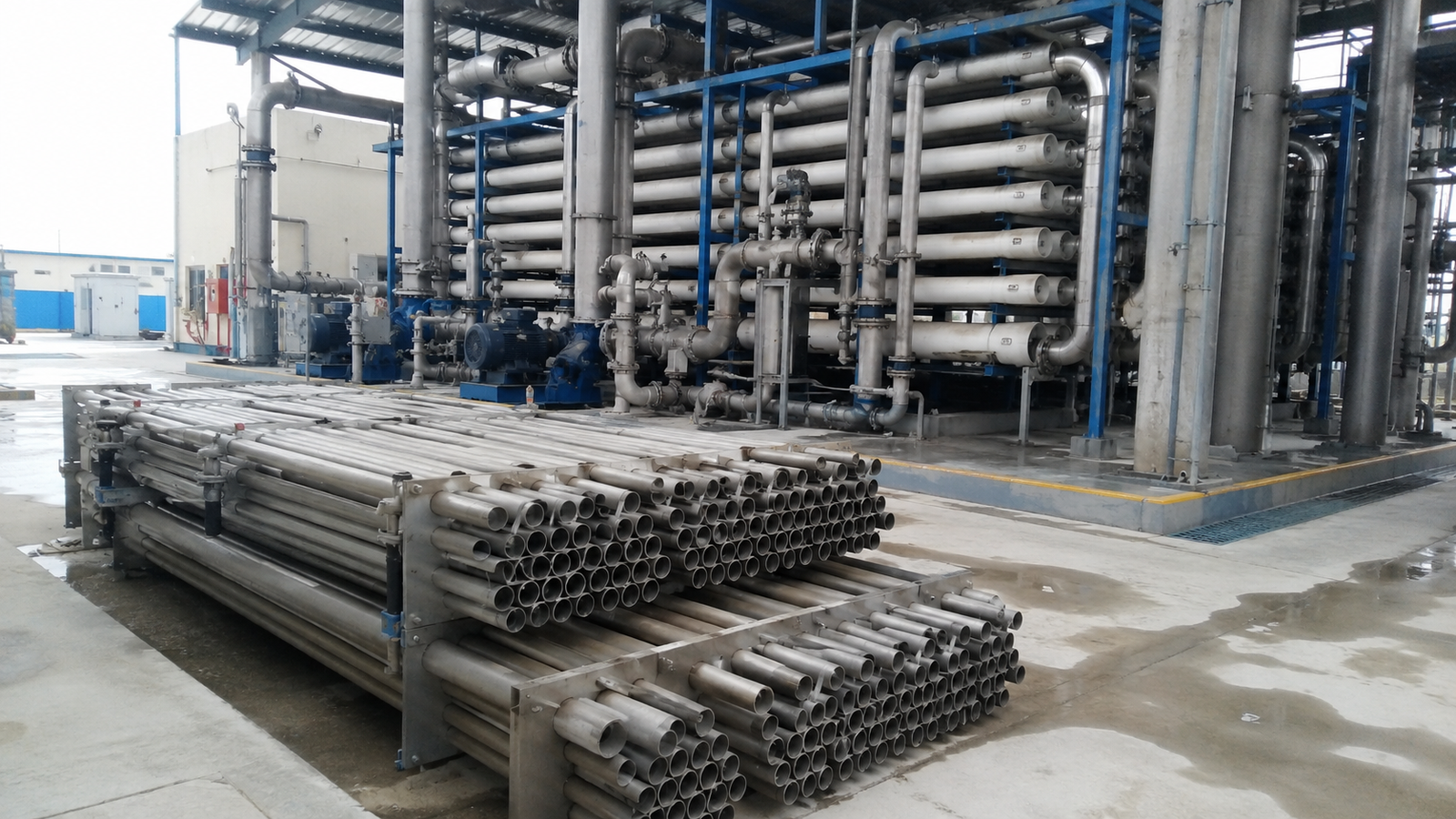
ASTM B338 covers seamless and welded titanium alloy tubes for surface condensers, evaporators and heat exchangers: ASTM B338.
ASTM B163 covers seamless nickel and nickel alloy tubes for condenser and heat-exchanger service: ASTM B163.
These standards are useful starting points, but they do not replace application-specific corrosion review.
Why Generic Datasheets Are Not Enough
A material datasheet is useful. It can show chemical composition, tensile strength, yield strength, elongation, density, hardness and basic corrosion information.
However, desalination evaporators and condensers operate in real water systems. The corrosion risk depends not only on the alloy, but also on the local environment.
AMPP notes that no material is resistant to all corrosive situations and that materials selection is critical to preventing many types of failures: AMPP Materials Selection and Design for Corrosion Control.
Operating Conditions Buyers Should Confirm
| Condition | Why It Matters |
|---|---|
| Seawater Source | Natural seawater, brackish water or mixed intake water may have different chemistry |
| Brine Concentration | Higher concentration can increase corrosion and scaling risk |
| Dissolved Oxygen | Can strongly affect localized corrosion behavior |
| pH | Lower pH can increase corrosion risk in some systems |
| Temperature | Higher temperature may increase corrosion, scaling and thermal stress |
| Chlorination / Biocide | May change corrosion potential and localized corrosion risk |
| Sulfides / Ammonia / Other Species | May affect copper alloys, nickel alloys or other materials |
| Flow Velocity | Low flow may promote deposits; high flow may increase erosion or vibration risk |
| Deposits and Scaling | Deposits can create crevice-like environments |
| Cleaning Method | Acid cleaning, mechanical cleaning or hydrojetting may affect tube condition |
| Shutdown Condition | Stagnant seawater or wet deposits may increase localized corrosion risk |
| Tube Location | Heat rejection section, brine heater, condenser or evaporator zone may face different risks |
A 2025 OSTI-indexed study on corrosion design constraints in desalination found that dissolved oxygen and pH can affect localized corrosion constraints and material selection in desalination evaporator design: Incorporating Corrosion Design Constraints in Desalination Systems.
This supports a practical buyer point: desalination tube selection should begin with operating conditions, not only material grade.
What Corrosion Risks Matter in Desalination Evaporators and Condensers?
Desalination systems can involve several corrosion risks. The main risk is not always uniform corrosion. Localized corrosion can be more difficult to detect and may lead to tube leakage.
Common Corrosion and Degradation Risks
| Risk | Why It Matters for Tubes |
|---|---|
| Pitting Corrosion | Small local pits may penetrate tube walls even when overall corrosion is low |
| Crevice Corrosion | Deposits, tube sheets, stagnant zones or gasket areas can create local attack |
| Erosion-Corrosion | High velocity, suspended solids or cleaning may damage surfaces |
| Galvanic Corrosion | Dissimilar metals in contact with seawater may create galvanic effects |
| Stress Corrosion Cracking | Relevant for susceptible materials under stress and corrosive conditions |
| Scaling / Fouling | Reduces heat transfer and can create under-deposit corrosion |
| Cleaning Damage | Mechanical cleaning or hydrojetting can damage tube surfaces if poorly controlled |
| Thermal Cycling | Startups and shutdowns may add stress and fatigue risk |
| Tube Vibration | Flow-induced vibration may affect tube integrity |
AMPP describes pitting as localized corrosion that produces cavities or holes and notes that it can be more difficult to detect, predict and design against than uniform corrosion: AMPP Forms of Corrosion.
For desalination plants, buyers should ask suppliers not only about corrosion resistance, but also about tube testing, surface condition, wall thickness, dimensional tolerance and inspection reports.
How Are Titanium Tubes Used in Desalination?
Titanium is widely evaluated for seawater condenser, evaporator and heat exchanger tubes because of its corrosion resistance in many seawater environments.
A review paper published in IOP Conference Series: Materials Science and Engineering discusses the applications and prospects of titanium and its alloys in seawater desalination equipment and reviews MED, MSF and RO desalination technologies: Applications and Prospects of Titanium and Its Alloys in Seawater Desalination Industry.
Titanium Grades Buyers May Review
| Titanium Grade | General Feature | Desalination Buyer Note |
|---|---|---|
| Titanium Grade 1 | Lower strength, higher ductility | May be evaluated where formability is important |
| Titanium Grade 2 | Commercially pure titanium with higher strength than Grade 1 | Widely specified for heat exchanger and condenser tube applications |
| Titanium Grade 7 | Palladium-bearing commercially pure titanium | May be evaluated for stronger crevice corrosion resistance requirements |
| Titanium Grade 11 | Palladium-bearing version related to Grade 1 | May be evaluated where ductility and enhanced corrosion resistance are needed |
| Titanium Grade 12 | Titanium alloyed with nickel and molybdenum | May be evaluated for selected corrosion and heat exchanger applications |
| Titanium Grade 16 / 17 | Palladium-bearing CP titanium grades | May be evaluated depending on project specification |
ASTM B338 lists multiple titanium grades for condenser, evaporator and heat exchanger tube service, including Grade 1, Grade 2, Grade 7, Grade 11, Grade 12, Grade 16 and Grade 17: ASTM B338.
Important Caution
Titanium Grade 2 is often discussed for desalination heat exchanger service, but buyers should not assume one titanium grade fits every condition.
If the system has severe crevice conditions, deposits, low pH, stagnant zones, high temperature or special cleaning chemistry, the buyer should review whether a different titanium grade, different design, different cleaning strategy or different inspection plan is needed.
How Are Nickel Alloy Tubes Used in Desalination?
Nickel alloy tubes may be evaluated where seawater, brine, temperature, dissolved oxygen, pH, chlorination or localized corrosion conditions make standard materials less suitable.
However, “nickel alloy” is not one material. Alloy 400, Alloy 625, Alloy 825, Alloy C276 and other grades have very different chemistry and performance behavior.
Nickel Alloy Review
| Nickel Alloy | General Feature | Desalination Buyer Note |
|---|---|---|
| Alloy 400 / UNS N04400 | Nickel-copper alloy | May be evaluated for selected seawater, brine or heat exchanger service; verify velocity, oxygen, sulfides and operating temperature |
| Alloy 625 / UNS N06625 | Nickel-chromium-molybdenum alloy | May be evaluated for more severe localized corrosion or high-temperature brine conditions |
| Alloy 825 / UNS N08825 | Nickel-iron-chromium alloy with molybdenum and copper | May be evaluated for selected acid or chloride-containing environments |
| Alloy C276 / UNS N10276 | Nickel-molybdenum-chromium alloy | May be evaluated for aggressive chemical or severe corrosion conditions |
| Nickel 200 / UNS N02200 | Commercially pure nickel | May be evaluated only when process chemistry and temperature are suitable |
ASTM B163 covers seamless nickel and nickel alloy tubes for condenser and heat-exchanger service and includes chemical and mechanical property requirements: ASTM B163.
A recent corrosion design study for desalination systems found that, under higher dissolved oxygen conditions, more corrosion-resistant materials may be required to satisfy localized corrosion constraints, and in some modeled cases nickel alloy 625 was selected for evaporator material: Incorporating Corrosion Design Constraints in Desalination Systems.
This does not mean Alloy 625 is always required. It means severe conditions should be evaluated with real corrosion constraints, not only with a generic material table.
Titanium vs. Nickel Alloy Tubes: How Should Buyers Compare?
Titanium and nickel alloys are not direct “better or worse” choices. They solve different problems.
Practical Comparison
| Factor | Titanium Tubes | Nickel Alloy Tubes |
|---|---|---|
| Seawater Resistance | Strong candidate in many seawater heat exchanger applications | Depends strongly on alloy grade and condition |
| Density | Lower density | Higher density |
| Strength | CP titanium has moderate strength; titanium alloys vary | Some nickel alloys offer high strength |
| Localized Corrosion | Good in many seawater conditions; severe crevice conditions still need review | Higher alloyed grades may be evaluated for severe localized corrosion |
| Heat Transfer Design | Wall thickness, fouling, cleanliness and tube condition matter | Wall thickness and fouling also matter |
| Weld / Tube Fabrication | Must follow appropriate titanium welding and tube standards | Must follow nickel alloy standards and inspection requirements |
| Cost | Material and processing cost depends on grade and market | Higher alloyed grades can be costly |
| Best Use | Many seawater condenser, evaporator and heat exchanger tube applications | Severe corrosion, high-temperature, special chemical or critical sections |
Buyers should compare materials by service condition, not by generic material reputation.
What Should Buyers Confirm Before Ordering Tubes?
Before ordering titanium or nickel alloy tubes for desalination evaporators and condensers, buyers should prepare a clear technical scope.
Buyer Confirmation Checklist
| RFQ Item | What to Confirm |
|---|---|
| Application | Evaporator, condenser, brine heater, heat rejection section or heat recovery section |
| Desalination Process | MED, MSF, MVC, RO-related heat exchanger or hybrid system |
| Medium | Seawater, brine, condensate, cooling water or chemical cleaning medium |
| Seawater Chemistry | Salinity, chloride, dissolved oxygen, pH, sulfides, ammonia, bromides if relevant |
| Temperature | Normal, maximum, cleaning and shutdown temperature |
| Pressure | Operating and design pressure |
| Flow Velocity | Tube-side and shell-side flow conditions |
| Fouling / Scaling | Scaling tendency and anti-scale treatment |
| Cleaning Method | Mechanical cleaning, sponge ball cleaning, acid cleaning or hydrojetting |
| Tube Material | Titanium grade or nickel alloy grade |
| UNS Number | Exact material designation |
| Standard | ASTM B338, ASTM B163 or customer specification |
| Tube Type | Seamless or welded |
| Size | OD, wall thickness, length and tolerance |
| Surface Condition | Pickled, polished, bright, cleaned or special finish |
| Testing | ECT, UT, hydrostatic, pneumatic, flattening or other required tests |
| Documentation | MTR / MTC, heat number, inspection report, certificate |
| Third-Party Inspection | Required or optional |
| Packaging | End protection, bundle marking, seaworthy export packing |
| Delivery | Project schedule, port, packing requirement and logistics plan |
This checklist helps buyers avoid vague requests such as:
“Please quote titanium tubes for desalination.”
A better RFQ includes the process, water chemistry, temperature, pressure, tube standard, grade, size, testing and documentation requirements.
What Standards and Tests Should Buyers Review?
Tube standards and inspection methods help define the purchase basis.
Common Standards and Inspection References
| Standard / Test | Why It May Be Relevant |
|---|---|
| ASTM B338 | Titanium and titanium alloy tubes for condensers, evaporators and heat exchangers |
| ASTM B163 | Seamless nickel and nickel alloy tubes for condenser and heat-exchanger service |
| ASTM E213 | Ultrasonic testing of metal pipe and tubing |
| ASTM E426 | Eddy current examination of seamless and welded tubular products including titanium and nickel alloys |
| ASTM E8/E8M | Tensile testing of metallic materials |
| EN 10204 3.1 / 3.2 | Inspection certificate level when required |
| PMI / Grade Verification | Helps reduce material mix-up risk |
| Hydrostatic / Pneumatic Test | Confirms pressure integrity when specified |
| Dimensional Inspection | Confirms OD, WT, length, straightness and tolerance |
| Surface Inspection | Confirms visible surface condition and defects |
ASTM E213 covers ultrasonic testing of metal pipe and tubing to detect discontinuities during volumetric examination: ASTM E213.
ASTM E426 covers eddy current examination of seamless and welded tubular products made of titanium, stainless steel and similar alloys such as nickel alloys: ASTM E426.
Testing should be specified according to tube type, alloy grade, wall thickness, project risk and customer specification.
Why Supplier Capability Matters
For desalination evaporator and condenser tubes, the supplier should do more than quote the material name.
A qualified supplier should help clarify:
- Correct grade and UNS number
- Applicable ASTM / ASME / EN / customer standard
- Seamless or welded tube type
- OD, wall thickness, length and tolerance
- Surface condition
- Heat number traceability
- MTR / MTC
- Chemical composition
- Mechanical properties
- ECT / UT / hydrostatic / pneumatic testing if required
- Dimensional inspection
- Surface inspection
- Third-party inspection
- Packing and marking
- Delivery schedule
Supplier Verification Checklist
| Supplier Capability | Buyer Question |
|---|---|
| Material Traceability | Can each tube be traced to heat number and MTR? |
| Standards Knowledge | Can the supplier explain ASTM B338 or ASTM B163 scope? |
| Inspection Support | Can ECT, UT, hydrostatic or dimensional inspection be provided? |
| Surface Control | Can the required surface condition be confirmed? |
| Documentation | Can MTR, inspection report and certificate be supplied? |
| Third-Party Inspection | Can SGS, BV, TÜV, LRQA, ABS or buyer-appointed inspection be supported? |
| Packaging | Can tubes be protected for export shipment and site storage? |
| Technical Clarification | Does the supplier ask about water chemistry, temperature and application? |
A supplier cannot guarantee plant performance. But strong documentation, testing and traceability can reduce procurement uncertainty.
Is the Cheapest Tube the Best Value?
Lowest initial price is not always the lowest life-cycle cost.
A tube with a lower unit price may become expensive if it increases leakage risk, replacement frequency, cleaning difficulty, unplanned shutdowns or documentation disputes.
The U.S. Environmental Protection Agency defines life-cycle cost as original cost minus salvage value plus operating costs, maintenance costs, renewal costs and decommissioning costs: EPA Life Cycle and Replacement Costs.
The U.S. Department of Energy’s O&M Best Practices Guide describes reactive maintenance as allowing machinery to run to failure and repairing or replacing damaged equipment only when obvious problems occur: DOE O&M Best Practices Guide.
Cost Factors Beyond Tube Price
| Cost Factor | Why It Matters |
|---|---|
| Tube Purchase Price | Initial procurement cost |
| Installation Cost | Retubing, welding, expansion or installation labor |
| Inspection Cost | ECT, UT, hydrostatic, third-party inspection |
| Cleaning Cost | Chemical cleaning, sponge ball cleaning, hydrojetting or mechanical cleaning |
| Downtime Cost | Lost production during unplanned shutdown |
| Replacement Cost | Tube removal, new tube purchase, installation and testing |
| Documentation Cost | Rework if MTR, heat number or inspection records are missing |
| Maintenance Cost | Long-term cleaning, inspection and monitoring |
| Energy Efficiency | Fouling and scale can affect heat transfer performance |
| Risk Cost | Leakage, corrosion failure or delayed commissioning |
A more suitable alloy may cost more initially, but it may reduce long-term risk when the material is properly matched to actual operating conditions.
Example RFQ Wording
For titanium tubes:
“Please quote titanium tubes for desalination evaporator / condenser service according to ASTM B338. Required grade: Titanium Grade / UNS . Size: OD mm, WT mm, length ___ mm. Application: MED / MSF / condenser / brine heater. Medium: seawater / brine / cooling water. Please confirm surface condition, MTR / MTC, heat number traceability, dimensional inspection, ECT / UT / hydrostatic test options, packing and delivery time.”
For nickel alloy tubes:
“Please quote seamless nickel alloy tubes for desalination heat exchanger service according to ASTM B163. Material: Alloy / UNS . Size: OD mm, WT mm, length ___ mm. Please review water chemistry, dissolved oxygen, pH, temperature, brine concentration and cleaning method. MTR / MTC, heat number traceability, chemical analysis, mechanical test report, dimensional inspection and NDT options required.”
For project-specific review:
“Please advise whether the proposed material is suitable for the stated operating conditions. Final material approval will be based on project specification, water chemistry, corrosion risk, inspection requirement and buyer qualification.”
This wording is clearer than:
“Please quote best titanium tube for desalination.”
How Emily PIPE Supports Desalination Tube Buyers
Emily PIPE is a China-based manufacturer and exporter specializing in nickel alloy tubes, nickel alloy bars, titanium alloy tubes and titanium alloy bars. We support customers across chemical processing, oil and gas, marine engineering, power generation, heat exchangers, desalination-related equipment and other corrosion-resistant or high-temperature applications.
For desalination evaporator and condenser tube projects, we can support:
- Titanium alloy tubes and pipes
- Nickel alloy tubes and pipes
- Titanium Grade 1, Grade 2, Grade 7, Grade 11, Grade 12 and other grades according to project requirements
- Alloy 400, Alloy 625, Alloy 825, Alloy C276, Nickel 200 and other nickel alloys according to application review
- ASTM B338 titanium tube support
- ASTM B163 nickel alloy tube support
- Custom OD, wall thickness, length, tolerance and surface condition
- MTR / MTC and heat number traceability
- Dimensional and surface inspection
- PMI, chemical analysis, tensile, hardness, UT, ECT, hydrostatic and other testing support when required
- Third-party inspection support
- Export packaging and logistics support
Our role is not to claim that one titanium or nickel alloy tube fits every desalination plant. Our role is to help buyers clarify application, water chemistry, temperature, pressure, material grade, standard, testing, documentation and delivery requirements before production.
If you are sourcing titanium or nickel alloy tubes for desalination evaporators, condensers, brine heaters or heat exchangers, please send the drawing, material grade, UNS number, standard, OD, wall thickness, length, water chemistry, operating temperature, pressure, testing requirement, documentation requirement and destination. Our team can help review your requirements and provide a suitable quotation.
FAQ: Titanium and Nickel Alloy Tubes for Desalination
1. What is the best tube material for desalination evaporators and condensers?
There is no single best tube material. The suitable choice depends on seawater chemistry, brine concentration, dissolved oxygen, pH, temperature, flow velocity, deposits, cleaning method and project standard.
2. Are titanium tubes used in desalination equipment?
Yes. Titanium tubes are widely evaluated for seawater condenser, evaporator and heat exchanger applications. ASTM B338 is a common standard for titanium and titanium alloy tubes used in condensers, evaporators and heat exchangers.
3. Is Titanium Grade 2 always enough?
Not always. Titanium Grade 2 is widely specified, but severe crevice conditions, deposits, low pH, high temperature or special cleaning chemistry may require further material review.
4. When should nickel alloy tubes be considered?
Nickel alloy tubes may be evaluated for selected severe corrosion, high-temperature brine, special chemical or critical heat exchanger conditions. ASTM B163 is a common standard for seamless nickel and nickel alloy condenser and heat-exchanger tubes.
5. Why are water chemistry details important?
Salinity, dissolved oxygen, pH, chlorination, sulfides, ammonia and brine concentration can affect corrosion behavior. Without this information, material selection is incomplete.
6. What tests should buyers request?
Depending on the project, buyers may request chemical analysis, tensile testing, dimensional inspection, surface inspection, eddy current testing, ultrasonic testing, hydrostatic or pneumatic testing and third-party inspection.
7. Is the lowest-priced tube the best choice?
Not always. Buyers should compare life-cycle cost, including maintenance, cleaning, replacement, downtime, inspection and documentation risk.
8. What documents should buyers request?
Buyers should request MTR / MTC, heat number traceability, dimensional report, surface inspection report, NDT report, hydrostatic or pneumatic test report and third-party inspection report if required.
Conclusion
Selecting titanium or nickel alloy tubes for desalination evaporators and condensers requires more than reading a generic datasheet.
Buyers should review water chemistry, brine concentration, dissolved oxygen, pH, temperature, flow velocity, deposits, cleaning method, tube standard, material grade, testing, traceability, supplier documentation and life-cycle cost.
The right tube choice is not the most expensive or the cheapest by default. It is the material that best matches the real operating conditions and verification requirements of the desalination project.