
Custom Cut Nickel Alloy Tubes: What Buyers Should Confirm Before Ordering
Are you looking for nickel alloy tubes in exact lengths for a heat exchanger, chemical processing line, oil and gas system, marine project, power plant or precision assembly? Many buyers ask whether nickel alloy tubes can be cut to custom lengths. The better question is:
What length tolerance, cut quality, end condition, traceability and inspection level does my project require?
Yes, nickel alloy tubes can usually be cut to custom lengths, but the result depends on the alloy grade, tube size, wall thickness, required length tolerance, cutting method, burr control, surface condition and end-use application. Nickel alloys such as Inconel can be difficult to machine because of rapid work hardening, while thermal cutting processes may create a heat-affected zone near the cut edge.
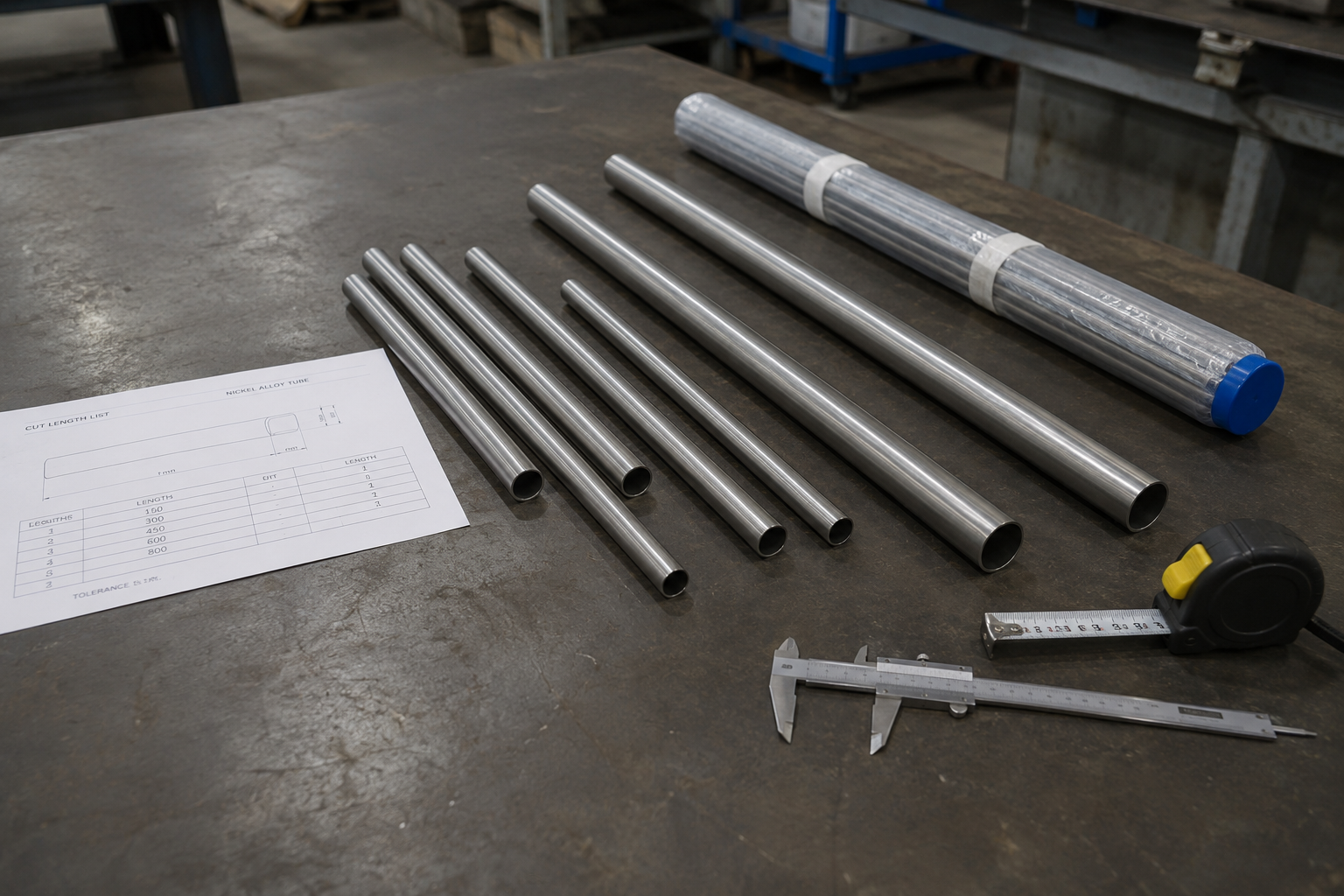
For industrial buyers, custom cutting is not only about reducing a tube to a shorter length. It is about making sure the cut tube can still meet assembly, welding, machining, inspection and service requirements.
This article explains what buyers should confirm before ordering custom-cut nickel alloy tubes.
Quick Answer: Can Nickel Alloy Tubes Be Cut to Custom Lengths?
Yes. Nickel alloy tubes can usually be cut to custom lengths when the supplier confirms the alloy grade, tube size, wall thickness, cutting method, tolerance, end condition and inspection requirement before production.
| Buyer Question | Practical Answer |
|---|---|
| Can nickel alloy tubes be cut to length? | Yes, but the required length tolerance and end finish should be specified. |
| Is cutting the same for every nickel alloy? | No. Inconel, Monel, Hastelloy and Alloy 825 may respond differently to cutting. |
| Does wall thickness matter? | Yes. Thin-wall tubes may deform; thick-wall tubes may require more cutting power or different methods. |
| Can I request burr-free ends? | Yes, but deburring should be clearly stated in the RFQ. |
| Can the heat number still be traced after cutting? | Yes, if marking, labeling and packing are managed properly. |
| Does an MTC prove the cut length? | Not usually. MTC proves material data; cut length should be checked by dimensional inspection. |
What Should Buyers Confirm Before Custom Cutting?
A clear cutting requirement should include more than “cut to length.” Buyers should define the exact product, size, tolerance, cutting quality and documentation requirements.
| Item to Confirm | Example | Why It Matters |
|---|---|---|
| Nickel Alloy Grade | Inconel 625, Inconel 600, Alloy 825, Hastelloy C276, Monel 400 | Different alloys respond differently to cutting |
| UNS Number | N06625, N06600, N08825, N10276, N04400 | Reduces grade confusion |
| ASTM Standard | ASTM B444, ASTM B163, ASTM B622, ASTM B167 | Confirms product scope and material requirement |
| Tube Form | Seamless tube, welded tube, pipe, heat exchanger tube | Cutting and inspection depend on product form |
| Tube Size | OD, wall thickness, ID if required | Affects cutting stability and deformation risk |
| Cut Length | Fixed length, multiple lengths, tolerance per piece | Affects machining, assembly and installation |
| Length Tolerance | ±0.5 mm, ±1 mm, ±2 mm or project-specific | Determines cutting method and inspection scope |
| Cut Squareness | Required or not required | Important for welding, sealing or assembly |
| End Condition | As-cut, deburred, chamfered, faced, polished, capped | Affects fit-up and further processing |
| Burr Control | Burr-free, ID deburred, OD deburred | Reduces assembly, flow and safety issues |
| Surface Protection | Scratch prevention, end caps, clean packing | Protects high-value alloy tubes during shipment |
| Traceability | Heat number marking, bundle label, packing list | Prevents material mix-up after cutting |
| Documents | MTR/MTC, dimensional report, packing list, inspection photos | Supports receiving inspection |
The goal is not only to cut the tube. The goal is to cut it without creating avoidable acceptance, machining or service risks.
Is Custom Cutting Nickel Alloy Tubes Always a Good Idea?
Custom cutting is useful when it reduces buyer-side cutting work, saves machining time, improves installation efficiency or helps prepare tube blanks for later processing. However, it should be evaluated carefully when the application requires tight tolerance, clean ends, burr control or strict documentation.
Custom cutting is usually a good idea when the buyer defines the required length, tolerance, end condition, deburring requirement and inspection method. It may create risk when the cutting method, heat input, burr control, deformation or traceability is not properly managed.
When Custom Cutting Helps
| Situation | Benefit |
|---|---|
| Fixed installation length is required | Reduces site cutting and fitting work |
| Buyer wants ready-to-use tube blanks | Saves machining preparation time |
| Export packing length is limited | Improves logistics planning |
| Multiple short pieces are required | Reduces buyer-side cutting and scrap |
| Heat number separation is needed | Supplier can label and pack by heat number |
| Machining allowance is already known | Supplier can prepare cut blanks for further machining |
| Tube sheet or assembly length is defined | Reduces installation mismatch |
When Buyers Should Be More Careful
| Situation | Risk to Review |
|---|---|
| Very tight length tolerance | Requires suitable cutting and inspection method |
| Thin-wall tube | May deform during clamping or cutting |
| High-value alloy grade | Scrap and rework cost can be high |
| Critical welding application | Cut squareness, burrs and end preparation matter |
| Fluid flow application | ID burrs or debris may affect cleanliness and flow |
| High-temperature or corrosion service | HAZ, surface damage or contamination may matter |
| Medical, aerospace or precision use | Surface integrity, traceability and documentation may be stricter |
Custom cutting should be treated as part of the procurement scope, not as a simple afterthought.
What Factors Influence Custom Cutting Quality?
Cutting quality depends on material, geometry, cutting method, tooling, clamping, coolant, heat input and inspection.
Key Factors Buyers Should Evaluate
| Factor | Why It Matters | Risk if Ignored |
|---|---|---|
| Alloy Grade | Nickel alloys differ in hardness, strength and work hardening behavior | Tool wear, rough edge, slow cutting |
| Wall Thickness | Thin-wall tubes can deform; thick-wall tubes need more cutting energy | Crushing, out-of-roundness, uneven cut |
| Tube OD / ID | Affects clamping, support and cutting access | Poor squareness or deformation |
| Length Tolerance | Determines whether rough cutting or precision cutting is needed | Rejection, extra machining, assembly mismatch |
| Cut Squareness | Important for welding, sealing, facing or assembly | Poor fit-up or extra facing work |
| Surface Finish | Cut edge may need deburring, polishing or facing | Flow obstruction, contamination or poor appearance |
| Burr Formation | Burrs can interfere with assembly, fasteners, flow and fatigue-sensitive edges | Extra deburring, rejection or performance risk |
| Heat Input | Thermal processes may create HAZ near the edge | Microstructure or property changes depending on alloy and heat input |
| Residual Stress | Cutting or clamping may leave stress in some cases | Distortion or cracking risk in critical parts |
| Cleanliness | Chips, abrasive particles or dust may remain in the tube | Contamination or cleaning cost |
| Traceability | Short pieces can be mixed if not labeled | Heat number mismatch or document issue |
A burr is unwanted material that remains attached to a workpiece after a modification process and is often removed by deburring. Burrs can affect assembly, friction, wear, corrosion risk and fatigue-sensitive areas. Surface integrity describes the surface condition after manufacturing or machining and may include roughness, residual stress, cracks, plastic deformation or other surface-layer changes.
What Is the Heat-Affected Zone and Why Does It Matter?
The heat-affected zone, or HAZ, is especially important when thermal cutting methods are used.
A heat-affected zone is the area of base material that is not melted but has had its microstructure or properties altered by welding or heat-intensive cutting operations. The size and effect of HAZ depend on alloy, heat input, thermal diffusivity and cutting process.
HAZ Considerations for Buyers
| Question | Why It Matters |
|---|---|
| Is the cutting method thermal or cold? | Thermal cutting may create HAZ; waterjet is often selected when avoiding HAZ is important |
| Is the cut edge used for welding? | End preparation and HAZ condition may affect fit-up |
| Is the tube used in corrosive media? | Surface condition and heat tint may require cleaning or finishing |
| Is the tube used at high temperature? | Microstructure and edge condition may be relevant |
| Will the end be machined again? | A rough cut may be acceptable if sufficient machining allowance exists |
| Is a clean ID required? | Heat scale, burrs or particles may require cleaning |
| Is post-cut inspection required? | Dimensional and visual inspection should be defined before order |
This does not mean thermal cutting is always unsuitable. It means the buyer should define whether HAZ, edge quality or post-cut finishing is critical.
Which Cutting Method Is Best for Nickel Alloy Tubes?
There is no single best cutting method for every nickel alloy tube project. The best method depends on alloy, wall thickness, precision, edge quality, cost, production volume and application.
Cutting Method Comparison
| Cutting Method | Advantages | Limitations | Suitable For |
|---|---|---|---|
| Saw Cutting / Mechanical Cutting | Common, practical, cost-effective for many tube lengths | Burrs, tool wear, possible deformation if poorly clamped | General cut-to-length tubes, machining blanks |
| Abrasive Cutting | Fast for some materials and rough blanks | Heat, dust, burrs, rougher edge may require finishing | Rough cutting before secondary machining |
| Laser Cutting | High precision, narrow kerf, relatively clean edge, small HAZ compared with many thermal methods | Thickness, reflectivity, cost and edge condition must be evaluated | Precision cuts, thin to medium sections, repeat jobs |
| Waterjet Cutting | Cold cutting, no HAZ, can cut thick or heat-sensitive materials | Slower, possible taper or edge roughness, abrasive cleaning may be needed | HAZ-sensitive parts, thick wall, complex shapes |
| Turning / Facing / CNC Machining | Good control of length, squareness and surface finish | Slower, higher cost, tool wear and work hardening risk | Tight tolerance, finished ends, precision components |
| Tube Cutter / Orbital Cutting | Good for controlled circular cuts when suitable | Depends on OD, wall, alloy and equipment capability | Clean tube ends, installation or welding preparation |
Water jet cutting is often valued because it cuts without creating a heat-affected zone. Laser cutting can provide precision and a small heat-affected zone, but buyers should still consider material thickness, reflectivity, thermal effect and edge finish.
How Should Buyers Choose the Right Cutting Method?
Buyers should choose the cutting method based on functional requirements, not only price.
Cutting Method Selection Logic
| If Your Priority Is... | Consider... | Also Confirm |
|---|---|---|
| Lowest cutting cost | Saw cutting or abrasive cutting | Burr control, length tolerance, secondary machining |
| No HAZ | Waterjet cutting | Edge roughness, cleaning, tolerance |
| High precision length | CNC machining, facing or precision saw cutting | Inspection method and tolerance |
| Clean welding end | Facing, deburring, chamfering, orbital cutting if suitable | Squareness, burrs, surface condition |
| High-volume repeat cutting | Automated saw, laser or dedicated cutting setup | Consistency and inspection plan |
| Thin-wall tube | Low-deformation clamping and suitable cutting method | Ovality, ID burrs, support |
| Thick-wall tube | Waterjet, sawing or machining depending on tolerance | Cut speed, cost, edge finish |
| Corrosion-sensitive service | Low-contamination process and post-cut cleaning | Surface finish, cleaning and packaging |
| Further machining planned | Rough cut with machining allowance | Extra length and stock allowance |
For critical parts, it is often better to specify the required result rather than only naming a method.
Example:
Cut length 500 ±0.5 mm, burr-free ID/OD, clean end, heat number marked, dimensional report required.
What Should Buyers Inspect After Custom Cutting?
Cutting inspection should be defined before production. If the buyer does not specify inspection requirements, the supplier may only provide a standard cut.
Post-Cut Inspection Checklist
| Inspection Item | What to Check |
|---|---|
| Cut Length | Actual length vs ordered tolerance |
| Cut Squareness | Whether the end is perpendicular enough for application |
| Burrs | ID and OD burrs, sharp edges, loose material |
| End Deformation | Flattening, ovality, dents or clamp marks |
| Surface Damage | Scratches, burn marks, heat tint, rough edge |
| ID Cleanliness | Chips, abrasive particles, dust, oil or scale |
| Wall Integrity | No visible cracks, tearing or severe deformation |
| Marking | Grade, size, heat number or bundle label |
| Traceability | Heat number matches MTC and packing list |
| Packaging | End caps, anti-scratch protection and separate heats if required |
A cut tube should not only be the correct length. It should also be clean, traceable and suitable for the next process.
Can an MTC Prove Custom Cutting Quality?
An MTC is important, but it does not normally prove cut length or cut-end quality.
A Mill Test Report or Material Test Certificate certifies chemical and physical properties and states compliance with applicable standards. A heat number links the metal product to a specific batch or heat. For custom cutting, buyers should also request dimensional inspection records, cut length reports, packing lists and marking photos when needed.
MTC vs Cutting Inspection
| Document | What It Supports | What It Does Not Fully Prove |
|---|---|---|
| MTR / MTC | Chemical composition, mechanical properties, standard compliance | Cut length, squareness, burr condition unless specifically included |
| Heat Number Record | Traceability between material and certificate | Cutting quality by itself |
| Dimensional Inspection Report | Actual cut length, OD, WT or other measured dimensions | Chemistry or mechanical properties |
| Cutting Report | Quantity, length, tolerance, cutting batch | Full material certification |
| Visual Inspection Photos | End condition, marking, packing | Internal test results |
| Packing List | Quantity, size, heat number distribution | Full dimensional compliance |
| Third-Party Inspection Report | Independent verification if required | Only the items included in inspection scope |
Buyers should not rely on MTC alone when custom cutting is critical.
Which ASTM Standards Are Commonly Relevant to Nickel Alloy Tubes?
The correct ASTM standard depends on alloy grade and tube form. The following standards are common starting points.
| Standard | Product Scope | Why Buyers May Need It |
|---|---|---|
| ASTM B444 | UNS N06625, UNS N06852 and UNS N06219 cold-worked seamless pipe and tube | Common for Inconel 625-type seamless pipe/tube requirements |
| ASTM B163 | Seamless nickel and nickel alloy condenser and heat-exchanger tubes | Common for heat exchanger and condenser tube procurement |
| ASTM B622 | Seamless nickel and nickel-cobalt alloy pipe and tube | Common for Hastelloy C276/C22-type corrosion-resistant pipe/tube requirements |
| ASTM B167 | Nickel-chromium-iron alloy seamless pipe and tube | Often associated with Alloy 600-type materials |
| ASTM B704 / B705 | Welded nickel alloy tube / pipe | Relevant when welded product form is required |
ASTM B444 covers UNS N06625 and related nickel alloy cold-worked seamless pipe and tube products and includes chemical, tensile, hydrostatic and nondestructive electric testing. ASTM B163 covers seamless nickel and nickel alloy condenser and heat-exchanger tubes. ASTM B622 covers seamless pipe and tube of nickel and nickel-cobalt alloys.
Custom cutting should be added as a separate requirement in the purchase order, because a material standard does not automatically define every cut length, deburring or packaging requirement.
How Should Buyers Evaluate a Supplier for Custom-Cut Nickel Alloy Tubes?
A supplier should be evaluated not only by price, but also by material knowledge, cutting capability, inspection control and traceability.
Supplier Evaluation Checklist
| Evaluation Area | What Buyers Should Ask |
|---|---|
| Alloy Experience | Have you supplied or cut this nickel alloy grade before? |
| Tube Size Range | What OD, wall thickness and length range can you handle? |
| Cutting Method | What method do you recommend and why? |
| Length Tolerance | What tolerance can you hold for this tube size and quantity? |
| End Condition | Can you deburr, chamfer, face, cap or polish the ends? |
| Thin-Wall Control | How do you prevent deformation or ovality? |
| Heat Control | Is HAZ relevant for the chosen method? |
| Inspection Equipment | How do you measure length, squareness, OD, WT and ovality? |
| Dimensional Report | Can you provide actual measured cut lengths? |
| Traceability | How do you keep heat numbers separated after cutting? |
| MTR/MTC | Can you provide batch-level material certificate? |
| Packing Protection | How are cut ends and surfaces protected? |
| Third-Party Inspection | Can you support buyer or third-party inspection? |
ISO 9001 is a quality management system standard that supports process management and customer satisfaction, but it does not replace actual dimensional inspection records. If testing or calibration credibility is important, ISO/IEC 17025 sets requirements for laboratory competence, impartiality and consistent operation.
RFQ Checklist for Custom-Cut Nickel Alloy Tubes
Buyers can use the following checklist when requesting custom-cut nickel alloy tubes.
| RFQ Item | Information to Provide |
|---|---|
| Alloy Grade | Inconel 625, Inconel 600, Alloy 825, Hastelloy C276, Monel 400 |
| UNS Number | N06625, N06600, N08825, N10276, N04400 |
| ASTM Standard | ASTM B444, ASTM B163, ASTM B622, ASTM B167 or other |
| Tube Form | Seamless tube, welded tube, pipe, heat exchanger tube |
| Tube Size | OD × WT × original length |
| Custom Cut Length | Required length per piece |
| Length Tolerance | ±0.5 mm, ±1 mm, ±2 mm or project-specific |
| Quantity | Number of pieces or total meters |
| Cutting Method Preference | Saw, waterjet, laser, machining or supplier recommendation |
| End Condition | As-cut, deburred, chamfered, faced, polished, capped |
| Burr Requirement | ID/OD deburred, burr-free, clean ID |
| Squareness Requirement | Required or not required |
| Surface Requirement | No deep scratches, no burn marks, clean surface |
| Cleaning Requirement | Remove chips, oil, dust or abrasive residue |
| Traceability | Heat number marking, labels, separate heat packing |
| Documents | MTR/MTC, dimensional report, packing list, photos |
| Certificate Type | EN 10204 3.1, EN 10204 3.2, CoC if required |
| Third-Party Inspection | Required or not required |
| Packaging | End caps, anti-scratch protection, wooden case |
| Application | Heat exchanger, chemical processing, marine, oil and gas, aerospace, power generation |
| Delivery Terms | Incoterms, destination and required schedule |
A complete RFQ helps the supplier recommend the right cutting method and avoid misunderstanding about tolerance, end finish and documents.
FAQ: Custom Cut Nickel Alloy Tubes
Can nickel alloy tubes be cut to exact length?
Yes, but the required length tolerance should be clearly specified. A rough cut and a precision cut are not the same quotation scope.
Which cutting method is best for Inconel 625 tubes?
There is no universal best method. For UNS N06625 / Inconel 625 tubes, buyers should confirm OD, wall thickness, length tolerance, burr requirement, HAZ sensitivity and whether further machining is planned.
Does waterjet cutting avoid heat-affected zone?
Waterjet cutting is commonly selected when avoiding HAZ is important because it is a cold cutting process. However, buyers should still confirm edge roughness, abrasive residue and cleaning requirements.
Does laser cutting create HAZ?
Laser cutting is a thermal cutting process. It can produce a small HAZ compared with some other thermal methods, but buyers should confirm whether HAZ, edge quality or post-cut finishing matters for the application.
Can the heat number be maintained after tubes are cut?
Yes. Heat number traceability can be maintained if the supplier controls marking, labeling, packing list and heat separation after cutting.
Is an MTC enough for custom-cut tubes?
No. MTC/MTR is important for material chemistry, mechanical properties and standard compliance, but cut length, squareness, burrs and end condition should be verified through dimensional or visual inspection when required.
How Can Emily PIPE Support Custom-Cut Nickel Alloy Tube Orders?
Emily PIPE supplies nickel alloy tubes, nickel alloy bars, titanium alloy tubes and titanium alloy bars for global industrial customers. We support standard and customized specifications according to drawings, technical requirements and application environments.
For custom-cut nickel alloy tube projects, we can help review:
- nickel alloy grade and UNS number
- ASTM / ASME / EN / ISO standard requirements
- seamless or welded tube form
- OD, wall thickness, length and tolerance
- average wall or minimum wall requirement
- custom cut length and quantity
- length tolerance and end condition
- deburring, chamfering or facing requirements
- MTR/MTC and heat number traceability
- dimensional inspection report requirements
- marking, labeling and separate heat-number packing
- export packaging and logistics documents
- third-party inspection coordination if required
We recommend sending the exact alloy grade, UNS number, ASTM standard, tube size, cut length, tolerance, end condition, application and certificate requirement at the RFQ stage. This helps us prepare a clear quotation and avoid cutting, inspection or document mismatch.
Conclusion
Nickel alloy tubes can usually be cut to custom lengths, but buyers should confirm alloy grade, tube size, tolerance, cutting method, end condition, inspection and traceability before ordering.
If you are sourcing custom-cut nickel alloy tubes, you can send us your material grade, UNS number, ASTM standard, OD, wall thickness, required cut length, tolerance, end finish, testing requirement and certificate type. Our team can help review the cutting scope and provide a quotation based on your project needs.