
Are Common Alloy Pipe and Rod Sizes Always the Best Choice?
Finding the right nickel alloy or titanium alloy pipe, tube, rod or bar size is not always simple. Many buyers first ask whether a supplier has a “common size” in stock because stock sizes usually mean faster delivery and easier purchasing.
But common size does not always mean best size.
Common stock sizes can be useful when they match your technical requirement, drawing tolerance, machining allowance and delivery schedule. However, for critical applications, buyers should compare stock size availability with final dimensions, wall thickness, pressure requirement, flow requirement, material standard, inspection requirement and total processing cost before making a decision.
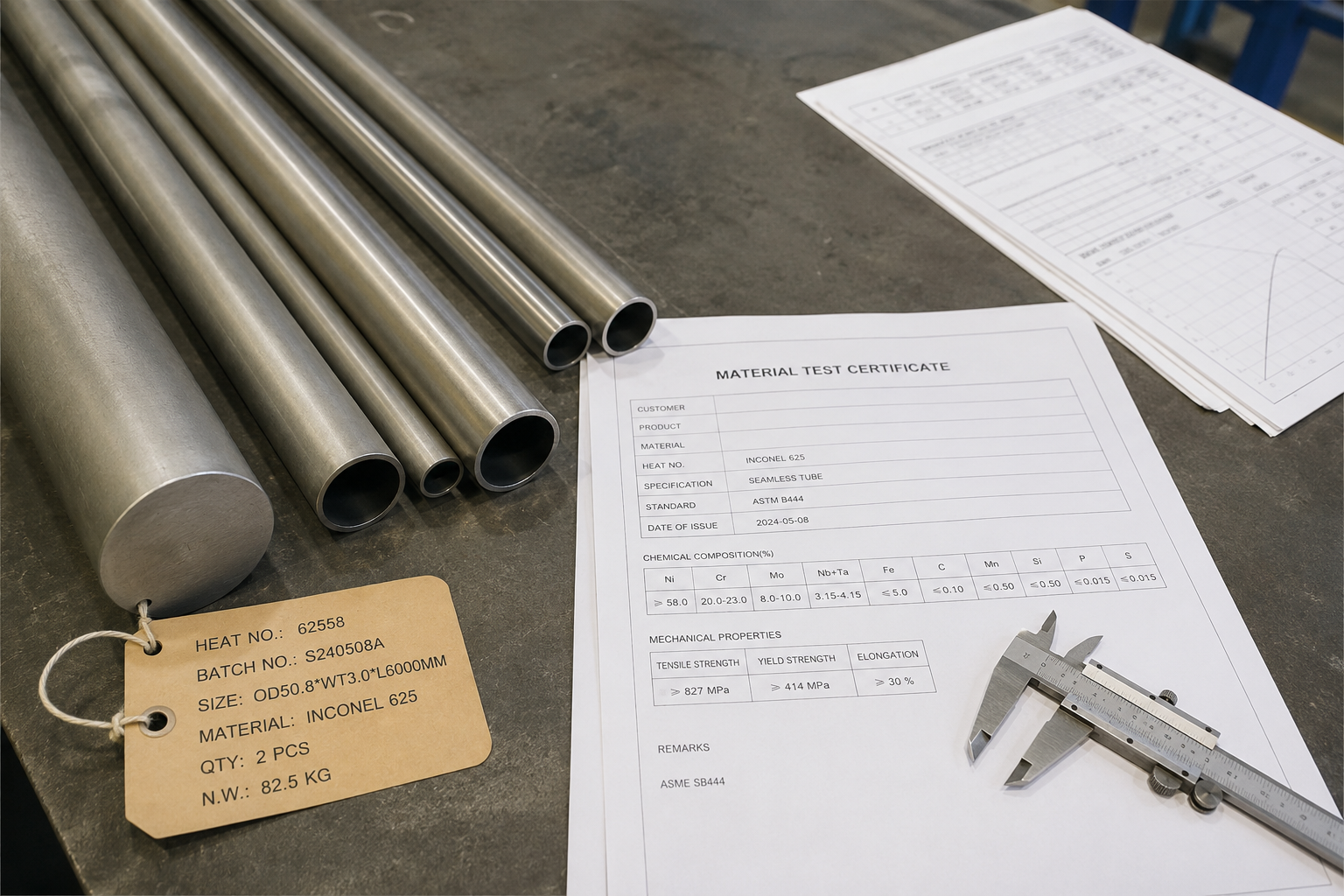
Distributors and stockists often keep commonly requested sizes because they need to balance customer demand, stock availability, inventory cost and lead time. Safety stock is used to reduce stockout risk caused by demand variation, forecast inaccuracy and lead time variability. Source: MIT / APICS — Safety Stock
NIST also notes that supply chain decisions should consider total cost of ownership, including longer lead times and higher inventory costs, not only purchase price. Source: NIST — Supply Chain Management
For buyers, the key question is not only:
Is this size available?
A better question is:
Does this available size truly meet my design, processing and service requirement?
Quick Answer: Should Buyers Choose Common Stock Sizes or Custom Sizes?
There is no universal answer.
A common stock size may be the best choice when:
- It matches the drawing or design tolerance.
- It has enough machining allowance.
- It meets the required ASTM / ASME / EN standard.
- It has the correct wall thickness or diameter.
- It can be supplied with the required MTC/MTR and inspection reports.
- It reduces lead time without creating technical compromise.
A custom size may be better when:
- The stock size is undersized.
- Oversized stock creates too much machining waste.
- Wall thickness affects pressure, corrosion allowance or heat transfer.
- ID affects flow rate, pressure loss or equipment fit.
- OD affects fit-up, tube sheet expansion, sealing or assembly.
- The project has strict tolerance, surface finish or inspection requirements.
- The material is used in critical, high-pressure, high-temperature, corrosive or fatigue-sensitive service.
Buyer Takeaway
Common size is a supply choice. Correct size is an engineering choice. Buyers need to compare both.
What Does “Common Size” Mean in Alloy Materials?
“Common size” usually means a size that is frequently requested, easier to stock, or commonly produced according to market demand or standard dimensional systems.
For alloy pipes, tubes, rods and bars, common size may refer to:
| Product Form | Common Size May Refer To |
|---|---|
| Pipe | NPS, DN, schedule, outside diameter and wall thickness. |
| Tube | OD, ID, wall thickness, average wall or minimum wall. |
| Rod / bar | Diameter, length, tolerance, hot-worked or cold-worked condition. |
| Heat exchanger tube | OD, wall thickness, straight length and tube standard. |
| Custom machined stock | Oversize bar or tube used for later machining. |
| Metric / inch material | Metric size, imperial size or converted equivalent. |
ASME B36.19M covers stainless steel pipe dimensions and wall thickness schedules. Source: ASME B36.19M — Stainless Steel Pipe
ISO 1127 specifies diameters, thicknesses, tolerances and conventional masses per unit length for stainless steel tubes. Source: ISO 1127 — Stainless Steel Tubes
Buyer Takeaway
A common size is not always a project size. Always check whether the available size matches the drawing, standard and end-use.
Why Do Distributors Stock Common Sizes?
Distributors usually cannot stock every possible alloy grade, diameter, wall thickness, length and tolerance. Nickel alloy and titanium alloy materials are expensive, and too much slow-moving inventory ties up capital.
So distributors often focus on sizes that are requested frequently.
Why Common Sizes Are Stocked
| Reason | Practical Meaning |
|---|---|
| Frequent demand | Popular sizes are easier to sell repeatedly. |
| Shorter lead time | Buyers can receive material faster when stock is available. |
| Lower inventory risk | Common sizes are less likely to sit unused for years. |
| Larger production runs | Standardized sizes may be more efficient to produce. |
| Better service coverage | One size may serve several general applications. |
| Emergency supply | Stock sizes help urgent maintenance and repair orders. |
| Lower handling complexity | Fewer size combinations are easier to manage. |
But There Is a Limitation
A distributor’s stock strategy is based on market demand. Your project requirement is based on engineering design.
These two are not always the same.
Buyer Takeaway
Stock availability is helpful, but it should not replace technical verification.
How Can Common Sizes Be Less Than Optimal?
Common sizes may create hidden compromises when they do not match the final requirement.
Common Size Trade-Offs
| Situation | Possible Problem |
|---|---|
| Stock bar is too large | Extra machining, more scrap, longer processing time and higher tool wear. |
| Stock bar is too small | Final part may not meet drawing size or machining allowance. |
| Tube wall is too thick | Higher weight, reduced ID, lower flow area and more cost. |
| Tube wall is too thin | Pressure margin, corrosion allowance or mechanical strength may be insufficient. |
| OD does not match fit-up | Assembly, sealing, tube sheet or fitting problems. |
| ID does not match flow requirement | Higher velocity, pressure drop or flow restriction. |
| Wrong length | Extra cutting, more waste or insufficient usable length. |
| Wrong tolerance | Rework, grinding or inspection rejection. |
| Wrong surface condition | Additional polishing, pickling, cleaning or machining. |
| Wrong standard | End-user or third-party inspection rejection. |
Example: Oversized Bar
A drawing may require a final machined diameter of 31.75 mm. If stock material is 35 mm, it may be usable if machining allowance is acceptable. But the buyer should calculate:
- Extra material cost
- Machining time
- Tool wear
- Surface finish requirement
- Straightness requirement
- Hardness condition
- Final tolerance
Example: Undersized Bar
If the final part needs 31.75 mm and available stock is 31.5 mm, it may not be acceptable even if the price is lower. An undersized bar cannot create missing material.
Buyer Takeaway
Oversized stock may be workable. Undersized stock is usually a serious risk. Always compare stock size with final machined dimensions and tolerance.
Why Do Pipe and Tube Dimensions Matter So Much?
For pipes and tubes, size is not only about outer appearance.
OD, ID and wall thickness may affect fit-up, flow, pressure drop, strength, corrosion allowance and heat transfer.
Key Pipe / Tube Dimensions
| Dimension | Why It Matters |
|---|---|
| OD | Affects fittings, clamps, tube sheets, expansion, welding and installation. |
| ID | Affects flow area, internal clearance, cleaning and pressure loss. |
| Wall thickness | Affects pressure capacity, corrosion allowance, strength, weight and cost. |
| Length | Affects installation, cutting waste and transport. |
| Ovality | Affects fit-up and sealing. |
| Straightness | Important for heat exchanger tubes, long tubes and precision assembly. |
| Minimum wall vs average wall | Important for pressure and corrosion allowance. |
The Darcy-Weisbach equation is used to calculate pressure and head loss due to friction in ducts, pipes or tubes, and pipe diameter is a key variable in flow and pressure loss calculations. Source: Engineering ToolBox — Darcy-Weisbach Equation
Fluid velocity in a circular pipe is related to flow rate and pipe inside diameter. Source: Engineering ToolBox — Pipe Velocity
Thin-walled pressure vessel theory shows that internal pressure creates hoop and axial stresses in cylindrical walls, making wall thickness relevant to pressure-related design. Source: Purdue University — Thin-Walled Pressure Vessels
Buyer Takeaway
A pipe or tube size that is “close” may still change flow, pressure loss, fit-up or safety margin.
Which Standards Should Buyers Check?
Different products follow different standards. A common size should still be checked against the correct product standard.
Common Standards for Nickel and Titanium Alloy Products
| Product | Common Standard Example | What It Helps Define |
|---|---|---|
| Nickel alloy seamless pipe / tube | ASTM B444 | UNS N06625 and related nickel alloy seamless pipe/tube requirements. |
| Nickel alloy seamless heat exchanger tube | ASTM B163 | Seamless nickel and nickel alloy tubes for condenser and heat exchanger service. |
| Nickel alloy rod / bar | ASTM B446 | UNS N06625 and related nickel alloy rod and bar requirements. |
| Titanium alloy bar / billet | ASTM B348 | Titanium and titanium alloy bars and billets. |
| Titanium alloy heat exchanger tube | ASTM B338 | Seamless and welded titanium tubes for condensers and heat exchangers. |
| Titanium alloy seamless pipe | ASTM B861 | Titanium and titanium alloy seamless pipe for corrosion-resisting and elevated-temperature service. |
| Titanium alloy welded pipe | ASTM B862 | Titanium and titanium alloy welded pipe for corrosion-resisting and elevated-temperature service. |
| Stainless pipe dimensional system | ASME B36.19M | Pipe dimensions and wall thickness schedules. |
| Tube dimensional reference | ISO 1127 | Tube diameters, thicknesses, tolerances and mass per length. |
ASTM B444 covers UNS N06625 and related nickel alloy seamless pipe and tube, including tensile, hydrostatic and nondestructive electric testing requirements. Source: ASTM B444
ASTM B446 covers UNS N06625 and related nickel alloy rod and bar products. Source: ASTM B446
ASTM B348 covers annealed titanium and titanium alloy bars and billets, including chemical composition and tensile property requirements. Source: ASTM B348
ASTM B338 covers seamless and welded titanium and titanium alloy tubes for condensers, evaporators and heat exchangers. Source: ASTM B338
ASTM B861 covers titanium and titanium alloy seamless pipe for general corrosion-resisting and elevated-temperature service. Source: ASTM B861
ASTM B862 covers titanium and titanium alloy welded pipe for general corrosion-resisting and elevated-temperature service. Source: ASTM B862
Buyer Takeaway
A stock size is only useful if it matches the right standard, not just the right approximate dimension.
What Trade-Offs Should Buyers Compare?
Choosing between common stock size and custom size requires a total-cost view.
Stock Size vs Custom Size
| Factor | Common Stock Size | Custom Size |
|---|---|---|
| Lead time | Usually faster if available. | Usually longer due to production planning. |
| Unit price | May be lower due to stock availability. | May be higher due to smaller batch or special processing. |
| Machining waste | May be higher if oversized. | May be lower if close to final dimension. |
| Technical fit | Must be checked against drawing and tolerance. | Can be made closer to project requirement. |
| Inspection | Standard documents may be available. | Special testing must be planned before production. |
| Flexibility | Good for urgent use and general machining stock. | Better for strict dimensions or special applications. |
| Risk | Risk of compromise if “close enough” is accepted. | Risk of longer lead time and higher MOQ. |
| Inventory | Easier to source repeatedly if common. | May need stocking plan for future replacement. |
Total Cost Items to Calculate
| Cost Item | Why It Matters |
|---|---|
| Material price | Initial purchase cost. |
| Machining cost | Extra turning, boring, grinding or cutting. |
| Scrap value | Oversized stock creates unused material. |
| Tool wear | Hard nickel alloys and titanium alloys can increase machining difficulty. |
| Inspection cost | Dimensional, NDT, PMI or third-party inspection may be required. |
| Delay cost | Custom production may affect project schedule. |
| Rework cost | Wrong size may require redesign or replacement. |
| Logistics cost | Urgent stock purchase may require express shipping. |
| Documentation cost | EN 10204 3.1, 3.2 or third-party documents may affect quotation. |
| Future replacement | Non-standard custom sizes may need future stock planning. |
Buyer Takeaway
The cheaper size is not always the cheaper solution. Calculate material, machining, waste, inspection and lead time together.
When Is a Common Size a Good Choice?
Common stock sizes can be a good choice when they meet the project requirement without creating unacceptable compromise.
Common Size May Be Suitable When
| Situation | Why It Works |
|---|---|
| Machining allowance is enough | Oversized bar or rod can be machined to final dimension. |
| Tolerance requirement is not extremely tight | Standard tolerance may be acceptable. |
| Application is not highly critical | General use may allow normal stock condition. |
| Lead time is urgent | Stock size reduces waiting time. |
| Quantity is small | Custom production may be uneconomical. |
| Standard pipe schedule is acceptable | NPS and schedule meet design requirements. |
| Surface condition is acceptable | Pickled, ground or polished condition matches end use. |
| Inspection documents are available | MTC/MTR and heat number traceability meet buyer needs. |
Buyer Takeaway
Common size is often the fastest path when it fits the engineering requirement.
When Should Buyers Consider Custom Size?
Custom size may be necessary when stock sizes create technical, economic or inspection problems.
Custom Size May Be Better When
| Situation | Why Custom Size Helps |
|---|---|
| Strict final dimension | Reduces machining and tolerance risk. |
| Thin-wall tube requirement | Exact wall thickness may be critical. |
| Pressure service | Wall thickness and minimum wall requirement must match design. |
| Flow-sensitive system | ID and pressure loss matter. |
| Heat exchanger tube | OD, wall, length and straightness may need strict control. |
| Aerospace-related parts | Drawing, tolerance, certification and traceability may be strict. |
| Medical equipment components | Surface, cleanliness and material validation may be important. |
| Expensive alloy grade | Reducing waste may offset custom production cost. |
| Repeated project demand | Custom size can be standardized for future orders. |
| Special inspection | NDT, PMI, corrosion testing or third-party inspection can be built into production. |
Buyer Takeaway
Custom size is not always more expensive when it reduces machining, waste, rejection and project risk.
What Hidden Risks Come From Choosing Only Common Sizes?
Choosing only from available stock can be risky if the buyer does not verify technical requirements.
Hidden Risks
| Risk | How It Happens |
|---|---|
| Wrong wall thickness | Stock wall does not match pressure, corrosion allowance or heat transfer requirement. |
| Wrong ID | Flow rate or internal clearance is affected. |
| Wrong OD | Fit-up, tube sheet expansion, clamp fit or sealing is affected. |
| Insufficient machining allowance | Final dimension cannot be achieved. |
| Excessive machining waste | Oversized stock becomes more expensive after processing. |
| Wrong tolerance | Material fails incoming inspection or machining requirement. |
| Wrong delivery condition | Annealed, solution annealed, aged or stress-relieved condition does not match use. |
| Wrong surface finish | Extra polishing, pickling or cleaning is needed. |
| Missing certificate | Stock material may not include required EN 10204 3.1 or project reports. |
| Future replacement issue | One-time stock size may not be available when replacement is needed. |
Buyer Takeaway
Common size is convenient, but convenience should not override engineering requirements.
What Documents Should Buyers Request?
Whether buying common stock size or custom size, documentation should match the project requirement.
Useful Documents
| Document | Why It Matters |
|---|---|
| MTC / MTR | Confirms heat number, chemistry, mechanical properties, standard and material condition. |
| EN 10204 3.1 certificate | Provides batch-specific test results and order compliance. |
| Dimensional report | Confirms OD, ID, wall thickness, bar diameter, length and tolerance. |
| PMI report | Confirms alloy identity if required. |
| NDT report | UT, ET, PT, hydrostatic or other inspection if required. |
| Surface report | Confirms roughness, polish, pickling or surface condition if specified. |
| Heat treatment record | Useful for critical aged, solution-treated or stress-relieved conditions. |
| Third-party inspection report | Required for some critical or end-user-controlled projects. |
EN 10204 Type 3.1 inspection certificates provide actual test results from the supplied material lot and are endorsed by a manufacturer’s authorized inspection representative independent from manufacturing. Source: EN 10204 Type 3.1 Inspection Certificates
Buyer Takeaway
Available stock without the right certificate may still be unusable for a quality-controlled project.
RFQ Checklist: How to Ask for the Right Size
When sending an inquiry, buyers should not only ask “Do you have this size in stock?” The RFQ should include both stock flexibility and technical requirements.
RFQ Information to Provide
| RFQ Item | What to Specify |
|---|---|
| Product form | Pipe, tube, rod, round bar, flat bar, billet or custom machined blank. |
| Material grade | Alloy 625, Alloy 718, C-276, Alloy 825, Monel 400, Titanium Grade 2, Grade 5, etc. |
| UNS number | N06625, N07718, N10276, N08825, N04400, R50400, R56400, etc. |
| Standard | ASTM B444, B446, B348, B338, B861, B862, ASME, EN, AMS or drawing. |
| Size requirement | OD, ID, wall thickness, diameter, length, width, thickness. |
| Tolerance | Standard tolerance or drawing tolerance. |
| Critical dimension | Tell supplier whether OD, ID, wall, diameter or length is most important. |
| Machining allowance | Final machined size and minimum acceptable stock size. |
| Pressure / flow requirement | For pipes and tubes, provide pressure, flow or ID requirement if relevant. |
| Surface condition | Pickled, polished, ground, bright annealed, machined, cleaned, capped. |
| Delivery condition | Annealed, solution annealed, aged, stress relieved, cold worked. |
| Inspection | PMI, UT, ET, PT, hydrostatic, dimensional report, third-party inspection. |
| Certificate | EN 10204 3.1 / 3.2, MTC/MTR, CoC. |
| Lead time need | Urgent stock, normal production or scheduled project delivery. |
| Substitution rule | Whether larger stock size is acceptable for machining. |
| Application | Chemical processing, heat exchanger, marine, aerospace-related, medical-related, power generation, oil and gas. |
Example RFQ Message
We need nickel alloy round bars for CNC machining. Material: Alloy 625 / UNS N06625, ASTM B446. Final machined diameter is 31.75 mm. Please quote available stock sizes with enough machining allowance, recommended bar diameter, delivery condition, surface finish, tolerance, EN 10204 3.1 MTC, heat number traceability, dimensional report option, MOQ and lead time. Please also advise whether a custom size would reduce machining waste for repeated orders.
Example RFQ Message for Pipe
We need titanium seamless pipe, Grade 2 / UNS R50400, ASTM B861. Please quote stock and custom options for OD, wall thickness and length. The pipe will be used in a corrosion-resistant service environment. Please confirm standard, dimensional tolerance, heat treatment condition, surface condition, EN 10204 3.1 MTC, NDT availability, lead time and packing.
Common Mistakes Buyers Should Avoid
1. Assuming Common Size Means Correct Size
Stock availability does not prove engineering suitability.
2. Accepting Undersized Material
If material is undersized, it may be impossible to meet final machined dimensions.
3. Ignoring Machining Waste
Oversized material may increase total cost through scrap and machining time.
4. Not Checking Wall Thickness
For pipes and tubes, wall thickness affects pressure, corrosion allowance, strength and cost.
5. Not Checking ID
ID affects flow, pressure loss, cleaning and internal clearance.
6. Not Defining Tolerance
Nominal size is not the same as controlled tolerance.
7. Not Checking Certificate Availability
Some stock material may not have the certificate type or test reports required by the project.
8. Confusing Pipe and Tube
Pipe is often specified by NPS and schedule, while tube is often specified by OD and wall thickness.
9. Ignoring Future Replacement
A one-time stock size may create problems if future replacement is needed.
10. Choosing Only by Lowest Price
The lowest material price may create higher machining, inspection, delay or rejection cost.
FAQ: Common vs Custom Alloy Pipe and Rod Sizes
1. Are common alloy sizes always cheaper?
Not always. Common sizes may have lower initial price, but oversized material can create extra machining waste and processing cost.
2. Are stock sizes faster to deliver?
Usually yes, if the material is truly in stock and has the required certificate and inspection documents.
3. When should I choose a custom size?
Choose custom size when stock sizes do not meet drawing, tolerance, pressure, flow, machining allowance or project inspection requirements.
4. Can I use a larger bar and machine it down?
Often yes, if there is enough machining allowance and the material condition, hardness and tolerance are suitable.
5. Can I use a smaller bar if it is close to my required size?
Usually no. Undersized stock cannot meet a larger final dimension unless the design is changed and approved.
6. Why does pipe wall thickness matter?
Wall thickness affects pressure capability, corrosion allowance, strength, ID, weight and cost.
7. Why does tube ID matter?
ID affects flow area, pressure loss, internal clearance and cleaning.
8. What is the difference between pipe size and tube size?
Pipe is often specified by nominal pipe size and schedule. Tube is often specified by actual OD and wall thickness.
9. What documents should I ask for when buying stock material?
Ask for MTC/MTR, EN 10204 3.1 if required, heat number traceability, dimensional report and any required NDT or PMI report.
10. How can I reduce size selection risk?
Provide final application, drawing, tolerance, critical dimensions, machining allowance, pressure/flow requirement, standard, inspection requirement and certificate requirement in the RFQ.
Conclusion
Common alloy pipe and rod sizes are useful because they can reduce lead time and simplify purchasing. But common does not always mean optimal.
For nickel alloy and titanium alloy materials, buyers should evaluate size selection based on engineering requirements, not only stock availability. OD, ID, wall thickness, diameter, tolerance, surface condition, delivery condition, machining allowance, pressure, flow, certificates and inspection reports all matter.
A common stock size may be the best option for urgent or general applications. A custom size may be better when precision, performance, waste reduction or project approval is more important.
Emily PIPE supplies nickel alloy tubes, nickel alloy bars, titanium alloy tubes and titanium alloy bars for global industrial applications. If you are comparing common stock sizes with custom alloy material sizes, you can send your material grade, UNS number, standard, target dimension, tolerance, application environment and certificate requirement for technical review and quotation.