
ASTM Nickel Alloy Tubes: What Buyers Should Confirm Before Ordering
Do you need nickel alloy tubes according to ASTM standards, but feel unsure which ASTM specification to use? Many buyers ask for “ASTM nickel alloy tubes,” but this request is usually too broad for accurate quotation, production, inspection and project acceptance.
Yes, nickel alloy tubes can be supplied according to ASTM standards, but buyers should specify the exact ASTM designation, alloy grade, UNS number, product form, size, wall thickness, tolerance, test scope and certificate requirement. ASTM International develops and publishes voluntary consensus technical standards for materials, products, systems and services. For nickel alloy tubes, different standards such as ASTM B163, ASTM B444 and ASTM B622 cover different alloy groups, product forms and testing requirements.
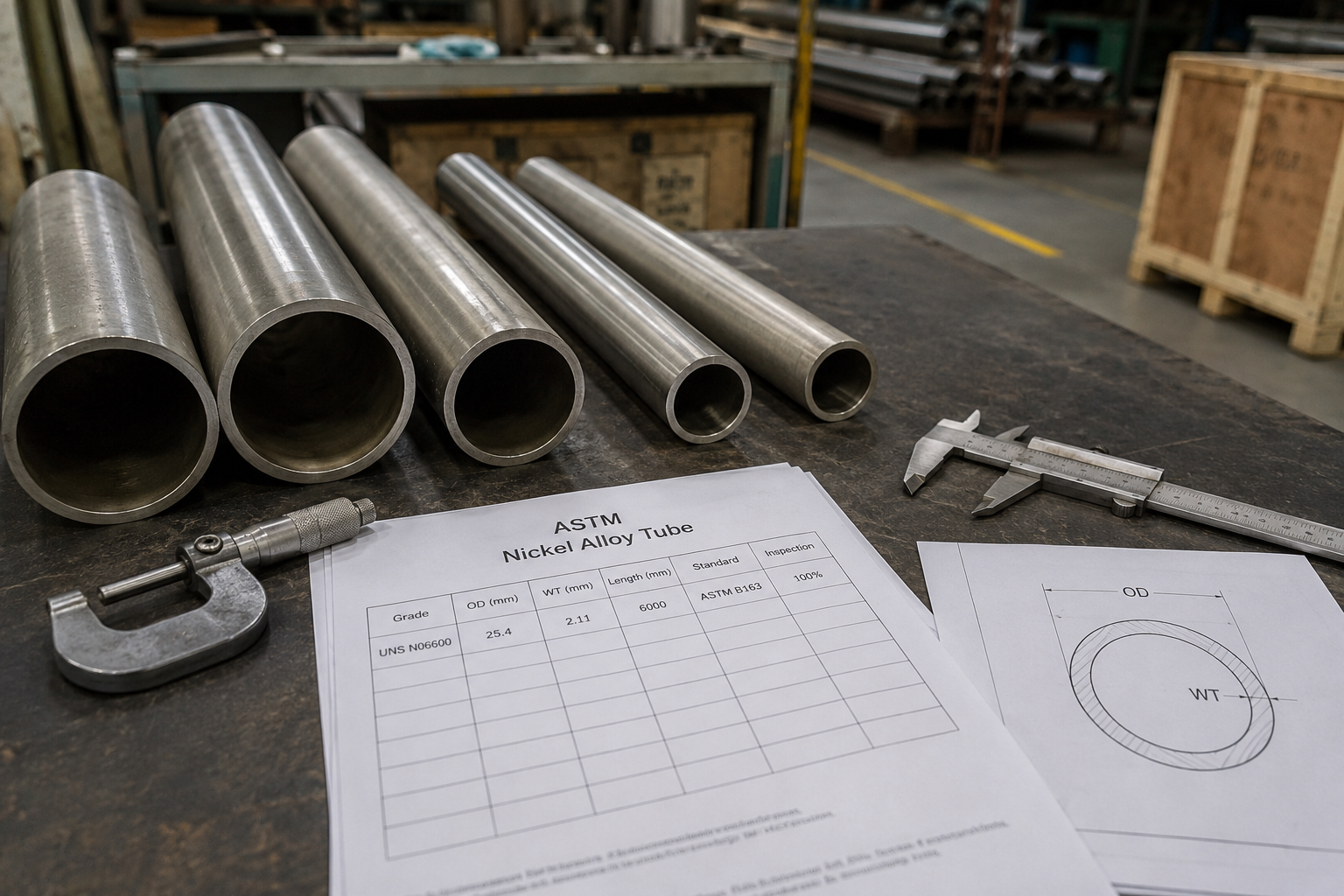
For industrial buyers, ASTM compliance is not just a label on a quotation. It should be verified through the purchase order, Mill Test Report, heat number, product marking, inspection records and packing list.
This article explains what buyers should confirm before purchasing ASTM nickel alloy tubes.
Quick Answer: What Does “ASTM Nickel Alloy Tube” Need to Include?
A clear RFQ should not only say “ASTM standard.” It should identify the exact material, tube form, dimensional requirement and inspection scope.
| RFQ Item | What Buyers Should Provide | Why It Matters |
|---|---|---|
| ASTM Standard | ASTM B163, ASTM B444, ASTM B622 or other applicable standard | Defines product scope, material requirements and tests |
| Alloy Grade / Trade Name | Inconel 625, Inconel 600, Alloy 825, Hastelloy C276, Monel 400, etc. | Helps identify the material family |
| UNS Number | N06625, N06600, N08825, N10276, N04400, etc. | Reduces confusion between trade names and similar alloys |
| Product Form | Seamless tube, welded tube, pipe, heat exchanger tube | ASTM standards are product-form specific |
| Size | OD, wall thickness, ID if required, length | Affects production, inspection and fit-up |
| Wall Basis | Average wall, minimum wall, schedule or exact wall thickness | Important for acceptance and pressure-related requirements |
| Tolerance | OD, WT, length, straightness, ovality if required | Affects assembly and inspection |
| Heat Treatment Condition | Annealed, solution annealed, stress relieved or other condition | Affects final mechanical and corrosion-related properties |
| Testing Requirements | Chemical, tensile, hydrostatic, ET, UT, PMI, dimensional inspection | Defines quality scope |
| Certificate Requirement | MTR/MTC, EN 10204 3.1, EN 10204 3.2, CoC | Supports project acceptance |
| Application Environment | Temperature, pressure, media, chloride, pH, flow, service life | Helps confirm whether the ASTM grade is suitable |
| Packaging and Marking | Heat number, grade, size, bundle label, end caps, wooden case | Maintains traceability and prevents shipment damage |
A supplier can only quote accurately when the ASTM requirement is specific.
Is “ASTM Standards” One Standard or Many Standards?
ASTM is not one single standard. It is a standards organization, and each ASTM number refers to a specific product or test standard.
For nickel alloy tubes, the buyer must identify the exact ASTM designation because different standards cover different alloys, tube types and test requirements. Saying only “ASTM nickel alloy tube” does not define the material clearly enough.
Common ASTM Standards for Nickel Alloy Tubes
| ASTM Standard | Product Scope | Buyer Notes |
|---|---|---|
| ASTM B163 | Seamless nickel and nickel alloy condenser and heat-exchanger tubes | ASTM states that B163 covers outside diameter and average wall, or outside diameter and minimum wall tubes |
| ASTM B444 | UNS N06625, UNS N06852 and UNS N06219 cold-worked seamless pipe and tube | ASTM states that chemical, tensile, hydrostatic and nondestructive electric testing are included |
| ASTM B622 | Seamless pipe and tube of nickel and nickel-cobalt alloys | ASTM lists many UNS alloys and includes tension, hydrostatic and nondestructive electric tests |
| ASTM B167 | Nickel-chromium-iron alloy seamless pipe and tube | Often associated with Alloy 600-type materials; check exact edition and scope |
| ASTM B704 | Welded nickel alloy tubes | Used for welded tube forms; not the same as seamless tube standards |
| ASTM B705 | Welded nickel alloy pipe | Used for welded pipe forms; not the same as seamless tube standards |
Why the Exact ASTM Number Matters
Different ASTM standards may define:
- covered alloys
- product form
- chemical composition limits
- heat treatment condition
- mechanical property requirements
- outside diameter and wall requirements
- hydrostatic testing
- nondestructive electric testing
- dimensional tolerance
- marking and certification requirements
This is why buyers should specify the exact ASTM standard and UNS number in the RFQ.
ASTM B163 vs ASTM B444 vs ASTM B622: How Are They Different?
Many nickel alloy tube buyers are unsure which ASTM standard applies. The difference usually depends on alloy grade, tube form and application.
Practical Comparison for Buyers
| Standard | Typical Buyer Search Intent | What It Usually Indicates |
|---|---|---|
| ASTM B163 | Nickel alloy heat exchanger tubes | Seamless nickel and nickel alloy tubes for condenser and heat-exchanger service |
| ASTM B444 | Inconel 625 seamless tube / pipe | UNS N06625 and related Ni-Cr-Mo alloy seamless pipe and tube |
| ASTM B622 | Hastelloy C276 / C22 seamless tube / pipe | Nickel and nickel-cobalt alloy seamless pipe and tube for corrosion-resistant applications |
| ASTM B167 | Inconel 600 seamless tube / pipe | Nickel-chromium-iron alloy seamless pipe and tube |
| ASTM B704 / B705 | Welded nickel alloy tube / pipe | Welded product forms, not seamless |
Example Selection Logic
| If You Need... | You May Start by Checking... |
|---|---|
| UNS N06625 seamless tube or pipe | ASTM B444 |
| Seamless condenser or heat exchanger nickel alloy tubes | ASTM B163 |
| UNS N10276 or UNS N06022 seamless pipe or tube | ASTM B622 |
| Nickel alloy welded tube | ASTM B704 |
| Nickel alloy welded pipe | ASTM B705 |
| Pressure equipment application | ASTM/ASME material requirement plus project code requirement |
This table is only a starting point. Final standard selection should be based on the exact grade, product form, application and project specification.
How Do Buyers Verify Whether a Supplier Truly Meets ASTM Requirements?
A supplier saying “ASTM compliant” is not enough. Buyers should verify the claim through batch-level documents and physical traceability.
ASTM compliance should be checked by comparing the RFQ, purchase order, MTR/MTC, heat number, product marking, inspection reports and packing list. A Mill Test Report or Material Test Certificate certifies chemical and physical properties and states compliance with applicable standards. A heat number links the metal product to a specific batch or heat for traceability.
ASTM Compliance Verification Checklist
| Verification Item | What to Check | Why It Matters |
|---|---|---|
| Exact ASTM Standard | Same ASTM number on RFQ, PO and MTC | Avoids wrong standard scope |
| UNS Number | Same UNS number on quotation, MTC and marking | Avoids grade confusion |
| Product Form | Seamless tube, welded tube or pipe | Standards are product-form specific |
| Heat Number | Same heat number on MTC, product marking and packing list | Supports traceability |
| Chemical Composition | Actual element values vs standard limits | Confirms alloy chemistry |
| Mechanical Properties | Tensile strength, yield strength, elongation, hardness if required | Confirms batch-level properties |
| Heat Treatment Condition | Annealed, solution annealed or other condition | Affects final properties |
| Hydrostatic Test | Required or not required by standard / PO | Confirms pressure-tightness scope |
| NDT Reports | ET, UT or nondestructive electric test if required | Confirms flaw inspection scope |
| Dimensional Report | OD, WT, length, tolerance, straightness if required | Confirms size acceptance |
| Certificate Type | MTC, EN 10204 3.1, EN 10204 3.2 or CoC | Supports project acceptance |
| Packing List | Quantity, heat distribution, bundle information | Helps receiving inspection |
The MTC should not be checked alone. It should match the material marking and packing list.
What Should Buyers Look for in the MTR/MTC?
The MTR/MTC is one of the most important documents for ASTM nickel alloy tube procurement.
Key MTC Data for Nickel Alloy Tubes
| MTC Data | What It Should Show |
|---|---|
| Manufacturer / Mill Name | Clear issuing source |
| Customer / PO Number | Link to the order |
| ASTM Standard | Exact standard and edition if required |
| Material Grade / UNS | Exact alloy identity |
| Product Form | Seamless tube, welded tube, pipe or heat exchanger tube |
| Size | OD, WT, length and tolerance if reported |
| Heat Number | Batch identity |
| Chemical Composition | Actual values for Ni, Cr, Mo, Fe, Nb, C, Mn, Si, P, S and other required elements |
| Mechanical Properties | Tensile strength, yield strength, elongation and hardness if required |
| Heat Treatment | Annealed, solution annealed or other condition |
| Test Results | Hydrostatic, ET, UT, PMI or other tests if required |
| Inspection Certificate Type | EN 10204 3.1 / 3.2 or other certificate type if required |
| Signature / Approval | Authorized approval or document control information |
Red Flags in an MTC
| Red Flag | Why It Matters |
|---|---|
| Only says “ASTM” without standard number | The material scope is unclear |
| ASTM standard does not match PO | Wrong acceptance criteria may apply |
| UNS number missing | Trade-name confusion may occur |
| Heat number missing | Traceability is incomplete |
| Actual values not shown | Buyer cannot independently compare results |
| Product form unclear | Pipe, tube, seamless and welded forms may be mixed |
| Test reports missing | Required ET, UT or hydrostatic test may not be included |
| Certificate type unclear | EN 10204 3.1 / 3.2 requirement may not be met |
| Heat number does not match marking | Certificate may not belong to the physical material |
| “Equivalent” stated without approval | Substitute material may not meet project requirement |
If any red flag appears, the buyer should ask for clarification before accepting, machining, welding or installing the material.
Why Does Application Context Matter for ASTM Compliance?
ASTM compliance confirms that the material meets a stated standard. It does not automatically prove that the material is suitable for every service condition.
The application context helps determine which ASTM standard, alloy grade, wall thickness, heat treatment, test scope and certificate requirement are appropriate. Temperature, pressure, corrosion media, flow, stress and service life should be reviewed before final material selection.
Application Factors Buyers Should Provide
| Application Factor | Why It Matters |
|---|---|
| Corrosive Media | Determines grade selection and corrosion risk |
| Chemical Concentration | Same chemical may behave differently at different concentrations |
| Temperature | Affects corrosion rate, strength, oxidation and creep |
| Pressure | Affects tube wall, test scope and safety margin |
| Flow Rate | High velocity or particles may cause erosion-corrosion |
| Chloride Level | Important for pitting, crevice corrosion and SCC risk |
| pH Value | Helps evaluate acid, neutral or alkaline environment |
| Mechanical Load | Affects tensile, fatigue and vibration considerations |
| Welding / Forming | May require specific condition, surface finish or heat treatment |
| Service Life Target | Helps balance material cost and reliability |
| Inspection Requirement | Defines ET, UT, hydrostatic, PMI or third-party inspection scope |
Standard Compliance vs Application Suitability
| ASTM Compliance Can Confirm | It Does Not Automatically Confirm |
|---|---|
| Chemistry is within the standard limits | The alloy is suitable for every corrosive medium |
| Mechanical properties meet the standard | The tube will last for the full service life |
| Required tests were performed | No additional project test is needed |
| Heat treatment condition is reported | Welding, bending or installation will be problem-free |
| Heat number supports traceability | The material cannot fail in service |
| MTC states standard compliance | The selected standard is the correct one for your application |
This is why buyers should provide application details at the RFQ stage.
What Questions Should Buyers Ask an ASTM Nickel Alloy Tube Supplier?
A reliable supplier should be able to explain what ASTM standard applies and what evidence can be provided.
Supplier Evaluation Questions
| Question | What a Useful Answer Should Include |
|---|---|
| Which exact ASTM standard applies to this tube? | Standard number, product form, grade and UNS number |
| Is the tube seamless or welded? | Matching ASTM standard and manufacturing route |
| Can you provide an MTR/MTC for this order? | Actual chemistry, mechanical values, heat number and standard compliance |
| How do you maintain heat number traceability? | Heat number on MTC, marking, label and packing list |
| What tests are included in the quotation? | Chemical, tensile, hydrostatic, ET, UT, PMI, dimensional inspection |
| Are tests in-house or third-party? | Lab capability and external inspection option |
| Is ISO 9001 certification available? | Quality management system evidence |
| Can you support ISO/IEC 17025 laboratory testing if required? | Accredited lab option for independent testing |
| Can you provide EN 10204 3.1 or 3.2? | Certificate type and inspection arrangement |
| How are tubes marked and packed? | Grade, heat number, size, bundle label, end protection |
| How are nonconforming products controlled? | Identification, separation, review and corrective action process |
| Can you support third-party inspection? | Witness testing, document review and pre-shipment inspection |
ISO 9001 is a quality management system standard that helps organizations establish, implement, maintain and improve a QMS. It supports process management, but it does not replace batch-level MTR/MTC and heat number traceability.
If independent testing is required, ISO/IEC 17025 sets requirements for testing and calibration laboratory competence, impartiality and consistent operation.
What Tests May Be Required for ASTM Nickel Alloy Tubes?
The exact test requirement depends on the ASTM standard, purchase order and project specification.
Common Test and Inspection Items
| Test / Inspection | Purpose |
|---|---|
| Chemical Analysis | Confirms alloy chemistry |
| Tensile Test | Confirms tensile strength, yield strength and elongation |
| Hardness Test | Confirms hardness if required |
| Hydrostatic Test | Checks pressure tightness for tubes or pipes when required |
| Nondestructive Electric Test / ET | Checks surface or near-surface flaws in conductive tubes |
| Ultrasonic Test / UT | Checks internal flaws or wall-related discontinuities when required |
| PMI | Confirms alloy identity during receiving or pre-shipment inspection |
| Dimensional Inspection | Confirms OD, WT, length, tolerance, straightness and ovality |
| Surface Inspection | Checks pits, scratches, dents, contamination and finish |
| Third-Party Inspection | Provides independent verification if required by project |
Eddy-current testing is an electromagnetic nondestructive testing method used for conductive materials and can detect or characterize surface and subsurface flaws. Ultrasonic testing is widely used to detect internal flaws or characterize materials. Hydrostatic testing is commonly used for pipes, pipelines, boilers and pressure vessels to test strength and leaks.
Buyers should specify required tests before placing the order. If a test is not included in the ASTM standard or purchase order, it may not be included in the quotation.
RFQ Template for ASTM Nickel Alloy Tubes
Buyers can use the following template when requesting ASTM nickel alloy tubes.
| RFQ Item | Information to Provide |
|---|---|
| ASTM Standard | ASTM B163, ASTM B444, ASTM B622, ASTM B167, ASTM B704, ASTM B705, etc. |
| Standard Version | Year/version if required by project |
| Alloy Grade | Inconel 625, Alloy 600, Alloy 825, Hastelloy C276, Monel 400, etc. |
| UNS Number | N06625, N06600, N08825, N10276, N04400, etc. |
| Product Form | Seamless tube, welded tube, pipe, heat exchanger tube |
| Size | OD × WT × length |
| Wall Basis | Average wall, minimum wall, schedule or exact wall |
| Tolerance | OD, WT, length, straightness, ovality if required |
| Heat Treatment | Annealed, solution annealed, stress relieved or required condition |
| Surface Finish | Pickled, polished, bright annealed, cleaned, as-welded |
| Application | Heat exchanger, chemical processing, oil and gas, marine system, power plant |
| Operating Conditions | Temperature, pressure, media, chloride, pH, flow, service life |
| Testing | Hydrostatic, ET, UT, PMI, tensile, hardness, dimensional inspection |
| Certificate | MTR/MTC, EN 10204 3.1, EN 10204 3.2, CoC |
| Traceability | Heat number marking, bundle labels, packing list |
| Third-Party Inspection | Required or not required |
| Packaging | Caps, waterproof film, wooden case, separate heats |
| Delivery Terms | Quantity, Incoterms, destination, required delivery date |
A complete RFQ reduces back-and-forth communication and helps the supplier quote the correct ASTM material scope.
How Can Emily PIPE Support ASTM Nickel Alloy Tube Orders?
Emily PIPE supplies nickel alloy tubes, nickel alloy bars, titanium alloy tubes and titanium alloy bars for global industrial customers. We support standard and customized specifications according to drawings, technical requirements and application environments.
For ASTM nickel alloy tube projects, we can help review:
- ASTM standard and grade selection
- UNS number confirmation
- seamless or welded tube requirement
- OD, wall thickness, length and tolerance
- average wall vs minimum wall requirement
- heat treatment condition
- surface finish and end protection
- chemical and mechanical property requirements
- hydrostatic, ET, UT, PMI and dimensional inspection requirements
- MTR/MTC and heat number traceability
- EN 10204 3.1 / 3.2 certificate requirements
- third-party inspection and pre-shipment inspection
- export packaging and logistics documents
We recommend sharing the exact ASTM standard, UNS number, application environment and certificate requirement at the RFQ stage. This helps avoid wrong quotation scope, missing tests, document mismatch and project acceptance delays.
Conclusion
Supplying nickel alloy tubes according to ASTM standards is not a simple “yes” or “no.” The buyer must define the exact ASTM designation, alloy grade, UNS number, product form, size, tolerance, test scope and certificate requirement.
ASTM B163, ASTM B444 and ASTM B622 are not interchangeable. Each standard has its own scope and requirements. A good supplier should provide not only a quotation, but also MTR/MTC, heat number traceability, product marking, inspection reports and packing information that match the purchase order.
If you are sourcing ASTM nickel alloy tubes, you can send us your ASTM standard, UNS number, tube size, wall thickness, application environment, testing requirements, certificate type and delivery schedule. Our team can help review the material scope and provide a quotation based on your project needs.