
How to Choose Alloy Tubes for Pharmaceutical Processing Pipelines
Selecting alloy tubes for pharmaceutical processing pipelines is not only a material purchasing decision. In pharmaceutical and bioprocessing systems, tubing may contact product, purified water, WFI, clean steam, cleaning agents, sterilization media, or process gases. A poor material choice may increase contamination risk, corrosion risk, cleaning difficulty, maintenance work, validation burden, or premature replacement.
Choosing the right alloy tube means making a risk-based decision. Buyers should match process media, temperature, pressure, CIP/SIP conditions, surface finish, cleanliness, documentation, inspection scope, and supplier traceability with the actual application.
FDA 21 CFR 211.65 states that equipment surfaces contacting components, in-process materials, or drug products should not be reactive, additive, or absorptive in a way that alters drug safety, identity, strength, quality, or purity. FDA 21 CFR 211.67 also requires equipment to be cleaned, maintained, and, where appropriate, sanitized or sterilized at suitable intervals to prevent malfunction or contamination.
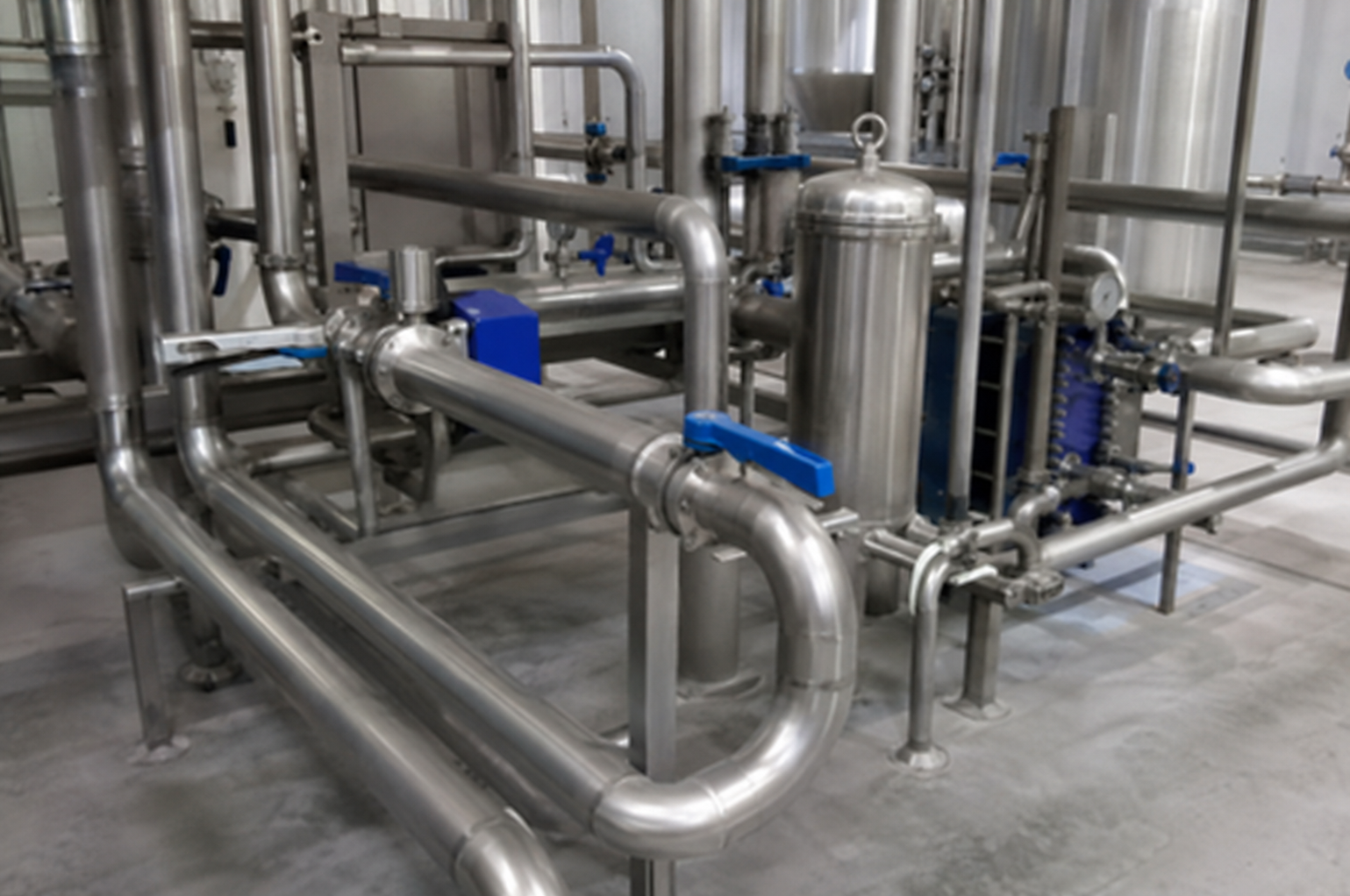
For buyers, engineers, and project teams, the key question is not simply “Which alloy tube is best?” The better question is “Which tube material, surface finish, documentation, and inspection plan match this pharmaceutical process and compliance requirement?”
Why Pharmaceutical Tube Selection Should Be Risk-Based
Pharmaceutical processing is different from many general industrial applications. A tube may be technically strong enough, but still unsuitable if it is difficult to clean, reacts with the process media, releases contaminants, has the wrong surface finish, or lacks proper documentation.
FDA’s process validation guidance describes process validation as a lifecycle concept and encourages the use of quality risk management and quality systems throughout the manufacturing process lifecycle.
For alloy tube selection, a risk-based approach should consider:
- Product contact or non-product contact service
- Process fluid or gas composition
- Temperature and pressure range
- CIP cleaning chemicals
- SIP or steam sterilization cycles
- WFI, purified water, or clean steam exposure
- Corrosion and rouging risk
- Surface finish and cleanability
- Drainability and hygienic design
- Weldability and orbital welding requirements
- Documentation and validation support
- MTC / heat number traceability
- Applicable standards such as ASME BPE, ASTM, ASME, EN, ISO, or customer specification
This approach helps avoid the mistake of selecting material only by grade name or initial price.
Do Process Conditions Dictate Alloy Choice?
Yes. Process conditions should drive alloy tube selection. A material that performs well in one pharmaceutical process may not be suitable for another if the temperature, cleaning agent, chloride level, pH, sterilization cycle, or product chemistry is different.
Important process conditions include:
| Process Factor | What to Confirm | Why It Matters |
|---|---|---|
| Product or media | API, solvent, purified water, WFI, clean steam, acid, alkali, buffer, gas, or cleaning agent | Determines corrosion and contamination risk |
| Temperature | Normal temperature, maximum temperature, thermal cycling, SIP exposure | Affects corrosion rate, oxide formation, strength, and surface stability |
| Pressure | Operating pressure, pressure cycling, vacuum, clean steam pressure | Affects wall thickness, mechanical design, and testing requirements |
| CIP chemicals | Caustic, acid, oxidizing cleaner, disinfectant, or mixed cleaning regime | May attack unsuitable alloys or surface finishes |
| SIP / sterilization | Steam-in-place, hot water, chemical sterilization, or dry heat | May affect passive layer, surface condition, and long-term appearance |
| Chlorides and halides | Chloride level, fluoride, bromide, or other halogens | May increase pitting, crevice corrosion, or SCC risk |
| Flow condition | High velocity, stagnant zones, dead legs, or low-flow areas | Affects cleaning, deposits, corrosion, and contamination risk |
| Surface finish | Ra value, mechanical polishing, electropolishing, passivation | Supports cleanability and inspection acceptance |
| Documentation | MTC, surface finish report, inspection record, weld documentation | Supports validation and traceability |
The more critical the pharmaceutical application, the more important it is to define the process condition before selecting the alloy tube.
Why Surface Finish and Cleanability Matter
For pharmaceutical pipelines, internal surface finish is not only an appearance issue. It can affect cleanability, drainability, inspection, contamination control, and acceptance against project specifications.
ASME BPE includes sections on process contact surface finishes for multiuse components, acceptance criteria for metallic process contact surface finishes, Ra readings for metallic process contact surfaces, and passivation. Buyers can refer to the ASME BPE table of contents here: ASME BPE Bioprocessing Equipment.
When ordering alloy tubes for pharmaceutical pipelines, buyers should confirm:
- Internal surface finish requirement
- Ra value requirement
- Mechanical polishing or electropolishing
- Passivation requirement
- Pickled, bright annealed, or polished surface
- Inner surface cleanliness
- No visible cracks, pits, laps, scratches, or heavy scale
- End protection and clean packaging
- Surface finish report if required
However, surface finish alone does not guarantee sterility or compliance. It must work together with hygienic design, proper welding, cleaning validation, maintenance, and process control.
What About Rouging in Pharmaceutical Water and Steam Systems?
Rouging is a common concern in pharmaceutical water and pure steam systems, especially where stainless steel surfaces are exposed to elevated temperatures. Rouging generally refers to reddish-brown, dark, or black oxide deposits that can appear on internal surfaces.
A review on rouging in pharmaceutical water systems notes that rouging can affect high-purity water systems such as WFI and purified water systems, and may create particulate contamination or water quality concerns.
ECA Academy also explains that rouging can appear in PW, WFI, and pure steam systems, and that temperature, passive layer condition, material condition, passivation, electropolishing, flow, and system operation can influence the rate of rouging formation.
For buyers, the practical point is clear: if a tube will be used in WFI, purified water, or clean steam service, surface condition, passivation, cleaning, temperature, and documentation should be reviewed carefully.
Is ASME BPE Always Required?
Not always. ASME BPE is highly relevant for many bioprocessing, pharmaceutical, and high-purity applications, but whether it applies depends on the project specification, customer requirement, system design, and end-use.
ASME BPE covers topics such as:
- Manufacturer quality assurance
- Examination, inspection, and testing
- Documentation
- Metallic material documentation
- Weld examination and inspection
- Process contact surface finishes
- Ra readings
- Passivation
- Rouge and stainless steel
- Positive material identification
- Vendor documentation requirements
If a project requires ASME BPE, buyers should not only ask for “pharmaceutical grade tube.” They should define the required surface finish, dimensions, tolerance, weldability, inspection, packaging, and documentation according to the project specification.
How to Think About Alloy Families
Many pharmaceutical pipelines use 316L stainless steel, especially in hygienic and high-purity systems. However, some applications may involve aggressive cleaning chemicals, special process media, high chloride exposure, acids, solvents, or other demanding environments where nickel alloys or titanium alloys may be considered.
The following table is only a starting point for technical discussion. It should not be treated as a final selection chart.
| Material Family | Why Buyers May Consider It | Important Caution |
|---|---|---|
| 316L stainless steel | Commonly used in pharmaceutical and hygienic piping systems | Surface finish, passivation, rouging, chloride exposure, and cleaning regime must be reviewed |
| Nickel alloys | May be considered for special corrosive media, acids, or severe chemical exposure | Must confirm media, concentration, temperature, cleanability, cost, and standard requirements |
| Titanium alloys | May be considered for selected chloride-containing or oxidizing wet environments | Not suitable for every chemical or temperature condition; galling and cleaning compatibility should be checked |
| Hastelloy / Ni-Cr-Mo alloys | May be considered for severe corrosion or aggressive chemical service | High cost, availability, welding, surface finish, and validation requirements must be reviewed |
| Electropolished stainless systems | Often considered for high-purity water and cleanability requirements | Electropolishing is not a substitute for correct design, cleaning validation, and maintenance |
The best choice depends on process chemistry, surface finish, cleaning method, sterilization condition, project standard, and validation needs.
How to Verify Supplier Claims
Supplier claims should be supported by documents, test results, inspection records, and traceability. For pharmaceutical projects, documentation can be as important as the material itself.
Buyers should ask:
- Can you provide MTC / MTR for the specific heat number?
- Can the material be traced back to the batch or melt?
- Which standard does the tube follow?
- Is the tube seamless or welded?
- What surface finish is supplied?
- Can you provide Ra measurement reports if required?
- Can you provide passivation or electropolishing documentation if required?
- Can you support PMI testing?
- Can you support UT, PT, eddy current, hydrostatic, or pressure testing if required?
- Can you provide ASME BPE-related documentation if the project requires it?
- Can you support third-party inspection before shipment?
- Can you provide clean packaging and end protection suitable for the application?
A reliable supplier should be able to explain both material capability and documentation scope.
What Documents Should Buyers Request?
For pharmaceutical processing tubes, buyers may request:
- Material Test Certificate / Mill Test Report
- EN 10204 Type 3.1 or Type 3.2 certificate if required
- Heat number or batch number traceability
- Chemical composition report
- Mechanical properties report
- Dimensional inspection report
- Surface finish / Ra report if required
- PMI report if required
- UT / PT / eddy current testing report if required
- Hydrostatic or pressure test report if required
- Passivation or electropolishing certificate if required
- Weld documentation if applicable
- ASME BPE compliance documentation if specified
- Third-party inspection report if required
- Packing and marking records
For metallic products, EN 10204 Type 3.1 and Type 3.2 inspection documents are commonly used to define inspection documentation. Type 3.1 provides specific inspection results and is validated by the manufacturer’s authorized inspection representative independent of the manufacturing department. Type 3.2 adds validation by the manufacturer’s authorized inspection representative and the purchaser’s authorized inspection representative or a designated inspector, depending on the requirement.
Buyers should still check whether the certificate matches the physical material. The heat number, grade, size, standard, surface condition, test values, quantity, and marking should match the purchase order.
What Testing and Inspection May Be Useful?
Testing should be defined before production or shipment. The required inspection depends on product form, standard, application risk, and customer specification.
| Test / Inspection | Purpose |
|---|---|
| Chemical analysis | Confirms alloy composition |
| Mechanical testing | Confirms tensile strength, yield strength, elongation, or hardness |
| PMI testing | Helps verify alloy identity and major elements |
| Dimensional inspection | Confirms OD, ID, wall thickness, length, tolerance, and straightness |
| Visual inspection | Checks cracks, dents, pits, scratches, scale, or contamination |
| Surface roughness testing | Confirms Ra value when specified |
| Ultrasonic testing | Helps detect internal discontinuities in suitable products |
| Liquid penetrant testing | Helps reveal surface-breaking defects |
| Eddy current testing | Often used for tube surface or near-surface discontinuity checks |
| Hydrostatic / pressure testing | Helps verify pressure integrity where required |
| Third-party inspection | Adds independent verification for critical projects |
ASNT explains that ultrasonic testing uses high-frequency sound waves to detect and measure discontinuities in industrial components. ASNT also explains that liquid penetrant testing can reveal surface discontinuities in solid, nonporous materials.
Balancing Performance, Cost, and Compliance
The lowest purchase price is not always the lowest total cost. For pharmaceutical processing pipelines, the real cost may include installation, welding, surface finishing, cleaning, testing, documentation, validation, maintenance, replacement, and production delay.
NIST’s Life Cycle Cost Manual explains that life cycle cost includes the total cost of owning, operating, maintaining, and disposing of a system over a study period. NIST research on maintenance costs and advanced maintenance techniques also shows that unplanned downtime and defects are important manufacturing cost factors.
When comparing tube options, buyers should consider:
- Initial material cost
- Surface finish cost
- Electropolishing or passivation cost
- Welding and installation cost
- Testing and inspection cost
- Documentation cost
- Cleaning and sterilization compatibility
- Maintenance and derouging cost
- Replacement cycle
- Validation or requalification burden
- Risk of contamination or process interruption
- Lead time and availability
A higher-cost tube may be more economical if it reduces corrosion risk, cleaning difficulty, replacement frequency, or documentation problems. A lower-cost tube may be acceptable if the process risk is low and project requirements are less demanding. The correct decision depends on the actual risk level.
Practical RFQ Checklist for Pharmaceutical Alloy Tubes
Before sending an inquiry, buyers can prepare the following information:
- Application: product line, WFI, purified water, clean steam, CIP, SIP, gas, solvent, or chemical line
- Product contact or non-product contact service
- Required material grade and UNS number if known
- Required standard: ASME BPE, ASTM, ASME, EN, ISO, or customer specification
- Tube type: seamless, welded, bright annealed, polished, electropolished, or custom
- OD, ID, wall thickness, length, and tolerance
- Internal surface finish and Ra requirement
- Passivation or electropolishing requirement
- Process media and chemical composition
- Cleaning chemicals and concentration
- SIP / sterilization temperature and cycle frequency
- Operating temperature and pressure
- Chloride level, pH, solvents, acids, alkalis, or other contaminants
- Required certificate type, such as EN 10204 3.1 or 3.2
- Required testing: PMI, UT, PT, eddy current, hydrostatic test, Ra measurement, or third-party inspection
- Required documentation for validation package
- Packing, end protection, cleanliness, and marking requirements
- Delivery schedule and export documentation requirements
A clear RFQ helps the supplier confirm technical feasibility and quote the correct material, surface finish, inspection scope, and documentation package.
Conclusion
Choosing alloy tubes for pharmaceutical processing pipelines is a risk-based technical decision. The right material depends on process media, temperature, pressure, CIP/SIP conditions, surface finish, cleanability, documentation, inspection, and supplier traceability.
There is no universal alloy tube for every pharmaceutical process. Buyers should verify the actual service conditions, define applicable standards, review surface finish and documentation requirements, and evaluate total lifecycle risk before ordering.
When material selection, surface finish, testing, documentation, and supplier control are confirmed in advance, pharmaceutical pipeline projects are more likely to achieve reliable operation, easier validation support, and better long-term risk control.