
Alloy specification changes during production should never be treated as a simple paperwork update. For nickel alloy bars, titanium alloy bars, alloy tubes, and other critical materials, a change in grade, chemistry, heat treatment, tolerance, surface condition, testing, or documentation can affect whether the delivered material still matches the buyer’s original requirement.
A specification change does not always mean the material will fail. However, if the change is not reviewed, approved, tested, and documented properly, it may affect fitness for purpose, production schedule, certification, traceability, and total project cost.
Quick Answer:
If alloy material specifications change during production, buyers should pause and review the change before accepting the material. Important checks include the reason for the change, affected specification items, mechanical properties, corrosion resistance, fatigue requirements, heat treatment, dimensional tolerance, MTR, heat number traceability, applicable standards, customer approval, and whether re-testing or re-qualification is needed.
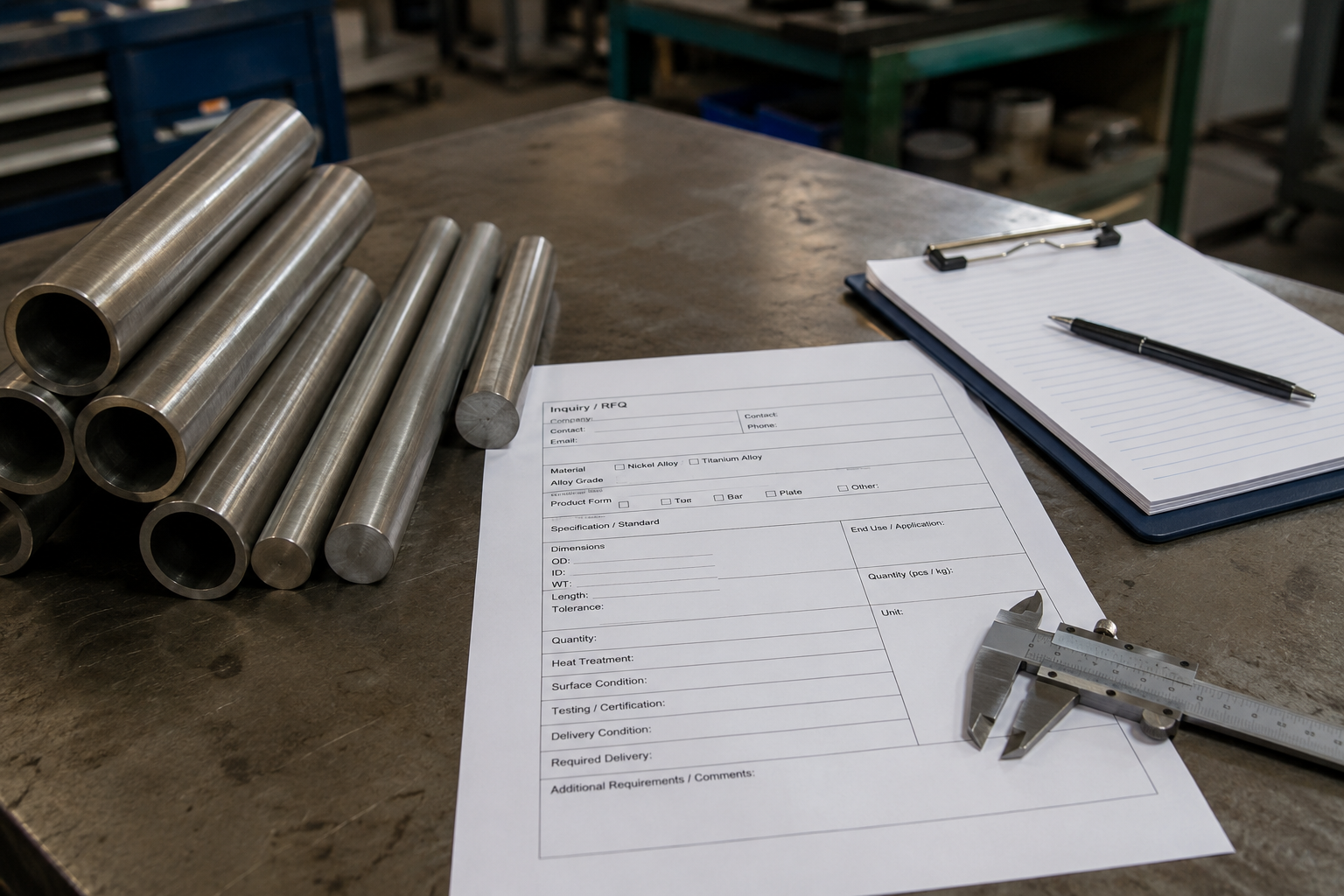
Specification control is part of quality management. ISO explains that ISO 9001 helps organizations meet customer and regulatory requirements through a quality management system: ISO 9001 Quality Management. ISO implementation guidance on managing change also emphasizes that changes should be reviewed and controlled to ensure continuing conformity: ISO 9001:2015 Managing Change Guidance.
For alloy buyers, this means any change should be handled as a controlled technical decision, not as an informal substitution.
Why Are Alloy Specification Changes Not Always “Minor” Adjustments?
Some changes may look small on paper. For example:
- A small change in chemical composition
- A different heat treatment condition
- A different dimensional tolerance
- A change from one standard edition to another
- A change in surface finish
- A change in testing method
- A different raw material source
- A different production route
- A different certificate or documentation package
But for alloy materials, small changes may become significant when they affect critical requirements.
A specification change should be reviewed because it may affect mechanical properties, corrosion behavior, fabrication performance, inspection requirements, and compliance with the buyer’s original design intent.
The UK Health and Safety Executive notes that material selection can involve many factors, including tensile strength, toughness, fatigue resistance, creep resistance, temperature effects, corrosion resistance, ease of fabrication, availability, and cost: HSE Design Codes - Plant.
This is why one change can create several technical questions:
- Does the material still meet the purchase order?
- Does it still meet the required ASTM, ASME, EN, ISO, AMS, NACE, or customer specification?
- Does it still meet the original mechanical property requirements?
- Does it still resist the intended corrosive environment?
- Does it still match the required heat treatment condition?
- Does the MTR still support the delivered material?
- Does the heat number still match the material marking?
- Does the buyer need to approve the change before shipment?
Example: Chemical Composition Change
A slight composition change may still fall within a broad material grade, but it may affect specific performance targets. In some applications, one property may improve while another becomes weaker. For example, a chemistry adjustment may affect strength, ductility, weldability, or corrosion resistance depending on the alloy system and process route.
The Unified Numbering System page notes that a UNS number relates to a specific metal or alloy, but a UNS number alone does not constitute a full material specification because it does not establish all requirements for material properties, heat treatment, form, or quality: Unified Numbering System.
This is an important point for buyers. A material name or alloy number alone is not enough. The full specification must define grade, standard, product form, heat treatment, testing, tolerance, surface condition, and documentation.
Example: Corrosion Resistance Change
For corrosion-resistant alloys, specification changes can be especially sensitive. A material may perform well in one environment but not in another.
AMPP states that no material is resistant to all corrosive situations and that material selection is critical to preventing many types of failures: AMPP Materials Selection and Design for Corrosion Control.
NIST also provides corrosion performance databases showing corrosion observations across many specific corrosive environments, reinforcing that corrosion performance must be evaluated according to actual medium, concentration, and temperature: NIST NACE/NIST Corrosion Performance Databases.
This means a supplier should not simply say, “The substitute alloy is also corrosion resistant.” The buyer should ask: corrosion resistant in what environment, at what temperature, under what concentration, and for what service life expectation?
What Hidden Risks and Costs Can Come from Specification Changes?
An alloy specification change may be proposed for practical reasons such as raw material availability, lead time pressure, cost reduction, production difficulty, or customer design revision. Some changes may be acceptable after review. Others may create risk.
Hidden costs from unreviewed specification changes may include extra testing, rework, scrap, delayed delivery, customer approval delays, documentation updates, re-qualification, warranty claims, replacement cost, or downtime risk.
Possible Technical Risks
| Risk Type | How a Specification Change May Affect It |
|---|---|
| Mechanical Properties | Strength, ductility, hardness, toughness, or elongation may change |
| Fatigue Life | Surface condition, heat treatment, or strength changes may affect cyclic performance |
| Corrosion Resistance | Chemistry, surface finish, or heat treatment may change corrosion behavior |
| Weldability | Chemistry or heat treatment may affect welding procedure and weld integrity |
| Machinability | Hardness or microstructure changes may affect tool wear and machining time |
| Dimensional Fit | Tolerance changes may affect assembly, machining allowance, or fit-up |
| Compliance | The changed material may no longer match the original standard or customer specification |
| Traceability | New heat numbers, MTRs, or certificates may need to be reviewed |
| Lead Time | Re-testing, approval, or re-production may extend delivery time |
NASA’s materials and processes standard defines minimum requirements for materials and processes and includes controls related to material selection, processing, certification, verification, and traceability for demanding engineering hardware: NASA Standard Materials and Processes Requirements.
For industrial buyers, the lesson is clear: a specification change should be evaluated through a controlled process.
Possible Cost Impacts
| Cost Area | Potential Impact |
|---|---|
| Production Cost | New setup, different processing, additional machining, or rework |
| Testing Cost | Additional chemical, mechanical, corrosion, or NDT testing |
| Documentation Cost | Updated MTRs, certificates, deviation records, or approval documents |
| Lead Time | Waiting for customer approval, re-testing, or re-production |
| Scrap and Rework | Material may need to be quarantined, reprocessed, or rejected |
| Field Risk | Wrong material may increase maintenance, replacement, or downtime risk |
| Reputation | If end-user performance is affected, buyer trust may be damaged |
Corrosion-related failures are one example of how material decisions can affect lifecycle cost. AMPP explains that corrosion management typically includes optimizing corrosion control actions and minimizing lifecycle corrosion costs while meeting safety and environmental goals: AMPP Corrosion Management.
A lower initial material cost does not always mean lower total project cost if the change creates downstream risk.
How Can Buyers Decide Whether a Specification Change Is Acceptable?
A specification change should not be accepted only because it seems convenient or cheaper. Buyers should use a structured review process.
To decide whether an alloy specification change is acceptable, buyers should define the reason for the change, identify what changed, evaluate the impact on critical properties, review standards and documentation, confirm whether re-testing is required, and obtain written approval from the responsible technical or quality team.
Step 1: Define the Reason for the Change
First, clarify why the change is being proposed.
Common reasons include:
- Raw material shortage
- Lead time pressure
- Cost reduction
- Supplier process limitation
- Customer drawing revision
- Standard revision
- Stock availability
- Production difficulty
- Improved manufacturability
- Updated project requirement
The reason matters because a cost-driven change should be reviewed differently from a customer-approved design improvement.
Step 2: Identify Exactly What Changed
The buyer should ask the supplier to identify the exact change.
| Change Item | Questions to Ask |
|---|---|
| Alloy Grade | Is the material grade changing? |
| Chemical Composition | Are any element ranges or impurity limits changing? |
| Standard | Is the ASTM, ASME, EN, ISO, AMS, NACE, or customer standard changing? |
| Heat Treatment | Is the delivery condition changing? |
| Product Form | Is it still the same tube, pipe, bar, rod, or forged product? |
| Tolerance | Are OD, WT, diameter, length, straightness, or roundness changing? |
| Surface Finish | Is the surface condition changing? |
| Testing | Are any inspection or test methods changing? |
| Documentation | Will the MTR, certificate, or traceability package change? |
| Supplier / Mill Source | Is the material source changing? |
Step 3: Review Critical Properties
The supplier and buyer should review whether the changed specification affects:
- Tensile strength
- Yield strength
- Elongation
- Hardness
- Impact toughness
- Fatigue performance
- Corrosion resistance
- Weldability
- Machinability
- Heat treatment response
- Dimensional stability
- Surface condition
- Inspection acceptance criteria
NASA’s corrosion fundamentals page explains that corrosion is degradation of a material due to reaction with its environment and that degradation implies deterioration of physical properties: NASA Corrosion Fundamentals.
This supports why material changes must be evaluated against the real service environment, not only the alloy name.
Step 4: Confirm Whether Re-Testing Is Needed
Depending on the application, a specification change may require:
- Chemical analysis
- Mechanical testing
- Hardness testing
- PMI
- UT
- Eddy current testing
- Hydrostatic testing
- Corrosion testing
- Weld procedure review
- Machining trial
- Third-party inspection
- Customer approval
- Design authority approval
ASQ explains that a quality control plan may specify product tolerances, testing parameters, and acceptance criteria: ASQ Quality Plans.
This means the change should be checked against the original quality plan, purchase order, and acceptance criteria.
What Should Buyers Expect from Suppliers Regarding Specification Changes?
Buyers should expect clear, written, and verifiable communication from suppliers before any specification change is implemented.
A responsible supplier should not make unapproved material changes silently. The supplier should explain the reason for the change, provide technical impact information, update documentation, maintain traceability, and request customer approval when the purchase order or project specification requires it.
Supplier Change Notification Should Include
| Information | Why It Matters |
|---|---|
| Description of Change | Helps buyer understand what exactly changed |
| Reason for Change | Clarifies whether it is due to cost, supply, production, or technical need |
| Affected Products | Identifies which order, size, heat, batch, or delivery is affected |
| Standards Comparison | Shows whether the new material still meets required standards |
| Mechanical Properties | Confirms strength, ductility, hardness, or other required properties |
| Corrosion Impact | Reviews whether resistance in the intended environment changes |
| Heat Treatment Status | Confirms delivery condition and processing route |
| Test Results | Provides objective evidence, not only verbal assurance |
| MTR and Heat Number | Maintains traceability to the actual batch |
| Customer Approval Request | Ensures the buyer accepts the change before shipment |
MTR and Heat Number Traceability
A specification change must be reflected in the documentation. The MTR should match the delivered material, and the heat number should connect the material to its batch records.
A heat number is a traceable identifier that links a metal product to its specific batch or heat and related composition, manufacturing, and quality records: Heat Number.
For buyers, this means:
- Do not accept changed material without updated MTRs.
- Confirm the heat number on the material matches the MTR.
- Confirm the MTR matches the purchase order.
- Confirm the changed material still meets the required standard.
- Keep written approval records for the change.
What Should Buyers Do Before Accepting a Changed Alloy Specification?
Before accepting a specification change, buyers should review it with engineering, quality, procurement, and the supplier.
Buyer Review Checklist
| Review Item | Key Question |
|---|---|
| Original Requirement | What did the original PO, drawing, standard, or specification require? |
| Change Description | What exactly changed? |
| Reason for Change | Why is the supplier proposing the change? |
| Application Impact | Does the change affect the working environment or service risk? |
| Mechanical Impact | Are strength, ductility, hardness, or fatigue requirements affected? |
| Corrosion Impact | Is corrosion resistance in the intended medium affected? |
| Processing Impact | Will machining, welding, forming, or heat treatment change? |
| Testing Impact | Is additional testing required? |
| Certification Impact | Does the material still meet ASTM, ASME, EN, ISO, AMS, NACE, or customer standards? |
| Traceability | Are new MTRs, heat numbers, and inspection records available? |
| Approval | Has the buyer approved the change in writing? |
| Delivery Impact | Will the change affect lead time or shipment schedule? |
When Buyers Should Reject or Pause a Change
Buyers should pause or reject the change if:
- The supplier cannot clearly explain the reason.
- The changed material does not meet the purchase order.
- The changed material does not meet the required standard.
- MTRs or heat number traceability are missing.
- Mechanical properties are not verified.
- Corrosion performance is uncertain for the application.
- Required customer approval has not been obtained.
- The change affects a safety-critical or regulated application without review.
- The supplier cannot provide updated documentation.
How Emily PIPE Handles Material Specification Communication
Emily PIPE is a China-based manufacturer and exporter specializing in nickel alloy tubes, nickel alloy bars, titanium alloy tubes, and titanium alloy bars. We understand that material changes can affect customer projects, especially in chemical processing, oil and gas, marine engineering, aerospace, power generation, medical equipment, heat exchangers, and other demanding applications.
For alloy material supply, we support customers with:
- Material grade confirmation
- Standard and specification review
- MTR and heat number traceability
- Chemical and mechanical property documentation
- Dimensional and surface inspection
- PMI, UT, ECT, hydrostatic testing, and other inspection support when required
- Communication before production and shipment
- Custom size, tolerance, surface, and documentation support
If a customer needs to change a specification, we recommend reviewing the change before production whenever possible. This helps avoid rework, delay, documentation gaps, and material mismatch.
If you are sourcing nickel alloy or titanium alloy tubes and bars, please send your grade, standard, size, drawing, application environment, tolerance, surface condition, testing requirement, and documentation requirement. Our team can help review whether the material requirement is clear before production.
FAQ: Alloy Specification Changes During Production
1. Are alloy specification changes always dangerous?
No. Some specification changes may be acceptable if they are reviewed, tested, documented, and approved. The risk comes from unreviewed or unapproved changes that affect critical requirements.
2. Why can a small specification change matter?
A small change can matter if it affects chemical composition, heat treatment, mechanical properties, corrosion resistance, testing, tolerance, surface finish, or certification.
3. Can a supplier substitute a similar alloy without approval?
For critical applications, buyers should not accept unapproved substitutions. Any substitute alloy should be reviewed against the purchase order, standard, application environment, and documentation requirements.
4. What documents should be updated after a specification change?
Updated documents may include MTR, certificate of conformity, inspection report, heat number records, deviation approval, test reports, and customer approval records.
5. Does the same UNS number guarantee the same material performance?
No. A UNS number identifies an alloy designation, but it does not define all requirements such as product form, heat treatment, mechanical properties, testing, or quality level.
6. How can specification changes affect lead time?
Lead time may increase if the change requires engineering review, customer approval, additional testing, third-party inspection, re-production, or updated documentation.
7. What should buyers ask suppliers before accepting a change?
Buyers should ask what changed, why it changed, what properties are affected, whether the material still meets the standard, whether new testing is required, and whether updated MTR and traceability records are available.
8. What is the safest way to handle a specification change?
The safest way is to document the change, review its technical impact, verify test data, confirm standards compliance, maintain traceability, and obtain written approval before shipment or use.
Conclusion
Changing alloy specifications during production is not always wrong, but it must be controlled. For nickel alloy and titanium alloy tubes and bars, specification changes can affect mechanical properties, corrosion resistance, fatigue performance, heat treatment, dimensional accuracy, testing, certification, traceability, lead time, and project cost.
Buyers should not treat a change as minor until its impact has been reviewed. A responsible supplier should provide transparent communication, technical data, updated documentation, and traceability records.
The best approach is simple: define the original requirement clearly, control any change carefully, verify the changed material with data, and approve it in writing before use.