
How Should Buyers Specify Delivery Conditions for Alloy Material Orders?
When buying nickel alloy tubes, nickel alloy bars, titanium alloy tubes or titanium alloy bars, many buyers focus first on material grade, size and price.
These details are important, but they are not enough.
For alloy materials, the delivery condition can directly affect fabrication, machining, welding, fitting, corrosion performance, mechanical properties, inspection approval and final project reliability.
Delivery condition describes the final state of the material as supplied. It may include heat treatment condition, surface finish, dimensional tolerance, mechanical properties, hardness, straightness, end condition, inspection status, certificates, marking and packing. For buyers, clearly specifying delivery condition helps reduce misunderstanding between drawings, quotation, production, inspection and final application.
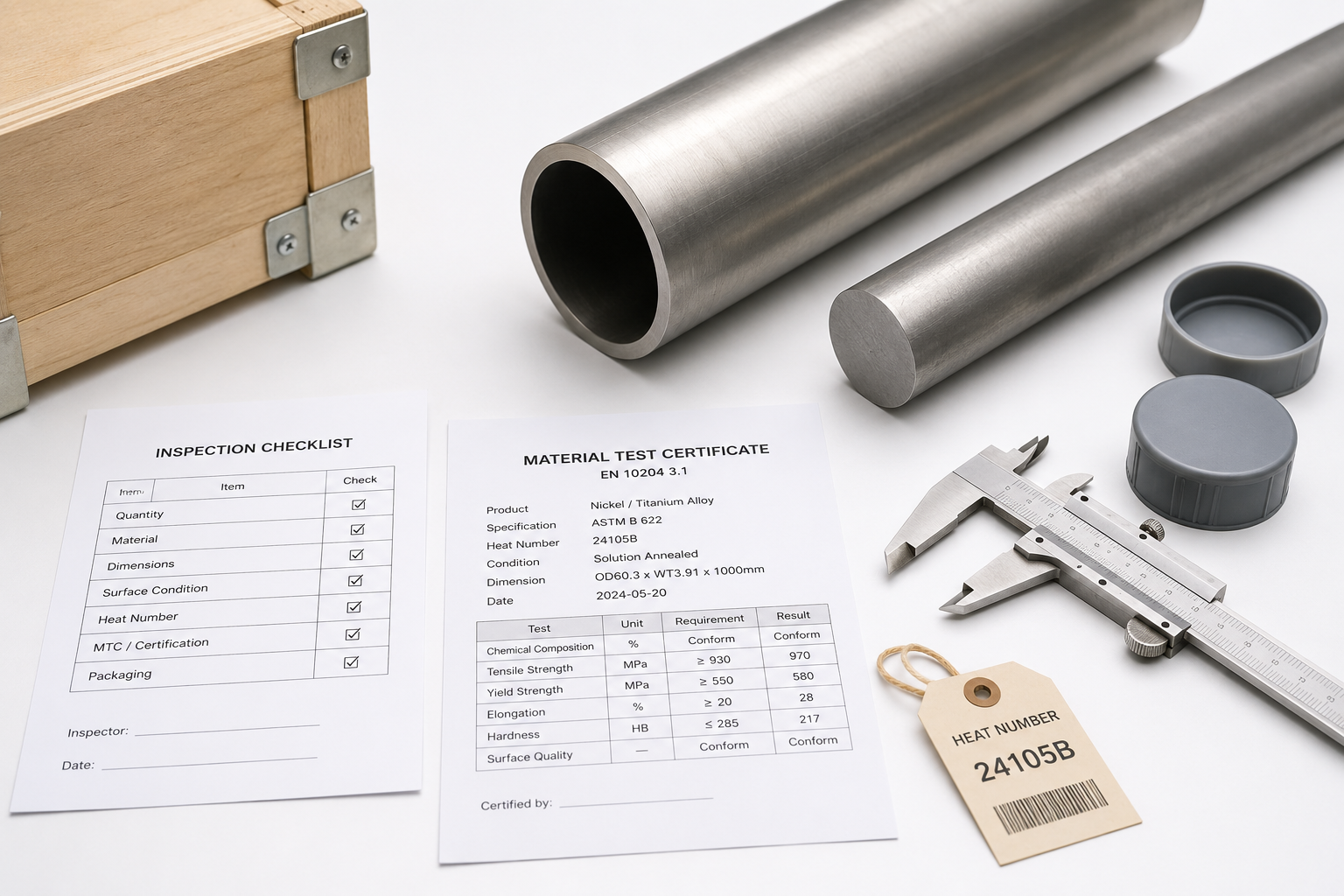
For industrial buyers, the key question is not only:
What alloy grade and size do I need?
A better question is:
What delivery condition does this material need for my processing, inspection and service environment?
This guide explains how buyers should specify delivery conditions for alloy material orders and what should be confirmed before purchasing nickel alloy and titanium alloy tubes or bars.
Quick Answer: What Does “Delivery Condition” Mean?
Delivery condition means the material condition as delivered by the supplier. It is the combination of manufacturing and inspection details that determine whether the material is ready for the buyer’s next step.
Delivery Condition May Include
| Delivery Condition Item | What It Means for Buyers |
|---|---|
| Heat treatment | Annealed, solution annealed, aged, stress relieved, hardened or customer-specified condition. |
| Surface finish | Pickled, polished, ground, bright annealed, cold drawn, machined, cleaned or capped. |
| Dimensional tolerance | OD, ID, wall thickness, bar diameter, length, ovality, straightness and cutting tolerance. |
| Mechanical properties | Tensile strength, yield strength, elongation, reduction of area and hardness. |
| Testing | Chemical analysis, tensile test, hardness test, UT, ET, hydrostatic test, PMI or corrosion test. |
| Certificates | MTC/MTR, EN 10204 3.1, CoC, NDT report, dimensional report, third-party inspection report. |
| Product form | Seamless tube, welded tube, round bar, flat bar, forged bar, billet or custom processed material. |
| End condition | Plain end, bevelled end, deburred end, capped end, square cut or machined end. |
| Packing | Bundle, wooden case, end protection, moisture protection, surface protection and marking. |
| Traceability | Heat number, batch number, marking and certificate consistency. |
ASTM B348 covers annealed titanium and titanium alloy bars and billets and includes chemical composition and tensile property requirements. Source: ASTM B348 — Titanium and Titanium Alloy Bars and Billets
ASTM B444 covers UNS N06625 and related nickel alloy seamless pipe and tube, including tensile testing, hydrostatic testing and nondestructive electric testing requirements. Source: ASTM B444 — Nickel-Chromium-Molybdenum-Columbium Alloy Seamless Pipe and Tube
Buyer Takeaway
Delivery condition is not just “how the material looks.” It defines the condition in which the material is supplied and verified.
Why Is Delivery Condition Important?
A material may have the correct alloy grade but still be unsuitable if the delivery condition does not match the application.
For example:
- A bar may have the correct diameter but the wrong hardness for machining.
- A tube may have the correct OD but the wrong wall tolerance for pressure service.
- A nickel alloy may have the correct grade but the wrong heat treatment condition for high-temperature service.
- A titanium tube may have the correct size but an unsuitable surface condition for heat exchanger use.
- A material may meet chemical composition requirements but lack required NDT or EN 10204 3.1 documentation.
Delivery Condition Can Affect
| Area | Possible Impact |
|---|---|
| Machining | Hardness, residual stress and surface condition can affect tool wear, distortion and surface finish. |
| Forming / bending | Annealed or stress-relieved material may behave differently from cold-worked material. |
| Welding | Heat treatment, surface cleanliness and end condition can affect fit-up and weld quality. |
| Corrosion resistance | Alloy grade, heat treatment, surface condition and cleaning can all affect corrosion behavior. |
| Fit-up | Tolerance, straightness, ovality and end condition affect assembly. |
| Pressure performance | Wall thickness, mechanical properties and testing affect pressure-related acceptance. |
| Inspection approval | Missing reports may cause project hold points or customer rejection. |
| Lead time and cost | Special heat treatment, grinding, polishing, NDT and third-party inspection can increase lead time. |
Buyer Takeaway
A clear delivery condition helps the supplier quote correctly, manufacture correctly and prepare the right inspection documents.
What Heat Treatment Condition Should Buyers Specify?
Heat treatment is one of the most important parts of delivery condition because it can affect strength, ductility, hardness, residual stress, corrosion behavior, creep performance and machinability.
Common Heat Treatment Conditions
| Heat Treatment Condition | General Purpose | Buyer Concern |
|---|---|---|
| Annealed | Improves ductility and workability; may reduce cold-work effects. | Useful for forming, bending, machining or fabrication. |
| Solution annealed / solution treated | Dissolves certain phases or precipitates and produces a specified metallurgical condition. | Important for some nickel alloys, titanium alloys and high-temperature/corrosion applications. |
| Aged / precipitation hardened | Increases strength and hardness in precipitation-hardenable alloys. | Important for high-strength parts such as Alloy 718 components. |
| Stress relieved | Reduces residual stress from cold work, forming, welding or machining. | Useful when distortion or stress-related cracking is a concern. |
| Cold worked | Increases strength and hardness through deformation. | May improve strength but reduce ductility and increase residual stress. |
| Customer-specified heat treatment | Follows drawing, project or end-user requirement. | Must be clearly defined before production. |
ASTM B446 covers UNS N06625 rod and bar and identifies different heat-treated conditions, including Grade 1 annealed and Grade 2 solution annealed. Grade 2 is normally used above 1100°F / 593°C when resistance to creep and rupture is required. Source: ASTM B446 — Nickel-Chromium-Molybdenum-Columbium Alloy Rod and Bar
Important Caution
Do not assume one heat treatment condition is best for every alloy.
For example:
- Annealed material may be suitable for forming or machining, but may not provide the highest strength.
- Solution annealed material may be required by a standard or high-temperature service.
- Aged material may provide high strength, but may be harder to machine or form.
- Stress relief may reduce residual stress, but it does not replace required mechanical or corrosion testing.
Buyer Questions
| Question | Why It Matters |
|---|---|
| Which heat treatment condition is required by the standard? | Avoids conflict between RFQ, PO and MTC. |
| Is the condition suitable for fabrication? | Bending, machining, welding or forming may require different properties. |
| Is the condition suitable for service? | Temperature, pressure and corrosion media may influence selection. |
| Are mechanical properties reported? | Confirms tensile strength, yield strength and elongation. |
| Is hardness required? | Useful for machining, forming or heat treatment verification. |
| Can heat treatment records be provided if required? | Critical projects may require more than a standard MTC. |
Buyer Takeaway
Specify the heat treatment condition by standard, grade and application. Do not rely only on words such as “standard condition.”
How Should Buyers Specify Surface Finish?
Surface finish is part of delivery condition because it affects appearance, corrosion behavior, cleaning, welding, machining, friction, sealing and inspection.
Common Surface Conditions
| Surface Condition | Typical Meaning | Buyer Concern |
|---|---|---|
| Pickled | Oxide scale or surface contamination removed by chemical treatment. | Common for titanium and nickel alloy tubes after heat treatment or hot working. |
| Polished | Surface mechanically polished to improve smoothness or appearance. | Important for clean service, flow, hygiene, appearance or reduced surface defects. |
| Ground | Abrasive process used to improve size accuracy and surface finish. | Useful for precision bars, shafts or machined parts. |
| Bright annealed | Heat treated in controlled atmosphere to produce a bright surface. | Useful when oxidation must be minimized. |
| Cold drawn / cold rolled | Cold processing improves size control and can change strength/hardness. | May require stress relief or further heat treatment depending on application. |
| Machined | Surface produced by turning, milling, boring or facing. | Important for final fit, tolerance and finish. |
| Cleaned and capped | Internal or external cleanliness protected before shipment. | Important for tubes, heat exchangers and high-purity systems. |
ASTM B600 covers descaling and cleaning procedures for titanium and titanium alloy surfaces to remove shop soils, oxides, scales from heat treatment operations and foreign surface contaminants. Source: ASTM B600 — Descaling and Cleaning Titanium and Titanium Alloy Surfaces
Surface roughness should be specified with measurable parameters such as Ra or Rz when it matters. ISO 4287 defined surface texture parameters, and ISO 21920-2 is the newer replacement reference. Source: Surface Metrology Guide — ISO 4287 Parameters
Surface Finish Buyer Questions
| Question | Why It Matters |
|---|---|
| Is the surface pickled, polished, ground or bright annealed? | Different surface states have different uses and costs. |
| Is Ra or Rz required? | “Smooth” is vague; roughness should be measurable. |
| Is ID surface finish required for tubes? | Internal roughness may affect flow, cleaning or inspection. |
| Is oxide scale allowed? | Some applications require scale-free surfaces. |
| Is surface defect acceptance defined? | Scratches, pits, dents or burrs may affect performance. |
| Is cleaning or capping required? | Important for clean-process or tube applications. |
| Will the material be welded or machined later? | Surface condition may affect downstream processing. |
Buyer Takeaway
Do not write only “standard surface.” Specify pickled, polished, ground, bright annealed, Ra/Rz value, cleaning and protection requirements when they matter.
How Should Buyers Specify Dimensional Tolerances?
Dimensional tolerance determines whether the material can fit, machine, assemble, weld, expand, seal or pass inspection.
For alloy tubes and bars, tolerance should not be left vague.
Key Dimensional Items
| Product Form | Dimensions to Confirm |
|---|---|
| Tube / pipe | OD, ID, wall thickness, length, straightness, ovality, end condition. |
| Round bar / rod | Diameter, length, straightness, roundness, surface finish, cut tolerance. |
| Flat bar | Width, thickness, length, flatness, edge condition. |
| Forged bar / billet | Diameter or section size, machining allowance, surface condition, UT requirement. |
| Precision part | Drawing tolerance, surface roughness, hardness and inspection method. |
ASTM B704 covers welded nickel alloy tubes for boilers, heat exchangers and condensers and includes manufacturing, chemical composition, mechanical properties and dimensional requirements. Source: ASTM B704 — Welded Nickel Alloy Tubes
ASTM B338 covers seamless and welded titanium alloy tubes for surface condensers, evaporators and heat exchangers. Source: ASTM B338 — Titanium and Titanium Alloy Tubes
Tolerance Buyer Questions
| Question | Why It Matters |
|---|---|
| Which tolerance standard applies? | ASTM, ASME, EN, ISO or customer drawing may differ. |
| Is OD or ID the critical dimension? | OD affects fit-up; ID affects flow and clearance. |
| Is wall thickness nominal, average or minimum wall? | Important for pressure, corrosion allowance and heat transfer. |
| Is straightness required? | Important for long tubes and bars. |
| Is ovality controlled? | Important for fittings, tube sheets and precision assembly. |
| Is cut length tolerance required? | Important for fixed-length installation or machining. |
| Is grinding required to meet tolerance? | Tight bar tolerance may require centerless grinding. |
Buyer Takeaway
A clear tolerance requirement avoids confusion between catalog size, standard tolerance and drawing-controlled tolerance.
What Mechanical Properties Should Buyers Confirm?
Mechanical properties show whether the material meets the required strength and ductility for the project.
Common Mechanical Properties
| Property | Why It Matters |
|---|---|
| Tensile strength | Maximum stress before fracture. |
| Yield strength | Stress level where permanent deformation begins. |
| Elongation | Indicator of ductility. |
| Reduction of area | Another ductility indicator after tensile testing. |
| Hardness | Useful for heat treatment verification, machining and forming. |
| Impact toughness | May be required for low-temperature or impact-sensitive service. |
| Creep / rupture | May be required for high-temperature service. |
ASTM E8/E8M covers tension testing of metallic materials and the determination of properties such as yield strength, tensile strength and elongation. Source: ASTM E8/E8M — Tension Testing of Metallic Materials
ASTM E18 covers Rockwell hardness testing of metallic materials and provides useful information about metallic materials through indentation hardness testing. Source: ASTM E18 — Rockwell Hardness of Metallic Materials
Buyer Takeaway
Mechanical properties should match the alloy grade, heat treatment condition, product standard and final application. Do not rely only on nominal grade.
What Testing and Inspection Should Buyers Request?
Testing should be selected according to product form, application risk, standard and customer requirement. Not every order needs every test, but the required tests should be stated before production.
Common Tests for Alloy Materials
| Test / Inspection | What It Verifies |
|---|---|
| Chemical analysis | Confirms alloy composition and grade. |
| PMI | Positive material identification for alloy verification. |
| Tensile test | Confirms strength and ductility. |
| Hardness test | Helps verify material condition or heat treatment. |
| Dimensional inspection | Confirms OD, ID, wall, diameter, length, straightness and tolerance. |
| Ultrasonic testing (UT) | Detects internal discontinuities in metal pipe, tubing or bars when applicable. |
| Eddy current testing (ET) | Examines seamless and welded tubular products made from materials such as titanium, stainless steel and nickel alloys. |
| Hydrostatic / pneumatic test | Verifies pressure-related integrity where required by tube standard. |
| Liquid penetrant testing (PT) | Detects open surface discontinuities. |
| Corrosion testing | Required only for certain harsh environments or customer specifications. |
| Third-party inspection | Independent verification for critical or high-value projects. |
ASTM E213 covers ultrasonic testing of metal pipe and tubing for detecting discontinuities during volumetric examination. Source: ASTM E213 — Ultrasonic Testing of Metal Pipe and Tubing
ASTM E426 covers eddy current examination of seamless and welded tubular products made of relatively low conductivity materials such as titanium, stainless steel and nickel alloys. Source: ASTM E426 — Eddy Current Examination of Tubular Products
Buyer Takeaway
Do not assume all possible tests are included. Define the required tests, standards, acceptance criteria and reports in the RFQ or purchase order.
What Certificates and Documents Should Buyers Require?
Documentation is part of delivery condition because it proves what was supplied and how it was verified.
Common Documents
| Document | What It Usually Shows |
|---|---|
| MTC / MTR | Heat number, chemical composition, mechanical properties, standard, material condition and test results. |
| EN 10204 3.1 certificate | Actual test results from the supplied material lot, endorsed by the manufacturer’s representative independent from manufacturing. |
| Certificate of Conformance (CoC) | Statement that material conforms to a specified order, standard or drawing. |
| Dimensional report | OD, ID, wall thickness, bar diameter, length, straightness, ovality and tolerance results. |
| NDT report | UT, ET, hydrostatic, pneumatic, PT or other testing records. |
| PMI report | Alloy verification by positive material identification. |
| Hardness report | Actual hardness test results. |
| Surface report | Roughness, visual inspection, polishing or cleaning status. |
| Heat treatment record | Furnace cycle data if specifically required for critical projects. |
| Third-party inspection report | Independent inspection or witness record. |
EN 10204 Type 3.1 inspection certificates provide actual test results from the material lot supplied and are endorsed by the manufacturer’s representative independent from manufacturing. Source: EN 10204 Type 3.1 Inspection Certificates
Important Caution
MTC/MTR is very important, but it may not prove everything. It may not include full heat treatment furnace cycles, surface roughness, full dimensional inspection, packing condition or every NDT record unless those items are required and reported.
Buyer Takeaway
If a requirement matters for approval, write it into the order and ask for the corresponding report.
How Do Supplier Capability and Quality Management Affect Delivery Condition?
Some delivery conditions require special equipment, process control or inspection capability.
For example:
- Tight OD tolerance may require precision drawing or grinding.
- Bright annealing may require controlled atmosphere equipment.
- Long-length tubes may need straightness control and special packing.
- NDT may require qualified operators and calibrated equipment.
- Specific surface roughness may require polishing and roughness measurement.
- Customer-specified heat treatment may require furnace capability and records.
ISO 9001 defines requirements for establishing, implementing, maintaining and continually improving a quality management system. Source: ISO 9001 — Quality Management Systems
ISO/IEC 17025 enables testing and calibration laboratories to demonstrate competent operation and valid results. Source: ISO/IEC 17025 — Testing and Calibration Laboratories
Supplier Capability Questions
| Question | Why It Matters |
|---|---|
| Can the supplier achieve the required heat treatment? | Furnace size, atmosphere and control may matter. |
| Can the supplier meet the tolerance for this size? | Tight tolerance may not be possible for all diameters or lengths. |
| Can the supplier provide the required surface finish? | Grinding, polishing or pickling capacity may be needed. |
| Can the supplier perform or arrange required testing? | UT, ET, hydrostatic, PMI or corrosion testing may need special facilities. |
| Can the supplier provide required certificates? | Project approval may depend on documentation. |
| Can third-party inspection be arranged? | Useful for high-value or critical applications. |
| Can packing protect the delivery condition? | Surface finish and straightness can be damaged during transport. |
Buyer Takeaway
Delivery condition must be realistic for the alloy, size, quantity, process route and supplier capability.
Buyer Checklist: What to Confirm Before Ordering Alloy Materials
| RFQ Item | What to Provide or Ask |
|---|---|
| Material grade | Alloy 625, Alloy 718, Alloy C-276, Alloy 825, Titanium Grade 2, Titanium Grade 5, etc. |
| UNS number | N06625, N07718, N10276, N08825, R50400, R56400, etc. |
| Product form | Seamless tube, welded tube, round bar, flat bar, rod, billet, forging or custom part. |
| Standard | ASTM B348, ASTM B444, ASTM B446, ASTM B338, ASTM B704, ASME, EN, AMS or customer drawing. |
| Delivery condition | Annealed, solution annealed, aged, stress relieved, cold drawn, ground, polished, pickled, etc. |
| Heat treatment | Required condition, standard basis, mechanical property requirement and heat treatment record if needed. |
| Surface finish | Pickled, polished, ground, Ra/Rz value, bright annealed, cleaned, capped, oxide-free if required. |
| Dimensions | OD, ID, wall thickness, diameter, width, thickness, length and tolerance. |
| Straightness / ovality | Required for long tubes, bars, machining or assembly. |
| Mechanical properties | Tensile strength, yield strength, elongation, hardness, impact, creep/rupture if required. |
| Testing | Chemical analysis, PMI, tensile test, hardness, UT, ET, hydrostatic, pneumatic, corrosion test. |
| Certificates | EN 10204 3.1 / 3.2, MTC/MTR, CoC, NDT report, dimensional report, third-party report. |
| Application | Chemical processing, heat exchanger, marine, aerospace, oil and gas, medical equipment, power generation. |
| Service environment | Temperature, pressure, media, pH, chloride, acid, seawater, H₂S, vibration, thermal cycling. |
| Secondary processing | Welding, bending, machining, forming, polishing, heat treatment after machining. |
| Packing | Surface protection, end caps, separated bundles, moisture protection, export wooden case. |
| Lead time | Confirm additional time for heat treatment, grinding, polishing, NDT or third-party inspection. |
Example RFQ Message for Nickel Alloy Tubes
We need Alloy 625 seamless tubes, UNS N06625, per ASTM B444. Size: OD 25.4 mm × WT 2.11 mm × length 6000 mm. Required delivery condition: please confirm Grade 1 annealed or Grade 2 solution annealed based on service temperature and application. Surface: pickled and cleaned, ends capped. Please provide OD/WT tolerance, hydrostatic or NDT test availability, EN 10204 3.1 MTC, heat number traceability, dimensional inspection report, PMI option, lead time, MOQ and export packing.
Example RFQ Message for Titanium Bars
We need Titanium Grade 5 round bars, UNS R56400, per ASTM B348. Required condition: annealed. Size: diameter 30 mm × length 3000 mm. Please confirm tensile strength, yield strength, elongation, hardness if available, surface condition, diameter tolerance, straightness, EN 10204 3.1 MTC, heat number traceability, UT option, third-party inspection option, lead time and packing.
Example RFQ Message for Precision Alloy Bars
We need nickel alloy round bars for CNC machining. Please quote material grade, UNS number, standard, heat treatment condition, diameter tolerance, straightness, surface finish, hardness range, MTC/MTR, dimensional inspection report and delivery time. The bars will be machined into high-precision components, so please confirm whether centerless grinding is required to meet tolerance.
Common Mistakes When Specifying Delivery Conditions
1. Using Vague Words Like “Standard Condition”
“Standard” may mean different things to different suppliers. Always define heat treatment, surface finish, tolerance and certificate requirements.
2. Ordering Only by Material Grade
“Alloy 625” or “Titanium Grade 5” is not enough for many projects. Condition, standard and testing also matter.
3. Confusing Annealed and Solution Annealed
These conditions may have different meanings depending on the alloy and standard.
4. Ignoring Surface Finish
Surface condition may affect corrosion, welding, cleaning, machining and inspection.
5. Not Defining Tolerance
Nominal size alone may not ensure fit-up or machining allowance.
6. Assuming All Tests Are Included
UT, ET, PMI, hydrostatic testing, hardness testing and corrosion testing should be specified if required.
7. Treating MTC as Complete Proof
MTC/MTR is important, but dimensional reports, NDT reports and surface reports may also be needed.
8. Not Sharing the Application
A supplier cannot judge the correct delivery condition without knowing the service environment and processing method.
9. Ignoring Lead Time for Special Processing
Grinding, polishing, heat treatment, NDT and third-party inspection may extend delivery time.
10. Choosing Only by Lowest Price
A cheaper quotation may not include the required condition, testing, tolerance, certificate or packing.
FAQ: Alloy Material Delivery Conditions
1. What is delivery condition in alloy material orders?
Delivery condition is the final state of the supplied material, including heat treatment, surface finish, tolerance, mechanical properties, inspection and documentation.
2. Why is delivery condition important?
It determines whether the material is suitable for machining, forming, welding, fitting, corrosion service, inspection and final use.
3. What is the difference between annealed and solution annealed?
Annealed condition is often used to improve ductility and workability. Solution annealed condition involves higher-temperature treatment to produce a specific metallurgical condition. Exact meaning depends on alloy and standard.
4. Does surface finish affect performance?
Yes. Surface finish may affect corrosion behavior, cleanliness, flow, welding, sealing, appearance and machining.
5. What does MTC/MTR prove?
MTC/MTR usually shows heat number, chemical composition, mechanical properties, standard, material condition and test results. It may not include every dimensional, surface or NDT detail unless required.
6. Is EN 10204 3.1 necessary?
It is commonly requested for industrial alloy materials when batch-specific test results and traceability are required. Whether it is necessary depends on the project.
7. What tests should buyers request?
Common tests include chemical analysis, tensile test, hardness test, PMI, UT, ET, hydrostatic test, dimensional inspection and corrosion testing if required.
8. What should buyers specify for alloy tubes?
Buyers should specify alloy grade, UNS number, standard, OD, ID, wall thickness, length, tolerance, heat treatment, surface finish, NDT, MTC and packing.
9. What should buyers specify for alloy bars?
Buyers should specify grade, UNS number, standard, diameter, length, tolerance, straightness, heat treatment, surface finish, hardness, MTC and any UT or inspection requirement.
10. How can buyers avoid ordering mistakes?
Provide the final application, service environment, fabrication process, exact standard, delivery condition, tolerance, testing and certificate requirements in the RFQ or purchase order.
Conclusion
Clearly specifying delivery condition is one of the most important steps in alloy material procurement. It helps connect material grade with real application performance.
For nickel alloy and titanium alloy tubes or bars, buyers should confirm heat treatment, surface finish, dimensional tolerance, mechanical properties, testing, certificates, traceability, packing and supplier capability before ordering.
A clear delivery condition reduces misunderstanding, rework, inspection rejection and project delay. It also helps suppliers quote accurately and manufacture the material according to the real application requirement.
Emily PIPE supplies nickel alloy tubes, nickel alloy bars, titanium alloy tubes and titanium alloy bars for global industrial applications. If you are preparing an alloy material order, you can send your material grade, UNS number, size, standard, delivery condition, surface finish, tolerance, application environment and certificate requirements for technical review and quotation.