
Why Is Titanium Bar Difficult to Machine? Tool Wear Causes and Buyer Checklist
Titanium bars are widely used for CNC machined parts because titanium offers low density, corrosion resistance, and useful strength for demanding industrial applications. However, many machinists and buyers also know that titanium is not an easy material to cut.
Titanium bars are difficult to machine mainly because titanium alloys have low thermal conductivity, high chemical reactivity at cutting temperatures, high strength, low elastic modulus, and challenging chip behavior. These factors can cause heat concentration, tool adhesion, built-up edge, vibration, surface damage, rapid tool wear, and higher machining cost.
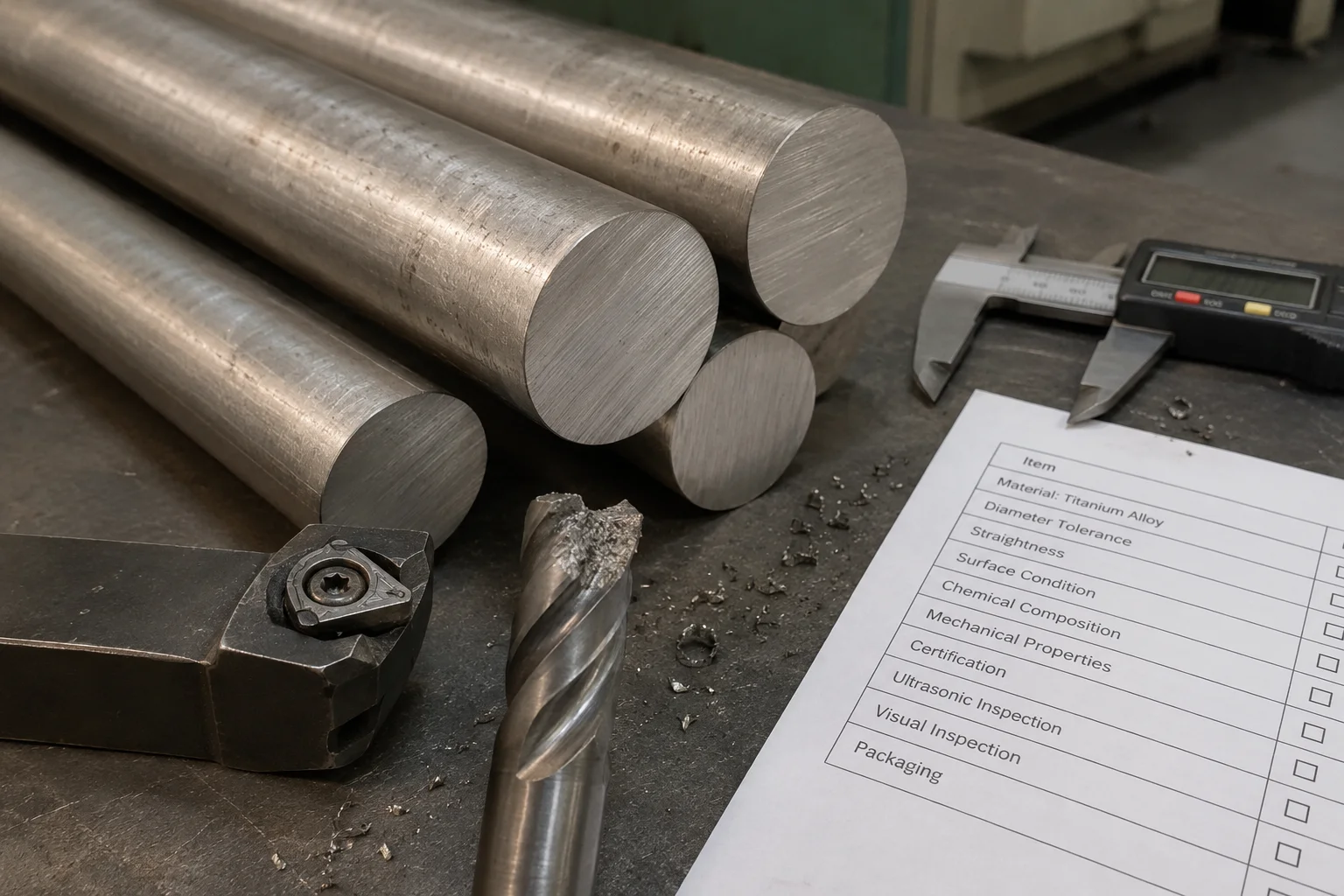
For industrial buyers, the problem is not only that titanium is difficult to machine. The bigger problem is ordering titanium bars without clearly confirming the grade, standard, heat treatment condition, surface condition, certificate, tolerance, machining allowance, and final application.
This guide explains why titanium bars can cause tool sticking, deformation, built-up edge, and rapid tool wear. It also provides a practical checklist for buyers preparing CNC machining projects with titanium bars.
Quick Answer: Why Is Titanium Difficult to Machine?
Research on titanium alloy machining explains that titanium alloys are challenging because of low thermal conductivity, high chemical reactivity, strength at elevated temperatures, and work hardening tendency. These factors can increase cutting temperature, tool wear, adhesion, galling, and surface degradation. Source: Analysis of Tool Wear in Finish Turning of Titanium Alloy Ti-6Al-4V
| Main Reason | What Happens During Machining | Buyer Impact |
|---|---|---|
| Low thermal conductivity | Heat remains close to the cutting edge instead of spreading away quickly. | Faster tool wear, thermal deformation, shorter tool life |
| High chemical reactivity | Titanium can adhere to cutting tools at high temperature and pressure. | Built-up edge, tool sticking, poor surface finish |
| High strength | The tool must overcome higher cutting resistance. | Higher cutting force, rigid setup required |
| Low elastic modulus | The workpiece may deflect or spring back during cutting. | Chatter, dimensional control issues, poor tolerance stability |
| Work hardening risk | Rubbing or poor cutting strategy can make the surface harder to cut. | More tool wear and unstable machining |
| Difficult chip control | Hot, tough chips may be difficult to remove from the cutting zone. | Chip re-cutting, tool chipping, surface damage |
Why Does Low Thermal Conductivity Cause Tool Wear?
One of the most important reasons titanium is difficult to machine is its low thermal conductivity. Ti-6Al-4V has a thermal conductivity of about 6.7 W/m·K according to ASM/MatWeb material data. Source: ASM Material Data Sheet: Ti-6Al-4V
This means heat generated during cutting does not leave the cutting zone efficiently. Instead, heat can concentrate near the tool edge and tool-chip interface. When the cutting edge becomes too hot, tool wear increases and the machined surface may become damaged.
A NASA technical report on machining titanium alloys also notes that low thermal conductivity and small tool-chip contact areas can produce high tool-tip temperatures and accelerate tool wear. Source: NASA Technical Report: Machining Titanium Alloys
Buyer Takeaway
When sourcing titanium bars for machining, buyers should not only ask for the lowest material price. They should also confirm:
- Titanium grade
- Heat treatment condition
- Bar surface condition
- Diameter tolerance
- Straightness
- Machining allowance
- Final part tolerance
- Surface finish requirement
- Whether the machinist has experience with titanium
A low-cost bar may still create high machining cost if the material condition, tolerance, or surface quality is not suitable.
Why Does Titanium Stick to Cutting Tools?
Titanium alloys can show strong chemical reactivity at elevated temperatures. During machining, the cutting tool and titanium workpiece contact each other under high pressure and high temperature. This can cause tool-workpiece adhesion, built-up edge, galling, and material transfer.
Research on titanium alloy machining states that high chemical reactivity at elevated temperatures can cause adverse interactions with cutting tools, leading to adhesion, galling, and premature wear. Source: Analysis of Tool Wear in Finish Turning of Titanium Alloy Ti-6Al-4V
A separate open-access review on machining additively manufactured titanium alloys also explains that titanium alloys are difficult to machine because of lower thermal conductivity and higher chemical reactivity with cutting tools. Source: The State of the Art in Machining Additively Manufactured Titanium Alloys
What Is Built-Up Edge?
Built-up edge happens when workpiece material adheres to the cutting edge. This changes the tool geometry and makes cutting unstable. As the built-up material breaks away, it may damage the cutting edge and worsen the surface finish.
For buyers, this is why titanium machining should be discussed early with the machinist. A correct material order should include not only the titanium grade and size, but also the final use, drawing requirement, and surface finish expectation.
Why Do Strength and Elastic Modulus Matter?
Titanium is selected because it combines useful strength with relatively low density. However, this strength also means the material resists cutting. For Ti-6Al-4V, high strength and toughness are useful for aerospace, medical, marine, and industrial components, but they also increase machining difficulty.
Titanium also has a lower elastic modulus than many steels. During machining, this can cause the workpiece to deflect or spring back, especially in thin-wall components, long shafts, small-diameter parts, or parts with tight tolerance requirements.
Buyer Takeaway
Before ordering titanium bars, buyers should confirm whether the final part is:
- A shaft
- A valve component
- A pump component
- A fastener
- A flange or fitting
- A medical component
- An aerospace component
- A marine part
- A chemical processing component
- A precision machined custom part
The final part geometry can affect the required bar tolerance, straightness, surface condition, and machining allowance.
Titanium vs Stainless Steel vs Aluminum: Why Machining Behavior Is Different
Titanium should not be machined with the same assumptions used for aluminum or stainless steel. The heat behavior, cutting force, chip behavior, and tool wear mechanisms are different.
| Property | Titanium Alloy, e.g. Ti-6Al-4V | Stainless Steel, e.g. 304 | Aluminum Alloy, e.g. 6061 | Impact on Titanium Machining |
|---|---|---|---|---|
| Thermal conductivity | Low, about 6.7 W/m·K for Ti-6Al-4V | Medium | High | Heat stays near the tool edge and increases tool wear |
| Density | Low, about 4.43 g/cm³ for Ti-6Al-4V | Higher | Low | Useful for lightweight parts, but does not make machining easy |
| Chemical reactivity at cutting temperature | High | Medium | Lower | Promotes adhesion, galling, and built-up edge |
| Strength-to-weight ratio | High | Medium to high | Medium | Requires rigid setup and stable cutting |
| Elastic modulus | Lower than steel | Higher | Lower | Can cause springback, chatter, and dimensional control problems |
| Chip behavior | Tough and hot | Variable | Usually easier to evacuate | Coolant and chip evacuation are important |
Do Machining Parameters Cause Tool Problems with Titanium?
Yes. Even when the correct titanium grade is selected, poor machining parameters can make titanium machining problems worse.
Cutting speed, feed rate, depth of cut, tool geometry, tool coating, coolant delivery, and chip evacuation all affect tool life and surface quality.
1. Cutting Speed
Excessive cutting speed generates heat faster than titanium can dissipate it. Because titanium has low thermal conductivity, too much cutting speed can sharply reduce tool life.
The safest approach is not to use one universal cutting speed for all titanium grades. Cutting speed should be selected according to:
- Titanium grade
- Heat treatment condition
- Tool material
- Tool coating
- Machine rigidity
- Coolant method
- Operation type
- Final surface requirement
2. Feed Rate
If the feed rate is too low, the cutting edge may rub instead of forming a proper chip. Rubbing increases heat and can worsen work hardening and tool wear.
If the feed rate is too high, the tool may overload, chip, or break. The correct feed rate depends on tool geometry, insert grade, operation type, material condition, and required surface finish.
3. Depth of Cut
A very shallow depth of cut may cause rubbing and surface hardening. An excessive depth of cut may increase cutting force, vibration, and tool breakage.
For buyers, this means machining allowance should be confirmed before ordering titanium bars. If the bar diameter is too close to the final part size, there may not be enough stock for rough turning, finishing, grinding, or removing surface defects.
4. Tool Geometry
Titanium generally requires sharp tools and suitable cutting geometry. Dull tools increase rubbing, heat, surface damage, and tool wear.
Tool geometry should be selected by the machinist or tooling supplier based on operation type, part shape, and final requirements. Buyers should provide drawings and technical requirements early so that the machining strategy can be planned correctly.
5. Cooling and Lubrication
Cooling is critical in titanium machining because heat concentration is one of the main causes of tool failure. Research on high-speed machining of Ti-6Al-4V found that a high-pressure coolant system had a positive effect on both tool life and machined surface quality. Source: Investigation of the Impact of High-Speed Machining in Ti-6Al-4V
Effective coolant delivery can help:
- Reduce cutting temperature
- Improve chip evacuation
- Reduce tool-chip contact temperature
- Lower risk of built-up edge
- Improve surface quality
- Extend tool life in suitable conditions
How Do Titanium Grades Affect Machining?
Not all titanium bars machine the same way. Commercially pure titanium and titanium alloys have different chemical compositions, strength levels, microstructures, corrosion resistance, and machining behavior.
Common Titanium Bar Grades for CNC Machining
| Titanium Grade | UNS Number | General Characteristics | Machining Notes |
|---|---|---|---|
| Grade 2 Titanium | UNS R50400 | Commercially pure titanium with good corrosion resistance and moderate strength | Softer but may feel gummy or sticky; sharp tools and chip control are important |
| Grade 5 Titanium / Ti-6Al-4V | UNS R56400 | Alpha-beta titanium alloy with higher strength and wide industrial use | More demanding to machine; heat, tool wear, and cutting stability must be controlled |
| Grade 7 Titanium | UNS R52400 | Commercially pure titanium with palladium addition for improved corrosion resistance in certain environments | Used for corrosion-focused applications; condition and certificate should be confirmed |
| Grade 9 Titanium / Ti-3Al-2.5V | UNS R56320 | Medium-strength titanium alloy with good corrosion resistance and formability | Often used in tubing and industrial components; machining depends on form and condition |
| Grade 23 Titanium / Ti-6Al-4V ELI | UNS R56401 | Extra-low interstitial version of Ti-6Al-4V, often used for medical or high-toughness applications | Requires strict traceability, certificate control, and surface cleanliness |
ASTM B348 covers annealed titanium and titanium alloy bars and billets. The ASTM abstract states that material grades covered by the specification should conform to chemical composition requirements, and that tension test specimens should be machined and tensile properties determined. Source: ASTM B348: Titanium and Titanium Alloy Bars and Billets
For aerospace or critical engineering applications, AMS specifications may be required. SAE AMS4928 covers Ti-6Al-4V in the form of bars, wire, forgings, flash welded rings, and drawn shapes in annealed condition. Source: SAE AMS4928: Titanium Alloy Bars, Wire, Forgings, Rings, and Drawn Shapes
Which Standard Should Buyers Confirm Before Ordering Titanium Bars?
The material standard should be confirmed before purchase. A titanium bar order should not only say “Titanium Grade 5 bar.” It should also confirm the applicable standard, condition, size tolerance, certificate, and inspection requirement.
Common Standards Buyers May Need
| Standard | Typical Use | What Buyers Should Confirm |
|---|---|---|
| ASTM B348 | Titanium and titanium alloy bars and billets | Grade, chemical composition, tensile properties, condition, product form |
| AMS4928 | Ti-6Al-4V bars, wire, forgings, rings, drawn shapes for aerospace or critical engineering use | Annealed condition, dimensional requirement, mechanical properties, traceability |
| ASTM F136 | Ti-6Al-4V ELI for surgical implant applications | Medical-grade requirements, chemistry, mechanical properties, cleanliness, traceability |
| Customer drawing / project specification | Custom machined parts | Tolerance, surface finish, inspection, marking, packing, and documentation |
Buyers should always check which standard is required by the drawing, end user, engineering company, or project specification. The latest revision should also be confirmed before placing the order.
Why Are MTC, MTR, and Heat Number Traceability Important?
For titanium bars used in CNC machining, material certificates are important because they help prove that the supplied material matches the order.
EN 10204 Type 3.1 inspection documents include a statement that the supplied products comply with the order and include test results. The document is validated by the manufacturer’s authorized inspection representative independent of the manufacturing department. Source: BS EN 10204:2004 Inspection Documents
What Should Be Checked on a Titanium Bar MTC?
| Certificate Item | What to Check |
|---|---|
| Material grade | Confirm Grade 2, Grade 5, Grade 7, Grade 23, or other requested grade. |
| UNS number | Confirm R50400, R56400, R52400, R56401, or other correct UNS number. |
| Standard | Confirm ASTM B348, AMS4928, ASTM F136, or customer specification. |
| Heat number | Match the certificate, bar marking, packing list, and purchase order. |
| Chemical composition | Check Ti, Al, V, Fe, O, N, H, C, and other required elements. |
| Mechanical properties | Confirm tensile strength, yield strength, elongation, hardness, or other required data. |
| Heat treatment condition | Confirm annealed, solution treated, aged, or other required condition. |
| Dimensional inspection | Confirm diameter, length, tolerance, straightness, and surface condition. |
| Inspection records | Check PMI, UT, third-party inspection, or other required records if applicable. |
If a titanium bar is cut into shorter pieces before machining, each piece should remain traceable to the heat number and certificate. This is especially important for aerospace, medical, marine, chemical processing, and project-based procurement.
What Can Buyers Do to Reduce Tool Sticking and Deformation?
Tool sticking and deformation cannot be solved by material selection alone. They require coordination between material supplier, machinist, tooling supplier, and buyer.
1. Choose the Correct Titanium Grade
The first step is to confirm whether the final part requires commercially pure titanium, Ti-6Al-4V, Ti-6Al-4V ELI, or another titanium alloy.
For example:
- Grade 2 titanium may be selected for corrosion resistance and moderate strength.
- Grade 5 / Ti-6Al-4V may be selected for higher strength and lightweight structural parts.
- Grade 23 / Ti-6Al-4V ELI may be selected for medical or high-toughness applications.
- Grade 7 titanium may be selected for stronger corrosion resistance in certain chemical environments.
The best grade depends on service environment, strength requirement, certificate requirement, machining requirement, and final part design.
2. Confirm Material Quality and Bar Condition
Material quality can affect machining stability. Buyers should confirm:
- Heat number traceability
- Chemical composition
- Mechanical properties
- Heat treatment condition
- Surface condition
- Diameter tolerance
- Straightness
- Internal quality if UT is required
- Whether the bar is black, peeled, ground, or polished
A poorly selected or poorly documented bar can cause machining delays even if the alloy name is correct.
3. Use Suitable Tooling and Coatings
Titanium is commonly machined with carbide tools, but tool material, edge geometry, coating, and coolant strategy should match the operation.
TiAlN-based coatings are widely studied for machining applications because of their wear behavior, high-temperature stability, and mechanical properties. Source: Characteristics and Wear Mechanisms of TiAlN-Based Coatings for Machining Applications
However, coating choice should not be treated as universal. Some titanium operations may require very sharp uncoated carbide tools, while other operations may benefit from specific coated tools. Buyers should rely on experienced machinists and tooling suppliers for cutting parameter recommendations.
4. Control Coolant Delivery
Because titanium retains heat near the cutting zone, coolant delivery is especially important.
For titanium machining, the coolant system should help:
- Remove chips from the cutting area
- Reduce heat concentration
- Improve lubrication
- Reduce tool-chip contact temperature
- Lower risk of built-up edge
- Improve surface quality
- Extend tool life in suitable conditions
High-pressure coolant may be useful for demanding titanium machining operations, especially when tool life and surface finish are critical.
5. Avoid Rubbing and Poor Chip Formation
Rubbing is one of the common causes of titanium machining problems. It can increase heat, accelerate tool wear, and worsen work hardening.
To reduce rubbing, the machining plan should consider:
- Sharp cutting edge
- Suitable feed rate
- Suitable depth of cut
- Stable tool holder
- Rigid machine setup
- Proper chip evacuation
- Correct coolant direction and pressure
- Sufficient machining allowance
6. Review Final Tolerance and Surface Finish
Very tight tolerance or very fine surface finish can increase machining difficulty and cost. Buyers should specify what is functionally necessary, not simply the tightest possible requirement.
Important questions include:
- Is the part a shaft, fastener, valve component, implant component, pump part, or aerospace component?
- Does the surface need a specific Ra value?
- Is polishing required?
- Is grinding required after turning?
- Is the part fatigue-sensitive?
- Is the part exposed to corrosion or sealing pressure?
- Does the part need dimensional inspection report or CMM inspection?
Recommended RFQ Format for Titanium Bars Before CNC Machining
A clear RFQ helps the supplier quote faster and reduces misunderstanding.
| RFQ Item | Example |
|---|---|
| Material grade | Titanium Grade 5 / Ti-6Al-4V |
| UNS number | UNS R56400 |
| Standard | ASTM B348 / AMS4928 |
| Bar form | Round bar / flat bar / hex bar / forged bar |
| Condition | Annealed / solution treated and aged / peeled / ground |
| Size | Diameter, length, tolerance, straightness |
| Quantity | Pieces, meters, kilograms, or total weight |
| Final part | Shaft, valve stem, fastener, implant component, aerospace part |
| Working environment | Temperature, corrosion media, pressure, load, vibration |
| Certificate | EN 10204 3.1, MTC/MTR, heat number traceability |
| Inspection | PMI, UT, hardness, dimensional report, third-party inspection |
| Surface requirement | Black, peeled, ground, polished, Ra requirement |
| Machining allowance | Extra stock for turning, grinding, polishing, or final tolerance |
| Packing | End protection, marking, wooden case, export packing |
| Delivery requirement | Required delivery time, destination port, shipping method |
Example Buyer Message
We need Titanium Grade 5 / Ti-6Al-4V round bars, UNS R56400, per ASTM B348 or AMS4928. Diameter 40 mm, length 3000 mm, peeled surface, annealed condition, EN 10204 3.1 certificate required. The bars will be CNC machined into precision shaft components. Please confirm chemical composition, mechanical properties, heat treatment condition, heat number traceability, diameter tolerance, straightness, PMI, lead time, MOQ, and export packing.
This type of RFQ is much more useful than simply asking, “Please quote titanium bar.”
Common Mistakes When Buying Titanium Bars for Machining
1. Only Asking for “Titanium Bar”
Titanium bar is too general. Buyers should confirm grade, UNS number, standard, condition, size, tolerance, certificate, and application.
2. Ignoring the Difference Between Grade 2 and Grade 5
Grade 2 and Grade 5 titanium are not the same. Grade 2 is commercially pure titanium with moderate strength and good corrosion resistance. Grade 5 / Ti-6Al-4V is stronger and more widely used in high-performance applications, but it is usually more demanding to machine.
3. Not Confirming ASTM or AMS Standard
For titanium bars, ASTM B348 and AMS4928 are common references, but the correct standard depends on application, industry, and customer requirement.
4. Not Checking the MTC Before Machining
The MTC should be checked before cutting or machining. Once material is cut into smaller pieces, traceability problems become harder to correct.
5. Forgetting Machining Allowance
If the supplied bar is too close to the final part diameter, there may not be enough stock for turning, grinding, polishing, or removing surface defects.
6. Over-Specifying Surface Finish
Polishing or grinding may be necessary for precision parts, sealing surfaces, or corrosion-sensitive components. However, unnecessary fine surface requirements can increase cost and lead time.
7. Not Discussing Final Application
If the supplier does not know the final application, it is harder to recommend the correct grade, condition, certificate, and inspection requirement.
8. Treating Tool Coating as a Complete Solution
Tool coatings can help in some operations, but coating alone cannot solve all titanium machining problems. Machine rigidity, coolant delivery, tool geometry, cutting parameters, chip evacuation, and material condition all matter.
Buyer-Focused Material Selection Notes
For Aerospace Parts
Confirm AMS specification, heat treatment condition, traceability, mechanical properties, dimensional tolerance, and inspection requirements. For Ti-6Al-4V, AMS4928 may be required for bars, wire, forgings, rings, and drawn shapes.
For Medical or Implant-Related Parts
Confirm whether Grade 23 / Ti-6Al-4V ELI or ASTM F136 is required. Medical applications usually require stricter certificate control, traceability, surface cleanliness, and inspection.
For Marine and Offshore Parts
Confirm seawater exposure, chloride environment, pressure, galvanic corrosion risk, surface finish, and whether Grade 2, Grade 5, Grade 7, or another titanium grade is suitable.
For Chemical Processing Parts
Confirm the chemical media, concentration, pH, temperature, oxidizing or reducing conditions, and corrosion allowance. Grade 2, Grade 7, or other corrosion-resistant titanium grades may be considered depending on the environment.
For Precision Machined Components
Confirm drawing tolerance, final diameter, straightness, surface roughness, machining allowance, inspection method, and whether stress relief or special heat treatment is needed.
FAQ: Titanium Bar CNC Machining
1. Why does titanium cause rapid tool wear?
Titanium has low thermal conductivity, so heat stays near the cutting edge. It also has high chemical reactivity at cutting temperatures, which can cause adhesion between the tool and workpiece. These factors can accelerate tool wear.
2. Why does titanium stick to cutting tools?
At high temperature and pressure, titanium can adhere to the tool surface and create built-up edge. This changes the cutting edge geometry, increases friction, and can damage both the tool and workpiece surface.
3. Is Ti-6Al-4V harder to machine than Grade 2 titanium?
In many cases, yes. Ti-6Al-4V has higher strength than commercially pure Grade 2 titanium, which can increase cutting force and tool wear. However, Grade 2 can also be sticky or gummy, so machining strategy still matters.
4. What is the best standard for titanium bars?
For general titanium and titanium alloy bars and billets, ASTM B348 is commonly used. For aerospace Ti-6Al-4V bars, wire, forgings, rings, and drawn shapes, AMS4928 may be required. The correct standard depends on the project and customer requirement.
5. Should titanium bars be supplied peeled or ground?
It depends on final machining needs. Peeled or ground bars may improve surface condition, diameter control, and inspection efficiency. Black surface bars may be acceptable when sufficient machining allowance is available.
6. Do titanium bars need EN 10204 3.1 certificate?
For industrial, project-based, aerospace, marine, medical, or critical applications, buyers often request EN 10204 3.1 certificate or equivalent MTC/MTR documentation. The certificate helps verify material grade, chemistry, mechanical properties, heat number, and traceability.
7. How can buyers reduce titanium machining problems?
Buyers can reduce problems by confirming the correct grade, standard, condition, certificate, surface requirement, tolerance, machining allowance, final application, and inspection requirements before ordering material.
8. Can titanium bars be custom cut before shipment?
Yes. Titanium bars can often be supplied in mill length, cut length, or custom length. Buyers should confirm cutting tolerance, marking, certificate traceability for each piece, packaging, and delivery schedule.
Conclusion
Machining titanium bars is difficult because titanium combines low thermal conductivity, high strength, chemical reactivity, low elastic modulus, and challenging chip behavior. These characteristics can lead to heat buildup, tool sticking, built-up edge, deformation, rapid tool wear, and surface quality problems.
For buyers, the most important step is not only choosing “titanium.” The buyer should confirm the exact titanium grade, UNS number, material standard, bar condition, certificate, heat number traceability, tolerance, surface finish, machining allowance, inspection requirements, and final application before production.
Emily PIPE supplies titanium alloy bars, titanium alloy tubes, nickel alloy bars, and nickel alloy tubes for global industrial applications. If you are preparing a CNC machining project with titanium bars, you can send your drawing, material grade, size, quantity, standard, certificate requirement, and application environment for technical review and quotation.