
How to Choose Titanium and Nickel Alloy Tubes for Nuclear Auxiliary Heat Exchangers
Choosing titanium and nickel alloy tubes for nuclear auxiliary heat exchangers is not a simple material-grade decision. These components may work in cooling water systems, component cooling systems, service water systems, residual heat removal support systems, intermediate heat exchangers, auxiliary coolers, or other plant-specific systems.
A poor tube selection may increase corrosion risk, leakage risk, heat-transfer loss, inspection burden, maintenance work, repair difficulty, replacement cost, downtime risk, or lifecycle cost. However, the solution is not simply to choose the most expensive alloy. Buyers should confirm the actual service conditions, safety classification, design code, material standard, inspection scope, documentation requirements, and supplier quality programme before ordering.
For nuclear-related applications, final material selection must always follow the plant owner's specification, project code, safety classification, regulatory requirements, and qualified engineering review.
IAEA ageing management guidance explains that effective ageing management for nuclear power plant structures, systems and components requires a systematic approach covering prevention, detection, monitoring and mitigation of ageing effects: IAEA Ageing Management for Nuclear Power Plants.
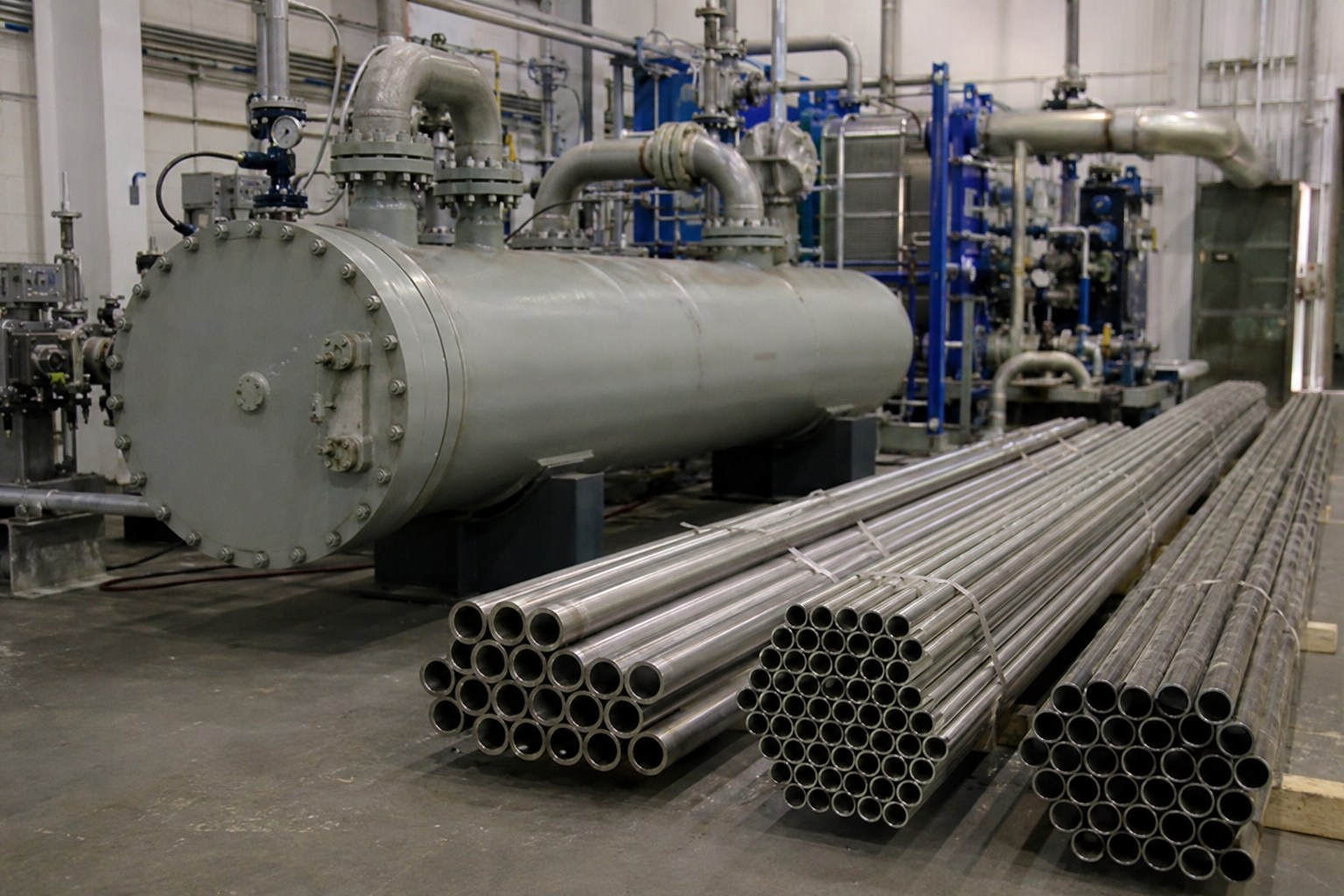
For procurement teams, the key question is not “Which alloy is best for nuclear heat exchangers?” The better question is “Which alloy tube is suitable for this system function, this water chemistry, this temperature, this pressure, this design code, this safety classification, this inspection plan, and this QA requirement?”
Are Basic Material Parameters Enough?
No. Basic material parameters alone are not enough for nuclear auxiliary heat exchanger tube selection. Tensile strength, yield strength, elongation, hardness, thermal conductivity and general corrosion resistance are important, but they do not fully describe the real operating environment.
Buyers should also confirm:
- System function
- Safety classification
- Design code
- Water chemistry
- Chloride level
- Dissolved oxygen
- pH control
- Boron or chemical additives if applicable
- Sulfides or other contaminants
- Temperature and pressure
- Flow velocity
- Fouling and scaling tendency
- Tube vibration risk
- Crevice areas
- Tube sheet design
- Cleaning and lay-up conditions
- Inspection accessibility
- Ageing management plan
- Required QA programme
- Required MTC / MTR and traceability
IAEA guidance on ageing management states that degradation mechanisms, susceptible operating environments, functions, materials, design, fabrication and operating conditions should be considered when selecting ageing mechanisms for nuclear power plant subcomponents: IAEA Ageing Management and Long Term Operation.
This is why a material datasheet is only the starting point.
Why Service Conditions Matter More Than Alloy Name
A nuclear auxiliary heat exchanger is not defined by alloy name alone. The same material may perform differently in different systems.
Important service questions include:
| Question | Why It Matters |
|---|---|
| Is the exchanger safety-related or non-safety-related? | Determines code, QA, documentation and inspection requirements |
| Is the medium seawater, river water, treated water, demineralized water or process coolant? | Controls corrosion and fouling risk |
| Is the water aerated, deaerated, borated, chlorinated or chemically treated? | Affects passivation, compatibility and corrosion mechanism |
| Is chloride present? | May increase localized corrosion risk for some alloy families |
| Is the exchanger exposed to radiation or located in a controlled area? | May affect qualification, handling, inspection and maintenance requirements |
| What is the design temperature and pressure? | Affects material strength, wall thickness and code compliance |
| Is there flow-induced vibration? | May affect tube wear, fatigue and support plate design |
| Can fouling reduce heat transfer? | Fouling can reduce heat transfer performance and require cleaning |
| Are there crevices at tube-to-tube sheet joints? | Crevices can create local chemistry and localized corrosion risk |
| Is galvanic coupling possible? | Tube, tube sheet, fasteners and shell materials should be reviewed together |
IAEA IGALL guidance gives an example of linking heat exchanger tube fouling with the heat transfer function and monitoring it by periodic heat balances: IAEA IGALL.
Titanium Tubes: Where They May Be Considered
Titanium tubes are often considered where cooling water contains chlorides, seawater, brackish water, or other aggressive cooling-side conditions. Titanium forms a stable passive film and has strong corrosion resistance in many chloride-containing environments.
ASTM B338 covers seamless and welded titanium alloy tubes for surface condensers, evaporators, and heat exchangers: ASTM B338.
Possible titanium tube applications may include:
- Service water heat exchangers
- Seawater-cooled auxiliary exchangers
- Component cooling water heat exchangers
- Surface condensers
- Coolers and auxiliary heat exchangers
- Heat exchangers exposed to chloride-containing cooling water
However, titanium should not be described as risk-free. Buyers still need to review:
- Crevice corrosion risk
- Tube sheet design
- Galvanic coupling
- Fluoride or reducing acid contamination
- Deposits and fouling
- Flow velocity
- Cleaning chemicals
- Tube expansion or welding method
- Handling and installation damage
- Inspection requirements
Titanium Grade 1, Grade 2, Grade 7, Grade 11, Grade 12 and other grades should be reviewed according to project conditions and ASTM B338 requirements.
Nickel Alloy Tubes: Where They May Be Considered
Nickel alloy tubes may be considered where higher temperature, specific chemistry, stress corrosion cracking concern, high-purity water, steam-side conditions, or demanding corrosion resistance requirements exist.
ASTM B163 covers seamless nickel and nickel alloy tubes for condenser and heat-exchanger service: ASTM B163.
Depending on the project, nickel alloy tube standards may include:
| Standard | Typical Scope | Common Relevance |
|---|---|---|
| ASTM B163 | Seamless nickel and nickel alloy tubes for condenser and heat-exchanger service | Nickel alloy heat exchanger tubes |
| ASTM B444 | UNS N06625 and related nickel-chromium-molybdenum seamless pipe and tube | Alloy 625 pipe and tube |
| ASTM B622 | Seamless pipe and tube of nickel and nickel-cobalt alloys | C-276, C-22 and related nickel alloy tubes |
| ASTM B829 | General requirements for nickel and nickel alloy seamless pipe and tube | General seamless nickel alloy tube requirements |
Useful references:
These standards help define product requirements. They do not prove that a tube material is suitable for a specific nuclear auxiliary heat exchanger without application review.
Titanium vs Nickel Alloy Tubes: Not a Simple Comparison
Titanium and nickel alloys should not be compared as “better” or “worse.” They serve different roles depending on service conditions.
| Material Family | Why Buyers May Consider It | Important Caution |
|---|---|---|
| Commercially pure titanium | Strong resistance in many seawater and chloride-containing cooling water environments | Crevice design, galvanic coupling, fluorides, cleaning chemicals and grade selection must be reviewed |
| Palladium-containing titanium grades | May be reviewed where crevice corrosion margin is important | Cost, availability, qualification and actual chemistry must be confirmed |
| Titanium Grade 12 | May be reviewed where strength and corrosion margin are both important | Welding, forming, project specification and compatibility must be checked |
| Nickel Alloy 600 / 690 families | May be reviewed for selected high-temperature or water chemistry conditions | Alloy history, project specification, stress corrosion cracking concern and regulatory requirements matter |
| Alloy 800 / 800H families | May be reviewed where high-temperature strength and oxidation resistance are relevant | Temperature, pressure, design code and product form must be checked |
| Alloy 625 | May be reviewed where strength and corrosion resistance are both required | Not universal; chemistry, temperature, stress and product standard must be confirmed |
| C-276 / C-22 type alloys | May be reviewed for severe chemical corrosion or mixed media | Cost, availability, fabrication and project qualification must be reviewed |
The correct material depends on the system function and verified operating environment.
Nuclear Quality Requirements Need Special Attention
For nuclear-related projects, supplier verification is not only a commercial issue. It may be a code, QA and regulatory issue.
NRC 10 CFR 50 Appendix B establishes quality assurance requirements for the design, manufacture, construction and operation of safety-related structures, systems and components, and states that QA includes planned and systematic actions needed to provide adequate confidence that an SSC will perform satisfactorily in service: 10 CFR 50 Appendix B.
ISO 19443 specifies quality management system requirements for organizations in the nuclear energy sector supply chain that provide products and services important to nuclear safety: ISO 19443.
ASME NQA-1 certification provides third-party certification for quality assurance programmes in conformance with ASME NQA-1, "Quality Assurance Requirements for Nuclear Facility Applications": ASME NQA-1 Certification.
Depending on the project, buyers may need to confirm:
- Safety classification
- Applicable nuclear code
- ASME Section III requirement if applicable
- ISO 19443 requirement if applicable
- ASME NQA-1 requirement if applicable
- 10 CFR 50 Appendix B requirement if applicable
- Owner's approved supplier list
- Project-specific QA plan
- Document retention period
- Nonconformance control
- Corrective action process
- Counterfeit / suspect item prevention
- Commercial-grade dedication if applicable
- Authorized inspection if required
ASME BPVC Section III Subsection NCA covers general requirements for manufacturers, fabricators, installers, designers, material manufacturers, material suppliers and owners of nuclear power plants, including quality assurance requirements and authorized inspection for nuclear construction classes: ASME BPVC Section III NCA.
What Supplier Claims Should Buyers Verify?
Supplier claims such as “nuclear grade,” “high reliability,” “excellent corrosion resistance,” “ASTM standard,” or “long service life” should be verified with documents and project-specific evidence.
Buyers should ask:
- Which alloy grade and UNS number are supplied?
- Which ASTM, ASME, EN, ISO or customer standard applies?
- Is the exchanger safety-related or non-safety-related?
- Does the project require ASME Section III?
- Does the project require ISO 19443, ASME NQA-1 or another nuclear QA programme?
- Is the tube seamless or welded?
- What is the heat treatment condition?
- What water chemistry or process condition was used for the recommendation?
- Are chloride, oxygen, pH, boron, sulfides, deposits and cleaning chemicals considered?
- Are crevice corrosion, SCC, galvanic effects, erosion, fouling and vibration reviewed?
- Can the supplier provide MTC / MTR for the actual heat number?
- Can the material be traced back to melt or batch?
- Are ECT, UT, hydrostatic or pneumatic testing, dimensional inspection and surface inspection included?
- Can third-party or authorized inspection be arranged if required?
- Can the supplier explain where the proposed alloy should not be used?
A reliable supplier should explain limitations, not only advantages.
What Documents Should Buyers Request?
For titanium and nickel alloy tubes used in nuclear auxiliary heat exchanger projects, buyers may request:
- Material Test Certificate / Mill Test Report
- EN 10204 Type 3.1 or Type 3.2 certificate if required
- Heat number or batch number traceability
- Chemical composition report
- Mechanical properties report
- Heat treatment record if required
- Manufacturing route statement if required
- Dimensional inspection report
- Surface inspection report
- Eddy current testing report if required
- Ultrasonic testing report if required
- Hydrostatic or pneumatic test report if required
- PMI report if required
- Cleanliness report if required
- Nonconformance records if applicable
- Third-party inspection report if required
- Authorized inspection documentation if required
- Packing and marking records
- QA plan or inspection and test plan if required
EN 10204 defines inspection documents for metallic products. Type 3.1 is an inspection certificate in which the manufacturer declares that supplied products comply with the order and provides test results: EN 10204 Inspection Documents.
Buyers should verify that certificates match the physical tubes: heat number, grade, standard, OD, wall thickness, length, test values, quantity, marking and purchase order.
Useful Testing and Inspection Methods
Testing requirements depend on product form, material grade, project standard, safety classification, wall thickness, and purchase order.
| Test / Inspection | Purpose |
|---|---|
| Chemical analysis | Confirms alloy composition |
| Mechanical testing | Confirms tensile strength, yield strength, elongation or hardness if required |
| Dimensional inspection | Confirms OD, wall thickness, length, tolerance and straightness |
| Surface inspection | Checks scratches, dents, pits, cracks, scale or contamination |
| Eddy current testing | Commonly used for heat exchanger tube inspection |
| Ultrasonic testing | Helps detect discontinuities in suitable products |
| Hydrostatic / pneumatic testing | Helps verify pressure integrity when required |
| PMI testing | Helps verify alloy identity |
| Cleanliness inspection | May be required for sensitive systems |
| Third-party inspection | Adds independent verification when required |
| Authorized inspection | May be required by nuclear code or project specification |
| Packing inspection | Helps prevent handling and transport damage |
ASNT explains that eddy current testing is commonly used to inspect heat exchanger tubes and detect wall-thickness changes or defects: ASNT Electromagnetic Testing.
ASNT explains that ultrasonic testing uses high-frequency sound waves to detect and measure discontinuities in industrial components: ASNT Ultrasonic Testing.
ISO 9001 Is Useful, but Not Enough for Nuclear Projects
ISO 9001 can support supplier evaluation, but it should not be treated as proof that a specific batch of titanium or nickel alloy tubes is suitable for a specific nuclear auxiliary heat exchanger.
ISO explains that ISO 9001 specifies requirements for a quality management system: ISO 9001 Quality Management Systems.
For nuclear-related projects, buyers may need additional QA and documentation controls depending on the component classification and project specification.
Buyers should still verify:
- Alloy grade
- Product standard
- Safety classification
- Nuclear QA requirement
- Heat number
- Chemical composition
- Mechanical properties
- Manufacturing route
- Heat treatment condition
- Surface condition
- Inspection reports
- MTC / MTR
- Application compatibility
- Third-party or authorized inspection if required
- Document retention and traceability
Quality management certification is helpful, but batch-level material verification and project-specific QA review are still necessary.
Lifecycle Cost: Why Initial Price Is Not Enough
The lowest purchase price is not always the lowest lifecycle cost. In nuclear auxiliary heat exchanger projects, the real cost may include inspection, qualification, documentation, installation, cleaning, leakage control, repair, retubing, replacement materials, downtime risk, regulatory review, radiation work planning, spare parts strategy and long-term maintenance.
NIST’s Life Cycle Cost Manual explains that lifecycle cost is the total cost of owning, operating, maintaining and disposing of a system over a given study period: NIST Life Cycle Cost Manual.
When comparing tube options, buyers should consider:
- Initial tube cost
- Product standard
- Safety classification
- Nuclear QA requirement
- Testing and inspection cost
- Documentation requirement
- Water chemistry and process condition
- Fouling and scaling risk
- Cleaning and maintenance cost
- Leakage consequence
- Retubing difficulty
- Downtime risk
- Lead time
- Packing and shipping protection
- Spare tube strategy
- Document retention cost
- Failure consequence
A higher-cost material or stricter inspection scope may be more economical in severe or safety-related service if it reduces leakage risk, replacement frequency, inspection burden or qualification uncertainty. A lower-cost option may be acceptable in mild and non-safety-related service. The correct decision depends on actual risk, code requirements and lifecycle cost.
Practical RFQ Checklist for Nuclear Auxiliary Heat Exchanger Tubes
Before sending an inquiry, buyers can prepare the following information:
- Plant type: PWR, BWR, PHWR, SMR, research reactor, nuclear auxiliary facility or other
- Equipment name: auxiliary heat exchanger, component cooling water heat exchanger, service water heat exchanger, residual heat removal support exchanger, cooler, condenser or custom unit
- System function and safety classification
- Applicable code: ASME Section III, ASME Section VIII, EN, RCC-M, project specification or other
- Required QA programme: ISO 19443, ASME NQA-1, 10 CFR 50 Appendix B, owner QA or other
- Tube side and shell side media
- Water chemistry: demineralized water, seawater, brackish water, river water, borated water, treated cooling water or other
- Chloride level and seasonal variation
- pH, dissolved oxygen, sulfides, boron, ammonia, hydrazine, metals or other chemistry details
- Operating temperature and maximum temperature
- Operating pressure and design pressure
- Flow velocity and turbulence
- Fouling, scaling, biofouling or deposit risk
- Cleaning chemicals and cleaning frequency
- Radiation or environmental qualification requirement if applicable
- Heat exchanger design: straight tube, U-tube, tube sheet joint, welded or expanded joints
- Tube sheet material and galvanic compatibility
- Vibration or fatigue concern
- Required alloy grade and UNS number
- Required product standard: ASTM B338, B163, B444, B622, B829, ASME SB standard or customer specification
- Seamless or welded tube requirement
- OD, wall thickness, length, tolerance and quantity
- Heat treatment condition
- Surface finish and cleanliness requirement
- Required testing: ECT, UT, hydrostatic, pneumatic, PMI, dimensional, surface inspection, cleanliness test or third-party inspection
- Required certificate type: EN 10204 3.1 or 3.2
- Required QA records and retention period
- Packing, end caps, marking and delivery requirement
A clear RFQ helps the supplier quote a traceable and verifiable tube product instead of a general “nuclear heat exchanger tube.”
Conclusion
Titanium and nickel alloy tube selection for nuclear auxiliary heat exchangers should be based on service conditions, system function, safety classification, applicable code, water chemistry, alloy grade, product standard, testing scope, supplier QA capability, documentation and lifecycle cost.