
How to Choose Small-Diameter Nickel Alloy Tubes for Instrumentation
Are you choosing small-diameter nickel alloy tubes for industrial instrumentation, process control, analytical equipment, pressure measurement, temperature probes, or sampling lines? In these applications, the tube is not just a small metal pipe. It may be part of a pressure boundary, a sensing assembly, a fluid path, or a critical connection between the process and the instrument.
Choosing small-diameter nickel alloy tubes should not be based only on material grade. A reliable selection should match the alloy, tube size, wall thickness, surface finish, manufacturing route, inspection scope, and documentation requirements to the actual service environment.
The U.S. Department of Energy’s technical brief on materials selection for thermal process equipment explains that material selection should consider mechanical properties, oxidation or hot corrosion resistance, component form, material availability, and long-term exposure behavior. This same logic is useful for small-diameter nickel alloy tubes: the grade name is only the starting point.
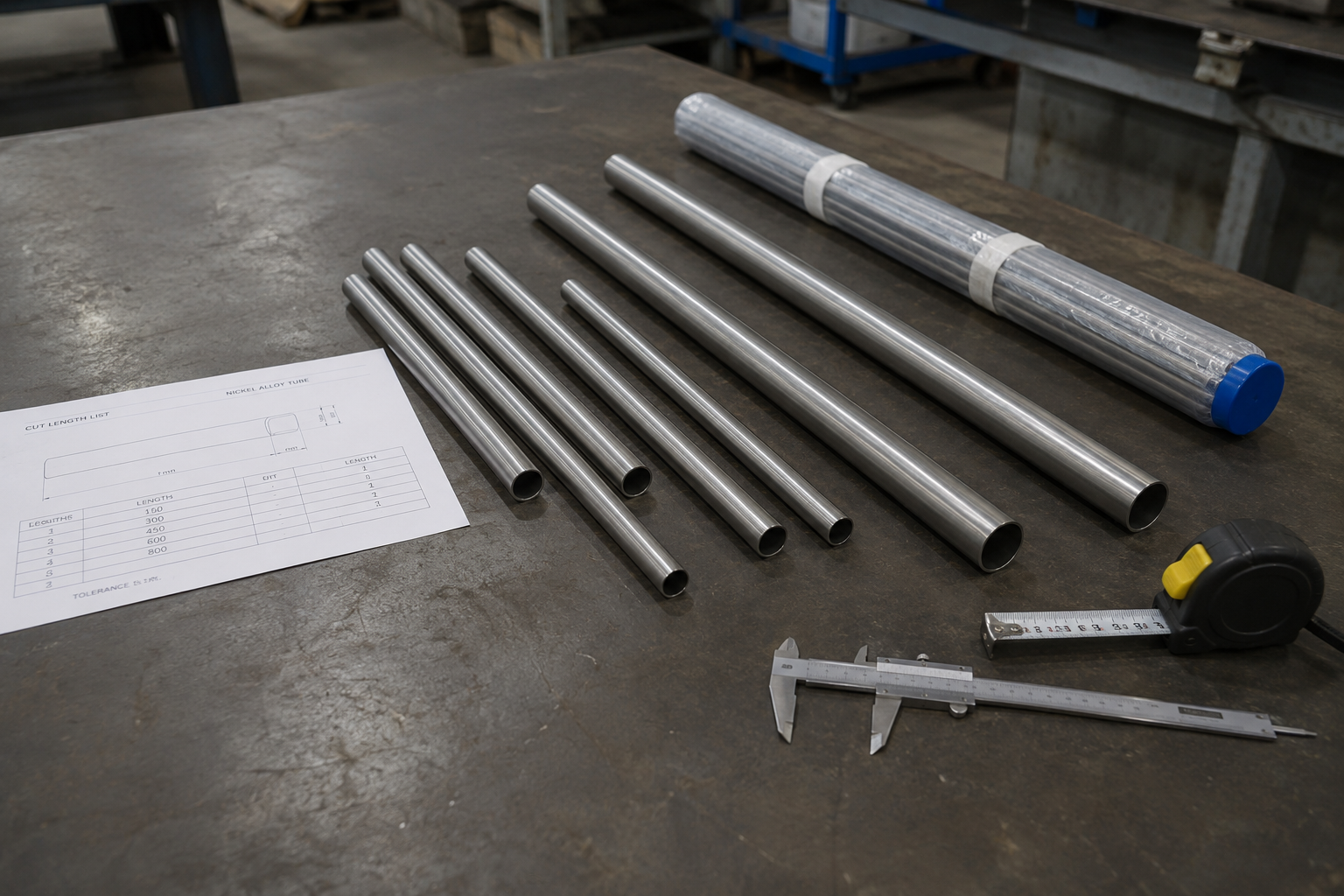
For buyers, engineers, and procurement teams, the key question is not simply “Which nickel alloy tube is available?” The better question is “Which tube is suitable for this media, pressure, temperature, tolerance, surface condition, inspection requirement, and service risk?”
Why Material Grade Is Only the Starting Point
Many buyers begin with familiar alloy names such as Alloy 625, Alloy 825, Alloy 600, Alloy C-276, or Nickel 200. This is a reasonable starting point, but it is not enough to confirm suitability.
Small-diameter nickel alloy tubes may be used in demanding environments such as:
- Chemical processing
- Oil and gas instrumentation
- Power generation
- Heat treatment equipment
- Marine and offshore systems
- Semiconductor equipment
- Analytical sampling systems
- High-temperature measurement systems
- Corrosive process lines
- Pressure and flow measurement systems
In these applications, a tube may face several conditions at the same time:
- Corrosive liquid or gas
- Chloride-containing media
- Acid or alkali
- High temperature
- Thermal cycling
- Internal or external pressure
- Vibration
- Flow-induced erosion
- Abrasive particles
- Tight installation space
- Cleanliness requirements
- Strict dimensional tolerance
A nickel alloy tube that performs well in one environment may not perform well in another. That is why material selection should be based on the complete operating condition, not only the grade name.
Key Operating Conditions to Confirm
Before selecting small-diameter nickel alloy tubes, buyers should define the actual working environment as clearly as possible.
| Factor | What to Confirm | Why It Matters |
|---|---|---|
| Process media | Acid, alkali, chloride, sulfur compound, steam, seawater, gas, solvent, slurry, or mixed media | Determines corrosion risk and alloy compatibility |
| Concentration | Chemical concentration, chloride level, pH, moisture, and impurities | Small changes may affect corrosion behavior |
| Temperature | Normal temperature, maximum temperature, and temperature cycling | Affects corrosion rate, strength, oxidation, and fatigue |
| Pressure | Internal pressure, external pressure, pressure cycling, or vacuum | Determines wall thickness and mechanical design requirements |
| Flow condition | Static, high velocity, turbulent, intermittent, or particle-containing flow | Affects erosion, vibration, and pressure drop |
| Tube size | OD, ID, wall thickness, length, and tolerance | Affects fit, connection, flow, pressure capability, and installation |
| Surface finish | Pickled, bright annealed, polished, cleaned, or special finish | Affects cleanliness, corrosion exposure, and assembly suitability |
| Inspection scope | PMI, dimensional inspection, NDT, pressure test, or third-party inspection | Helps reduce delivery and installation risk |
| Documentation | MTC, heat number, standard, test reports, packing and marking | Supports traceability and order verification |
This information helps the supplier recommend a tube that matches the real application instead of quoting a general nickel alloy grade.
How Corrosive Media Affect Nickel Alloy Tube Selection
Corrosion resistance is one of the main reasons buyers choose nickel alloy tubes. However, corrosion resistance is not universal. It depends on the exact media, temperature, concentration, flow condition, oxygen level, pH, and contaminants.
For chloride-containing environments, the Nickel Institute provides a technical guide on test techniques for pitting and crevice corrosion resistance of stainless steel and nickel-base alloys in chloride-containing environments. This is useful because chloride-related pitting and crevice corrosion are common concerns in many industrial systems.
Buyers should confirm whether the tube will contact:
- Chlorides
- Sulfur compounds
- Hydrochloric acid
- Sulfuric acid
- Nitric acid
- Phosphoric acid
- Caustic soda
- Seawater or brine
- Superheated steam
- High-temperature gas
- Organic solvents
- Slurries or abrasive media
- Mixed or contaminated process fluids
When the media is complex, buyers should avoid relying on a general corrosion resistance statement. It is better to provide the actual media composition, concentration, temperature, flow rate, and expected service life.
Why Pressure and Wall Thickness Matter
For instrumentation and process tubing, pressure is a critical factor. Tube OD and wall thickness are not only dimensional details. They are part of the mechanical design and system integrity.
ASME B31.3 covers process piping requirements typically found in petroleum, chemical, pharmaceutical, hydrogen, power generation, semiconductor, cryogenic, and related processing plants. It covers materials and components, design, fabrication, assembly, erection, examination, inspection, and testing of piping systems. Buyers can refer to ASME B31.3 Process Piping when their tubing is part of a process piping or pressure-related system.
For small-diameter nickel alloy tubes, buyers should confirm:
- Required OD and tolerance
- Required ID or flow path
- Wall thickness
- Pressure rating or design pressure
- Temperature at pressure
- Fitting type
- Bending or routing requirement
- Whether pressure testing is required
- Whether the tube is seamless or welded
- Applicable code or project specification
A tube with the correct alloy grade but the wrong wall thickness or tolerance may still be unsuitable for the system.
How Tube Precision Affects Instrumentation Applications
Small-diameter tubing is often used where space, flow control, pressure measurement, sampling accuracy, or connector fit is important. For this reason, dimensional consistency can matter as much as alloy composition.
Important precision factors include:
| Tube Feature | Why It Matters |
|---|---|
| Outer diameter | Affects connection with fittings, seals, clamps, and installation space |
| Inner diameter | Affects flow rate, pressure drop, sample volume, and response time in some systems |
| Wall thickness | Affects mechanical strength, pressure capability, heat transfer, and durability |
| Straightness | Helps installation and reduces unintended stress at connections |
| Roundness | Supports proper fitting engagement and sealing |
| Surface finish | Affects cleanliness, friction, corrosion exposure, and inspection acceptance |
| Batch consistency | Reduces variation between lots and supports stable assembly quality |
In precise instrumentation systems, even small deviations may create installation problems, leakage risk, flow inconsistency, or extra rework. Therefore, buyers should define the required tolerance clearly instead of assuming that all small-diameter tubes are produced to the same precision level.
Seamless or Welded Nickel Alloy Tubes?
Both seamless and welded nickel alloy tubes may be used in industrial applications, depending on standard, size, pressure, media, and project requirements.
ASTM B829 contains general requirements for seamless pipes and tubes made from nickel and nickel alloys. It also notes that specific product specifications take precedence when there is a conflict. Buyers can refer to ASTM B829 when discussing general requirements for seamless nickel alloy pipe and tube.
For welded nickel alloy tubes, ASTM B704 covers welded nickel alloy tubes, and ASTM B751 provides general requirements for longitudinally welded tubular products made from nickel and nickel alloys. Buyers can refer to ASTM B704 and ASTM B751 when welded tube requirements are relevant.
A simple comparison:
| Tube Type | Typical Consideration | Buyer Caution |
|---|---|---|
| Seamless tube | No longitudinal weld seam, often preferred for severe pressure or corrosion-related applications | Availability, tolerance, size range, cost, and lead time must be confirmed |
| Welded tube | May offer dimensional consistency and cost advantages in some sizes | Weld quality, heat treatment, NDT, corrosion environment, and standard requirements must be checked |
The correct choice depends on the actual application and specification, not only on general preference.
Common Nickel Alloy Tube Standards to Discuss
Different nickel alloy tubes may fall under different ASTM or project standards. The following examples are useful starting points for buyer-supplier communication.
| Standard | Typical Scope | Why It Matters |
|---|---|---|
| ASTM B829 | General requirements for seamless nickel and nickel alloy pipe and tube | Helps define general seamless tube requirements |
| ASTM B444 | Nickel-chromium-molybdenum-columbium alloys such as UNS N06625 pipe and tube | Relevant for Alloy 625 seamless pipe and tube discussions |
| ASTM B622 | Seamless nickel and nickel-cobalt alloy pipe and tube | Relevant for several corrosion-resistant nickel alloy grades |
| ASTM B704 | Welded nickel alloy tubes | Relevant when welded nickel alloy tube is specified |
| ASTM B751 | General requirements for nickel and nickel alloy welded tube | Helps define welded tube general requirements |
| ASME B31.3 | Process piping code | Relevant when tubing is part of process piping or pressure systems |
For example, ASTM B444 states that UNS N06625 products are supplied in different heat-treated conditions and that chemical testing, tensile testing, hydrostatic testing, and nondestructive electric testing are part of the specification. Buyers can refer to ASTM B444 when Alloy 625 pipe or tube is being discussed.
ASTM B622 also describes requirements for seamless nickel and nickel-cobalt alloy pipe and tube, including chemical composition, mechanical properties, hydrostatic testing, and nondestructive electric testing. Buyers can refer to ASTM B622 when grades such as Alloy C-276 or other covered nickel alloys are involved.
Surface Finish and Cleanliness Should Not Be Overlooked
For small-diameter nickel alloy tubes, surface condition can affect cleanliness, corrosion exposure, friction, assembly, and inspection acceptance. This is especially important in instrumentation, sampling, analytical, and high-purity systems.
Research on surface preparation and high-temperature oxidation of Ni, Cu and Ni-Cu alloy shows that surface preparation can change oxidation behavior. Although the exact effect depends on alloy and environment, the general lesson is useful: surface condition should be specified, not ignored.
Buyers should confirm:
- Pickled surface
- Bright annealed surface
- Polished surface
- Ground or machined surface
- Inner surface cleanliness
- Oil-free or contamination-controlled condition
- Maximum roughness if required
- No visible cracks, laps, pits, dents, or heavy scale
- Special cleaning or packaging requirements
For sensitive instrumentation lines, packaging and end protection are also important because small-diameter tubes can be damaged or contaminated during transport.
What Testing and Inspection Should Buyers Request?
Testing requirements depend on product form, size, standard, application risk, and project specification. For small-diameter nickel alloy tubes, buyers may request:
| Test / Inspection | Purpose |
|---|---|
| Chemical analysis | Confirms alloy composition against the required grade |
| Mechanical testing | Confirms tensile strength, yield strength, elongation, or hardness when required |
| PMI testing | Helps verify alloy identity and major elements |
| Dimensional inspection | Confirms OD, ID, wall thickness, length, roundness, and straightness |
| Visual inspection | Checks surface defects, dents, cracks, pits, scale, or contamination |
| Eddy current testing | Helps detect surface or near-surface discontinuities in conductive materials |
| Ultrasonic testing | Helps detect internal discontinuities in suitable products |
| Hydrostatic or pressure testing | Helps verify pressure integrity where required |
| Surface roughness testing | Confirms surface finish when specified |
| Third-party inspection | Adds independent verification for critical projects |
ASNT explains that nondestructive testing methods allow materials, components, and systems to be evaluated without causing damage, and that methods such as ultrasonic testing and electromagnetic testing can help detect flaws and support reliability.
Testing should be defined before production or shipment. If the purchase order does not specify required testing, the delivered tube may only follow the basic standard or supplier’s normal inspection scope.
Why MTC and Traceability Matter
For industrial nickel alloy tubes, documentation is not just paperwork. It helps buyers verify whether the delivered material matches the order.
Buyers should request:
- Material Test Certificate / Mill Test Report
- Heat number or batch number
- Chemical composition results
- Mechanical properties results
- Heat treatment condition if required
- Dimensional inspection report if required
- NDT report if required
- PMI report if required
- Pressure test report if required
- Surface finish or cleanliness report if required
- Packing and marking records
For metallic products, EN 10204 Type 3.1 inspection certificate provides a statement of compliance with the order and specific inspection results, validated by the manufacturer’s authorized inspection representative independent of the manufacturing department.
However, buyers should still check whether the certificate matches the physical material. The heat number, grade, size, standard, test values, quantity, and markings should be consistent with the purchase order and the delivered tubes.
How to Evaluate the True Cost of Nickel Alloy Tubes
The lowest purchase price is not always the lowest total cost. If a small-diameter tube fails early, the real cost may include replacement, labor, system cleaning, recalibration, delayed production, emergency shipping, and unplanned downtime.
NIST’s report on the costs and benefits of advanced maintenance in manufacturing explains that maintenance-related costs can include direct maintenance and repair costs, cascading damage from breakdowns, downtime, and rework or defects.
NIST also provides a Life Cycle Costing Manual, which explains life-cycle cost methodology. For industrial buyers, the useful idea is simple: evaluate cost over the service life, not only at the purchase stage.
When comparing quotations, buyers should check:
- Is the alloy grade the same?
- Is the standard the same?
- Is the tube seamless or welded?
- Is the tolerance the same?
- Is the surface finish the same?
- Are MTCs included?
- Are PMI, NDT, pressure testing, or third-party inspection included?
- Is packing suitable for small-diameter tubing?
- Is lead time realistic?
- Is documentation complete?
A tube that looks cheaper may not be cheaper if it lacks the required inspection, tolerance, surface condition, or documentation.
How to Evaluate a Supplier Beyond Price
A professional supplier should do more than quote a grade and price. For small-diameter nickel alloy tubes used in instrumentation, supplier capability should include technical communication, manufacturing control, inspection support, and documentation consistency.
When evaluating suppliers, ask:
| Supplier Factor | What to Ask | Why It Matters |
|---|---|---|
| Application understanding | Do they ask about media, pressure, temperature, flow, and failure history? | Shows whether they understand the real service condition |
| Product standard | Can they supply according to ASTM, ASME, EN, ISO, or customer drawings? | Helps ensure technical consistency |
| Manufacturing route | Is the tube seamless, welded, cold-drawn, annealed, or bright annealed? | Affects tolerance, surface condition, and properties |
| Inspection capability | Can they support PMI, dimensional inspection, NDT, pressure testing, or third-party inspection? | Helps reduce delivery risk |
| Traceability | Can they provide heat number control and MTCs? | Helps verify material identity |
| Quality system | Do they operate under a recognized quality management system such as ISO 9001? | Indicates structured quality management, but does not replace material verification |
| Packaging | Can they protect small tubes from bending, contamination, or surface damage? | Helps prevent installation problems |
| Technical communication | Can they discuss alternatives when the original material failed? | Helps buyers avoid repeating the same mistake |
ISO describes ISO 9001 as a globally recognized standard for quality management. It helps organizations establish, implement, maintain, and continually improve a quality management system. However, ISO 9001 should not be treated as proof that a specific batch of tubing is suitable for a specific application. The actual material, standard, test results, and service conditions still need to be checked.
Practical RFQ Checklist for Small-Diameter Nickel Alloy Tubes
Before sending an inquiry, buyers can prepare the following information:
- Application industry
- Instrument or system type
- Tube function: pressure line, sampling line, sensor tube, capillary tube, heat transfer tube, or custom part
- Required alloy grade and UNS number if known
- Required standard: ASTM, ASME, EN, ISO, or customer specification
- Seamless or welded requirement
- OD, ID, wall thickness, length, and tolerance
- Quantity and delivery schedule
- Operating temperature range
- Design pressure or working pressure
- Process media and chemical composition
- Chloride level, pH, sulfur compounds, acids, alkalis, or other contaminants
- Flow velocity, erosion risk, or abrasive particles
- Thermal cycling, pressure cycling, or vibration condition
- Required surface finish and cleanliness
- Required certificate type, such as EN 10204 3.1
- Required testing: PMI, UT, eddy current, hydrostatic test, dimensional inspection, surface roughness, or third-party inspection
- Packing, marking, and export documentation requirements
A clear RFQ helps the supplier confirm feasibility, quote accurately, and reduce the risk of material mismatch.
Conclusion
Choosing small-diameter nickel alloy tubes for instrumentation is a technical decision, not only a purchasing decision. Buyers should go beyond material grade and evaluate media, temperature, pressure, tolerance, wall thickness, surface finish, testing, documentation, and supplier capability.
The right tube should match the actual service environment and project requirements. When material selection, dimensional control, inspection, MTC traceability, and packaging are confirmed before ordering, small-diameter nickel alloy tubes are more likely to support reliable instrumentation and long-term system integrity.