
How to Choose Nickel and Titanium Alloys for Chlor-Alkali Equipment
Choosing materials for chlor-alkali equipment is not about finding one universal “best” alloy. A chlor-alkali plant contains different process stages, including brine preparation, electrolysis, caustic soda concentration, chlorine cooling and drying, hydrogen handling, hypochlorite service, storage, piping, heat exchangers, valves, pumps, and fittings.
Each stage may expose materials to different combinations of chlorine, brine, caustic soda, hypochlorite, sulfuric acid, hydrogen, moisture, temperature, pressure, concentration, flow velocity, impurities, and mechanical stress.
The European Commission chlor-alkali BREF covers multiple chlor-alkali process activities, including brine preparation and purification, brine electrolysis, sodium or potassium hydroxide concentration and handling, chlorine cooling, drying and handling, and hydrogen cooling and handling: European Commission Chlor-Alkali BREF.
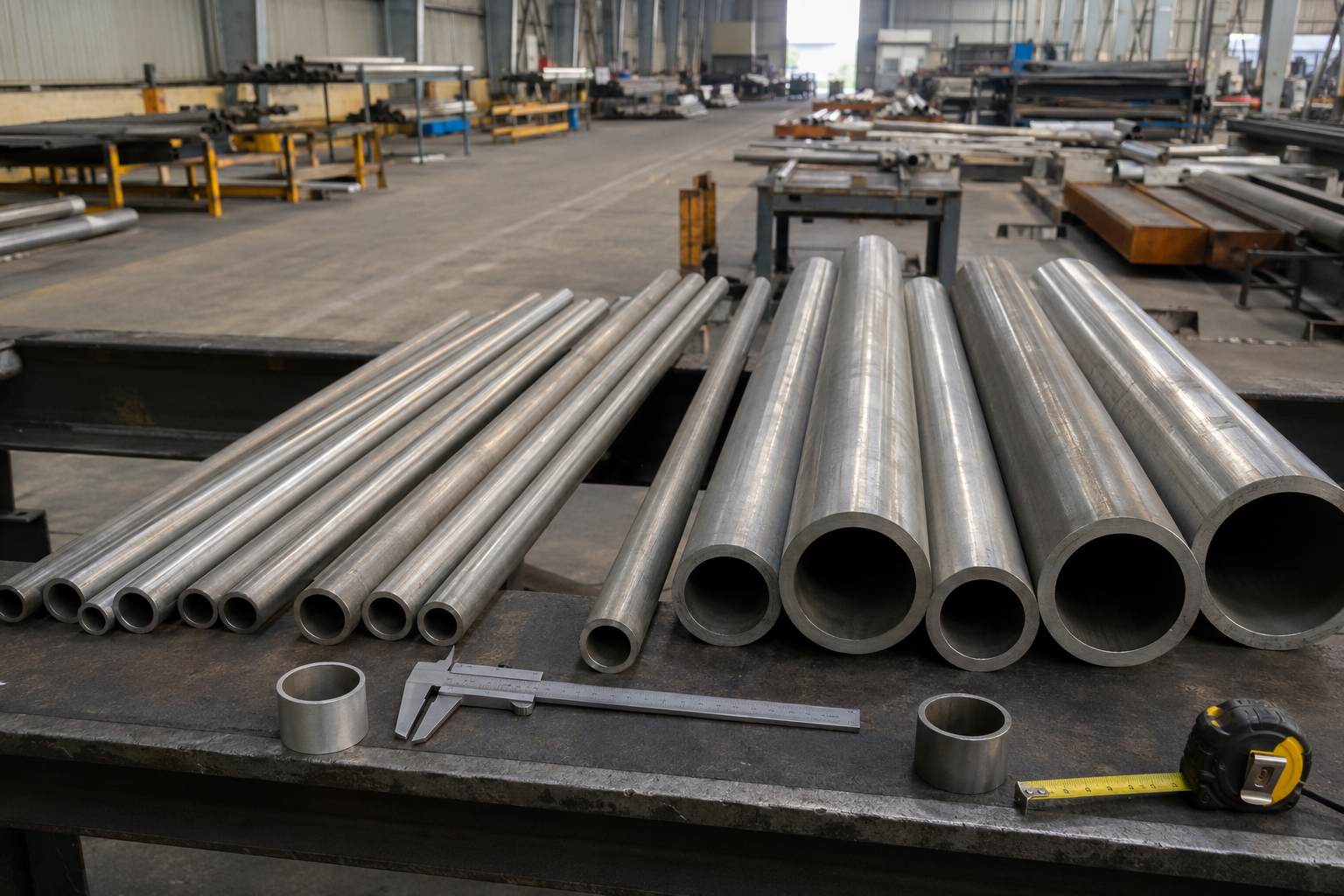
For buyers and engineers, the correct question is not “Is nickel better than titanium?” or “Is titanium better than nickel?” The better question is “Which material is suitable for this process stage, this chemical medium, this temperature, this concentration, and this inspection requirement?”
Why No Single Material Is Best for Chlor-Alkali Equipment
No single material is best for every chlor-alkali application. Material selection depends on the process stage, chemical medium, temperature, concentration, moisture level, impurities, flow velocity, stress, fabrication method, and inspection requirement. Nickel and titanium alloys should be selected by service condition, not by material name alone.
A chlor-alkali plant is not one uniform environment. Different sections may involve:
- Purified brine
- Hot brine
- Wet chlorine
- Dry chlorine
- Sodium hypochlorite
- Hot caustic soda
- Concentrated caustic soda
- Sulfuric acid used for chlorine drying
- Hydrogen
- Cooling water
- Cleaning chemicals
- Process upsets and shutdown conditions
This is why the same material may perform well in one area but fail or become uneconomical in another.
Key Operating Conditions to Confirm
Before selecting nickel alloy tubes, titanium alloy tubes, bars, fittings, or custom parts, buyers should confirm the real operating condition.
| Factor | What to Confirm | Why It Matters |
|---|---|---|
| Process stage | Brine, electrolysis, wet chlorine, dry chlorine, hypochlorite, caustic, hydrogen, drying, storage, heat exchange | Different stages require different materials |
| Chemical medium | Chlorine, caustic soda, brine, hypochlorite, sulfuric acid, hydrogen, cooling water | Determines the main corrosion mechanism |
| Moisture level | Wet chlorine or dry chlorine | Titanium may behave very differently in wet and dry chlorine |
| Concentration | NaOH concentration, acid concentration, hypochlorite concentration, brine salinity | Corrosion risk changes strongly with concentration |
| Temperature | Normal, maximum, startup, shutdown and upset temperature | Higher temperature often increases corrosion and cracking risk |
| Pressure | Operating pressure, design pressure, pressure cycling | Affects mechanical design and inspection requirements |
| pH | Acidic, neutral, alkaline or fluctuating | Affects passivation and localized corrosion risk |
| Impurities | Iron, oxygen, chlorates, sulfates, metals, solids or process contaminants | Trace species may change corrosion behavior |
| Flow velocity | Low-flow, high-flow, turbulent or stagnant | Affects erosion-corrosion, deposits and local attack |
| Stress | Pressure stress, vibration, thermal stress, residual stress, weld stress | Important for SCC and fatigue review |
| Fabrication | Welding, forming, bending, heat treatment, machining | Fabrication can affect final corrosion resistance |
| Documentation | MTC / MTR, heat number, EN 10204 3.1 / 3.2 if required | Supports traceability and verification |
A vague RFQ such as “material for chlor-alkali equipment” is usually not enough. The supplier needs the specific process stage and service condition.
Where Titanium Performs Well in Chlor-Alkali Service
Titanium is often selected in chlor-alkali equipment because of its passive oxide film and strong resistance in many wet chlorine, hypochlorite, and chloride-containing environments.
A Titanium Association presentation on titanium in chloralkali and related applications states that titanium is fully resistant to wet chlorine, chlorine dioxide, and hypochlorite in many conditions: Titanium in Chlorate, Chloralkali and Chlorine Dioxide Applications.
Common areas where titanium may be considered include:
- Wet chlorine gas coolers
- Wet chlorine piping
- Brine-side equipment
- Electrolyzer-related components
- Hypochlorite handling equipment
- Selected heat exchanger tubes
- Selected pump and valve wetted parts
- Chloride-containing process sections
ASTM B338 covers seamless and welded titanium alloy tubes for surface condensers, evaporators and heat exchangers: ASTM B338.
However, titanium is not suitable for every chlor-alkali environment.
Important Titanium Limitations
Titanium should not be treated as a universal chlor-alkali material. The same Titanium Association source lists several titanium limitations, including acidic fluoride environments, very hot chloride solutions, hydrogen embrittlement risk, hot caustic conditions, and dry chlorine attack.
Important limitations to review include:
- Dry chlorine gas
- Acidic fluoride-containing environments
- Hot concentrated caustic soda
- Very hot chloride solutions
- Crevice areas under gaskets or deposits
- Hydrogen absorption risk in some electrochemical conditions
- High-velocity caustic scrubber areas
- Incompatible gasket or sealing materials
The presentation specifically notes that titanium is attacked by dry chlorine and by hot caustic above certain concentration and temperature conditions: Titanium Limitations in Chloralkali Service.
This is why buyers should always separate wet chlorine service from dry chlorine service when discussing titanium.
Where Nickel and High-Nickel Materials Are Commonly Considered
Nickel and high-nickel materials are commonly considered for caustic soda service, especially where temperature and concentration increase corrosion risk.
Nickel Institute has a technical guide focused on the corrosion resistance and uses of nickel and high-nickel materials in caustic solutions: Corrosion Resistance of Nickel and Nickel-Containing Alloys in Caustic Soda and Other Alkalies.
Common areas where nickel or high-nickel materials may be considered include:
- Hot caustic soda equipment
- Caustic evaporators
- Caustic heat exchangers
- Caustic piping in selected temperature and concentration ranges
- Caustic storage or handling equipment where carbon steel is not sufficient
- Selected hydrogen handling components after application review
- Selected high-temperature or strongly alkaline process areas
World Chlorine Council guidance for chlorine safety scrubbing systems lists nickel as a material for caustic solution heat exchanger process side service and notes that caustic soda material selection should be based on expected service temperatures, pressures and concentrations: Chlorine Safety Scrubbing Systems.
Nickel Limitations to Review
Nickel and high-nickel materials are not universal answers either. Buyers should confirm:
- NaOH concentration
- Temperature
- Pressure
- Oxygen or oxidizer content
- Chlorate or impurity level
- Stress condition
- Flow velocity
- Erosion-corrosion risk
- Welding or fabrication condition
- Required standard
- MTC / MTR and heat number traceability
- Whether hydrogen service conditions require special review
The correct approach is not “nickel for everything caustic.” The correct approach is to match the nickel alloy family and product form to the exact caustic condition.
Wet Chlorine, Dry Chlorine and Hypochlorite Are Different Services
Chlorine-related service should be divided carefully.
| Service Condition | Material Selection Note |
|---|---|
| Wet chlorine | Titanium is often considered because moist chlorine can support titanium passivation |
| Dry chlorine | Titanium may be attacked; other materials such as carbon steel or selected metals may be considered depending on service |
| Hypochlorite solution | Titanium may be considered, but pH, temperature and crevice conditions must be reviewed |
| Chlorine plus caustic | Requires careful review because hypochlorite, caustic concentration and flow conditions can change corrosion behavior |
| Chlorine drying with sulfuric acid | Material selection must consider sulfuric acid concentration, temperature, water content and contamination |
| Chlorine valves and fittings | Require special design and material review; should not be treated as routine commodity components |
World Chlorine Council guidance states that valves for chlorine service require special attention and cannot be considered routine commodity valve applications: Chlorine Safety Scrubbing Systems.
Candidate Material Families by Process Area
The following table is only a starting point for technical discussion. It is not a final material selection chart.
| Process Area | Common Service Conditions | Candidate Material Families to Review | Important Caution |
|---|---|---|---|
| Brine preparation and purification | Chloride-containing brine, impurities, pH control | Titanium, FRP, lined steel, stainless steel depending on condition | Check chlorides, oxidizers, temperature, solids and cleaning chemicals |
| Electrolyzer area | Brine, wet chlorine, caustic, electrochemical conditions | Titanium and coated titanium components are often important | Check electrical role, coating, hydrogen absorption and crevice areas |
| Wet chlorine cooling / handling | Moist chlorine gas, condensate, temperature changes | Titanium grades, selected linings or compatible non-metallic materials | Do not assume the same material works for dry chlorine |
| Dry chlorine handling | Dry chlorine gas, low moisture | Carbon steel or selected materials depending on design and purity | Titanium may be attacked by dry chlorine |
| Hypochlorite service | Hypochlorite solution, high pH, oxidizing conditions | Titanium, lined steel, polymers, selected materials | Check pH, temperature, crevice corrosion and gasket compatibility |
| Caustic evaporators | Hot concentrated NaOH | Nickel 200 / 201, high-nickel materials, selected alloys | Check concentration, temperature, stress, flow and impurities |
| Caustic storage / piping | NaOH solution at defined concentration and temperature | Carbon steel, stainless steel, nickel depending on severity | Material selection must be based on temperature, pressure and concentration |
| Hydrogen handling | Co-produced hydrogen, pressure, moisture and purity | Selected steels or nickel alloys depending on requirement | Hydrogen service needs separate compatibility and safety review |
| Heat exchangers | Process-side corrosion, cooling-side corrosion, scaling and thermal cycling | Titanium tubes, nickel alloy tubes, stainless steel or lined designs | Select by both process side and cooling side conditions |
A material that works in one section may not be suitable in another.
How to Interpret Technical Specifications
Technical specifications are necessary, but they are not the whole selection process.
ASTM B338 defines titanium alloy tubes for condensers, evaporators and heat exchangers. ASTM B163 covers seamless nickel and nickel alloy tubes for condenser and heat-exchanger service. ASTM B444 covers UNS N06625 and related nickel alloy cold-worked seamless pipe and tube. ASTM B622 covers seamless pipe and tube of nickel and nickel-cobalt alloys.
Useful standards include:
| Standard | Typical Scope | Common Relevance |
|---|---|---|
| ASTM B338 | Seamless and welded titanium alloy tubes for condensers, evaporators and heat exchangers | Titanium heat exchanger tubes |
| ASTM B163 | Seamless nickel and nickel alloy tubes for condenser and heat-exchanger service | Nickel alloy heat exchanger tubes |
| ASTM B444 | UNS N06625 and related nickel alloy cold-worked seamless pipe and tube | Alloy 625 pipe and tube |
| ASTM B622 | Seamless pipe and tube of nickel and nickel-cobalt alloys | C-276, C-22 and related nickel alloy seamless pipe and tube |
| ASTM B829 | General requirements for nickel and nickel alloy seamless pipe and tube | General nickel alloy seamless tube requirements |
These standards help define product requirements. They do not prove that a material is suitable for a specific chlor-alkali process condition.
What Specifications Do Not Always Tell You
A material data sheet may not fully capture:
- Process upsets
- Startup and shutdown conditions
- Wet-to-dry chlorine transition
- Caustic concentration changes
- Trace impurities
- Flow velocity and erosion
- Crevices under gaskets
- Deposits and fouling
- Welding and heat treatment effects
- Residual stress
- Localized corrosion
- Long-term exposure
- Cleaning chemicals
- Galvanic coupling
- Tube-to-tube sheet joint condition
Buyers should compare specification data with actual service conditions.
How to Verify Supplier Claims
Supplier claims such as “chlor-alkali grade,” “excellent corrosion resistance,” “wet chlorine resistant,” or “caustic resistant” should be verified with documents, standards and service-condition discussion.
Buyers should ask:
- Which alloy grade and UNS number are supplied?
- Which ASTM, ASME, EN, ISO or customer standard applies?
- Is the product tube, pipe, bar, plate, fitting or custom machined part?
- Is the tube seamless or welded?
- What is the heat treatment condition?
- What exact process stage is the material recommended for?
- Is the service wet chlorine, dry chlorine, caustic, hypochlorite, sulfuric acid, hydrogen or brine?
- What temperature, pressure and concentration were used for the recommendation?
- Are impurities, flow velocity, crevices and cleaning chemicals considered?
- Can the supplier provide MTC / MTR for the actual heat number?
- Can the material be traced back to the melt or batch?
- Are PMI, ECT, UT, hydrostatic test, dimensional inspection or surface inspection included?
- Can third-party inspection be arranged if required?
- Can the supplier explain where the material should not be used?
A reliable supplier should explain both advantages and limitations.
What Documents Should Buyers Request?
For nickel and titanium alloy materials used in chlor-alkali equipment, buyers may request:
- Material Test Certificate / Mill Test Report
- EN 10204 Type 3.1 or Type 3.2 certificate if required
- Heat number or batch number traceability
- Chemical composition report
- Mechanical properties report
- Heat treatment condition
- Hardness report if required
- Dimensional inspection report
- Surface inspection report
- Eddy current testing report if required
- Ultrasonic testing report if required
- Hydrostatic or pneumatic test report if required
- PMI report if required
- Third-party inspection report if required
- Packing and marking records
EN 10204 defines inspection documents for metallic products, including Type 3.1 and Type 3.2 inspection certificates: EN 10204 Inspection Documents.
Buyers should verify that the certificate matches the physical material: heat number, grade, standard, size, condition, test values, quantity, marking and purchase order.
Useful Testing and Inspection Methods
Testing requirements depend on product form, material standard, pressure rating, customer specification and service risk.
| Test / Inspection | Purpose |
|---|---|
| Chemical analysis | Confirms alloy composition |
| Mechanical testing | Confirms tensile strength, yield strength, elongation, hardness or other required values |
| PMI testing | Helps verify alloy identity and major elements |
| Eddy current testing | Commonly used to inspect heat exchanger tubes for wall changes or defects |
| Ultrasonic testing | Helps detect internal discontinuities in suitable tubes, bars or components |
| Hydrostatic / pneumatic testing | Helps verify pressure integrity when required |
| Dimensional inspection | Confirms OD, ID, wall thickness, diameter, length, tolerance and straightness |
| Surface inspection | Checks scratches, dents, pits, cracks, scale or contamination |
| Liquid penetrant testing | Helps reveal surface-breaking defects when applicable |
| Third-party inspection | Adds independent verification for critical projects |
ASNT explains that eddy current testing is commonly used to inspect heat exchanger tubes and detect changes in wall thickness or defects: ASNT Electromagnetic Testing.
ASNT also explains that ultrasonic testing uses high-frequency sound waves to detect and measure discontinuities in industrial components: ASNT Ultrasonic Testing.
ISO 9001 Is Useful, but Not Enough
ISO 9001 can support supplier evaluation, but it should not be treated as proof that a specific batch of nickel or titanium material is suitable for a specific chlor-alkali process stage.
ISO explains that ISO 9001 is a globally recognized standard for quality management and helps organizations establish, implement, maintain and continually improve a quality management system: ISO 9001 Quality Management Systems.
For critical chlor-alkali equipment, buyers should still verify:
- Material grade
- Product standard
- Heat number
- Chemical composition
- Mechanical properties
- Heat treatment
- Manufacturing route
- Surface condition
- Inspection reports
- MTC / MTR
- Application compatibility
- Third-party inspection if required
Quality management certification is helpful, but batch-level material verification and process-condition review are still necessary.
Lifecycle Cost: Why Initial Price Is Not Enough
The lowest purchase price is not always the lowest lifecycle cost. In chlor-alkali plants, the real cost may include inspection, installation, leakage, corrosion monitoring, maintenance, repair, replacement materials, downtime, cleaning, production interruption and safety control.
When comparing material options, buyers should consider:
- Initial material cost
- Product standard
- Manufacturing route
- Testing and inspection cost
- Documentation requirement
- Service temperature and concentration
- Corrosion mechanism
- Expected maintenance interval
- Leakage consequence
- Replacement difficulty
- Downtime risk
- Lead time
- Spare parts strategy
- Failure consequence
A higher-cost alloy may be more economical in severe service if it reduces leakage risk, replacement frequency or inspection burden. A lower-cost material may be acceptable in mild service. The correct decision depends on total risk and lifecycle cost.
Practical RFQ Checklist for Chlor-Alkali Alloy Materials
Before sending an inquiry, buyers can prepare the following information:
- Process stage: brine, electrolysis, wet chlorine, dry chlorine, caustic, hypochlorite, hydrogen, sulfuric acid drying, storage or heat exchange
- Component name: tube, pipe, heat exchanger tube, valve, fitting, pump part, bar, plate, tank part, fastener or custom machined component
- Product form: seamless tube, welded tube, pipe, bar, plate, sheet, fitting or custom blank
- Required alloy grade and UNS number if known
- Required standard: ASTM, ASME, EN, ISO or customer specification
- Size, tolerance, wall thickness, length, quantity and surface condition
- Chemical medium and concentration
- Wet chlorine or dry chlorine condition
- NaOH concentration and temperature if caustic service
- Hypochlorite concentration, pH and temperature if applicable
- Sulfuric acid concentration and water content if chlorine drying service
- Operating temperature and maximum temperature
- Operating pressure and pressure cycling
- Flow velocity and turbulence
- Impurities, solids, deposits or fouling risk
- Cleaning method and cleaning chemicals
- Corrosion mechanism: general corrosion, pitting, crevice corrosion, SCC, erosion-corrosion, galvanic corrosion or unknown
- Heat treatment condition
- Required testing: PMI, ECT, UT, PT, hydrostatic, pneumatic, hardness, dimensional inspection, surface inspection or third-party inspection
- Required certificate type: EN 10204 3.1 or 3.2
- Packing, marking, export documentation and delivery schedule
A clear RFQ helps the supplier recommend a suitable material instead of quoting a general “chlor-alkali corrosion-resistant alloy.”
Conclusion
Chlor-alkali material selection should be based on process stage, chemical medium, temperature, concentration, moisture level, verified standards, traceability and inspection.