
Annealed, Solution Treated and Aged: What Do They Mean in Nickel Alloy Purchasing?
When buying nickel alloy tubes, nickel alloy bars, forgings, or custom machined components, buyers often see terms such as annealed, solution treated, solution annealed, aged, or precipitation hardened on quotations, drawings, standards, and material certificates.
These terms are not just technical labels. They describe heat treatment conditions that can affect strength, ductility, hardness, corrosion resistance, creep performance, formability, machinability, weldability, and final application suitability.
Annealed, solution treated, and aged are heat treatment conditions used to control the microstructure and properties of nickel alloys. For buyers, the correct heat treatment condition should be selected according to the alloy grade, product form, standard, fabrication method, service temperature, corrosion environment, strength requirement, inspection requirement, and final application.
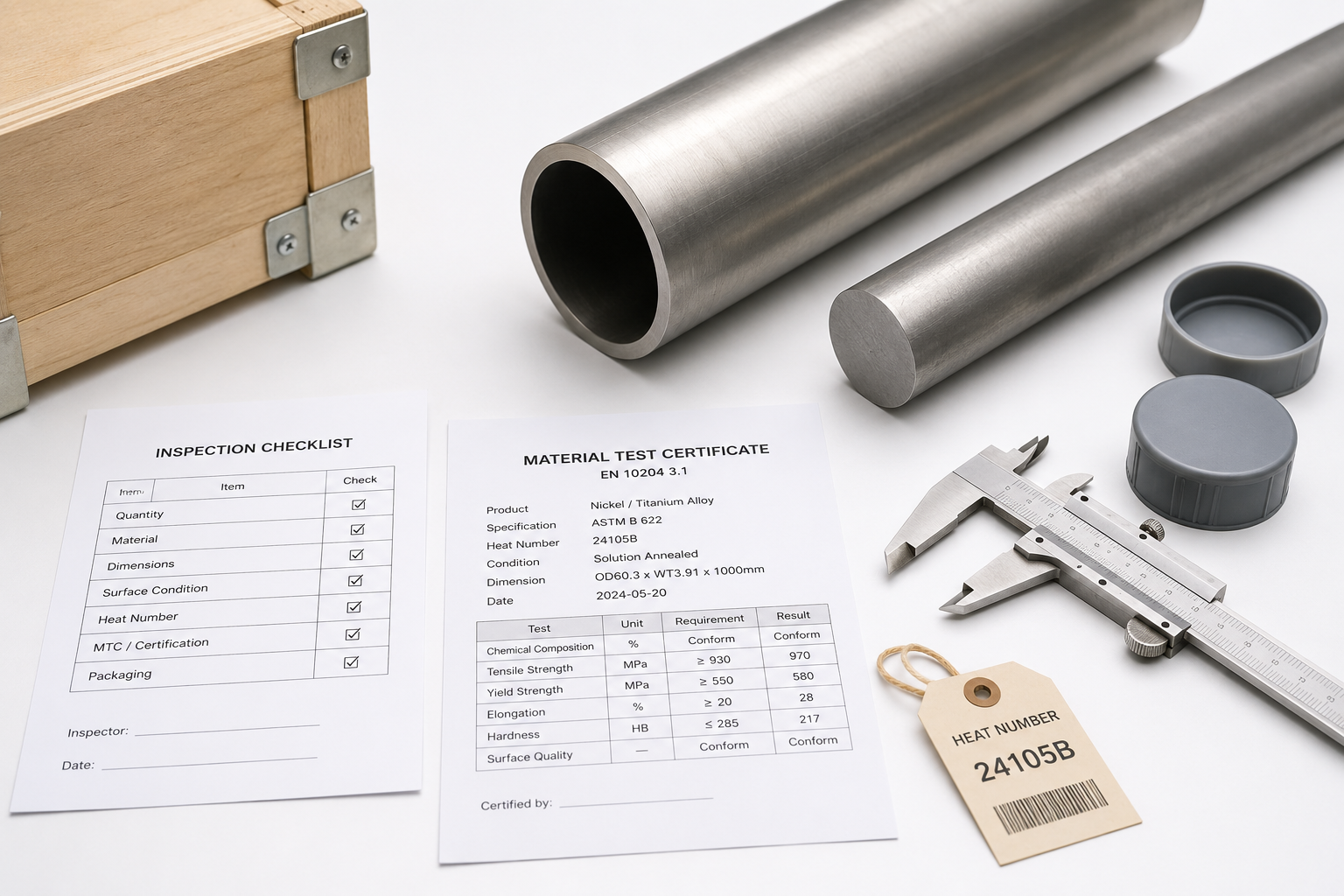
For industrial buyers, the key question is not only “What nickel alloy grade do I need?” A better question is: What heat treatment condition does this nickel alloy need for my fabrication and service environment?
This guide explains what annealed, solution treated, and aged mean in nickel alloy purchasing, and what buyers should confirm before placing an order.
Quick Answer: What Do Annealed, Solution Treated and Aged Mean?
Annealed, solution treated, and aged describe different ways of using heat to change or control nickel alloy properties.
| Heat Treatment Term | General Purpose | Typical Buyer Concern |
|---|---|---|
| Annealed | Softens material, improves ductility, reduces cold-work effects, supports forming and fabrication. | Will the material bend, form, machine or fabricate without cracking or excessive stress? |
| Solution treated / solution annealed | Dissolves certain phases or precipitates into a solid solution and prepares the alloy for corrosion performance or later aging. | Is the alloy in the correct condition for corrosion resistance, high-temperature service, or later age hardening? |
| Aged / precipitation hardened | Forms fine precipitates that increase strength and hardness in precipitation-hardenable alloys. | Does the material need high strength, hardness, creep resistance or high-temperature mechanical performance? |
| Stress relieved | Reduces residual stress without fully softening or changing the entire microstructure. | Is distortion, residual stress or fabrication stability a concern? |
| Stabilized | Used in some alloys to improve structural stability or reduce harmful phase effects. | Is the material exposed to a temperature range where stability matters? |
ASM Digital Library describes heat treatment of wrought nickel alloys, including solid-solution and precipitation-hardening alloy families. Source: ASM — Heat Treatment of Wrought Nickel Alloys
ASM also lists nickel alloy heat treatment processes such as homogenization, annealing, solution annealing, solution treating, stabilization treatment, age hardening, stress relieving, and stress equalizing. Source: ASM — Heat Treatment Metallurgy of Nickel-Base Alloys
Buyer Takeaway
Do not treat heat treatment terms as interchangeable. The correct condition depends on the alloy and the application.
Why Does Heat Treatment Matter in Nickel Alloy Purchasing?
Nickel alloys are selected for demanding applications such as chemical processing, marine engineering, oil and gas, aerospace, power generation, heat exchangers, high-temperature equipment, and corrosion-resistant systems.
However, the same alloy grade can behave differently depending on its heat treatment condition.
For example:
- Alloy 625 bar may be supplied in annealed or solution annealed condition depending on service temperature and creep/rupture requirements.
- Alloy 718 usually requires solution treatment and aging to achieve high strength.
- Solid-solution nickel alloys may not be age hardenable in the same way as precipitation-hardening alloys.
- Some applications prioritize ductility and forming, while others prioritize strength and high-temperature stability.
Heat Treatment Can Affect
| Property | Why Buyers Should Care |
|---|---|
| Strength | Important for pressure, load-bearing, aerospace, fasteners, springs and high-stress components. |
| Ductility | Important for bending, forming, drawing, flaring and fabrication. |
| Hardness | Important for wear, machining behavior, forming difficulty and inspection acceptance. |
| Corrosion resistance | Important for chemical, marine, acidic, chloride-containing and high-temperature environments. |
| Creep resistance | Important for sustained high-temperature load. |
| Dimensional stability | Important for machining, welding, heat exposure and final assembly. |
| Weldability | Heat treatment condition can affect cracking sensitivity, HAZ behavior and post-weld requirements. |
| Machining behavior | Hardness and work hardening behavior affect tool wear and surface finish. |
Buyer Takeaway
The material grade tells you the alloy family. The heat treatment condition tells you how that alloy has been prepared to perform.
What Does “Annealed” Mean for Nickel Alloys?
Annealing is commonly used to soften metal, reduce the effects of cold work, restore ductility, and make the material easier to form or fabricate. For nickel alloys, annealing may be applied after cold working, drawing, rolling, bending, or other deformation processes.
What Annealing Usually Does
| Effect | Buyer Meaning |
|---|---|
| Increases ductility | Helps bending, forming, flaring and fabrication. |
| Reduces hardness | Material may be easier to form, but machining behavior still depends on alloy. |
| Reduces cold-work effects | Helps restore a more workable condition after drawing or rolling. |
| Improves formability | Useful when the buyer needs bending, expansion, forming or deep drawing. |
| May reduce residual stress | Can help reduce distortion or cracking risk in later processing. |
| Changes mechanical properties | Strength may decrease compared with cold-worked condition. |
Important Caution
Annealed does not automatically mean “best” for every application. It often improves ductility and formability, but it may reduce strength compared with cold-worked or aged conditions. For pressure, high-strength, or high-temperature applications, annealed material may not always be the correct final condition.
Buyer Questions for Annealed Nickel Alloys
| Question | Why It Matters |
|---|---|
| Is the material annealed or cold worked? | Affects strength, hardness and formability. |
| Is annealed condition suitable for my fabrication process? | Important for bending, forming, expansion or machining. |
| What hardness range is required? | Confirms whether the material is too hard or too soft for the process. |
| Is a mechanical test report available? | Verifies actual tensile strength, yield strength and elongation. |
| Does the standard specify annealed condition? | Avoids mismatch between order, standard and application. |
| Will the material be heat treated again after fabrication? | Later processing may change final properties. |
Example
If a buyer needs nickel alloy tube or bar for bending, forming, or machining before final assembly, annealed condition may be preferred because it offers better ductility. But if the final part requires high strength at elevated temperature, annealed condition alone may not be enough.
Buyer Takeaway
Annealed condition is usually selected when fabrication and ductility are important. Buyers should still confirm strength, hardness, elongation, standard and final service conditions.
What Does “Solution Treated” or “Solution Annealed” Mean?
Solution treatment, also called solution annealing in many contexts, involves heating the alloy to a high temperature so that certain alloying elements or precipitates dissolve into the matrix, followed by controlled rapid cooling to retain the desired structure.
The exact temperature, holding time and cooling method depend on the alloy grade, product form and standard.
Why Solution Treatment Matters
| Purpose | Buyer Meaning |
|---|---|
| Dissolves unwanted or controlled phases | Helps create a more uniform metallurgical condition. |
| Improves ductility in many alloys | May prepare material for further forming or aging. |
| Supports corrosion performance | Helps avoid harmful precipitation or segregation effects in some alloys. |
| Prepares for aging | In precipitation-hardenable alloys, solution treatment may be required before aging. |
| Improves high-temperature service condition | Some alloys require solution annealed condition for creep or rupture resistance. |
| Creates a specified standard condition | Important for ASTM/ASME/AMS/customer drawing compliance. |
Example: Alloy 625
ASTM B446 covers nickel-chromium-molybdenum-columbium alloy rod and bar, including UNS N06625. It identifies Grade 2 as solution annealed and notes that this condition is normally used above 1100°F / 593°C where resistance to creep and rupture is required. Source: ASTM B446
Special Metals also notes that for INCONEL alloy 625, either annealed or solution-treated material gives best service above 1200°F, and solution-treated condition is recommended when optimum resistance to creep or rupture is required. Source: Special Metals — INCONEL Alloy 625
Important Caution
Solution treated does not always mean the material has the highest strength. In many cases, solution treated condition is relatively ductile and may be used as a final condition for corrosion/high-temperature service or as an intermediate condition before aging.
Buyer Questions for Solution Treated Nickel Alloys
| Question | Why It Matters |
|---|---|
| Is solution treatment required by the standard? | Some standards or grades specify solution annealed condition. |
| Is this the final condition or a pre-aging condition? | Important for precipitation-hardenable alloys. |
| What service temperature is expected? | High-temperature service may require a specific condition. |
| Is corrosion resistance the main concern? | Solution treatment may support corrosion performance in some alloys. |
| Are heat treatment records available? | Temperature, holding time and cooling method may be required for critical projects. |
| Is hardness or mechanical testing required after heat treatment? | Confirms the actual condition supplied. |
Buyer Takeaway
Solution treated condition is often selected for corrosion performance, ductility, high-temperature service, or preparation for aging. Buyers should confirm whether it is the final required condition or part of a heat treatment sequence.
What Does “Aged” or “Precipitation Hardened” Mean?
Aging, also known as precipitation hardening or age hardening, is used for precipitation-hardenable nickel alloys. After solution treatment, the alloy is reheated to a controlled temperature for a defined time so that fine precipitates form in the matrix.
These precipitates can strengthen the alloy by making dislocation movement more difficult. The result is usually higher yield strength, tensile strength and hardness, but ductility and toughness trade-offs must be checked.
What Aging Usually Does
| Effect | Buyer Meaning |
|---|---|
| Increases strength | Important for fasteners, springs, aerospace parts, oil and gas tools and high-stress parts. |
| Increases hardness | May improve load capacity but can make machining or forming more difficult. |
| Improves creep resistance in some alloys | Important for high-temperature sustained-load service. |
| Reduces formability compared with softer conditions | Forming should often be done before aging. |
| Requires controlled heat treatment | Temperature and time strongly affect final properties. |
| Can cause over-aging if misapplied | Excessive time or temperature may reduce desired strength. |
Example: Alloy 718
INCONEL alloy 718 is a precipitation-hardenable nickel-chromium alloy. Special Metals lists solution annealing followed by precipitation hardening as common heat treatments for Alloy 718. Source: Special Metals — INCONEL Alloy 718
Cambridge University material on nickel-based superalloys explains that after solution treatment, nickel-based superalloys are often heat treated at different temperatures in the γ/γ′ phase field, producing precipitates that affect properties. Source: University of Cambridge — Nickel Based Superalloys
ASTM B637 covers hot- and cold-worked precipitation-hardenable nickel alloy rod, bar, forgings and forging stock for high-temperature service. Source: ASTM B637
Important Caution
Not all nickel alloys are precipitation hardenable. For example, Alloy 625 is primarily a solid-solution strengthened alloy, while Alloy 718 is commonly supplied in solution treated and aged condition for high strength. Buyers should not assume that every nickel alloy should be aged.
Buyer Questions for Aged Nickel Alloys
| Question | Why It Matters |
|---|---|
| Is the alloy precipitation hardenable? | Not all nickel alloys respond to aging. |
| Is the material solution treated before aging? | Often required for controlled precipitation response. |
| What aging temperature and time are required? | Final strength depends on the aging cycle. |
| What mechanical properties are required? | Yield strength, tensile strength, hardness and elongation should be verified. |
| Will the material be machined before or after aging? | Aged material is harder and may be more difficult to machine. |
| Will the part be formed or bent? | Forming is usually easier before aging. |
| Is creep resistance required? | High-temperature service may need specific aged condition. |
Buyer Takeaway
Aged condition is selected when high strength, hardness or high-temperature performance is required. Buyers should confirm alloy grade, standard, aging condition and final mechanical properties.
Are Annealed, Solution Treated and Aged Always a Sequence?
Not always.
Sometimes these terms describe separate final delivery conditions. In other cases, they are part of a sequence.
Possible Scenarios
| Scenario | Example |
|---|---|
| Annealed as final condition | Material supplied soft and ductile for forming, bending or machining. |
| Solution treated as final condition | Material supplied for corrosion or high-temperature service without aging. |
| Solution treated before aging | Precipitation-hardenable alloys such as Alloy 718. |
| Aged as final condition | Material supplied high-strength after solution treatment and aging. |
| Cold worked + annealed | Tube or bar processed by cold work, then annealed to restore ductility. |
| Cold worked + solution annealed | Material processed and then solution treated to meet standard condition. |
| Customer-specific heat treatment | Aerospace, oil and gas, pressure equipment or drawing-controlled projects. |
Buyer Takeaway
Do not assume the heat treatment sequence. Ask whether the stated condition is the final delivery condition or an intermediate processing step.
How Do Heat Treatment Conditions Affect Common Nickel Alloys?
Different nickel alloys respond differently to heat treatment.
General Examples
| Alloy | Typical Strengthening / Heat Treatment Consideration |
|---|---|
| Alloy 625 / UNS N06625 | Primarily solid-solution strengthened. Often supplied annealed or solution annealed depending on product form and service temperature. |
| Alloy 718 / UNS N07718 | Precipitation hardenable. Often solution treated and aged for high strength. |
| Alloy 600 / UNS N06600 | Solid-solution strengthened Ni-Cr alloy. Often supplied annealed depending on product form and standard. |
| Alloy 825 / UNS N08825 | Stabilized Ni-Fe-Cr-Mo-Cu alloy; heat treatment condition depends on product standard and corrosion service. |
| Alloy C-276 / UNS N10276 | Ni-Mo-Cr corrosion-resistant alloy; usually selected for corrosion resistance, with solution annealed conditions common in many product forms. |
| Alloy 400 / UNS N04400 | Ni-Cu alloy; generally not precipitation hardenable like Alloy 718. |
| Nickel 200 / UNS N02200 | Commercially pure nickel; heat treatment is usually used for workability and stress/ductility control rather than precipitation hardening. |
Buyer Takeaway
The same words can mean different practical results in different alloys. Always connect heat treatment condition with the exact alloy grade and standard.
What Documents Should Buyers Request?
Documentation is important because heat treatment affects final properties. However, different documents prove different things.
Common Documents
| Document | What It Helps Verify |
|---|---|
| MTC / MTR | Heat number, chemical composition, mechanical properties, heat treatment condition, standard compliance. |
| EN 10204 3.1 certificate | Actual test results from the supplied material lot and order compliance. |
| Heat treatment record | Temperature, holding time, cooling method and furnace batch, if required. |
| Hardness report | Confirms hardness range, useful for annealed or aged material. |
| Mechanical test report | Tensile strength, yield strength, elongation and sometimes reduction of area. |
| Microstructure report | Useful for critical or failure-sensitive applications. |
| PMI report | Confirms alloy identity by positive material identification. |
| NDT report | Confirms UT, ET, hydrostatic or other inspection if required. |
| Third-party inspection report | Independent verification for critical projects. |
EN 10204 Type 3.1 inspection certificates provide actual test results from the material lot supplied and are endorsed by the manufacturer’s representative independent from manufacturing. Source: EN 10204 Type 3.1 Inspection Certificates
Buyer Takeaway
MTC/MTR is the starting point, but critical projects may also require heat treatment records, hardness reports, mechanical test reports, NDT reports or third-party inspection.
Common Mistakes When Buying Heat-Treated Nickel Alloys
1. Treating Heat Treatment Terms as Interchangeable
Annealed, solution treated and aged are not the same. Each condition affects properties differently.
2. Ordering Only by Alloy Name
“Nickel alloy” or “Inconel” is not enough. Buyers should specify exact grade, UNS number, standard and heat treatment condition.
3. Assuming Aged Material Is Always Better
Aged material may offer high strength, but it may be harder to machine, bend or form. It may not be suitable for every fabrication step.
4. Assuming Annealed Material Is Always Better for Machining
Annealed material may improve formability, but machining behavior depends on alloy, hardness, tool, speed, coolant and final tolerance.
5. Ignoring Service Temperature
High-temperature service may require different heat treatment conditions, especially for creep or rupture resistance.
6. Ignoring Corrosion Environment
Corrosion resistance depends on alloy grade, heat treatment, surface condition, welding condition and service media.
7. Not Confirming Standard Condition
ASTM, ASME, AMS, EN or customer drawings may specify a particular condition. Buyers should not rely only on supplier wording.
8. Not Requesting Mechanical Properties
Heat treatment should be verified by actual mechanical properties when required.
9. Confusing MTC With Complete Process Proof
MTC/MTR may list heat treatment condition and test results, but it may not include the full furnace cycle unless requested.
10. Not Sharing Final Application
The supplier cannot recommend the right condition without knowing fabrication method, service temperature, stress level and corrosion environment.
Buyer Checklist: What to Confirm Before Ordering
| RFQ Item | What to Provide or Ask |
|---|---|
| Material grade | Alloy 625, Alloy 718, Alloy 600, Alloy 825, Alloy C-276, Alloy 400, Nickel 200, etc. |
| UNS number | N06625, N07718, N06600, N08825, N10276, N04400, N02200, etc. |
| Product form | Tube, pipe, bar, rod, forging, wire, plate or custom part. |
| Standard | ASTM B446, ASTM B637, ASTM B444, ASTM B622, ASME, AMS, EN or customer drawing. |
| Heat treatment condition | Annealed, solution annealed, solution treated, aged, precipitation hardened, stress relieved. |
| Final application | Chemical processing, aerospace, marine, oil and gas, heat exchanger, power generation, medical equipment, high-temperature service. |
| Fabrication process | Bending, forming, machining, welding, cold working, heat treatment after machining. |
| Service temperature | Especially important for creep, rupture and aging stability. |
| Corrosion media | Chloride, acid, caustic, seawater, H₂S, oxidizing/reducing media. |
| Mechanical properties | Tensile strength, yield strength, elongation, hardness, creep/rupture if required. |
| Inspection documents | EN 10204 3.1 MTC/MTR, heat treatment record, hardness report, mechanical test report, NDT report. |
| Traceability | Heat number, batch number, marking, packing list and certificate consistency. |
| Third-party inspection | If required by project, end user or regulation. |
Example RFQ Message
We need Alloy 718 bars, UNS N07718, per ASTM B637. Required condition: solution treated and aged. Please confirm heat treatment condition, mechanical properties, hardness range, EN 10204 3.1 MTC, heat number traceability, heat treatment record availability, dimensional tolerance, surface condition, lead time, MOQ and export packing. The material will be used for high-strength machined components in elevated-temperature service.
For Alloy 625:
We need Alloy 625 rods, UNS N06625, per ASTM B446. Please confirm whether Grade 1 annealed or Grade 2 solution annealed is more suitable for our service temperature and application. Provide EN 10204 3.1 MTC, mechanical properties, heat treatment condition, hardness if available, dimensional tolerance and delivery time.
FAQ: Annealed, Solution Treated and Aged Nickel Alloys
1. What does annealed mean in nickel alloys?
Annealed generally means the material has been heat treated to reduce cold-work effects, improve ductility and support forming or fabrication.
2. What does solution treated mean?
Solution treated or solution annealed means the alloy has been heated to dissolve certain phases into the matrix and then cooled to retain the desired structure. It may be used as a final condition or before aging.
3. What does aged mean?
Aged means the alloy has been heat treated to form fine precipitates that strengthen precipitation-hardenable alloys. It is also called precipitation hardened or age hardened.
4. Are all nickel alloys age hardenable?
No. Some nickel alloys are solid-solution strengthened and are not age hardenable in the same way as Alloy 718.
5. Is annealed material always softer?
Usually annealed material is softer and more ductile than cold-worked or aged material, but exact properties depend on alloy grade and standard.
6. Is solution treated material stronger than aged material?
Not usually for precipitation-hardenable alloys. Solution treated material is often more ductile, while aged material usually has higher strength and hardness.
7. Which condition is better for machining?
It depends on alloy, hardness, tool, machine rigidity and final tolerance. Annealed material may be easier to form, while aged material may be harder and require different machining strategy.
8. Which condition is better for high-temperature service?
It depends on alloy and service temperature. For example, Alloy 625 may require annealed or solution-treated condition depending on temperature and creep/rupture needs, while Alloy 718 often uses solution treatment plus aging for high strength.
9. Does MTC show heat treatment condition?
Often yes, but not always with full furnace cycle details. For critical projects, buyers may request heat treatment records, hardness reports, mechanical test reports or third-party inspection.
10. What should buyers include in an RFQ?
Buyers should include alloy grade, UNS number, product form, standard, heat treatment condition, size, tolerance, mechanical property requirement, application, service temperature, corrosion environment, certificate requirement and inspection requirement.
Conclusion
Annealed, solution treated and aged are not just technical words on a quotation. They describe heat treatment conditions that can strongly influence nickel alloy performance.
Annealed condition is often selected for ductility and fabrication. Solution treated condition may support corrosion performance, high-temperature service or preparation for aging. Aged condition is used for precipitation-hardenable alloys when high strength, hardness or creep resistance is required.
For buyers, the safest approach is to connect the heat treatment condition with the real application. Before ordering nickel alloy tubes, bars or custom parts, confirm the alloy grade, UNS number, product standard, heat treatment condition, mechanical properties, service environment, fabrication process, MTC/MTR, heat number traceability and inspection requirements.
Emily PIPE supplies nickel alloy tubes, nickel alloy bars, titanium alloy tubes and titanium alloy bars for global industrial applications. If you are preparing a nickel alloy project and need help confirming annealed, solution treated or aged condition, you can send your material grade, UNS number, size, standard, heat treatment requirement, application environment and inspection requirement for technical review and quotation.