
How to Choose Nickel and Titanium Alloys for Pump Shafts and Valve Stems?
Choosing the right alloy for pump shafts and valve stems is not a simple material comparison. A wrong material choice may lead to corrosion, galling, cavitation damage, leakage, vibration, shaft failure, valve sticking, downtime, maintenance cost, or shorter equipment service life.
Selecting the right nickel or titanium alloy for pump shafts and valve stems requires a detailed review of the actual operating environment, including fluid type, temperature, pressure, flow velocity, chloride level, H₂S exposure, abrasive particles, cyclic load, cavitation risk, wear condition, surface contact, applicable standards, testing requirements, and material traceability. Material selection should be based on performance goals and working conditions, not only generic data sheets or alloy names.
From my perspective as a manufacturer of nickel alloy bars, nickel alloy tubes, titanium alloy bars, and titanium alloy tubes, I often see customers ask a simple question:
> Which alloy is best for pump shafts or valve stems?
The better question is:
> What fluid, load, temperature, pressure, wear condition, and corrosion mechanism will this pump shaft or valve stem face?
There is no universal “best” alloy. A material that works well for a seawater pump shaft may not be suitable for a sour gas valve stem. A titanium alloy that performs well in many chloride environments may not be suitable in certain reducing acids or severe sliding wear conditions. A nickel alloy that handles high temperature and corrosion may be unnecessary for mild service.
The goal is not to choose the most expensive alloy. The goal is to choose the material that offers the best balance of strength, corrosion resistance, wear resistance, manufacturability, traceability, service life, and total cost.
Quick Selection Guide for Pump Shaft and Valve Stem Alloys
Before going deep into technical details, this quick guide can help buyers understand which alloy family should be reviewed first.
| Application Scenario | First Alloy Family to Review | Key Selection Concern |
|---|---|---|
| Seawater pump shaft | Monel, Inconel, titanium, duplex/super duplex stainless | Chloride corrosion, corrosion fatigue, cavitation, flow velocity |
| Marine centrifugal pump shaft | Monel K-500, Inconel 625, titanium grade depending on design | Strength, seawater corrosion, shaft fatigue |
| Chemical pump shaft | Hastelloy-type alloy, Inconel 625, Alloy 825, titanium depending on fluid | Acid type, pH, temperature, impurities |
| Valve stem in corrosive fluid | Nickel alloy, titanium alloy, high-alloy stainless, coating/hardfacing if required | Corrosion, galling, packing friction |
| High-temperature valve stem | Inconel 600, Inconel 601, Inconel 625, Inconel 718 | Oxidation, creep, strength retention |
| Abrasive slurry service | Wear-resistant alloy, sleeve, coating, or hardfacing first | Abrasion, impact, erosion, surface damage |
| Sour gas / H₂S service | NACE/ISO-compliant material selection | Sulfide stress cracking, hardness, H₂S partial pressure |
| Lightweight corrosion-resistant component | Titanium alloy | Strength-to-weight ratio, chloride resistance, wear/galling risk |
This table is only an initial guide. Final material selection should always be based on actual service data, project standards, inspection requirements, and risk level.
Why Is There No Universal Best Alloy for Pump Shafts and Valve Stems?
Many buyers search for the “best alloy,” but pump shafts and valve stems do not fail for one single reason. They may fail because of corrosion, corrosion fatigue, cavitation, galling, wear, poor machining, wrong heat treatment, wrong surface finish, or incomplete material verification.
There is no universal best nickel or titanium alloy for every pump shaft or valve stem. The right alloy depends on fluid chemistry, temperature, pressure, mechanical load, vibration, flow velocity, abrasive particles, sliding contact, corrosion mechanism, applicable standards, and required documentation.
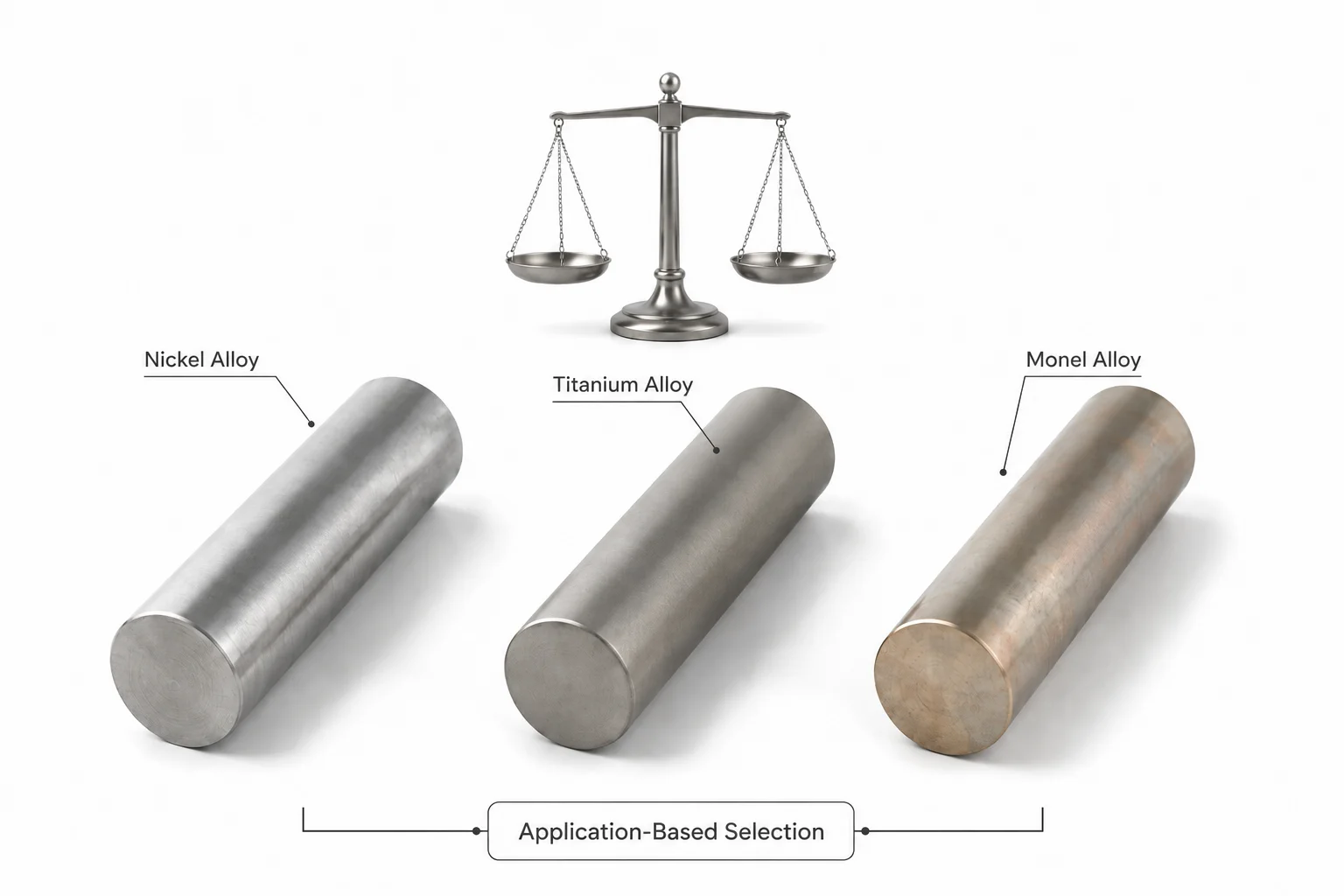
A pump shaft may rotate under torque, bending load, vibration, and corrosion exposure. A valve stem may face sliding contact, packing friction, pressure, corrosion, galling, and temperature changes.
For example:
- A seawater pump shaft may need resistance to chloride corrosion, crevice corrosion, corrosion fatigue, and cavitation.
- A valve stem in chemical service may need resistance to specific acids, packing wear, galling, and stress corrosion cracking.
- A high-temperature valve stem may need oxidation resistance, creep resistance, and dimensional stability.
- A slurry pump shaft or shaft sleeve may need wear and abrasion resistance as much as corrosion resistance.
- A sour gas valve component may require resistance to sulfide stress cracking and compliance with NACE/ISO sour service requirements.
This is why alloy selection should start from the application scenario, not from the alloy name.
How Do Material Parameters Affect Real-World Performance?
Are you confused by material data sheets? Tensile strength, yield strength, hardness, and elongation are important, but they do not fully explain how a pump shaft or valve stem will perform in service.
Material parameters such as tensile strength and hardness are only starting points. Real-world performance is shaped by corrosion fatigue, cavitation, galling, pitting, crevice corrosion, abrasive wear, high temperature, surface finish, and cyclic loading. Corrosion fatigue is the mechanical degradation of a material under the combined action of corrosion and cyclic loading, making it highly relevant for rotating shafts and vibrating components in corrosive environments.
When customers ask for nickel or titanium bars, they often start with basic mechanical properties:
- tensile strength
- yield strength
- elongation
- hardness
- impact toughness
- heat treatment condition
These values matter, but they are not enough. For pump shafts and valve stems, the operating environment may be more important than one static strength value.
A high tensile strength does not guarantee long service life if the alloy is vulnerable to corrosion fatigue in the process fluid. A hard material may resist indentation but may still gall, crack, or lose toughness. A corrosion-resistant alloy may still suffer wear if abrasive particles or poor sliding conditions are present.
Spec Sheet vs Real-World Performance
| Material Parameter | Spec Sheet Meaning | Real-World Meaning for Pump Shafts and Valve Stems |
|---|---|---|
| Tensile Strength | Maximum stress before fracture | Helps resist static overload, but does not predict fatigue life alone |
| Yield Strength | Stress where permanent deformation begins | Helps resist bending, twisting, and dimensional change |
| Hardness | Resistance to indentation | May support wear resistance, but high hardness may reduce toughness |
| Corrosion Resistance | General resistance to chemical attack | Must be checked against the actual fluid, pH, chloride, acid, alkali, H₂S, and temperature |
| Fatigue Strength | Resistance to repeated stress cycles | Critical for rotating shafts, vibration, pressure cycling, and cyclic loads |
| Corrosion Fatigue Resistance | Resistance to combined corrosion and cyclic stress | Important for shafts in seawater, chemical fluids, marine systems, and oil and gas service |
| Galling Resistance | Resistance to adhesive wear under sliding contact | Important for valve stems, threaded sections, packing areas, and sliding metal contact |
| Cavitation Resistance | Resistance to surface damage from collapsing bubbles | Important for pumps, impellers, control valves, and high-velocity liquid systems |
| Creep Resistance | Resistance to deformation under long-term stress at high temperature | Important for high-temperature pump and valve applications |
| Impact Toughness | Ability to absorb sudden load before fracture | Important for shock loading, low-temperature service, and safety-critical components |
A data sheet should be treated as a starting point. The real question is how these properties work together under the actual fluid, load, temperature, surface contact, and inspection requirements.
Why Are Cavitation, Wear, and Galling Important?
Pump shafts and valve stems are not static laboratory samples. They operate inside mechanical systems where fluid flow, pressure changes, sliding surfaces, and repeated movement can create damage mechanisms.
Cavitation occurs when vapor-filled cavities form and collapse in a liquid. In pumps and valves, cavitation can cause vibration, surface damage, premature wear, seal problems, bearing problems, and reduced performance.
Cavitation can damage pump components even when the alloy has good chemical resistance. In pumps, cavitation may cause noise, vibration, pitting, surface fatigue, and premature component wear. Centrifugal pumps may face problems such as cavitation, impeller wear, corrosion caused by fluid properties, overheating, leakage along the rotating shaft, and other issues.
Valve stems may face a different problem: galling. Galling is adhesive wear caused by microscopic transfer of material between metallic surfaces during sliding contact. It is common where metal surfaces slide against each other, especially with poor lubrication.
This means valve stem material selection should review not only corrosion resistance, but also:
- sliding contact
- packing friction
- lubrication condition
- hardness difference between contact parts
- surface finish
- coating or hardfacing requirement
- operating temperature
- opening and closing frequency
In severe valve applications, surface engineering, hardfacing, or coating may be needed in addition to selecting the correct base alloy.
How Do Pump Shaft Applications Guide Alloy Choice?
A pump shaft must transmit torque and maintain alignment while resisting bending, fatigue, corrosion, and sometimes cavitation-related vibration. The right alloy depends heavily on fluid and load conditions.
Common Pump Shaft Selection Factors
| Factor | Why It Matters |
|---|---|
| Fluid Chemistry | Determines corrosion, pitting, crevice corrosion, or SCC risk |
| Chloride Level | Important for seawater, brine, and many chemical fluids |
| Flow Velocity | May affect erosion, cavitation, and corrosion behavior |
| Abrasive Solids | May require sleeve, coating, or wear-resistant design |
| Torque and Bending Load | Determines strength, stiffness, and fatigue requirements |
| Vibration | Increases fatigue and bearing/seal risk |
| Temperature | Affects mechanical strength, corrosion rate, and oxidation |
| NPSH / Cavitation Risk | Important for pump reliability and surface durability |
| Shaft Sleeve Design | May protect the shaft from wear, packing, or seal contact |
Alloy Families to Review for Pump Shafts
| Pump Shaft Scenario | Alloy Families to Review | Notes |
|---|---|---|
| Seawater pump shaft | Monel, Inconel, titanium, duplex/super duplex stainless | Review chloride corrosion, cavitation, and galvanic corrosion |
| Chemical pump shaft | Hastelloy-type alloys, Inconel 625, Alloy 825, titanium depending on fluid | Review exact chemical composition and temperature |
| High-temperature pump shaft | Inconel 600/601/625/718 | Review oxidation, creep, fatigue, and heat treatment |
| Slurry pump shaft/sleeve | Wear-resistant alloy, sleeve, coating, hardfacing | Abrasion may dominate corrosion resistance |
| Sour service pump component | NACE/ISO-compliant alloy selection | Review H₂S, chloride, pH, hardness, and temperature |
How Do Valve Stem Applications Guide Alloy Choice?
A valve stem must transmit motion, maintain sealing function, resist corrosion, and move smoothly through packing or guiding surfaces. Valve stems often fail through galling, corrosion, bending, packing wear, or seizure.
Common Valve Stem Selection Factors
| Factor | Why It Matters |
|---|---|
| Fluid Media | Determines corrosion compatibility |
| Packing Friction | Affects stem wear, galling, and operating torque |
| Sliding Contact | Makes galling resistance important |
| Temperature | Affects oxidation, creep, and coating performance |
| Pressure | Affects sealing load and mechanical stress |
| Operation Frequency | Frequent cycling increases wear and fatigue |
| Surface Finish | Important for sealing, friction, and galling control |
| Coating / Hardfacing | May be required for severe sliding or wear conditions |
| Sour Service | May require NACE/ISO material compliance |
Alloy Families to Review for Valve Stems
| Valve Stem Scenario | Alloy Families to Review | Notes |
|---|---|---|
| Corrosive chemical valve | Inconel, Hastelloy-type alloy, Alloy 825, titanium depending on media | Exact fluid chemistry must be reviewed |
| High-temperature valve | Inconel 600/601/625/718 | Review oxidation, creep, and galling risk |
| Marine valve stem | Monel, Inconel, titanium, high-alloy stainless | Review chloride corrosion and sliding wear |
| Sour gas valve | NACE/ISO-compliant nickel alloy or qualified material | Review hardness, heat treatment, and H₂S conditions |
| Severe sliding/galling service | Base alloy + coating/hardfacing | Material alone may not solve galling |
How Should You Think About Nickel Alloys?
Nickel alloys are often selected when corrosion resistance, high-temperature stability, strength, and reliability are required together.
Inconel alloys are nickel-chromium superalloys often used in extreme environments involving high temperature, pressure, mechanical load, oxidation, or corrosion. Inconel 625 is known for high strength, resistance to elevated temperatures, corrosion resistance, and oxidation resistance; its applications include chemical processing, marine, nuclear, pumps, valves, and high-pressure equipment. Inconel 718 is designed for fatigue and creep resistance at temperatures up to about 700°C.
Nickel alloys may be reviewed for:
- high-temperature pump or valve components
- chemical processing pumps
- corrosive valve stems
- marine shafts
- sour service components
- high-pressure equipment
- severe chloride environments
- mixed acid or reducing acid service
However, nickel alloy is not one single material. Inconel 625, Inconel 718, Monel 400, Monel K-500, Hastelloy C276, Hastelloy C22, Alloy 825, and Alloy 20 all behave differently. The UNS number and standard must be confirmed.
For nickel alloy bars and forgings, ASTM B637 covers precipitation-hardening and cold-worked nickel alloy rod, bar, forgings, and forging stock for moderate or high-temperature service. The ASTM abstract states that chemical analysis, heat treatment, tension testing, hardness testing, and stress-rupture testing are included.
Nickel Alloy Selection Reminder
Nickel alloys can be strong candidates for pump shafts and valve stems, but the exact grade must match the specific fluid, temperature, stress, and corrosion mechanism.
Do not specify only “nickel alloy bar.” Confirm:
- alloy grade
- UNS number
- ASTM / ASME / EN / AMS standard
- heat treatment condition
- mechanical properties
- hardness requirement
- corrosion environment
- testing and inspection requirements
How Should You Think About Monel for Pump Shafts and Valves?
Monel alloys are nickel-copper alloys that may be useful in selected marine, seawater, alkali, and reducing environments.
Monel is a group of nickel-copper alloys. Monel 400 is used in marine engineering, chemical and hydrocarbon processing, heat exchangers, valves, and pumps. Monel K-500 combines the corrosion resistance of Monel 400 with greater strength and hardness through aluminum and titanium additions.
Monel may be reviewed for:
- marine pump shafts
- seawater valves
- pump shafts and impellers
- selected reducing environments
- alkali or caustic applications
- hydrocarbon processing components
However, Monel is not universal. Monel K-500 may need careful review in some stress corrosion environments, especially depending on heat treatment, stress level, and service condition. Slow-moving or stagnant seawater may also create fouling and localized corrosion concerns. Therefore, service details must be confirmed before selection.
How Should You Think About Titanium Alloys?
Titanium alloys may be considered when low density, corrosion resistance, and strength-to-weight ratio are important.
Titanium forms a thin protective passivation layer that gives strong corrosion resistance in many oxidizing environments. Ti-6Al-4V is an alpha-beta titanium alloy known for high specific strength, low density, and excellent corrosion resistance.
Titanium may be reviewed for:
- seawater or brine service
- oxidizing chloride environments
- lightweight rotating components
- corrosion-resistant valve components
- high-purity applications
- selected chemical processing applications
However, titanium also has limitations. Titanium may be vulnerable in some reducing acids, fluoride-containing environments, or severe wear/galling conditions. For sliding valve stems, galling and surface finish must be reviewed carefully. If abrasion or severe sliding contact is present, titanium may require surface treatment, coating, or another material solution.
For titanium bars and billets, ASTM B348/B348M covers titanium and titanium alloy bars and billets. The ASTM abstract states that covered grades should conform to chemical composition requirements and that tensile test specimens are machined and tested for tensile properties.
Titanium Selection Reminder
Titanium should not be selected only because it is lightweight or corrosion-resistant. Buyers should confirm:
- exact fluid
- operating temperature
- acid type
- fluoride risk
- sliding contact
- wear condition
- galling risk
- surface finish requirement
- applicable ASTM/ASME/EN/ISO standard
What About Sour Gas and H₂S Service?
If the pump or valve is used in oil and gas service with H₂S, material selection must be handled carefully.
Sulfide stress cracking is a form of hydrogen embrittlement associated with hydrogen sulfide. It has special importance in the oil and gas industry, and equipment in H₂S environments may need sour service material selection according to NACE MR0175 / ISO 15156 or NACE MR0103 / ISO 17945 where applicable.
For sour service, buyers should confirm:
- H₂S partial pressure
- chloride concentration
- pH
- temperature
- pressure
- hardness limits
- heat treatment condition
- applicable NACE / ISO standard
- whether the material is acceptable for the exact environment
Not every nickel alloy or titanium alloy is automatically suitable for sour service. Material approval depends on the standard, material condition, hardness, environment, and project requirements.
How Can You Verify Alloy Quality and Supplier Claims?
Are you taking vendor claims at face value? Marketing claims are not enough for critical pump shaft or valve stem materials.
Verifying alloy quality requires Material Test Reports, heat-number traceability, applicable standards, inspection reports, and quality management review. A Mill Test Report certifies a metal product’s chemical and physical properties and states compliance with applicable standards. A heat number links the metal product to a specific batch or heat, supporting traceability to composition, manufacturing process, and quality assurance records.
A useful MTR should normally include:
- material grade
- UNS number
- heat number
- chemical composition
- mechanical properties
- heat treatment condition
- product form
- size
- applicable standard
- test results
- manufacturer information
- inspection statement where required
The MTR should match the physical bar marking, label, packing list, purchase order, and inspection reports.
Key Verification Methods
| Verification Method | What to Check | Why It Matters |
|---|---|---|
| Material Test Report / MTC | Chemistry, mechanical properties, standard compliance | Confirms batch-level material data |
| Heat Number Traceability | Heat number on MTR, bar marking, packing list | Links delivered material to production records |
| Chemical Analysis / PMI | Alloy identity and composition | Helps avoid wrong material mix-up |
| Mechanical Testing | Tensile, yield, elongation, hardness, impact where required | Confirms mechanical property compliance |
| NDT | UT, ET, PT, MT depending on product and requirement | Helps detect internal or surface flaws |
| Surface Inspection | Cracks, dents, scratches, straightness, surface finish | Important for fatigue, sealing, packing, and machining |
| Third-Party Inspection | Independent witness or verification | Useful for high-risk or project-critical orders |
| Supplier Quality System | ISO 9001 or other applicable systems | Supports process control and continual improvement |
Ultrasonic testing is a non-destructive testing method based on ultrasonic wave propagation and is used to detect internal flaws or characterize materials. Eddy-current testing is another NDT method used to detect and characterize surface and subsurface flaws in conductive materials.
ISO 9001 is a globally recognized quality management standard that helps organizations establish, implement, maintain, and continually improve a quality management system. However, ISO 9001 does not replace product-level testing. For pump shafts and valve stems, buyers still need MTRs, heat number traceability, inspection reports, and project-specific acceptance criteria.
What Should Buyers Confirm Before Ordering Nickel or Titanium Bars?
A clear RFQ helps suppliers recommend the right alloy and avoid misunderstandings. If the buyer only says “pump shaft material” or “valve stem alloy,” the supplier may not have enough information.
Pump Shaft and Valve Stem RFQ Checklist
| Area | What to Confirm |
|---|---|
| Component | Pump shaft, shaft sleeve, impeller shaft, valve stem, valve trim, stem extension |
| Material Type | Nickel alloy, titanium alloy, Monel, Inconel, Hastelloy-type alloy, or material to be recommended |
| Grade / UNS Number | Example: UNS N04400, N05500, N06625, N07718, R50400, R56400 |
| Standard | ASTM, ASME, EN, ISO, AMS, NACE/ISO sour service standard if applicable |
| Bar Size | Diameter, length, tolerance, straightness |
| Condition | Annealed, solution treated, aged, cold worked, forged, ground, polished |
| Operating Fluid | Seawater, brine, acid, alkali, slurry, hydrocarbon, H₂S, steam, chemical mixture |
| Temperature and Pressure | Operating and design values |
| Load Type | Static load, torque, bending, cyclic load, vibration, impact |
| Wear Condition | Abrasive solids, packing friction, sliding contact, galling risk |
| Corrosion Concern | Pitting, crevice corrosion, SCC, SSC, corrosion fatigue, erosion-corrosion |
| Cavitation Risk | Pump NPSH, flow velocity, pressure drop, control valve throttling |
| Machining Requirement | Turning, grinding, threading, keyway, surface roughness |
| Testing | Chemical analysis, tensile test, hardness, UT, PT, PMI, corrosion test if required |
| Documents | MTR, heat number, inspection report, certificate of conformity, third-party inspection |
| Packaging | Anti-scratch protection, waterproof packing, wooden case, export packing |
| Delivery | Stock or new production, lead time, shipping method, destination port |
How Does Informed Alloy Selection Reduce Operational Risks?
Poor material selection for pump shafts and valve stems may create operational risks, including premature failure, leakage, downtime, maintenance cost, safety hazards, and environmental damage.
Informed alloy selection can reduce operational risk when it is combined with correct design, manufacturing, inspection, installation, operation, and maintenance. Buyers should evaluate not only purchase price, but also total cost of ownership, maintenance intervals, replacement cost, downtime risk, and safety consequences. Total cost of ownership includes direct and indirect costs across a product or service life cycle.
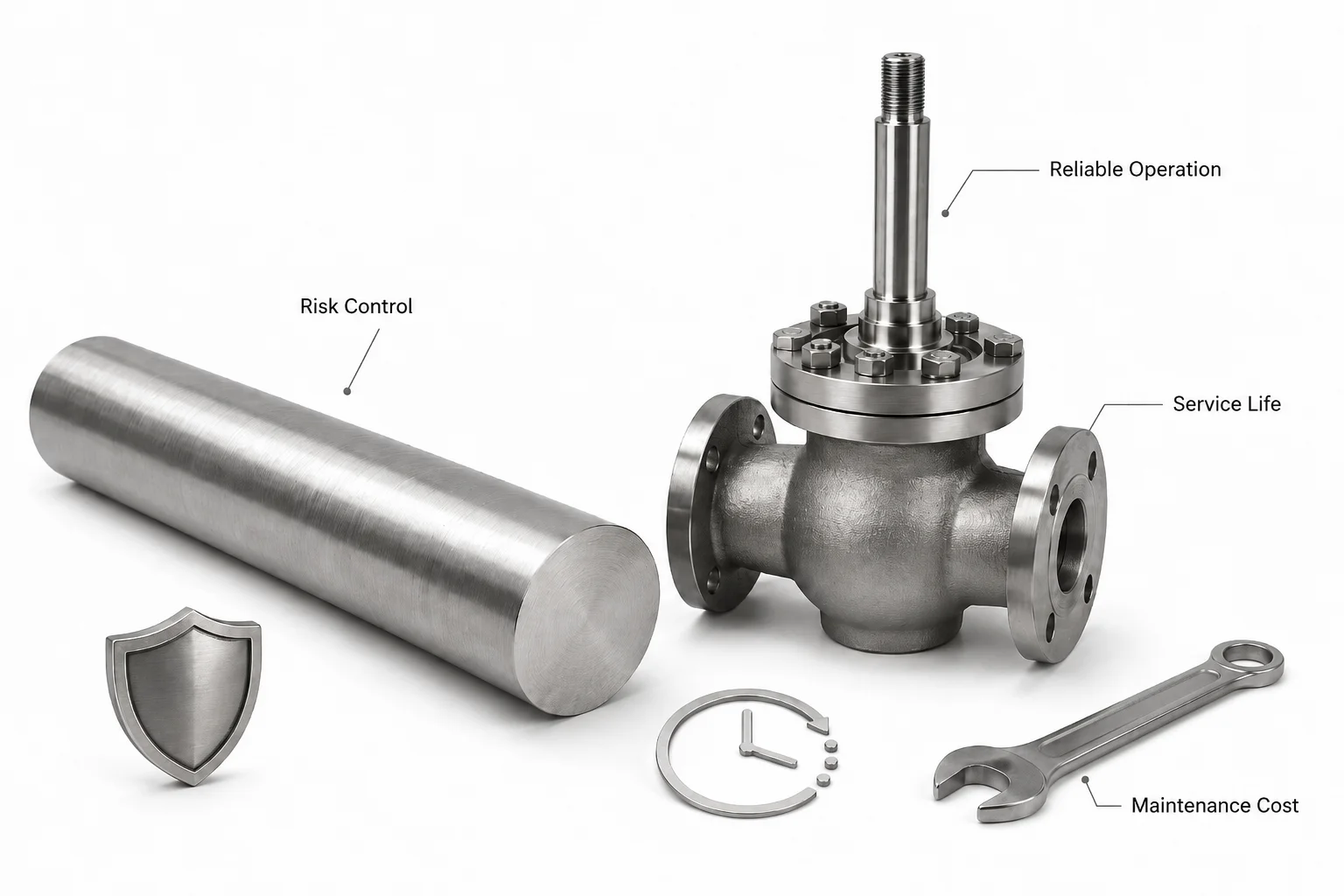
The initial material price is only one part of the decision. A cheaper material may meet basic strength requirements but fail early due to corrosion fatigue, galling, cavitation, or chemical attack. A more expensive alloy may reduce lifecycle risk if it is correctly matched to the service environment.
Risks Addressed by Informed Alloy Selection
| Operational Risk | Description | How Better Alloy Selection Helps |
|---|---|---|
| Premature Failure | Shaft or stem cracks, bends, seizes, or corrodes early | Match alloy to corrosion, fatigue, load, and temperature |
| High Maintenance Cost | Frequent repair, replacement, lubrication, or inspection | Select material with suitable wear and corrosion resistance |
| Downtime | Pump or valve failure stops production | Reduce unplanned outages through correct material and documentation |
| Leakage | Valve stem or pump sealing failure | Control surface finish, galling, corrosion, and dimensional stability |
| Safety Hazard | Failure in hazardous service creates personnel risk | Use verified materials and standards for critical service |
| Environmental Risk | Leakage of hazardous fluids | Confirm chemical compatibility and inspection requirements |
| Poor Efficiency | Cavitation, wear, or deformation reduces equipment performance | Review flow, NPSH, hardness, toughness, and surface durability |
TCO Factors to Consider
| Cost Factor | Why It Matters |
|---|---|
| Material Price | Visible cost in the quotation |
| Machining Cost | Nickel and titanium alloys may require controlled machining |
| Inspection Cost | Critical bars may require UT, PT, PMI, hardness, or third-party inspection |
| Replacement Cost | Failed components require new material, machining, and installation |
| Downtime Cost | Lost production may exceed material savings |
| Safety Cost | Failure in hazardous service can create serious consequences |
| Documentation Cost | MTR, traceability, third-party inspection, and compliance may be required |
| Lifecycle Reliability | Longer service life may justify higher initial material cost |
The goal is not to buy the most expensive alloy. The goal is to select the alloy that gives the best balance of performance, risk, cost, and reliability for the actual service conditions.
Practical Material Selection Examples
Example 1: Seawater Pump Shaft
A seawater pump shaft may face chlorides, oxygen, flow velocity, mechanical load, and possible cavitation. Monel K-500, Inconel 625, titanium grades, or duplex/super duplex stainless steel may be reviewed depending on design, load, speed, and corrosion risk.
Key questions:
- Is the seawater flowing or stagnant?
- Are abrasive particles present?
- Is cavitation expected?
- What is the shaft speed and torque?
- Is there risk of galvanic corrosion?
- What surface finish is required?
- Is a shaft sleeve needed?
Example 2: Chemical Valve Stem
A valve stem in chemical service may face packing friction, sliding contact, pressure, acids, alkalis, chlorides, and temperature changes. Nickel alloys or titanium alloys may be reviewed depending on the chemical media.
Key questions:
- What fluid contacts the stem?
- Is the service oxidizing or reducing?
- Is galling a concern?
- Is hardfacing or coating needed?
- Is the valve frequently operated?
- What leakage class or sealing requirement applies?
- What surface roughness is required?
Example 3: Sour Gas Valve Component
A sour gas valve component may face H₂S, chlorides, pressure, and stress. Material must be reviewed against sour service requirements.
Key questions:
- Does NACE MR0175 / ISO 15156 apply?
- What is the H₂S partial pressure?
- What is the chloride concentration?
- What is the maximum temperature?
- What hardness limit applies?
- Is the material heat treatment condition acceptable?
- Is third-party inspection required?
Example 4: High-Temperature Valve Stem
A high-temperature valve stem may face oxidation, creep, sliding contact, and packing wear. Inconel 600, Inconel 601, Inconel 625, or Inconel 718 may be reviewed depending on temperature, stress, and environment.
Key questions:
- What is the operating temperature?
- Is the atmosphere oxidizing or reducing?
- Is thermal cycling expected?
- Does the stem need creep resistance?
- Is galling resistance required?
- What heat treatment condition is required?
How Can Emily PIPE Support Pump Shaft and Valve Stem Buyers?
At Emily PIPE, we supply nickel alloy tubes, nickel alloy bars, titanium alloy tubes, and titanium alloy bars for demanding industrial applications. For pump shaft and valve stem projects, we can help customers review:
- alloy grade
- UNS number
- bar size and tolerance
- heat treatment condition
- surface finish
- operating fluid
- corrosion risk
- mechanical load
- applicable standard
- testing requirements
- MTR and traceability
- packing and delivery plan
We support standard and customized specifications according to drawings, technical requirements, and application environments.
Conclusion
Choosing the right nickel or titanium alloy for pump shafts and valve stems requires more than reading a data sheet. Buyers must understand the real operating environment, including fluid chemistry, temperature, pressure, flow, stress, vibration, wear, cavitation, galling, and corrosion mechanisms.
Nickel alloys may be strong candidates for high-temperature, severe chemical, marine, or high-strength applications. Titanium alloys may be useful where corrosion resistance, low density, and strength-to-weight ratio matter. Monel alloys may be reviewed for selected marine pump shafts and seawater valve components. But no alloy is universally best.
The safest approach is to define the working conditions clearly, verify supplier documentation, review applicable standards, and choose the material based on lifecycle risk—not only initial price.
If you are not sure which nickel or titanium alloy is suitable for your pump shaft or valve stem project, you can send us your fluid composition, temperature, pressure, shaft/stem size, drawing, standard, and testing requirements. Our team can help review material options and provide a quotation based on your actual operating conditions.