
How Alternative Alloy Grades Affect Welding, Machining and Final Acceptance
Alternative alloy grades can affect much more than the material price. For nickel alloy and titanium alloy tubes, bars, pipes, fittings or machined parts, a substitute grade may change welding behavior, machining difficulty, heat treatment requirements, inspection scope, certificate requirements, and final acceptance risk.
A lower-cost alternative may be acceptable if it meets the required application performance, product standard, fabrication process, testing scope and end-user approval requirements. But an unsuitable alternative may increase welding repair, machining cost, inspection uncertainty, rework, rejection risk, delivery delay, maintenance cost or lifecycle cost.
NIST’s Life Cycle Cost Manual explains that lifecycle cost is the total cost of owning, operating, maintaining and disposing of a system over a given study period: https://www.wbdg.org/FFC/NIST/hdbk_135_2022.pdf
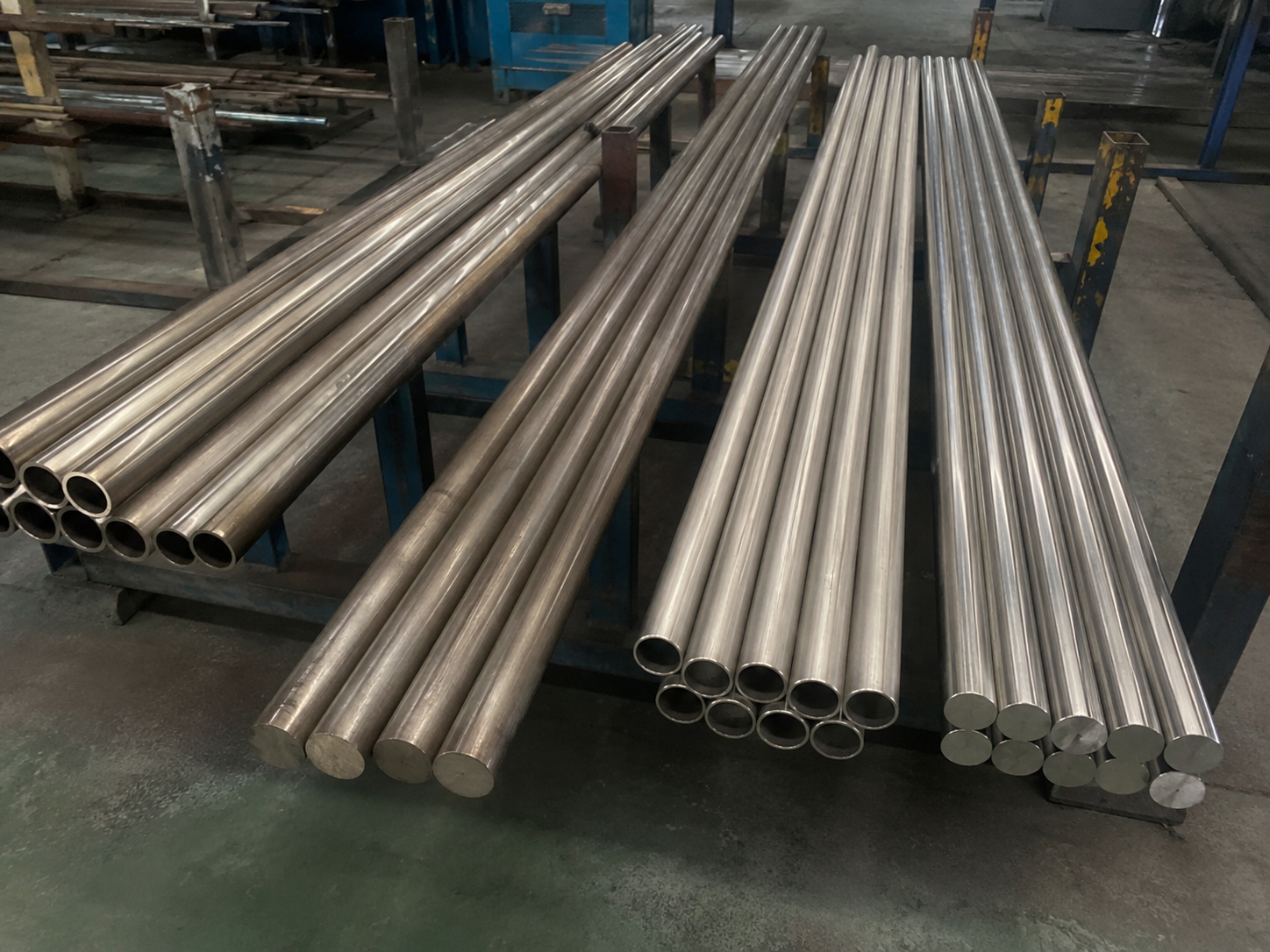
For procurement teams, the key question is not “Is the alternative grade cheaper?” The better question is “Will this alternative alloy behave correctly during welding, machining, inspection and final service?”
Why Alternative Alloy Grades Need Fabrication Review
Two alloy grades may look similar on a quotation sheet, but they may behave differently during production.
A grade change may affect:
- Welding procedure
- Filler metal selection
- Heat input control
- Shielding gas requirement
- Pre-weld and post-weld cleaning
- Post-weld heat treatment
- Machining speed
- Tool wear
- Cutting force
- Coolant strategy
- Surface finish
- Dimensional stability
- NDT method
- Mechanical testing
- Corrosion testing
- MTC / MTR content
- End-user approval
- Final acceptance
For this reason, alternative alloy selection should include both material performance and fabrication compatibility.
How Alloy Grade Changes Can Affect Welding
Welding behavior depends on alloy chemistry, product form, heat treatment condition, thickness, joint design, welding process, filler metal, shielding, heat input, restraint and cleanliness.
A change from one nickel alloy to another, or from one titanium grade to another, may require a different welding procedure.
Nickel Alloy Welding
Nickel and nickel alloys are widely used because of corrosion resistance and high-temperature properties. However, welding still needs proper procedure control.
TWI explains that, for nickel alloys, filler composition normally matches the parent metal, and many fillers include small amounts of titanium, aluminium and/or niobium to help minimize porosity and cracking: https://www.twi-global.com/technical-knowledge/job-knowledge/weldability-of-materials-nickel-and-nickel-alloys-022
This means a buyer should not assume that all nickel alloy grades can use the same filler, same heat input or same welding practice.
Important questions include:
- Is welding required?
- Which welding process will be used?
- Is the filler metal specified?
- Does the alternative grade require a different filler?
- Is heat input controlled?
- Is interpass temperature controlled?
- Is post-weld heat treatment required?
- Is corrosion resistance required after welding?
- Is weld NDT required?
- Is the welding procedure already qualified for this grade?
Solidification Cracking and Weld Defects
Solidification cracking is one welding risk that should be reviewed when welding certain alloys.
TWI explains that solidification cracking occurs when the weld bead in the final stage of solidification has insufficient strength to withstand contraction stresses as the weld pool solidifies. Risk factors include weld bead shape, high restraint, material properties, impurity content and shrinkage during solidification: https://www.twi-global.com/technical-knowledge/job-knowledge/defects-solidification-cracking-044
This does not mean every nickel alloy weld will crack. It means welding procedure, filler metal, restraint and material condition should be reviewed before accepting an alternative grade.
Titanium Alloy Welding
Titanium welding has a different concern: contamination by oxygen, nitrogen or hydrogen.
TWI explains that at temperatures above 500°C, titanium has a very high affinity for oxygen, nitrogen and hydrogen, and the weld pool, heat affected zone and cooling weld bead must be protected from oxidation by an inert gas shield such as argon or helium: https://www.twi-global.com/technical-knowledge/job-knowledge/weldability-of-materials-titanium-and-titanium-alloys-024
This is especially important when comparing titanium grades or accepting a substitute titanium alloy.
Important questions include:
- Is the titanium grade commercially pure or alloyed?
- Is the part tube, bar, sheet or machined component?
- Is full shielding required?
- Is trailing shield or back purging required?
- Is oxygen / nitrogen contamination controlled?
- Is weld color inspection required?
- Is post-weld cleaning required?
- Is corrosion resistance after welding required?
- Is the welding procedure qualified for this grade?
A titanium alternative may be acceptable only if the welding process can protect the material properly.
How Alternative Grades Can Affect Machining
Machining cost is often underestimated when buyers compare alloy grades.
A lower-cost material may not reduce total cost if it increases tool wear, cycle time, scrap rate, surface finish problems or dimensional instability.
Nickel Alloy Machinability
Nickel-based superalloys are generally difficult to machine because of high strength, toughness, hardness, low thermal conductivity, high heat resistance, chemical affinity with tool materials and work-hardening behavior.
A machining review in Procedia Engineering notes that nickel-based superalloys are difficult-to-machine materials because of properties such as toughness, hardness, low thermal conductivity, creep resistance and chemical reaction with tool materials: https://www.sciencedirect.com/science/article/pii/S2214785317304765
For nickel alloy alternatives, buyers should ask:
- Will the alternative grade work harden more quickly?
- Does it require slower cutting speed?
- Does it require different tool material?
- Will tool wear increase?
- Is high-pressure coolant required?
- Can the required surface finish be achieved?
- Can dimensional tolerance be maintained?
- Does the supplier or machine shop have experience with this grade?
- Is machining allowance sufficient?
- Is stress relief needed after rough machining?
A material that is cheaper per kilogram may be more expensive after machining.
Titanium Alloy Machinability
Titanium alloys can also be challenging to machine.
A study on titanium alloy machining notes that low thermal conductivity increases the temperature at the cutting edge, and cutting tools wear rapidly during machining: https://www.sciencedirect.com/science/article/abs/pii/S0924013601009268
For titanium alternatives, buyers should ask:
- Does the grade have higher strength?
- Does it generate higher cutting temperature?
- Is tool wear expected to increase?
- Is coolant strategy suitable?
- Is chip control difficult?
- Is galling risk present?
- Can the required tolerance be held?
- Is the surface finish acceptable?
- Is stress relief required?
- Is the machine shop familiar with titanium?
Titanium Grade 2, Grade 5, Grade 7 and Grade 12 should not be treated as interchangeable for machining cost or production planning.
How Alloy Grades Affect Final Acceptance
Final acceptance means the supplied material or finished part meets the purchase order, drawing, product standard, inspection plan, certificate requirements and project-specific acceptance criteria.
It is not only about chemical composition.
Final acceptance may include:
- Correct alloy grade
- Correct UNS number
- Correct product form
- Correct product standard
- Correct heat treatment condition
- Correct dimensions and tolerances
- Correct surface finish
- Correct chemical composition
- Correct mechanical properties
- Correct hardness if required
- Correct NDT results if required
- Correct pressure test if required
- Correct corrosion test if required
- Correct MTC / MTR
- Correct EN 10204 certificate type
- Correct heat number traceability
- Correct marking and packing
- End-user approval if substitution is involved
An alternative grade should be reviewed against all acceptance requirements, not only against price.
Testing Requirements That May Affect Acceptance
Different projects require different tests. Buyers should confirm testing requirements before accepting an alternative alloy.
| Test / Inspection | Why It Matters |
|---|---|
| Chemical analysis | Confirms alloy composition |
| PMI | Helps verify alloy identity |
| Tensile testing | Confirms yield strength, tensile strength and elongation |
| Hardness testing | Confirms hardness requirement when specified |
| Impact testing | May be required for low-temperature or critical service |
| Corrosion testing | May be required for aggressive environments |
| Ultrasonic testing | Helps detect internal discontinuities in suitable products |
| Eddy current testing | Commonly used for heat exchanger tube inspection |
| Hydrostatic / pneumatic testing | Helps verify pressure integrity when required |
| Surface inspection | Checks cracks, pits, dents, scratches or contamination |
| Dimensional inspection | Confirms OD, ID, wall thickness, length and tolerances |
| Third-party inspection | Adds independent verification for critical orders |
ASTM E8 / E8M covers tension testing of metallic materials and includes determination of yield strength, tensile strength, elongation and reduction of area: https://store.astm.org/e0008_e0008m-25.html
ASTM E18 covers Rockwell hardness and Rockwell superficial hardness testing of metallic materials: https://www.astm.org/e0018-22.html
ASNT explains that ultrasonic testing uses high-frequency sound waves to detect and measure discontinuities in industrial components: https://www.asnt.org/what-is-nondestructive-testing/methods/ultrasonic-testing
ASNT also explains that eddy current testing is commonly used to inspect heat exchanger tubes and detect wall-thickness changes or defects: https://www.asnt.org/what-is-nondestructive-testing/methods/electromagnetic-testing
Testing confirms specific requirements. It does not automatically prove that an alternative grade is suitable for every service condition.
Product Standards Must Match the Product Form
Alternative alloy review must also check the correct product standard.
| Product Type | Possible Standard | Typical Relevance |
|---|---|---|
| Titanium heat exchanger tube | ASTM B338 | Seamless and welded titanium alloy tubes for surface condensers, evaporators and heat exchangers |
| Titanium bar / billet | ASTM B348 | Titanium and titanium alloy bars and billets |
| Alloy 625 seamless pipe / tube | ASTM B444 | UNS N06625 and related nickel alloy seamless pipe and tube |
| Nickel alloy seamless pipe / tube | ASTM B622 | Seamless pipe and tube of nickel and nickel-cobalt alloys |
| Nickel alloy heat exchanger tube | ASTM B163 | Seamless nickel and nickel alloy tubes for condenser and heat-exchanger service |
Useful references:
- ASTM B338 Titanium Tubes: https://store.astm.org/b0338-17r21.html
- ASTM B348 Titanium Bars and Billets: https://store.astm.org/standards/b348
- ASTM B444 Alloy 625 Seamless Pipe and Tube: https://store.astm.org/b0444-06.html
- ASTM B622 Nickel Alloy Seamless Pipe and Tube: https://www.astm.org/Standards/B622.htm
- ASTM B163 Nickel Alloy Heat Exchanger Tubes: https://store.astm.org/b0163-22.html
If the original material and the alternative material are covered by different standards, buyers should confirm whether the project allows that change.
MTC, Traceability and Certificate Review
For alternative alloy grades, documentation review is critical.
Buyers should request:
- MTC / MTR
- Heat number
- Chemical composition
- Mechanical properties
- Heat treatment condition if required
- Product standard
- Size and quantity
- Test results
- Manufacturer information
- Order compliance statement
- EN 10204 Type 3.1 or 3.2 certificate if required
- Third-party inspection report if required
EN 10204 defines inspection documents for metallic products. Type 3.1 is an inspection certificate in which the manufacturer declares that the products supplied comply with the order and provides test results: https://www.sanyosteel.com/files/EN/EN%2010204.pdf
MTC / MTR supports batch verification and traceability. It does not replace engineering approval for an alternative grade.
Supplier Certifications Are Useful, but Not Final Proof
Supplier certifications can support supplier evaluation, but they should not be treated as proof that an alternative alloy grade is suitable for a specific application.
ISO explains that ISO 9001 is a globally recognized standard for quality management systems and helps organizations improve performance, meet customer expectations and define how to establish, implement, maintain and continually improve a QMS: https://www.iso.org/standard/62085.html
For critical testing, ISO/IEC 17025 enables laboratories to demonstrate that they operate competently and generate valid results: https://www.iso.org/ISO-IEC-17025-testing-and-calibration-laboratories.html
For alternative alloy approval, buyers should still verify:
- Exact grade
- UNS number
- Product standard
- Heat number
- MTC / MTR
- Testing reports
- NDT results if required
- Welding compatibility
- Machining compatibility
- Application suitability
- End-user approval
A quality management certificate is helpful, but it does not automatically approve a substitute material.
Why Initial Material Price Is Not Enough
Alternative alloy grades are often proposed because of cost or availability. But material price is only one part of the decision.
Buyers should also consider:
- Welding procedure cost
- Welding repair risk
- Filler metal availability
- Machining time
- Tool wear
- Scrap risk
- Inspection cost
- Testing cost
- Certificate cost
- Third-party inspection cost
- End-user approval time
- Rework risk
- Replacement risk
- Maintenance cost
- Downtime risk
- Lifecycle cost
NIST’s Life Cycle Cost Manual supports evaluating cost over the full study period, not only initial purchase price: https://www.wbdg.org/FFC/NIST/hdbk_135_2022.pdf
A cheaper alternative may be reasonable in mild service if it meets all requirements. A more expensive material may be justified in critical service if it reduces fabrication, inspection or lifecycle risk.
Practical Checklist Before Accepting an Alternative Alloy Grade
Before accepting an alternative nickel or titanium alloy grade, buyers can use this checklist:
- What is the original alloy grade?
- What is the proposed alternative grade?
- What are the UNS numbers?
- Are chemical composition limits comparable?
- Are mechanical properties comparable?
- Is the product form the same: tube, pipe, bar, forging, fitting or machined part?
- Is the product standard the same?
- Is the heat treatment condition the same?
- Is welding required?
- Does the welding procedure need revision?
- Is filler metal different?
- Is inert gas shielding or back purging required?
- Is post-weld heat treatment required?
- Is corrosion resistance after welding required?
- Is machining required?
- Will tool wear, speed, coolant or surface finish change?
- Is dimensional tolerance affected?
- Is surface finish affected?
- Is fatigue, creep, impact or hardness relevant?
- Is service environment reviewed?
- Are chlorides, acids, alkalis, seawater, H₂S or high temperature involved?
- Is PMI required?
- Is tensile testing required?
- Is hardness testing required?
- Is UT, ECT, radiographic testing or pressure testing required?
- Is corrosion testing required?
- Can MTC / MTR be provided for the exact batch?
- Is EN 10204 3.1 or 3.2 required?
- Is third-party inspection required?
- Does the end user allow material substitution?
- Does the alternative affect lifecycle cost?
- Are limitations clearly documented?
A supplier-recommended alternative should be treated as a technical proposal, not just a lower price.
When Can an Alternative Alloy Grade Be Reasonable?
An alternative alloy grade may be reasonable when:
- The original material has long lead time
- The alternative is allowed by the specification
- The application risk is well understood
- The material standard is acceptable
- Welding requirements can be met
- Machining requirements can be met
- Mechanical properties are acceptable
- Corrosion risks have been reviewed
- Testing and documentation are available
- End-user approval is obtained if required
- Lifecycle cost is acceptable
- Limitations are clearly documented
The goal is not to reject all alternatives. The goal is to accept only alternatives that are technically justified.
Conclusion
Alternative alloy grades can affect welding, machining and final acceptance. Buyers should not evaluate substitutes only by price or chemical composition.
A proper review should include application requirements, alloy grade, UNS number, product standard, heat treatment, welding behavior, machinability, testing scope, MTC / MTR, NDT, certificate requirements, end-user approval and lifecycle cost.
A well-supported alternative can reduce cost or lead time. A poorly reviewed alternative can create welding repairs, machining delays, inspection problems, rejection risk or long-term service issues.