
How to Check Tube Labels, Heat Numbers and MTC Consistency?
When buyers receive nickel alloy tubes or titanium alloy tubes, the material may look correct from the outside. But appearance alone cannot prove material identity, traceability or order compliance.
For alloy tube procurement, three items should be checked together:
- Physical tube label or bundle tag
- Heat number or batch number
- Material Test Certificate / Mill Test Report, also called MTC or MTR
To check tube label, heat number and MTC consistency, buyers should compare the physical goods, bundle labels, heat numbers, packing list, purchase order, MTC/MTR and required inspection reports. This helps verify material identity, batch-level traceability, standard compliance and project-specific requirements before the tubes enter production, machining, welding, installation or inventory.
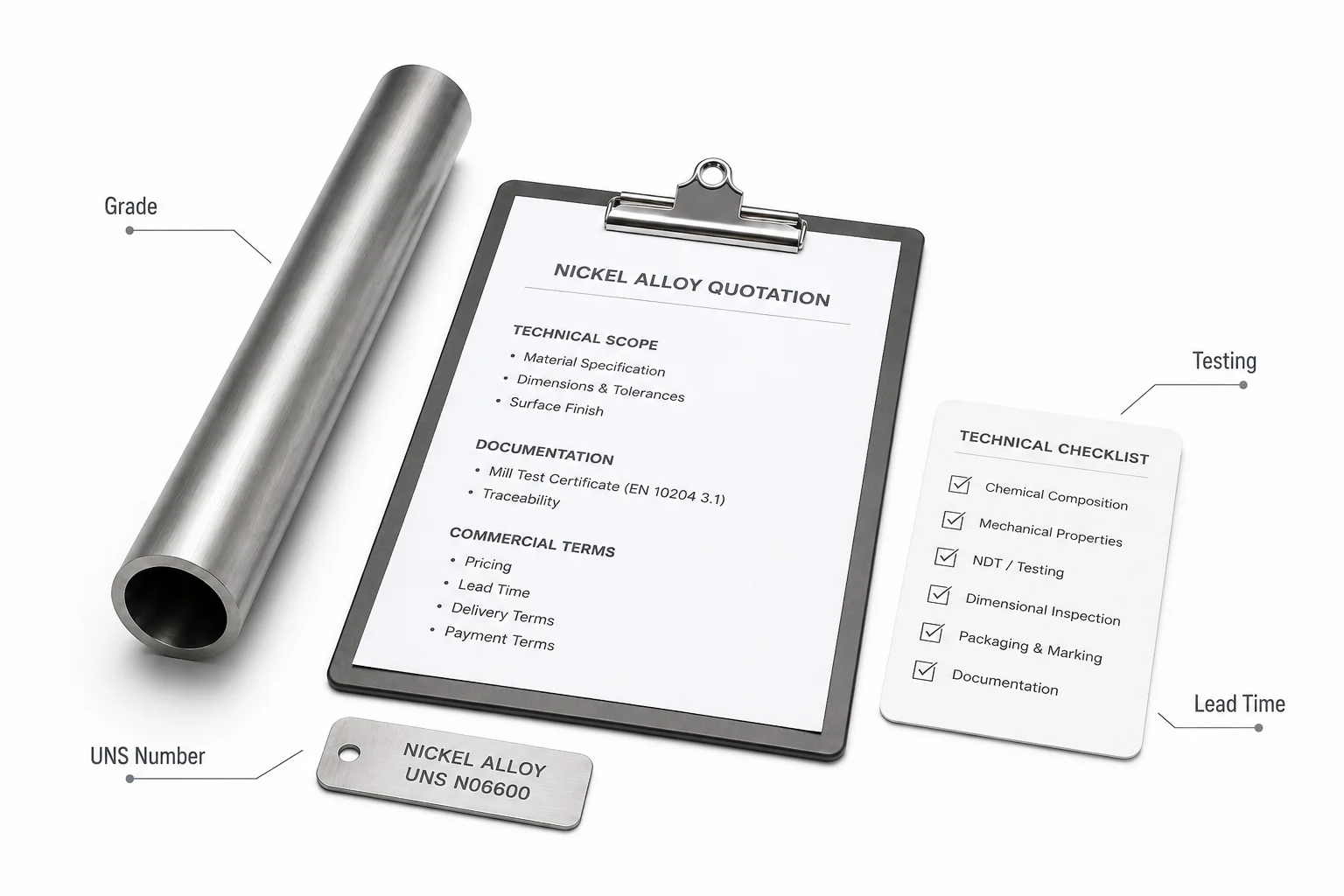
For nickel and titanium alloy tubes, this step is especially important because these materials are often used in chemical processing, oil and gas, marine engineering, heat exchangers, aerospace-related equipment, power generation, medical equipment and other demanding applications.
This guide explains how buyers should check tube labels, heat numbers and MTC consistency, and what to do when documents or markings do not match.
Quick Answer: What Should Buyers Check First?
Before using the tubes, buyers should perform a simple consistency check:
- Does the tube label or bundle tag match the purchase order?
- Does the alloy grade and UNS number match the order?
- Does the size match the PO and packing list?
- Does the heat number on the tube or bundle match the MTC/MTR?
- Does the MTC/MTR show the correct product standard?
- Do chemical and mechanical test results meet the required standard?
- Are required NDT, PMI, dimensional or corrosion test reports included?
- Are the labels readable and traceable after unpacking?
- Are any documents missing, unclear or inconsistent?
- Should the material be released, held or re-verified?
EN 10204 Type 3.1 inspection certificates provide actual test results from the supplied material lot and are endorsed by a manufacturer’s authorized inspection representative independent from manufacturing. Source: EN 10204 Type 3.1 Inspection Certificates
Buyer Takeaway
Do not check the label, heat number and MTC separately. Check whether all three tell the same story.
Why Is Tube Label Verification Important?
A tube label or bundle tag is the first visible identity check after delivery. It helps buyers quickly confirm whether the physical goods appear to match the order.
However, a label is only useful when it is clear, durable and consistent with the MTC/MTR and packing list.
A Tube Label May Include
| Label Item | Why It Matters |
|---|---|
| Alloy grade | Confirms material family, such as Alloy 625, Alloy 718, Alloy C-276, Alloy 825, Alloy 400 or Titanium Grade 2. |
| UNS number | Reduces confusion between similar trade names or alloy names. |
| Size | Confirms OD, wall thickness, ID if required and length. |
| Standard | ASTM, ASME, EN, AMS or customer drawing reference. |
| Heat number | Links physical material to MTC/MTR and batch records. |
| Lot or batch number | Supports production and inspection traceability. |
| PO number | Helps match goods to buyer order. |
| Bundle number | Helps compare with packing list and inspection records. |
| Supplier / manufacturer | Confirms source and document consistency. |
What Can Go Wrong?
| Label Problem | Possible Risk |
|---|---|
| Missing label | Material identity cannot be quickly verified. |
| Unreadable label | Heat number or size may be lost during receiving. |
| Wrong alloy grade on label | Material may be held until supplier clarification or PMI verification. |
| Label does not match MTC | Traceability gap and inspection hold. |
| Wrong size on label | May cause receiving rejection or dimensional recheck. |
| No heat number shown | Material may not be linked to batch-level test data. |
| Mixed labels in one shipment | Higher risk of material mix-up. |
Buyer Takeaway
The label is not final proof by itself. It is the starting point for cross-checking the physical product with the documents.
How Do Heat Numbers Support Traceability?
A heat number is a batch-level identifier that usually links the supplied material to a specific melt or production batch. It is one of the most important traceability details in alloy material procurement.
Heat Number Should Match
| Item | What to Check |
|---|---|
| Tube marking or bundle tag | Heat number should be visible or recorded. |
| Packing list | Heat number should match shipment records. |
| MTC/MTR | Heat number should match the certificate. |
| NDT report | If UT, ET, hydrostatic or other NDT is required, report should match heat/lot details. |
| PMI report | If PMI is required, report should identify tested heat/lot or bundle. |
| Dimensional report | If required, report should identify inspected batch or bundle. |
| Third-party inspection report | If required, release note should match material identity. |
Important Caution
A heat number helps trace material to batch-level records, but it does not automatically prove every later process, dimension, surface finish or test result unless the corresponding reports are provided and linked to the same heat number, lot number or bundle number.
Buyer Takeaway
Heat number is not just a number. It is the bridge between the physical tube and the material records.
What Is an MTC/MTR and What Should Buyers Verify?
A Material Test Certificate or Mill Test Report is a batch-level inspection document. It usually reports chemical composition, mechanical properties, product standard, heat number, material condition and test results.
Key MTC/MTR Items to Check
| MTC/MTR Item | Buyer Check |
|---|---|
| Manufacturer / supplier name | Does it match the approved source? |
| Buyer PO number | Does it match the order? |
| Product description | Tube, pipe, bar, rod, welded tube, seamless tube or custom product. |
| Alloy grade | Does it match the PO and label? |
| UNS number | Does it match the required material? |
| Heat number | Does it match physical marking and packing list? |
| Product standard | ASTM B444, ASTM B163, ASTM B704, ASTM B338, ASME SB standard or customer drawing. |
| Heat treatment condition | Annealed, solution annealed, aged, stress relieved or customer-specified condition. |
| Chemical composition | Elements must meet standard or PO requirements. |
| Mechanical properties | Tensile strength, yield strength, elongation and hardness if required. |
| Testing performed | Tensile, hardness, hydrostatic, NDT, PMI, corrosion test or other required tests. |
| Certificate type | EN 10204 3.1, 3.2, CoC or other document type. |
| Authorized signature | Confirms document responsibility and approval. |
ASTM B444 covers UNS N06625 and related nickel alloy seamless pipe and tube, including tensile testing, hydrostatic testing and nondestructive electric testing. Source: ASTM B444
ASTM B163 covers seamless nickel and nickel alloy tubes for condenser and heat-exchanger service, including outside diameter and wall-related requirements. Source: ASTM B163
ASTM B704 covers welded nickel alloy boiler, heat exchanger and condenser tubes, including manufacturing, chemical composition, mechanical properties and dimensional requirements. Source: ASTM B704
What MTC/MTR May Not Prove
An MTC/MTR is important, but it may not prove every requirement unless those items are included in the order and reported.
| Requirement | May Need Separate Report |
|---|---|
| Full dimensional inspection | Dimensional inspection report |
| Surface roughness | Roughness report |
| Internal cleanliness | Cleanliness report |
| UT / ET / PT results | NDT report |
| Hydrostatic / pneumatic test | Pressure or leak test report |
| PMI verification | PMI report |
| Corrosion test | ASTM G28, ASTM G48 or customer corrosion test report |
| Full heat treatment furnace cycle | Heat treatment record |
| Third-party witness | Third-party inspection report |
Buyer Takeaway
The MTC/MTR is the starting document, not the only document. Check whether it contains all information required by the PO.
How Should Buyers Cross-Reference Labels, Heat Numbers and MTCs?
The safest method is to check them step by step.
Step-by-Step Consistency Check
| Step | What to Compare |
|---|---|
| Step 1: PO vs packing list | Confirm alloy, size, quantity, standard and shipment details. |
| Step 2: Packing list vs physical goods | Confirm bundle count, piece count, length and weight. |
| Step 3: Label vs PO | Confirm alloy grade, UNS number, size and delivery condition. |
| Step 4: Label vs MTC | Confirm heat number, grade, standard and material condition. |
| Step 5: MTC vs PO | Confirm chemistry, mechanical properties, heat treatment and certificate type. |
| Step 6: MTC vs test reports | Confirm NDT, PMI, corrosion, dimensional or third-party reports match the same heat/lot. |
| Step 7: Physical tube vs documents | Confirm visible markings, dimensions, surface and tube ends match the order. |
| Step 8: Release or hold | Release only when identity, traceability and required documents are consistent. |
Buyer Takeaway
If one document does not match, do not assume it is a small paperwork issue. Hold the material and clarify before use.
How Do Nickel Alloy Requirements Change the Verification Process?
Nickel alloy tubes are often used because of corrosion resistance, high-temperature strength, oxidation resistance or special mechanical requirements. This means buyers may need more than a basic label check.
Nickel Institute explains that nickel alloys include families used for high-temperature strength and resistance to oxidation, carburization and other high-temperature corrosion, as well as alloys used for corrosion resistance in demanding environments. Source: Nickel Institute — Nickel Alloys
Nickel Alloy MTC Items to Review
| Item | Why It Matters |
|---|---|
| UNS number | Avoids confusion between trade names and similar grades. |
| Nickel, chromium, molybdenum, iron, niobium and other elements | Key elements affect standard compliance and application suitability. |
| Carbon content | May matter for weldability or sensitization-related concerns in selected alloys. |
| Heat treatment condition | Annealed, solution annealed or aged condition may affect properties. |
| Mechanical properties | Strength and elongation must meet standard and application requirements. |
| Hydrostatic / NDT | Required by some tube standards or project specifications. |
| Corrosion testing | ASTM G28 or G48 may be required for certain corrosion service. |
ASTM G28 is used to detect susceptibility to intergranular corrosion in wrought nickel-rich chromium-bearing alloys. Source: ASTM G28
ASTM G48 is used to evaluate pitting and crevice corrosion resistance of stainless steels and related alloys in ferric chloride solution. Source: ASTM G48
Buyer Takeaway
For nickel alloy tubes, verify not only the alloy name but also UNS number, chemistry, heat treatment condition, mechanical properties and any corrosion or NDT reports required by the project.
How Do Titanium Alloy Requirements Change the Verification Process?
Titanium alloy tubes are often selected for corrosion resistance, strength-to-weight ratio, marine service, heat exchangers, aerospace-related equipment or medical-related equipment. Verification should focus on grade, UNS number, chemistry, mechanical properties, surface condition and application-specific requirements.
Titanium Alloy MTC Items to Review
| Item | Why It Matters |
|---|---|
| Titanium grade | Grade 2, Grade 5, Grade 7, Grade 9 and Grade 23 have different properties. |
| UNS number | Confirms exact material identity. |
| Oxygen, nitrogen, hydrogen and iron limits | Important for titanium grade compliance and performance. |
| Mechanical properties | Tensile strength, yield strength and elongation are important for many applications. |
| Heat treatment condition | Annealed or stress-relieved condition may affect processing and performance. |
| Surface condition | Surface contamination, oxide or damage may affect welding or corrosion behavior. |
| Medical-related requirements | Final medical device suitability depends on customer validation and applicable standards. |
FDA guidance on ISO 10993-1 explains biological evaluation of medical devices within a risk management process. Source: FDA — Use of ISO 10993-1
Important Caution
For medical-related projects, an MTC alone does not prove final medical device suitability. Buyers should confirm the applicable medical material standard, biological evaluation requirement, surface requirement, cleaning requirement and final device validation process.
Buyer Takeaway
For titanium alloy tubes, check grade, UNS number, controlled elements, mechanical properties, surface condition and application-specific documentation.
What Testing Reports May Be Needed?
Testing requirements depend on the product standard, application and PO. Not every order needs every report, but required tests should be clearly stated before production.
Common Tests and Reports
| Test / Report | What It Helps Verify |
|---|---|
| Chemical analysis | Confirms alloy composition and standard compliance. |
| Tensile test | Confirms tensile strength, yield strength and elongation. |
| Hardness test | Helps verify material condition if required. |
| PMI | Confirms alloy identity by positive material identification. |
| UT | Detects internal discontinuities in metal pipe and tubing. |
| ET / ECT | Checks seamless and welded tubular products for discontinuities. |
| PT | Detects surface-open discontinuities. |
| Hydrostatic test | Confirms pressure-related integrity where required by standard. |
| Dimensional report | Confirms OD, wall thickness, length, ovality and straightness. |
| Corrosion test | Confirms specified corrosion test result if required. |
| Third-party inspection report | Provides independent witness or inspection record. |
ASTM E1473 describes chemical analysis test methods for nickel, cobalt and high-temperature alloys. Source: ASTM E1473
ASTM E213 covers ultrasonic testing of metal pipe and tubing for detecting discontinuities during volumetric examination. Source: ASTM E213
ASTM E426 covers eddy current examination of seamless and welded tubular products made from materials such as titanium, stainless steel and nickel alloys. Source: ASTM E426
ASTM E165 covers liquid penetrant examination for detecting discontinuities open to the surface, such as cracks, seams, laps and through leaks. Source: ASTM E165/E165M
Buyer Takeaway
If a test is important for acceptance, make sure it is written into the PO and supported by a report.
What Are the Risks of Inconsistent Labels, Heat Numbers and MTCs?
Inconsistent documentation may not always mean the material is wrong, but it creates a traceability and approval risk.
Possible Risks
| Inconsistency | Possible Result |
|---|---|
| Label does not match MTC | Material hold, investigation or PMI verification. |
| Heat number mismatch | Traceability gap and receiving inspection rejection. |
| Wrong alloy name | Risk of material mix-up or wrong application use. |
| Missing UNS number | Confusion between similar grades. |
| Missing MTC/MTR | Material cannot be released for quality-controlled projects. |
| Missing NDT report | Project hold if NDT was required by PO. |
| Missing corrosion test report | Critical corrosion service may reject the material. |
| Wrong dimensions in documents | Re-measurement or supplier clarification required. |
| Unclear heat treatment condition | Mechanical or corrosion performance concern. |
| Incomplete certificate type | End-user or inspection approval may be delayed. |
Important Caution
Avoid using extreme language such as “catastrophic failure” unless there is a specific engineering analysis or accident case. A more accurate statement is: inconsistent documentation may lead to material hold, rework, project delay, inspection rejection, compliance risk, or in critical service, safety risk.
Buyer Takeaway
Documentation consistency is not just paperwork. It protects material identity, traceability and project approval.
What Should Buyers Do If Something Does Not Match?
If labels, heat numbers and MTCs do not match, buyers should not use the material immediately.
Recommended Action Process
- Isolate the affected tubes or bundle.
- Mark the material as pending inspection.
- Take photos of labels, markings, packaging and tube condition.
- Compare PO, packing list, MTC/MTR and all reports again.
- Check whether the issue is a typo, missing document or actual material mismatch.
- Contact the supplier with clear evidence.
- Request corrected documents, technical clarification or replacement if required.
- Consider PMI or third-party verification if material identity is uncertain.
- Do not machine, weld or install the material until the issue is resolved.
- Keep a written record of all communication and corrective actions.
Evidence to Send Supplier
| Evidence | Why It Helps |
|---|---|
| Photo of tube label | Shows actual marking or tag. |
| Photo of heat number | Confirms physical traceability issue. |
| Packing list page | Shows shipment record. |
| MTC/MTR page | Shows certificate data. |
| PO requirement | Shows what was ordered. |
| Measurement record | Supports dimensional issue. |
| NDT or test report gap | Shows missing project requirement. |
Buyer Takeaway
The best response is to isolate, document, clarify and verify before using the material.
Buyer Checklist: Label, Heat Number and MTC Consistency
| Check Item | What to Confirm |
|---|---|
| Purchase order | Grade, UNS number, size, standard, condition, testing and certificate requirements. |
| Packing list | Bundle number, quantity, weight, length and shipment details. |
| Tube label / bundle tag | Grade, UNS number, size, heat number, standard and PO number. |
| Physical marking | Heat number or identification marking if required. |
| MTC/MTR | Heat number, chemistry, mechanical properties, standard and certificate type. |
| Heat number consistency | Label, packing list, MTC and reports should match. |
| Chemical composition | Must meet the required alloy standard or PO. |
| Mechanical properties | Tensile strength, yield strength, elongation and hardness if required. |
| Heat treatment condition | Annealed, solution annealed, aged, stress relieved or customer-specified condition. |
| NDT reports | UT, ET, PT, hydrostatic or pneumatic test reports if required. |
| Corrosion test reports | ASTM G28, ASTM G48 or project-specific test if required. |
| Dimensional report | OD, ID, wall thickness, length, straightness and ovality if required. |
| Surface condition | Pickled, polished, bright annealed, cleaned, capped or customer-specified finish. |
| Third-party report | If required by project or end user. |
| Release status | Approved, pending clarification, rejected or re-inspection required. |
Example: How to Check an Alloy 625 Tube Order
Order requirement:
Alloy 625 seamless tubes, UNS N06625, ASTM B444, OD 25.4 mm × WT 2.11 mm × 6000 mm, solution annealed, pickled surface, EN 10204 3.1 MTC, hydrostatic test and nondestructive electric test required.
Receiving check:
- Confirm label shows Alloy 625 / UNS N06625.
- Confirm size on label matches OD 25.4 mm × WT 2.11 mm.
- Confirm heat number on label matches MTC/MTR.
- Confirm MTC lists ASTM B444.
- Confirm chemical composition meets UNS N06625 requirements.
- Confirm mechanical properties meet standard requirements.
- Confirm heat treatment condition is correct.
- Confirm hydrostatic and nondestructive electric test records are included if required.
- Check tube surface and ends.
- Release material only after all required items match.
Example: How to Check a Titanium Tube Order
Order requirement:
Titanium Grade 2 seamless tubes, UNS R50400, ASTM B338, OD 19.05 mm × WT 1.65 mm × length 6000 mm, annealed, cleaned and capped, EN 10204 3.1 MTC required.
Receiving check:
- Confirm label shows Titanium Grade 2 / UNS R50400.
- Confirm OD, wall thickness and length.
- Confirm heat number matches MTC/MTR.
- Confirm ASTM B338 or customer standard is listed.
- Check oxygen, nitrogen, hydrogen and iron limits if required by the standard.
- Confirm tensile strength, yield strength and elongation.
- Check tube ends, cleanliness and caps.
- Hold material if any label, heat number or certificate mismatch is found.
Common Mistakes Buyers Should Avoid
1. Checking Only the Label
The label is important, but it must match the MTC/MTR and PO.
2. Ignoring Heat Number
Without heat number consistency, traceability becomes weak.
3. Filing the MTC Without Reviewing It
MTC/MTR should be checked before material is released.
4. Assuming MTC Proves Everything
MTC may not include dimensional inspection, surface roughness, NDT or corrosion test reports unless required.
5. Not Checking UNS Number
Trade names can be confusing. UNS number helps confirm exact material identity.
6. Not Checking Required Test Reports
If UT, ET, PT, PMI, hydrostatic test or corrosion test was required, confirm the report is included.
7. Mixing Unverified Material Into Stock
Keep material isolated until documents and markings match.
8. Accepting Torn or Unreadable Labels
Unreadable labels can create future inventory and traceability problems.
9. Not Reporting Discrepancies Quickly
Early reporting helps faster supplier clarification and corrective action.
10. Not Writing Clear PO Requirements
Future consistency starts with a clear purchase order.
FAQ: Tube Labels, Heat Numbers and MTC Consistency
1. What is a heat number?
A heat number is a batch-level identifier that links material to production and test records, including MTC/MTR data.
2. Why should the heat number match the MTC?
The heat number connects the physical tube to the certificate. If it does not match, traceability is uncertain.
3. Is an MTC the same as a CoC?
No. An MTC/MTR usually reports actual chemical and mechanical test results. A CoC is usually a statement of conformity and may contain less test data.
4. Does EN 10204 3.1 mean the material is fully inspected?
EN 10204 3.1 provides specific test results for the supplied lot, but it does not automatically include every test unless required by the order or standard.
5. Should every tube be marked with a heat number?
It depends on the order, standard, tube size and marking feasibility. At minimum, the bundle or packing should support traceability.
6. What if the label is missing but the MTC is available?
Hold the material and ask the supplier to confirm traceability before use. PMI or third-party verification may be needed.
7. What if the MTC shows the right alloy but the label shows a different grade?
Do not use the material immediately. Isolate it and request supplier clarification.
8. Should buyers perform PMI?
PMI is useful for critical applications, mixed inventory, first orders or when independent alloy verification is required.
9. What reports should be checked besides MTC?
Depending on the order, buyers may check dimensional reports, UT/ET/PT reports, PMI reports, hydrostatic test reports, corrosion test reports and third-party inspection reports.
10. How can buyers avoid future inconsistency?
Write clear PO requirements for labeling, heat number marking, EN 10204 3.1 MTC, NDT, dimensions, surface condition, packing and acceptance criteria.
Conclusion
Checking tube labels, heat numbers and MTC consistency is a practical way to protect material traceability and project quality.
For nickel alloy tubes and titanium alloy tubes, buyers should not rely on appearance alone. They should compare physical labels, heat numbers, packing lists, purchase orders, MTC/MTR and inspection reports before releasing material to production.
A consistent label, heat number and MTC helps confirm alloy identity, batch-level traceability, standard compliance and required testing. If something does not match, the safest response is to isolate the material, document the issue and clarify with the supplier before use.
Emily PIPE supplies nickel alloy tubes, nickel alloy bars, titanium alloy tubes and titanium alloy bars for global industrial applications. If you are preparing an alloy tube order and need help with labeling, heat number traceability, MTC review or inspection requirements, you can send your material grade, UNS number, size, standard, delivery condition and certificate requirement for technical review and quotation.