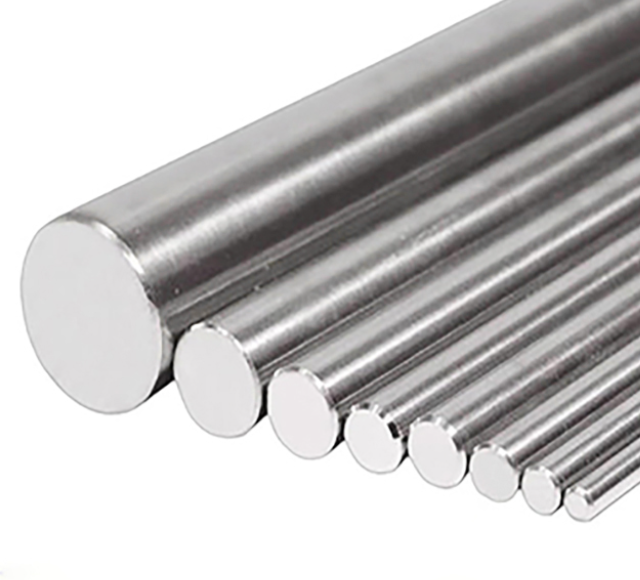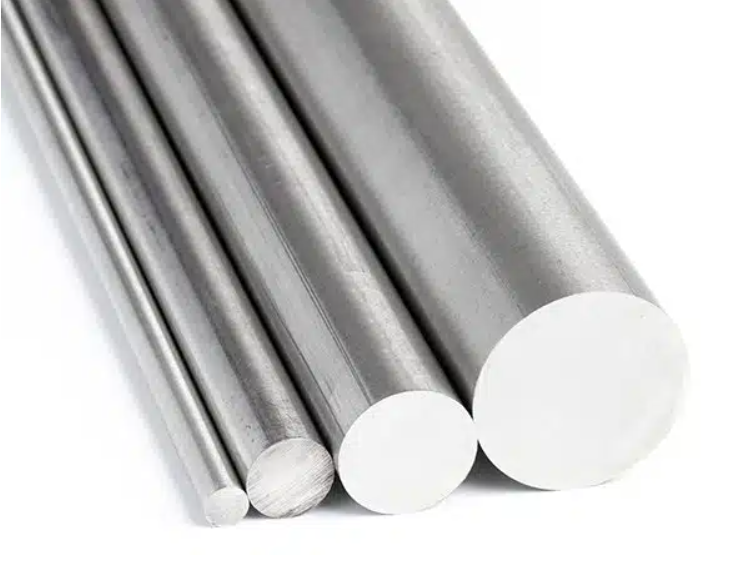

How to Choose Alloy Bars for Pumps and Valves
Choosing alloy bars for pumps and valves is not just a purchasing decision. For pump shafts, valve stems, valve trim, fasteners, sleeves, bushings, and other machined components, the wrong material choice may lead to corrosion damage, leakage risk, premature wear, rework, unplanned maintenance, or early replacement.
When ordering alloy bars for pumps and valves, manufacturers should go beyond basic specifications and evaluate how material properties translate into real service performance. The right decision should consider corrosive media, temperature, pressure, flow condition, mechanical stress, applicable standards, machining requirements, inspection scope, MTC traceability, and supplier quality control.
The National Physical Laboratory guide on corrosion control for pumps and valves explains that pumps and valves handle a wide range of fluids, so material selection advice must be general unless the actual application details are known.
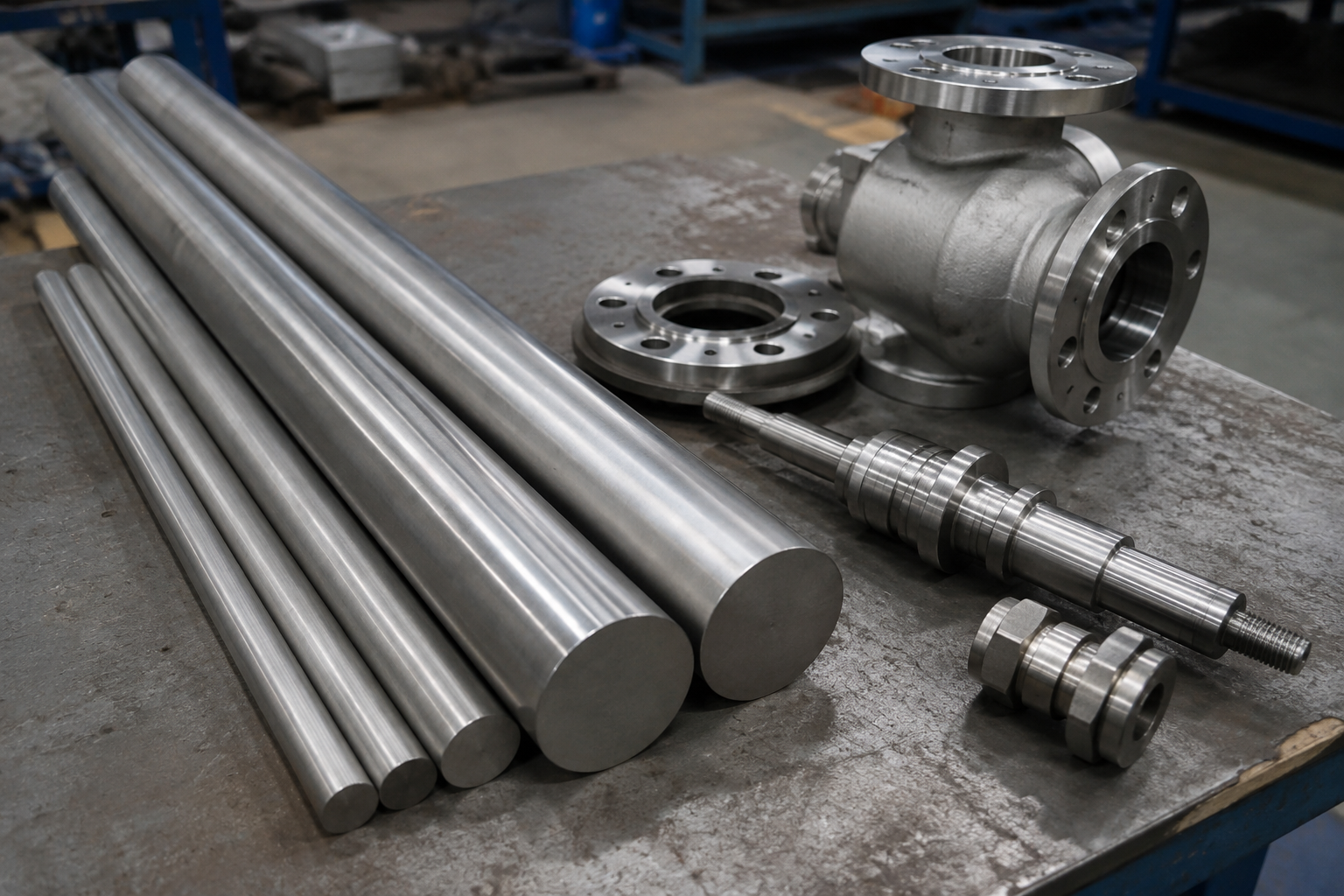
For manufacturers, the key question is not simply “Which alloy bar is strongest?” The better question is “Which alloy bar is suitable for this pump or valve component, in this medium, at this temperature and pressure, with this expected service life?”
Do Material Specifications Tell the Whole Story?
Material specifications are important, but they do not tell the whole story by themselves. A datasheet may show chemical composition, tensile strength, yield strength, hardness, elongation, or heat treatment condition. These values are necessary, but they must be interpreted in the context of the actual pump or valve application.
For example:
- A material with high tensile strength may still be unsuitable if it is sensitive to stress corrosion cracking in the service medium.
- A material with good general corrosion resistance may still fail by pitting or crevice corrosion in chloride-containing environments.
- A material with good high-temperature strength may not be suitable if the atmosphere causes oxidation, sulfidation, or hot corrosion.
- A material that meets the grade requirement may still create problems if the heat treatment condition, surface quality, or inspection scope is not correct.
This is why material grade is only the starting point. Pump and valve manufacturers should connect the specification to the actual service condition.
Why There Is No Single Best Alloy for Every Pump and Valve
There is no universal “best” alloy bar for all pump and valve applications. Pumps and valves may handle clean water, seawater, brine, acids, alkalis, solvents, steam, sour fluids, slurries, high-temperature gas, or mixed process chemicals. Each medium creates different corrosion and mechanical risks.
A material that works well in one environment may fail quickly in another.
For example:
- Seawater service may require resistance to pitting and crevice corrosion.
- Sulfuric acid service depends strongly on concentration, temperature, velocity, aeration, and impurities.
- H₂S-containing service may require review against ISO 15156 / NACE MR0175.
- Slurry service may require both corrosion resistance and erosion resistance.
- High-pressure valves require material strength, pressure-temperature suitability, and correct standard compliance.
- High-temperature service may require creep resistance, oxidation resistance, and thermal stability.
- Cryogenic service may require suitable toughness and ductility at low temperature.
The correct material is the one that matches the real operating environment without unnecessary over-engineering or dangerous under-selection.
Key Operating Conditions to Confirm Before Ordering
Before selecting alloy bars for pumps and valves, manufacturers should confirm the service conditions as clearly as possible.
| Factor | What to Confirm | Why It Matters |
|---|---|---|
| Fluid or gas medium | Water, seawater, acid, alkali, brine, H₂S, steam, solvent, slurry, or mixed chemicals | Determines corrosion mechanism and alloy compatibility |
| Chemical concentration | Chloride level, pH, sulfur content, acid concentration, oxygen, impurities | Small changes may alter corrosion behavior |
| Temperature | Normal temperature, maximum temperature, thermal cycling | Affects corrosion rate, strength, creep, oxidation, and fatigue |
| Pressure | Working pressure, design pressure, pressure cycling | Affects component design and material strength requirement |
| Flow condition | Velocity, turbulence, cavitation, solids, stagnant zones | Affects erosion, localized corrosion, and wear |
| Component function | Shaft, stem, trim, sleeve, bushing, fastener, body part, or machined component | Different parts face different stress and wear patterns |
| Mechanical stress | Torque, bending, vibration, tensile load, compressive load, sealing stress | Affects fatigue, SCC, deformation, and service life |
| Standard | ASTM, ASME, EN, ISO, NACE/ISO, or customer specification | Defines material and testing requirements |
| Inspection | PMI, UT, PT, hardness, dimensional inspection, third-party inspection | Helps verify material before machining or assembly |
| Documentation | MTC, heat number, inspection reports, packing and marking | Supports traceability and order verification |
A vague request such as “corrosion-resistant alloy bar for pump and valve parts” is usually not enough. The supplier needs real service details to recommend a suitable alloy.
How Corrosion Mechanisms Affect Pumps and Valves
Pump and valve components may fail through different corrosion mechanisms. Understanding the likely mechanism is more useful than choosing a material only by alloy name.
| Corrosion / Damage Mechanism | Why It Matters | What Buyers Should Check |
|---|---|---|
| General corrosion | Uniform material loss can reduce strength or sealing ability | Corrosion rate, allowance, service life |
| Pitting corrosion | Local pits can become crack initiation sites | Chlorides, stagnant zones, temperature, alloy resistance |
| Crevice corrosion | Attack can occur near seals, sleeves, deposits, or tight gaps | Design details, gasket areas, crevices, chloride level |
| Stress corrosion cracking | Cracking caused by tensile stress and corrosive environment | Residual stress, applied stress, chloride, caustic, H₂S |
| Corrosion fatigue | Cyclic stress plus corrosive environment can reduce fatigue life | Rotation, vibration, pressure cycling, surface condition |
| Erosion-corrosion | Flow or solids remove protective films and accelerate attack | Velocity, turbulence, slurry, particle loading |
| Cavitation damage | Vapor bubble collapse can damage surfaces | Pump operating point, pressure drop, flow design |
| Galvanic corrosion | Dissimilar metal contact may accelerate attack | Coupled materials, electrolyte, area ratio |
| High-temperature corrosion | Oxidation, sulfidation, halogenation, hot corrosion, or salt deposits | Temperature, atmosphere, contaminants, alloy chemistry |
AMPP defines stress corrosion cracking as cracking caused by the combined influence of tensile stress and a corrosive environment. For high-temperature conditions, ASM International discusses high-temperature corrosion mechanisms of nickel alloys, including oxidation, nitridation, sulfidation, halogenation, hot corrosion, ash or salt deposit corrosion, molten salt corrosion, and molten metal corrosion.
PREN Is Useful, but It Is Not a Universal Selection Rule
In chloride-containing environments, buyers may use PREN, or Pitting Resistance Equivalent Number, as a screening tool. Nickel Institute explains that PREN is used to estimate relative resistance to pitting initiation, commonly using chromium, molybdenum, and nitrogen in the calculation.
However, PREN is not a complete material selection method. It mainly helps compare pitting tendency in chloride-related environments. It does not automatically predict performance in sulfuric acid, caustic solution, H₂S service, erosion-corrosion, high-temperature oxidation, or corrosion fatigue.
For chloride-containing service, Nickel Institute also provides guidance on pitting and crevice corrosion testing of stainless steels and nickel-base alloys in chloride-containing environments.
Material Properties Must Be Connected to Component Function
Different pump and valve components require different material priorities.
| Component | Main Material Concerns |
|---|---|
| Pump shaft | Corrosion resistance, fatigue strength, straightness, toughness, machinability |
| Valve stem | Strength, galling resistance, corrosion resistance, surface finish |
| Valve trim | Erosion resistance, corrosion resistance, sealing performance |
| Sleeve / bushing | Wear resistance, corrosion resistance, dimensional stability |
| Fasteners | Strength, corrosion resistance, thread quality, galling risk |
| Valve body part | Pressure-temperature suitability, corrosion allowance, standard compliance |
| Machined custom part | Alloy condition, machinability, dimensional tolerance, inspection |
A high-strength alloy bar may still be unsuitable if it has poor corrosion resistance in the actual medium. A highly corrosion-resistant alloy may still be unsuitable if it lacks the mechanical properties, machinability, hardness, or dimensional stability required for the component.
Common Alloy Bar Candidates for Pumps and Valves
The following materials are common candidates for discussion. This table is not a final selection chart. The correct alloy depends on medium, concentration, temperature, pressure, flow, mechanical stress, standard, machining, and service life.
| Alloy / Material Family | Why Buyers May Consider It | Important Caution |
|---|---|---|
| Alloy 400 / Monel 400 | Often considered for seawater, brine, and some alkali-related environments | Crevice corrosion, velocity, and exact chemistry still need review |
| Alloy 625 / Inconel 625 | Often considered for chloride-containing, seawater, and demanding corrosion service with good strength | Cost, availability, machining, and media compatibility must be checked |
| Alloy 825 / Incoloy 825 | Often considered for certain acid, chloride, and H₂S-related environments | Not universal; concentration, temperature, and standard requirements matter |
| Alloy C-276 / Hastelloy C-276 | Often considered for severe chemical corrosion and reducing environments | Mechanical design, availability, cost, and machining should be reviewed |
| Alloy 20 | Often considered for sulfuric acid and some chemical process environments | Suitability depends strongly on concentration, temperature, and contaminants |
| Duplex / Super Duplex stainless steel | Often considered for chloride, seawater, and brine service | SCC risk, temperature limit, welding, and sour service rules must be checked |
| Titanium Grade 2 / Grade 5 | Often considered for seawater, chlorides, and some oxidizing media | Reducing acids, high-temperature limits, galling, and mechanical design need review |
| Nickel 200 / 201 | Often considered for selected caustic or reducing environments | Temperature, impurities, strength, and code requirements must be reviewed |
Buyers should treat this as a starting point for technical discussion, not as a direct material substitution chart.
Standards Commonly Discussed for Alloy Bars
When sourcing alloy bars for pumps and valves, the standard should match the alloy, product form, and application.
| Standard | Typical Scope | Common Relevance |
|---|---|---|
| ASTM B446 | Nickel-chromium-molybdenum-niobium alloy rod and bar, including UNS N06625 | Common reference for Alloy 625 bar |
| ASTM B574 | Low-carbon nickel-chromium-molybdenum alloy rod and bar, including UNS N10276 and related grades | Common reference for C-276, C-22 and similar corrosion-resistant nickel alloy bars |
| ASTM B425 | Nickel-iron-chromium-molybdenum-copper alloy rounds, squares, hexagons, and rectangles, including UNS N08825 | Common reference for Alloy 825 bar |
| ASTM B473 | UNS N08020, N08024, and N08026 nickel alloy bar and wire | Common reference for Alloy 20 bar |
| ASME B16.34 | Valves covering pressure-temperature ratings, dimensions, tolerances, materials, NDE, testing, and marking | Relevant for valve material and pressure-temperature discussions |
| ISO 15156 / NACE MR0175 | Materials for use in H₂S-containing oil and gas environments | Relevant when sour service applies |
Standards help define material requirements, but they do not replace application review. A material can meet an ASTM standard and still be unsuitable for a specific corrosive service if the medium, stress, temperature, or failure mechanism is not considered.
H₂S and Sour Service Need Special Review
If the pump or valve will be used in oil and gas production, refinery, natural gas treatment, or other H₂S-containing service, buyers should confirm whether ISO 15156 / NACE MR0175 applies.
ISO 15156 addresses materials for use in H₂S-containing environments in oil and gas production. It covers cracking mechanisms caused by H₂S, including sulfide stress cracking, stress corrosion cracking, hydrogen-induced cracking, stepwise cracking, stress-oriented hydrogen-induced cracking, soft zone cracking, and galvanically induced hydrogen stress cracking.
For sour service, buyers should not evaluate materials only by general corrosion resistance. Hardness, strength level, cold work, heat treatment condition, welding, and standard compliance may all affect suitability.
Can You Trust the Material Test Certificate?
A Material Test Certificate or Mill Test Report is important, but it should not be filed away without checking. Buyers should compare the certificate with the purchase order, applicable standard, physical marking, and material labels.
Key points to check include:
| Check Point | What to Verify | Why It Matters |
|---|---|---|
| Alloy grade and UNS number | Matches purchase order and specification | Prevents wrong material use |
| Heat number | Matches physical material marking | Supports traceability |
| Chemical composition | Each element meets the standard or order requirement | Confirms alloy identity |
| Mechanical properties | Tensile strength, yield strength, elongation, hardness if required | Confirms mechanical suitability |
| Heat treatment condition | Annealed, solution annealed, stabilized, aged, or other condition | Affects properties and service performance |
| Size and quantity | Diameter, length, tolerance, quantity | Confirms order compliance |
| Required tests | PMI, UT, PT, hardness, corrosion test, third-party inspection if required | Confirms agreed inspection scope |
| Certificate type | EN 10204 3.1 or 3.2 if specified | Defines verification level |
For metallic products, EN 10204 Type 3.1 and Type 3.2 inspection documents are often used to define inspection documentation. Type 3.1 provides a statement of compliance with order requirements and test results from specific inspection, validated by the manufacturer’s authorized inspection representative independent of manufacturing. Type 3.2 adds confirmation by the purchaser’s authorized inspection representative or a designated inspector, depending on the requirement.
What Testing and Inspection May Be Needed?
Testing requirements depend on product form, standard, application risk, and customer specification.
| Test / Inspection | Purpose |
|---|---|
| Chemical analysis | Confirms alloy composition |
| Mechanical testing | Confirms strength, elongation, hardness, or toughness when required |
| PMI testing | Helps verify alloy identity and major elements |
| Dimensional inspection | Confirms diameter, length, straightness, tolerance, and surface condition |
| Ultrasonic testing | Helps detect internal discontinuities in suitable bars |
| Liquid penetrant testing | Helps reveal surface-breaking defects |
| Hardness testing | Important for wear, sour service, or machining requirements |
| Corrosion testing | May be required for selected severe environments |
| Third-party inspection | Adds independent verification for critical orders |
ASNT explains that ultrasonic testing uses high-frequency sound waves to detect and measure discontinuities in industrial components. ASNT also explains that liquid penetrant testing can reveal surface discontinuities in solid, nonporous materials.
Is a Cheaper Alloy Really Saving Money?
The lowest initial price is not always the lowest total cost. For pump and valve manufacturers, the real cost of material selection may include machining, inspection, downtime risk, maintenance, rework, customer complaints, warranty claims, emergency replacement, and reputation impact.
NIST research on maintenance costs and advanced maintenance techniques in manufacturing machinery shows that unplanned downtime and defects are important operational cost factors. For alloy bar sourcing, the practical lesson is clear: material selection should be evaluated by total cost of ownership, not only by purchase price.
When comparing quotations, buyers should check:
- Is the alloy grade the same?
- Is the standard the same?
- Is the product form the same?
- Is the heat treatment condition the same?
- Are diameter, tolerance, and straightness the same?
- Are MTCs included?
- Are PMI, UT, PT, hardness, or third-party inspection included?
- Is the material suitable for the actual medium?
- Is machining allowance sufficient?
- Is lead time realistic?
- Is packaging suitable for long bars?
- Are markings and traceability clear?
A cheaper bar may not be cheaper if it lacks required testing, traceability, dimensional control, or corrosion suitability.
How to Evaluate Supplier Capability
A supplier should do more than provide a price and a grade name. For pump and valve alloy bars, supplier evaluation should include technical communication, standard knowledge, process control, inspection support, and documentation consistency.
Ask your supplier:
- Can you supply according to ASTM, ASME, EN, ISO, NACE/ISO, or customer drawings?
- Can you provide MTC / MTR for the specific heat number?
- Can the material be traced back to the melt or batch?
- What is the supplied heat treatment condition?
- Can you support PMI testing?
- Can you support ultrasonic testing for internal defects if required?
- Can you support liquid penetrant testing for surface defects if required?
- Can you provide hardness testing if required?
- Can you provide dimensional inspection and straightness records?
- Can you support third-party inspection before shipment?
- Can you discuss known limitations of the proposed alloy in the stated medium?
- Can you help review previous failure modes before recommending a replacement material?
ISO describes ISO 9001 as a globally recognized quality management standard that helps organizations improve performance. It is useful for supplier evaluation, but it should not be treated as proof that a specific batch of material is suitable for a specific pump or valve application. The actual material standard, test results, inspection scope, and service condition still need to be verified.
Practical RFQ Checklist for Alloy Bars Used in Pumps and Valves
Before sending an inquiry, manufacturers can prepare the following information:
- Application industry
- Pump or valve type
- Component name: shaft, stem, trim, sleeve, bushing, fastener, or machined part
- Required alloy grade and UNS number if known
- Required standard: ASTM, ASME, EN, ISO, NACE/ISO, or customer specification
- Bar shape: round, square, hexagon, flat, or custom
- Diameter, length, tolerance, straightness, and quantity
- Heat treatment condition
- Surface condition: peeled, turned, ground, polished, or machined
- Medium: seawater, acid, alkali, brine, steam, H₂S, slurry, solvent, or mixed chemicals
- Chemical concentration, chloride level, pH, sulfur content, and impurities
- Operating temperature range
- Operating pressure or pressure-temperature rating requirement
- Flow velocity, solids content, erosion, or cavitation risk
- Mechanical stress: rotation, torque, bending, vibration, sealing load, or fatigue
- Previous failure mode if available
- Required certificate type, such as EN 10204 3.1 or 3.2
- Required testing: PMI, UT, PT, hardness, dimensional inspection, corrosion test, or third-party inspection
- Packing, marking, and delivery requirements
A clear RFQ helps the supplier confirm technical feasibility, quote accurately, and reduce the risk of material mismatch.
Conclusion
Ordering alloy bars for pumps and valves is a strategic sourcing decision, not a simple transaction. The right material depends on the corrosive medium, temperature, pressure, flow condition, mechanical stress, component function, standard, heat treatment condition, testing requirements, and supplier traceability.
There is no single best alloy for every pump or valve. Manufacturers should evaluate application conditions, verify material documents, confirm inspection requirements, and compare total cost of ownership before making a decision. When these points are checked before ordering, pump and valve components are more likely to achieve reliable performance and reduce long-term sourcing risk.