
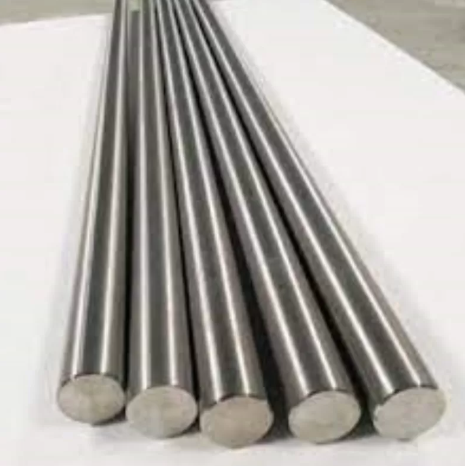
Corrosion Resistance
Alloy 625 has withstood many corrosive environments. In alkaline, salt water, fresh water, neutral salts, and in the air, almost no attack occurs. The nickel and chromium provide resistance to oxidizing environments. Nickel and molybdenum provide for resistance to nonoxidizing atmospheres. Pitting and crevice corrosion are prevented by molybdenum. Niobium stabilizes the alloy against sensitization during welding. Chloride stress-corrosion cracking resistance is excellent. The alloy resists scaling and oxidation at high temperatures.
Pickling
Sodium hydride baths are necessary to descale this alloy. After the sodium hydride treatment, the material should be immersed in a sulfuric acid bath 165°F (74°C) for approximately 3 minutes. A 25-minute immersion in a nitric-hydrofluoric bath 145°F (63°C) is then necessary. Rinse. Sulfuric solution: 16% by weight, H2SO4. Nitric solution: 8% HNO3 by weight and 3% HF by weight. Acid etching for macro-inspection-expose material electrolytically to a 3-to-1 HCl to HNO3 solution, saturated with CuCl2 at a current density of 0.645 amp/in² (25.4 A/m)
Physical Properties
| Physical Property | °C | Metric Units | °F | British Units |
| Density | 22 | 8.44 g/cubic cm | 72 | 0.305 lb/cubic in. |
| Electrical Resistivity |
23 100 200 300 400 500 600 |
1.26 microhm-m 1.27 1.28 1.29 1.30 1.31 1.32 |
74 212 392 572 752 932 1112 |
49.6 microhm-in. 50.0 50.4 50.8 51.2 51.6 52.0 |
| Mean Coefficient of Thermal Expansion |
20-204 20-316 20-427 20-538 20-649 20-760 20-871 20-982 |
13.1 x 10(-6)m/m-°C 13.5 13.9 14.4 15.1 15.7 16.6 17.3 |
68-400 68-600 68-800 68-1000 68-1200 68-1400 68-1600 68-1800 |
7.3 microinches/in.-°F 7.5 7.7 8.0 8.4 8.7 9.2 9.6 |
| Thermal Conductivity |
23 100 200 300 400 500 600 |
9.8 W/M-°C 11.4 13.4 15.5 17.6 19.6 21.3 |
74 212 392 572 752 932 1112 |
68 Btu-in./ft².-hr.-°F 79 93 108 122 136 148 |
| Specific Heat |
0 100 200 300 400 500 600 |
429 J/kg-°C 446 463 480 496 513 560 |
32 212 392 572 752 932 1112 |
0.102 Btu/lb-°F 0.107 0.111 0.115 0.118 0.123 0.134 |
Average Dynamic Modulus of Elasticity
| Form | Condition | Test Temp., F(C) |
Average Dynamic Modulus of Elasticity, psi x 10(6) (MPa) |
| Plate, 3/8 in. (9.5 mm) thick |
Annealed at 1925°F (1052°C), rapid cooled |
Room 200 (93) 400 (204) 600 (316) 800 (427) 1000 (538) 1200 (649) 1400 (760) 1600 (871) 1800 (982) |
30.2 (208,000) 29.2 (201,000) 28.8 (199,000) 27.7 (191,000) 26.7 (184,000) 25.6 (176,000) 24.3 (168,000) 22.8 (157,000) 21.2 (146,000) 18.7 (129,000) |
Average of five tests at each temperature.
Mechanical Properties
Average Impact Strength, Plate
| Aging Temperature, F (C) |
Aging Time, hrs. | Average Charpy V-Notch Impact Strength, |
|
| ft. lbs. | J | ||
| Annealed | — | 81 | 110 |
| 1200 (649) | 1000 4000 8000 16000 |
11 8 5 4 |
15 11 7 5 |
| 1400 (760) | 1000 4000 8000 16000 |
5 4 5 4 |
7 5 7 5 |
| 1600 (871) | 1000 4000 8000 16000 |
12 11 15 14 |
16 15 20 19 |
Average of four tests on 1/2-in. (12.7mm) plate from a single heat.
1875F (1024C), rapid cooled.
Average Hardness and Tensile Data, Room Temperature
Condition |
Form |
Ultimate
|
Yield
|
Elongation
|
Hardness,
|
Annealed at
|
Sheet
|
132.0 (910) |
67.9 (468) |
47 |
B94 |
Annealed at
|
Sheet,*
|
131.5 (907) |
67.4 (465) |
45 |
B97 |
Annealed at
|
Plate,***
|
132.0 (910)
|
65.5 (452)
|
46
|
B94
|
*Based on average of 146 tests
**Based on average of 67 tests.
***Based on average of 4 or less tests.
Aged Hardness, Room Temperature
| Form | Aging Temperature, F (C) |
Aging Tme, hrs. | Hardness, Rockwell A |
| Plate, 1/2 in. (12.7 mm) thick |
Annealed** | — | 58 |
| 1200 (649) | 1000 4000 8000 |
68 68 68 |
|
| 1400 (760) | 1000 4000 8000 |
65 66 65 |
|
| 1600 (871) | 1000 4000 8000 |
60 60 60 |
*Single tests from a single heat.
**1875F (1024C), rapid cooled.
Average Tensile Data, Room Temperature
Form |
Aging Temperature,
|
Aging Tme, hrs. |
Ultimate
|
Yield
|
Elongation
|
Plate,
|
Annealed** |
— |
127.7 (880) |
66.2 (456) |
46 |
1200 (649) |
1000
|
165.0 (1138)
|
122.3 (843)
|
28
|
|
1400 (760) |
1000
|
142.9 (985)
|
95.5 (658)
|
17
|
|
1600 (871) |
1000
|
130.0 (896)
|
68.3 (471)
|
30
|
*Average of three tests from a single heat.
**1875F (1024C), rapid cooled.
Average Tensile Data, Sheet
| Test Temperature, °F(°C) |
Ultimate Tensile Strength, ksi (MPa) |
Yield Strength at 0.2% offset,ksi (MPa) |
Elongation in 2″ percent |
| Room 200 400 600 800 1000 1200 1400 1600 1800 2000 |
138.8 (957) 133.3 (919) 129.4 (892) 125.6 (866) 122.2 (843) 119.9 (827) 119.6 (825) 88.4 (609) 52.1 (359) 25.0 (172) 13.3 (92) |
72.0 (496) 67.3 (464) 62.2 (429) 59.5 (410) 59.2 (408) 58.8 (405) 57.0 (393) 55.3 (381) 34.9 (241) 10.8 (75) 6.1 (42) |
38 41 44 45 45 46 47 70 69 108 89 |
*Annealed at 1925°F (1052°C), rapid cooled.
Average Rupture Data, Sheet
| Test Temperature, °F(°C) |
Average Rupture Strength, ksi (MPa) for Time Indicated |
||
| 10 hrs | 100 hrs | 1000 hrs | |
| 1200 (649) 1400 (760) 1600 (871) |
82 (565) 36 (248) 12 (83) |
71 (490) 27 (186) 6.7 (46) |
60 (414) 20 (138)** 3.7 (26)** |
*Annealed at 1925°F (1052°C), rapid cooled.
**Extrapolated
Heat Treatment
Alloy 625 has three basic heat treatments:
(1)High Solution Anneal – 2000/2200°F (1093/1204°C), air quench or faster.
(2)Low Solution Anneal – 1700/1900°F (927/1038°C), air quench or faster.
(3)Stress Relieve – 1650°F (899°C), air quench.
The time at the above temperatures depends on volume and section thickness. Strip, for example, would require shorter times than large sections. Temperatures for treatments No. 1 and 2 are generally held for 1/2 to 1 hour, 1 to 4 hours for treatment No. 3.
Treatment No. 1 is not commonly used for applications below 1500°F (816°C). It is generally used above 1500°F and where resistance to creep is important. The high solution anneal is also used to develop the maximum softness for mild processing operations such as cold rolling or drawing.
Treatment No. 2 is the used treatment and develops an optimum combination of tensile and rupture properties from ambient temperatures to 1900°F (1038°C). Ductility and toughness at cryogenic temperatures are also very good.
Treatment No. 3 is recommended for application below 1200°F (649°C) when maximum fatigue, hardness, tensile and yield strength properties are desired. Ductility and toughness at cryogenic temperatures are excellent. When a fine grain size is desired for fatigue, tensile and yield strengths up to 1500°F (816°C), treatment No. 3 is sometimes used.
Workability
Hot Working
Hot working may done at 2100°F (1149°C) maximum furnace temperature. Care should be exercised to avoid frictional heat build-up which can result in overheating, exceeding 2100°F (1149°C). Alloy 625 becomes very stiff at temperatures below 1850°F (1010°C). Work pieces that fall below this temperature should be reheated. Uniform reductions are recommended to avoid the formation of a duplex grain structure. Approximately 15/20% reduction is recommended for finishing.
Cold Forming
Alloy 625 can be cold formed by standards methods. When the material becomes too stiff from cold working, ductility can be restored by process anneal.
Machineability
Low cutting speeds, rigid tools and work piece, heavy equipment, ample coolant and positive feeds are general recommendations.
High-Speed Cutting Tools for Lathe Turning Operations
| Angle | Roughing | Finishing |
| Back rake Positive side rake End clearance End cutting edge Side cutting edge |
0°
6° |
8° 14-18° 8° 25° Up to 45° |
Cutting Speeds for High-Speed Steels
| Operation | Speed | Feed | ||
| sfpm | m/s | ipr | mm/rev | |
| Turning Drilling (.500″/12.70mm) Tapping Milling Reaming |
12-20 10-12 5-10 10-20 8-10 |
0.06/.010 0.05/0.06 0.03/0.05 0.05/0.10 0.04/0.05 |
0.010 0.006/0.010 — — — |
0.25 0.15/0.25 — — — |
Carbide tools should have smaller angles than high-speed tools and operating speeds can be higher. A sulfur-based cutting fluid is recommended. Thoroughly clean work piece after machining to prevent surface contamination during subsequent heat treating. Chlorine additives would be an alternative.
Weldability
Welding can be accomplished by the gas-shielded processes using a tungsten electrode or a consumable electrode. Postweld heat treatment of the weld are not necessary to maintain corrosion resistance. Heavy restrained sections can be welded and the weld’s mechanical properties follow the same trends as base metal properties. Standard practices such as clean surfaces, good joint alignment, U-joints for thicker sections, etc., should be followed.