
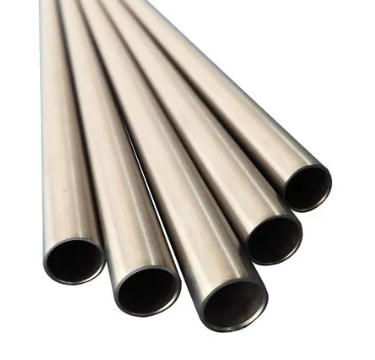
| Item | Details |
|---|---|
| Executive Standards and Scope |
1. Material Grade: Titanium Grade 9, Ti-3Al-2.5V, UNS R56320. 2. ASTM B338/B338M: May apply to seamless or welded titanium and titanium-alloy tubes for condenser and heat-exchanger service when the ordered dimensions, construction, condition, tests, and application fall within the standard scope. 3. SAE AMS4943: Applies to annealed seamless Ti-3Al-2.5V hydraulic tubing when specifically required by an aerospace or project specification. 4. ASTM B861: Covers seamless titanium and titanium-alloy pipe and should not be used as an automatic substitute for a tube specification. 5. Automotive Projects: Automotive tube orders may require customer drawings, internal OEM or Tier-1 specifications, pressure-fatigue validation, cleanliness controls, forming trials, joining qualification, and part approval requirements beyond a general material standard. 6. Contract Priority: The final purchase order shall identify the governing product standard, edition, construction, supplied condition, dimensions, tolerances, inspection, certification, and acceptance criteria. |
| Material Grade |
1. Grade: Titanium Grade 9. 2. UNS Designation: UNS R56320. 3. Nominal Alloy Description: Ti-3Al-2.5V, an alpha-beta titanium alloy with intermediate strength and useful cold-forming capability. 4. Common Product Conditions: Annealed, cold worked and stress relieved, or another specification-controlled condition. 5. Construction: Seamless or welded tube can be reviewed only when permitted by the selected product standard and purchase specification. 6. Selection Boundary: Grade 9 should not be treated as automatically interchangeable with Grade 2, Grade 5, Grade 18, or another Ti-3Al-2.5V specification. |
| Chemical Composition (Weight %) |
Reference limits for ASTM Grade 9 / UNS R56320; the current standard and Material Test Certificate control final acceptance: 1. Aluminum (Al): 2.5–3.5 2. Vanadium (V): 2.0–3.0 3. Iron (Fe): ≤0.25 4. Oxygen (O): ≤0.15 5. Carbon (C): ≤0.08 6. Nitrogen (N): ≤0.03 7. Hydrogen (H): ≤0.015 8. Residual Elements (each): ≤0.10 9. Residual Elements (total): ≤0.40 10. Titanium (Ti): Balance Grade 18 contains a palladium addition and is a separate material designation; it should not be represented as Grade 9. |
| Mechanical Properties and Supplied Condition |
1. Producer reference data for annealed Ti-3Al-2.5V list minimum room-temperature values of approximately 620 MPa tensile strength, 483 MPa yield strength, and 15% elongation. 2. Cold-worked and stress-relieved conditions may provide higher strength with reduced remaining ductility. 3. The required mechanical properties must be taken from the governing product specification, tube size, wall thickness, condition, orientation, and purchase order. 4. Hardness, fatigue strength, bend radius, burst pressure, and pressure-cycle life should not be assigned as universal Grade 9 values. 5. Mechanical test results shall be linked to the supplied heat or lot and reported on the applicable certification package. |
| Typical Physical Properties |
The following are typical reference values and are not universal product-acceptance limits: 1. Density: approximately 4.48 g/cm³. 2. Beta Transus: approximately 935 ±15°C. 3. Melting or Liquidus Temperature: approximately 1700°C. 4. Thermal Conductivity: approximately 8.3 W/m·K at room temperature. 5. Mean Thermal Expansion Coefficient: approximately 9.61 µm/m·°C from room temperature to about 95°C. 6. Young’s Modulus: approximately 95–105 GPa at room temperature. 7. Poisson’s Ratio: typically about 0.30. Actual values vary with product direction, temperature, condition, chemistry, microstructure, and manufacturing history. |
| Grade 9 Compared with Grade 2 and Grade 5 |
1. Grade 9 generally provides substantially higher strength than commercially pure Grade 2 while retaining better cold-forming capability than Grade 5. 2. Grade 5 normally offers higher strength, but its forming requirements and final-property controls may differ from Grade 9. 3. Grade 2 may be preferred where maximum formability or specific corrosion-service experience is more important than increased strength. 4. Grade 9 is not automatically the lowest-cost option after material price, tooling, joining, qualification, inspection, scrap, and production volume are considered. 5. Final selection should be based on the complete component design, loading, environment, manufacturing route, joining method, and required service life. |
| Tube Dimensions and Delivery Form |
1. Outside Diameter: Project-specific OD ranges can be reviewed according to construction, condition, quantity, wall thickness, and standard. 2. Wall Thickness: Nominal or minimum wall requirements must be stated clearly together with the permitted tolerance. 3. Length: Straight lengths, cut lengths, or coils can be reviewed subject to manufacturing capability and transport requirements. 4. Dimensional Characteristics: OD, wall, inside diameter where critical, ovality, eccentricity, straightness, length, and end condition should be defined in the RFQ. 5. Custom Tolerances: Tighter tolerances require a feasibility review covering measurement method, uncertainty, sampling, tooling, production route, and order quantity. 6. Drawing Review: A finished-tube drawing is recommended for assemblies involving bending, flaring, beading, fittings, or calibrated flow. |
| Manufacturing Route |
1. Seamless tube may be produced through hollow preparation, cold reduction, drawing, intermediate heat treatment, final drawing, straightening, and finishing. 2. Welded tube requires control of strip condition, forming, weld-seam quality, heat treatment, dimensional reduction where applicable, and weld inspection. 3. Drawing reductions, tooling alignment, lubrication, annealing atmosphere, straightening, and coil diameter can affect wall eccentricity, ovality, surface quality, residual stress, and formability. 4. The supplier should confirm which processes are performed in-house and which operations are subcontracted when this is contractually relevant. 5. Changes to the approved manufacturing route may require purchaser notification, a new first article, or requalification. |
| Heat Treatment and Condition |
1. Annealed Grade 9 generally supports forming and welding requirements where moderate strength and remaining ductility are needed. 2. Cold-worked and stress-relieved Grade 9 may be selected where higher strength or fatigue performance is required under an applicable specification. 3. Producer reference data identify annealing, stress-relieving, solution-treatment, and ageing ranges, but these should not be applied as universal instructions for every tube size or component. 4. Heat treatment influences tensile properties, ductility, residual stress, microstructure, dimensional stability, and forming response. 5. The ordered condition and final heat-treatment responsibility must be clearly stated before production. |
| Forming and Bending Guidance |
1. Grade 9 is valued for a useful balance between strength and formability, but achievable bend radius depends on OD, wall, condition, tooling, lubrication, bend method, and orientation. 2. A universal 1D bend radius, 30% expansion, or flare limit should not be promised without representative trials. 3. Thin-wall tubing may require a mandrel, wiper die, controlled boost, or internal support to reduce wrinkling, flattening, wall thinning, and ovality. 4. Forming acceptance should define ovality, wall thinning, wrinkling, cracking, springback, and dimensional limits. 5. First-article forming trials are recommended for new size, condition, tooling, or assembly combinations. |
| Welding and Joining |
1. Ti-3Al-2.5V can be welded using qualified titanium welding procedures when joint surfaces and shielding are properly controlled. 2. The weld pool, root, and adjacent heated surfaces require effective protection from oxygen, nitrogen, and hydrogen. 3. Weld strength retention, ductility, fatigue performance, and the need for post-weld treatment depend on the joint design, tube condition, filler, heat input, shielding, and application specification. 4. Brazing, mechanical fittings, flaring, orbital welding, laser welding, or another joining method must be qualified for the actual component. 5. Automotive and pressure-fluid assemblies may require leak, burst, pressure-cycle, vibration, cleanliness, corrosion, and assembly validation. |
| Surface Finish and Cleanliness |
1. Possible delivered surfaces include cold drawn, pickled, bright annealed, mechanically finished, or another agreed condition. 2. Surface roughness must be defined by parameter, measurement direction, method, sampling plan, and acceptance limit. 3. Tubes for fluid transfer may require controls for oil, particles, moisture, drawing lubricant, oxide, fibres, and cleaning residue. 4. End cutting must prevent burr intrusion, collapse, contamination, and fitting damage. 5. Electropolishing should not be listed as a standard Grade 9 tube finish unless the process, dimensional change, surface requirement, and application compatibility are specifically approved. |
| Pressure, Fatigue, and Functional Validation |
1. Pressure capacity depends on OD, minimum wall, material condition, temperature, eccentricity, surface condition, joint design, applicable code, and safety factor. 2. Grade 9 tube should not be assigned a universal 350 bar working pressure or fixed burst pressure. 3. Fatigue performance depends on mean stress, stress range, pressure cycles, vibration, bends, welds, fittings, surface condition, environment, and residual stress. 4. Safety-critical fluid lines require system-level design and validation rather than approval from material strength alone. 5. Depending on the application, validation may include hydrostatic, pneumatic, helium-leak, burst, impulse, vibration, thermal-cycle, corrosion, flow, and cleanliness testing. |
| Inspection and Nondestructive Testing |
1. Standard Inspection: Chemical composition, tensile properties, dimensions, surface condition, workmanship, marking, and documentation according to the governing specification. 2. Eddy-Current Testing: Can be applied when required by the tube standard or purchase order and when calibration, reference defects, coverage, sensitivity, and acceptance criteria are agreed. 3. Ultrasonic Testing: Can be reviewed where tube dimensions and the required defect sensitivity make the method suitable. 4. Pressure or Leak Testing: Hydrostatic, pneumatic, or leak testing shall be specified by method, pressure, medium, hold time, safety controls, and acceptance criteria. 5. PMI and Third-Party Inspection: Can be arranged when contractually required. 6. Testing Boundary: “100% NDT” is incomplete unless the exact method, calibration, coverage, sensitivity, and rejection criteria are defined. |
| Documentation and Traceability |
1. Material Test Certificate with heat-specific chemistry and mechanical properties. 2. Heat and lot identification linked to product labels, inspection records, packing list, and certificate package. 3. EN 10204 3.1 documentation when specified in the contract. 4. Dimensional, NDT, pressure, leak, cleanliness, or third-party reports when ordered. 5. Construction, supplied condition, standard, grade, UNS number, size, and quantity identified on the release documents. 6. Automotive quality records, PPAP documents, control plans, process capability, or customer-specific submissions are available only when specifically agreed and supported by the manufacturing route. |
| Automotive Application Guidance |
Grade 9 tubing may be evaluated for selected high-performance, motorsport, prototype, premium, or weight-sensitive vehicle applications where titanium provides a justified system-level advantage. Possible screening areas include lightweight fluid lines, heat-resistant small-bore lines, fabricated exhaust or intake components, specialty cooling circuits, structural tubing, and custom performance assemblies. It should not be presented as the universal or lowest-cost material for mass-market brake, fuel, refrigerant, battery-cooling, suspension, or safety-system tubing. Each application requires validation of pressure, fatigue, impact, joining, fire behaviour, fluid compatibility, galvanic interaction, cost, manufacturability, repair, regulatory requirements, and vehicle-level qualification. |
| Aerospace and Precision Hydraulic Applications |
Ti-3Al-2.5V has established use in aerospace hydraulic tubing and lightweight structures. AMS4943 covers annealed seamless hydraulic tubing, while other AMS or customer specifications may define cold-worked and stress-relieved conditions, contractile strain ratio, cleanliness, inspection, or pressure requirements. An ASTM Grade 9 tube order does not automatically satisfy an aerospace AMS specification, aircraft-prime specification, or approved-source requirement. |
| Other Potential Applications |
1. Bicycle frames and performance sporting equipment. 2. Lightweight industrial piping and pressure-containing components where the applicable design code permits the alloy. 3. Marine and offshore instrument or fluid-handling tubing after environment and galvanic review. 4. Precision fabricated tube assemblies requiring a balance of strength, formability, weldability, and low density. 5. Heat-exchanger or condenser service only when the selected grade, dimensions, construction, and environment comply with ASTM B338/B338M and the equipment design requirements. |
| Value-Added Processing |
1. Cut-to-length supply and controlled end preparation. 2. Bending, coiling, flaring, expanding, beading, swaging, or end forming subject to feasibility review and approved acceptance criteria. 3. Cleaning, drying, capping, and application-specific packaging. 4. Dimensional inspection and first-article documentation. 5. Assembly or fitting coordination only when drawings, joining procedure, inspection, and responsibility boundaries are agreed. |
| Packaging and Marking |
1. Straight tubes can be bundled or packed in wooden cases with suitable separators and end protection. 2. Coils can be supported to control coil diameter, crushing, kinking, and transit movement. 3. Clean fluid-service tubes can be capped or sealed after the agreed cleaning and drying process. 4. Different heats, lots, sizes, and conditions can be separated and clearly identified. 5. Product labels can include grade, UNS number, standard, construction, condition, size, heat number, lot number, length, quantity, and purchase-order reference. |
| Why Choose Emily PIPE |
1. More than 20 years of alloy-material production and export experience. 2. Supply support for standard and project-specific titanium tube requirements. 3. Review of material grade, standard, construction, condition, dimensions, tolerances, testing, documentation, and packaging before quotation. 4. Material traceability and inspection documentation according to agreed purchase requirements. 5. Dimensional, surface, PMI, NDT, pressure, and third-party inspection support when specified and technically applicable. 6. Cutting, forming, cleaning, end preparation, and export packaging services subject to a feasibility review. 7. Direct communication for drawings, specifications, application conditions, delivery requirements, and quotation clarification. |
| RFQ Information Required |
For an accurate quotation, please provide: 1. Titanium Grade 9, Ti-3Al-2.5V, and UNS R56320 confirmation. 2. Governing ASTM, AMS, ASME, customer, or project specification and edition. 3. Seamless or welded construction. 4. Annealed, cold-worked and stress-relieved, or another required condition. 5. OD, wall thickness, inside diameter where critical, length or coil requirement, and quantity. 6. Dimensional tolerances, ovality, straightness, surface finish, cleanliness, and end condition. 7. Forming, bending, welding, fittings, pressure, leak, fatigue, or functional-test requirements. 8. MTC, EN 10204 3.1, NDT, pressure-test, cleanliness, first-article, PPAP, or third-party documentation requirements. 9. Packaging, destination, Incoterms, and required delivery date. 10. Operating fluid, temperature, pressure, cycles, vibration, environment, and failure consequence when technical review is requested. |
| Buyer Questions |
What is Titanium Grade 9 tube? Is ASTM B338 a general automotive tubing standard? What does AMS4943 cover? Can Grade 9 tube be used for brake or fuel lines? Is every Grade 9 tube pressure tested and eddy-current tested? Can custom sizes and formed assemblies be supplied? |
Packaging
Export packaging is selected according to tube construction, OD, wall, length or coil form, surface condition, cleanliness, quantity, and transport method. Available controls can include bundles, supported coils, separators, end caps, sealed bags, waterproof wrapping, wooden cases, heat separation, and clear product identification.
Get Consultation & Quote
Send the grade, standard, construction, supplied condition, OD, wall, length, quantity, tolerances, forming requirements, inspection documents, destination, and delivery date to emilymetalsh@163.com. Drawings and operating conditions can also be reviewed for project-specific tubing and fabricated assemblies.