
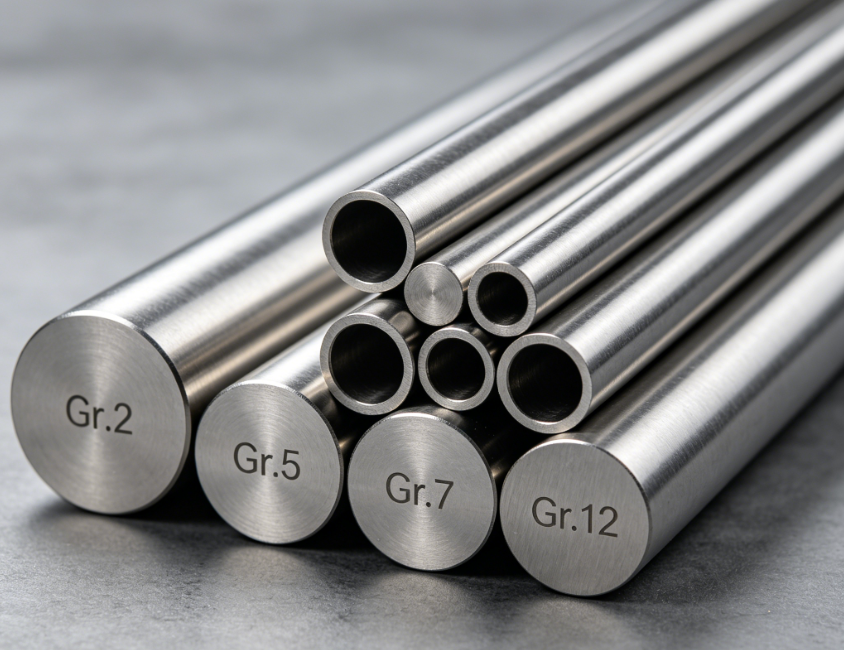
As a leading China-based titanium alloy manufacturer with over 20 years of experience, we supply precision-manufactured titanium products fully certified to ASME Section III, NQA-1 and ISO nuclear standards. From conventional PWR/BWR plants to advanced small modular reactors (SMRs) and fusion energy projects, our nuclear-grade titanium alloys deliver reliable performance that meets the demanding safety requirements of the global nuclear industry.
| Item | Details |
|---|---|
| Executive Standards | 1. International Material Standards: ASTM B337 (Seamless Pipe), ASTM B338 (Welded Pipe), ASTM B348 (Bar/Rod)
2. Nuclear Power Standards: ASME Section III, NQA-1, RCC-M, KTA 3201 3. Pressure Vessel Standards: ASME Section VIII Div.1 4. Testing Standards: ASTM E8, ASTM G31 (Corrosion), ASTM E243 (Eddy Current) 5. Quality Management Standards: ISO 9001, ISO 14001 |
| Material Grades | 1. Titanium Grade 2 (UNS R50400): Commercially pure titanium, most widely used nuclear grade, excellent general corrosion resistance
2. Titanium Grade 5 (UNS R56400): Ti-6Al-4V, high-strength alloy for structural components and pressure vessels 3. Titanium Grade 7 (UNS R52400): Ti-0.2Pd, superior crevice corrosion resistance in low-pH and chloride-containing environments 4. Titanium Grade 12 (UNS R53400): Ti-0.3Mo-0.8Ni, excellent high-temperature corrosion resistance up to 425℃ |
| Chemical Composition (Weight %) | Grade 2: Ti≥99.2, O≤0.25, Fe≤0.30, C≤0.08, N≤0.03, H≤0.015
Grade 5: Ti=Balance, Al5.5-6.75, V3.5-4.5, Fe≤0.30, O≤0.20, C≤0.08, N≤0.05, H≤0.015 Grade 7: Ti=Balance, Pd0.12-0.25, O≤0.25, Fe≤0.30, C≤0.08, N≤0.03, H≤0.015 Grade 12: Ti=Balance, Mo0.2-0.4, Ni0.6-0.9, O≤0.25, Fe≤0.30, C≤0.08, N≤0.03, H≤0.015 Note: Palladium addition in Gr.7 significantly improves crevice corrosion resistance in stagnant nuclear coolant |
| Mechanical Properties (Annealed State) | Grade 2: Tensile≥345MPa, Yield≥275MPa, Elongation≥20%, HB≤120
Grade 5: Tensile≥895MPa, Yield≥825MPa, Elongation≥10%, HB≤300 Grade 7: Tensile≥345MPa, Yield≥275MPa, Elongation≥20%, HB≤120 Grade 12: Tensile≥485MPa, Yield≥380MPa, Elongation≥18%, HB≤160 Neutron Absorption Cross-Section: 5.6 barns (Ti), 1/10 of stainless steel Max Service Temp: Gr.2/7: 315℃; Gr.12: 425℃; Gr.5: 400℃ |
| Dimensional Tolerance | 1. Seamless Pipes/Tubes: Ø6-50mm ±0.1mm; Ø50-150mm ±0.2mm; Wall thickness ±0.05-0.1mm
2. Welded Pipes: Ø10-300mm ±0.15mm; Wall thickness ±0.08mm 3. Round Bars/Rods: Ø6-50mm ±0.1mm; Ø50-150mm ±0.2mm; Ø150-300mm ±0.3mm 4. U-Bend Tubes: Bend radius ±0.5mm; Ovality at bend ≤3% of OD 5. Length Tolerance: ±2mm (1-6m); custom lengths up to 12m available |
| Why These Materials Are Used in Nuclear Power Industry | 1. Unmatched Boric Acid Corrosion Resistance:
– Virtually immune to corrosion in high-temperature (300℃) boric acid coolant used in PWRs – Corrosion rate <0.001mm/year vs. >0.1mm/year for 316L stainless steel – Eliminates frequent tube failures in heat exchangers and coolant systems – No metal ion release that could contaminate the reactor coolant 2. Ultra-Low Neutron Absorption: – Titanium has one of the lowest neutron absorption cross-sections among structural metals – Minimizes neutron activation, reducing radioactive waste generation – Components remain less radioactive during service and decommissioning – Ideal for spent fuel storage and transportation systems 3. Superior Stress Corrosion Cracking Resistance: – Immune to chloride-induced SCC in high-temperature water environments – Resists cracking in oxygenated and deoxygenated nuclear coolant – Eliminates the most common failure mode in nuclear piping systems 4. Excellent Radiation Stability: – Maintains mechanical properties after long-term exposure to neutron radiation – Minimal ductility loss and no significant embrittlement – Suitable for 60+ year design life of modern nuclear power plants 5. Superior Cost-Effectiveness: – While initial cost is 3-5x higher than 316L, 10-20x longer service life reduces total cost of ownership by 60-80% – Eliminates costly maintenance and replacement of stainless steel components – Reduces decommissioning costs by minimizing radioactive waste |
| Application Scenarios and Corresponding Customers | 1. PWR/BWR Conventional Nuclear Plants:
– Applications: Boric acid storage and transfer piping, heat exchanger tubes, condenser tubes, auxiliary cooling systems – Customers: Westinghouse, Areva, EDF, China National Nuclear Corporation, China General Nuclear Power Group 2. Radioactive Waste Management: – Applications: High-level waste tank liners, waste transfer piping, filter housings, ion exchange systems – Customers: Orano, Cameco, China National Nuclear Corporation, US Department of Energy 3. Spent Fuel Storage and Transportation: – Applications: Spent fuel pool components, storage racks, transportation cask liners, heat exchangers – Customers: Holtec International, NAC International, China Nuclear Engineering Corporation 4. Nuclear Fuel Cycle: – Applications: Uranium enrichment piping, fuel fabrication equipment, reprocessing plant components – Customers: Urenco, Orano, China National Nuclear Corporation 5. Advanced Small Modular Reactors (SMRs) and Fusion Energy: – Applications: Coolant systems, heat exchangers, structural components, vacuum vessel parts – Customers: NuScale Power, Rolls-Royce SMR, ITER, China Fusion Engineering Test Reactor |
| Customer Requirements in This Industry | 1. Performance Requirements:
– Boric Acid Corrosion Resistance: Must resist corrosion in high-temperature boric acid coolant – Low Neutron Absorption: Must minimize neutron activation and radioactive waste – Stress Corrosion Resistance: Must be immune to SCC in high-temperature water – Radiation Stability: Must maintain properties after long-term neutron exposure – Weldability: Must be easily weldable while retaining corrosion resistance 2. Quality and Compliance Requirements: – Nuclear Certification: Must meet ASME Section III and NQA-1 requirements – Full Traceability: Must provide complete traceability from titanium sponge to finished product – Material Certification: Must provide comprehensive MTRs including chemical analysis and mechanical properties – Third-Party Inspection: Must allow inspection by nuclear industry authorized inspectors – Cleanliness Requirements: Must meet strict cleanliness standards for nuclear applications 3. Manufacturing Requirements: – Precision Dimensional Tolerances: Must meet tight tolerances for proper fit and assembly – Surface Quality: Must have smooth, defect-free surfaces to prevent corrosion initiation – Internal Quality: Must be free from inclusions, porosity and segregation (100% UT/ET verified) – Consistent Quality: Must have uniform chemical composition and mechanical properties across all batches – Customization: Must produce custom sizes and shapes per customer drawings |
| Common Related Products in This Industry | 1. Titanium Seamless Pipes/Tubes: For boric acid systems, heat exchangers and auxiliary piping
2. Titanium Welded Pipes: Cost-effective solution for large-diameter process piping 3. Titanium U-Bend Tubes: Custom bent tubes for nuclear heat exchangers and condensers 4. Titanium Round Bars/Rods: For valve stems, pump shafts, fasteners and structural components 5. Titanium Forgings: Custom forgings including valve bodies, pump casings and flanges 6. Titanium Fasteners: Bolts, nuts, screws, studs and washers for nuclear applications 7. Titanium Welding Materials: ERTi-2, ERTi-5, ERTi-7 and ERTi-12 welding wires 8. Titanium Sheets and Plates: For tank liners, spent fuel pool components and structural parts 9. Titanium Machined Components: Precision-machined valves, fittings and pump parts 10. Custom Fabricated Assemblies: Pre-fabricated piping spools and heat exchanger bundles |
| Why Choose Us (Emily PIPE) | 1. 20+ Years of Nuclear Titanium Expertise: We have supplied titanium products to over 50 nuclear projects worldwide
2. Full ASME and NQA-1 Certification: Our production facility meets the strictest nuclear industry standards 3. Complete Grade Range: We offer all four nuclear titanium grades in one place, simplifying your supply chain 4. Full-Process Quality Control: We implement 100% ultrasonic, eddy current and hydrostatic testing on all products 5. Advanced Manufacturing Capabilities: We use state-of-the-art equipment to produce precision nuclear titanium products 6. Strategic Inventory Management: We maintain 200+ tons of nuclear titanium inventory to support urgent requirements 7. Global Nuclear Supply Chain Experience: We have extensive experience delivering to nuclear sites worldwide 8. One-Stop Solution: We provide complete solutions from raw material supply to pre-fabricated assemblies |
| Supplementary Industry Information | 1. Comprehensive Test Reports: Each batch comes with a full MTR including chemical analysis, mechanical properties and NDT results. Corrosion test reports available upon request
2. Full Material Traceability: Every product has a unique heat number and complete traceability documentation from ingot to finished product 3. Value-Added Processing: We offer precision cutting, CNC bending, welding, end processing and surface finishing services 4. Emergency Response Service: We provide 24/7 emergency support for nuclear plant shutdown requirements 5. Market Growth: The global nuclear titanium market is projected to grow at a CAGR of over 9% through 2030, driven by SMR development and nuclear plant life extension programs 6. Sustainability Commitment: All our titanium products are manufactured using sustainable practices and are 100% recyclable |
| Packaging | 1. Plastic Caps: All tube/bar ends are protected with heavy-duty polyethylene caps with internal sealing rings to prevent contamination
2. Waterproof Film: Each product is individually wrapped in waterproof and anti-corrosion film 3. Bundle Packing: Products of the same size are bundled with steel straps and wooden spacers to prevent contact damage 4. Wooden Case: Bundles are packed in sturdy fumigated wooden cases with steel reinforcement for international shipping 5. Export Standard Packing: All packaging complies with international export standards and ISPM 15 regulations 6. Marking: Each package is clearly marked with product specifications, heat number, batch number, quantity and destination |
Looking for nuclear-grade titanium pipe, bar or forging? Send us your dimensions, application requirements and nuclear standards. We will provide a customized solution and competitive quotation.