
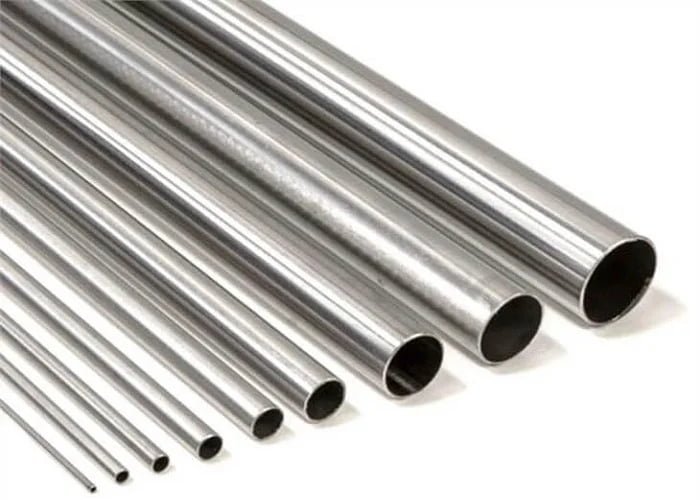
Hastelloy C-276 (UNS N10276 / W.Nr. 2.4819) is a very commonly used nickel-chromium-molybdenum alloy. Among superalloys, it is known for its high molybdenum content.
Nominal Composition
| Weight % | |
| Nickel | 57 Balance |
| Cobalt | 2.5 max. |
| Chromium | 16 |
| Molybdenum | 16 |
| Iron | 5 |
| Tungsten | 4 |
| Manganese | 1 max. |
| Vanadium | 0.35 max. |
| Silicon | 0.08 max. |
| Carbon | 0.01 max. |
| Copper | 0.5 max. |
Physical Properties
| Density | g/cm3 | 8.89 | |
|---|---|---|---|
| lb/in.3 | 0.321 | ||
| Melting Range | °F | 2415 – 2500 | |
| °C | 1323 – 1371 | ||
| Poisson’s Ratio | 0.31 | ||
| Magnetic Permeability | 200 oersted | 1.0002 | |
| 15.9 kA/m | 1.0002 | ||
Corrosion Resistance
First, Hastelloy C-276 alloy exhibits extremely high resistance to chloride-induced pitting and crevice corrosion. These forms of corrosion are particularly prone to occur in austenitic stainless steels.
Second, similar to other nickel alloys, one of the key features of Hastelloy C-276 is its resistance to chloride-induced stress corrosion cracking.
Additionally, Hastelloy C-276 has demonstrated exceptional ability to resist seawater corrosion. Sea water is the most common salt water solution. It is widely used in marine and offshore oil rigs and as a coolant in coastal installations.
Finally, although the microstructural inhomogeneity of the weld may result in slightly higher corrosion rates (relative to a uniformly forged product), Hastelloy C-276 is still able to resist corrosion in the weld area and exhibit excellent performance.
Mechanical Behavior
Hastelloy C-276 is a solid solution alloy. This alloy has good solid solution strengthening effect. Hastelloy C-276 is stronger than stainless steel, and even stronger than most solid solution alloys. Therefore, it is also easier to increase strength through cold working.
Note, however, that cold working will generally affect the resistance of Hastelloy C-276 to stress corrosion cracking. Proper annealing is very important for cold worked parts in order to achieve optimum corrosion performance. The corrosion resistance and ductility of this alloy can be improved by proper annealing process. In addition, for Hastelloy C-276, it is recommended to use a faster cooling rate for annealing.