
How Do Water and Impurities Change Alloy Selection for Wet CO2 Service?
CO₂ is often described as a corrosive gas, but this description is incomplete.
For conventional internal CO₂ corrosion, a water-containing phase is normally required. CO₂ dissolves into that water, changes the aqueous chemistry, and can cause carbon-steel dissolution. When the stream remains sufficiently dry and no separate aqueous or acidic phase develops, the internal-corrosion mechanism is fundamentally different.
The difficulty is that real process streams rarely contain only CO₂ and water.
H₂S, oxygen, chlorides, organic acids, SOx, NOx, CO, hydrogen, solids, and other contaminants can change:
- Whether a separate liquid phase forms
- The composition and pH of that liquid
- The stability of corrosion-product or passive films
- The risk of localized corrosion
- The risk of hydrogen-related or stress-corrosion cracking
- The material qualification standard that applies
Alloy selection for wet CO₂ service should therefore begin with the water state, CO₂ phase, impurity combination, temperature, pressure, and credible upset conditions—not with a generic ranking of stainless steel, nickel alloys, and titanium.
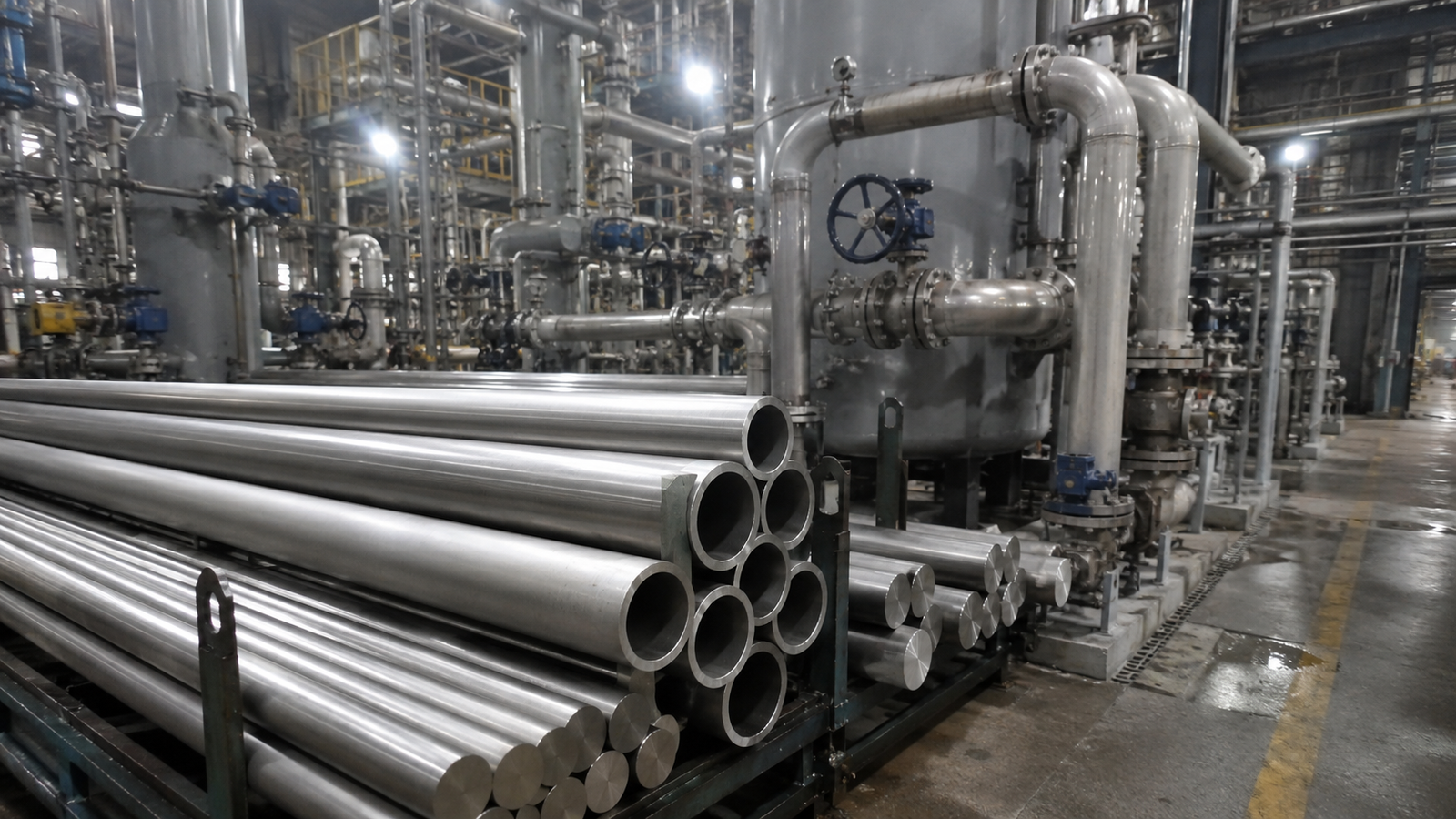
Image credit: Implicit Matrix, Wikimedia Commons, CC BY 4.0.
This article addresses wet CO₂ in hydrocarbon production, process equipment, injection systems, and gaseous or dense-phase CO₂ transport.
It does not address corrosion inside an aqueous amine solvent loop. That subject requires separate equipment-zone analysis, as discussed in alloy selection for amine carbon capture equipment.
First Determine What “Wet CO₂” Means
The word wet can describe several technically different conditions.
| Water Condition | Description | Material-Selection Significance |
|---|---|---|
| Bulk free water | A continuous or accumulated aqueous phase is present | Conventional aqueous CO₂ corrosion and dissolved-impurity effects become important |
| Water-saturated gas | Gas contains water vapour near saturation | Cooling or pressure change may create condensate |
| Intermittent condensation | Water forms during startup, shutdown, expansion, or cold-wall exposure | Short wet periods may control localized corrosion |
| Dense-phase CO₂ with dissolved water | Water is present without an initially visible bulk phase | Impurity reactions or phase changes may form acidic droplets |
| Entrained water droplets | Water is carried through the stream | Local impact, low-point accumulation, and concentration effects may occur |
| Produced brine | Water contains chlorides, bicarbonate, organic acids, metals, and other ions | Corrosivity cannot be predicted from CO₂ pressure alone |
| Dehydration upset | Water temporarily exceeds the normal specification | Material must tolerate the defined duration or the system must shut down |
A dry-stream design should therefore specify more than a normal water concentration.
It should address:
- Maximum water content
- Measurement location
- Measurement method
- Dew-point margin
- Lowest metal temperature
- Pressure and temperature transients
- Startup and shutdown
- Low points and dead legs
- Water carryover
- Duration of off-spec operation
A pipeline can meet its normal water specification and still experience corrosion if water condenses during a transient or combines with reactive impurities to form an acidic liquid phase.
Separate Hydrocarbon Wet CO₂ From CCS CO₂ Transport
The same phrase—wet CO₂ corrosion—can refer to two different engineering contexts.
| Topic | Hydrocarbon Production or Process System | CO₂ Capture and Transport System |
|---|---|---|
| Main fluid | Hydrocarbon gas or liquid containing CO₂ | Captured CO₂ stream |
| Water | Produced water, condensation, brine, or injected water | Residual capture moisture, upset water, or formed droplets |
| Typical impurities | H₂S, chlorides, organic acids, hydrocarbons, solids | O₂, SO₂, NOx, H₂S, CO, H₂, capture-solvent carryover |
| Common phase | Multiphase gas, oil, and water | Gaseous or dense-phase CO₂ |
| Common model | Oil-and-gas CO₂ corrosion models | CO₂ pipeline stream-quality and phase-behaviour assessment |
| Important standards | NORSOK M-506 and ISO 15156 where applicable | ISO 27913 and DNV-RP-F104 |
| Main cracking concern | H₂S-related SSC, SCC, HIC, and related mechanisms | Potential impurity-assisted cracking plus pipeline fracture and corrosion |
| Corrosion control | Material, allowance, inhibitor, dehydration, and monitoring | Stream specification, dehydration, impurity control, material qualification, and monitoring |
NORSOK M-506:2017 presents a recommended CO₂ corrosion-rate model for hydrocarbon production and process systems.
It should not be treated as a complete model for dense-phase CCS pipelines containing reactive capture impurities.
For CO₂ transport, ISO 27913:2024 and DNV-RP-F104 provide more relevant system frameworks.
Why Water Content Cannot Be Evaluated Alone
A single water limit may be useful for process control, but it does not describe the complete corrosion risk.
The critical question is:
What liquid phase can form from this exact CO₂ stream under the complete pressure and temperature envelope?
Reactive impurities may:
- Alter water solubility
- React with water
- Form strong acids
- Change droplet composition
- Concentrate at low points
- Create highly corrosive local environments
- Alter cracking behaviour
High-pressure testing has shown that CO₂ streams containing NO₂, or SO₂ plus O₂, can begin to corrode carbon steel at different water levels under otherwise controlled conditions.
Those experimental values should not be copied as universal pipeline specifications. They demonstrate that the water threshold depends on the impurity mixture.
How the Main Impurities Change Material Selection
H₂S: General Corrosion and Cracking Must Be Separated
H₂S does not simply add a fixed amount of corrosion to wet CO₂.
It can influence the system through:
- Formation of iron-sulfide corrosion products
- Changes in general corrosion rate
- Promotion of hydrogen entry into steel
- Sulfide stress cracking
- Hydrogen-induced cracking
- Stress-oriented hydrogen-induced cracking
- Stress corrosion cracking of susceptible CRAs
Iron-sulfide films may sometimes reduce general wall loss under particular conditions.
That does not mean the service is safe.
A material showing a low uniform corrosion rate may still be unacceptable because of cracking susceptibility.
Where the service falls within oil and gas production or natural-gas treatment, the current published ISO 15156-1:2020 and ISO 15156-3:2020 should be reviewed when contractually applicable.
The selection may depend on:
- H₂S partial pressure or fugacity
- pH
- Chloride concentration
- Temperature
- Elemental sulfur
- Material hardness
- Cold work
- Heat treatment
- Applied and residual stress
- Product form
- Weld condition
ISO 15156 addresses H₂S-related cracking resistance. It does not by itself calculate general CO₂ corrosion, establish corrosion allowance, or approve a material for every CCS transport stream.
Oxygen: Beneficial to Passivity but Potentially Harmful to the System
Oxygen can have different effects on different materials and environments.
For carbon steel, oxygen can support additional cathodic reactions and increase corrosion under some wet conditions.
For stainless steel, nickel-chromium alloys, and titanium, oxygen may support passive-film formation.
However, oxygen can also:
- Participate in reactions involving SO₂ or NO₂
- Change the chemistry of condensed droplets
- Increase localized corrosion potential
- Oxidize sulfide-containing species
- Change inhibitor or corrosion-product behaviour
The conclusion cannot be reduced to either:
- “Oxygen is always harmful,” or
- “Oxygen protects passive alloys.”
The correct conclusion depends on the complete water and impurity chemistry.
SO₂ and NO₂: Low Concentration Does Not Mean Low Importance
Captured CO₂ streams may contain sulfur- and nitrogen-oxide carryover.
When water is available, these species can contribute to strongly acidic liquid phases.
Their importance is not determined only by their gas-phase concentration.
Relevant factors include:
- Water content
- Temperature
- Pressure
- CO₂ phase
- Oxygen
- Reaction time
- Surface catalysis
- Mixing of streams from different capture sources
- Low-point accumulation
This is particularly important for CO₂ hubs receiving streams from several emitters. A combined stream may create interactions that were not present in the individual source specifications.
ISO 27913:2024 includes CO₂ stream-quality assurance and converging streams because composition control is an integrity requirement, not merely a product-purity issue.
Chlorides: Only the Aqueous Concentration Directly Describes the Localized-Corrosion Exposure
A chloride value reported for the total process stream does not automatically describe the chloride concentration at the metal surface.
Chlorides may enter through:
- Produced water
- Seawater contamination
- Upstream process carryover
- Cleaning water
- Condensation
- Salt deposits
- Concentrated low-point water
Once present in an aqueous phase, chlorides can contribute to:
- Pitting
- Crevice corrosion
- Chloride stress corrosion cracking
- Reduced passive-film stability
- More severe local chemistry beneath deposits
The risk depends on:
- Chloride concentration in the water phase
- Temperature
- pH
- H₂S
- Oxygen
- Alloy condition
- Crevice geometry
- Deposits
- Applied stress
There is no universal chloride concentration at which every stainless steel becomes unacceptable.
Likewise, a nickel alloy should not be approved solely because it contains more molybdenum than another grade.
Organic Acids
Acetic, formic, propionic, and other organic acids can be present in produced fluids or process contamination.
They may:
- Lower aqueous pH
- Increase metal-ion solubility
- Affect iron-carbonate scale formation
- Change the apparent CO₂ corrosion rate
- Increase the corrosivity of condensed water
Their impact depends on both total concentration and dissociated-acid concentration in the actual water phase.
A gas-phase organic-acid value without water chemistry, temperature, and pH is insufficient for material selection.
CO and H₂: Emerging High-Pressure CO₂ Integrity Questions
Current industry research is investigating whether CO, H₂, oxidizers, and high-pressure CO₂ combinations can create environment-assisted cracking risks in line-pipe steels and welds.
DNV’s CO/CO₂ cracking JIP is developing impurity limits, metallurgical limits, and qualification methods.
Until qualified guidance is available, buyers should avoid presenting one universal CO or H₂ limit as a proven material-selection boundary.
New or unusual CO₂ stream compositions may require project-specific testing of:
- Parent pipe
- Weld metal
- Heat-affected zone
- Actual strength level
- Actual hardness
- Applied stress
- Relevant condensate chemistry
Use a Mechanism-Based Material Screening Process
The material should be selected for the controlling mechanism rather than for the number of impurities listed on the process data sheet.
| Controlling Risk | Main Material Question |
|---|---|
| General aqueous CO₂ corrosion | Can carbon steel be used with allowance, inhibition, dehydration, and monitoring? |
| H₂S-related cracking | Does the material, hardness, condition, and weld comply with the applicable sour-service limits? |
| Chloride pitting or crevice corrosion | Can the passive alloy remain stable at the actual aqueous chloride, pH, and temperature? |
| Acidic droplet formation in CO₂ transport | Can droplet formation be prevented, or must the material tolerate the resulting acid phase? |
| Organic-acid-enhanced corrosion | Has the actual water chemistry been reproduced in testing? |
| Condensation | Is the cold-wall or low-point condensate more corrosive than the bulk stream? |
| Mixed-source impurity reaction | Does the combined CO₂ stream remain within the qualified envelope? |
| Environment-assisted cracking | Have parent material and welds been tested at the actual stress and environment? |
Preliminary Material Screening
This table identifies possible starting points only.
| Material | Possible Role | Important Limitation |
|---|---|---|
| Carbon steel | Common where water and impurity limits are controlled and corrosion can be managed | General corrosion, localized attack, H₂S cracking, and upset water require assessment |
| 13Cr stainless steel | Candidate in selected oil and gas wet CO₂ systems | Chlorides, temperature, H₂S, pH, and weld condition can limit use |
| 316L stainless steel | Candidate in selected mildly acidic and chloride-controlled aqueous systems | Localized corrosion and SCC may control at higher chloride or temperature |
| 22Cr duplex | Candidate where strength and localized-corrosion resistance are needed | H₂S limits, temperature, phase balance, welding, and cold work require review |
| 25Cr super duplex | Candidate for more severe chloride-containing water | Not immune to H₂S cracking, crevice corrosion, or high-temperature limits |
| Alloy 825 | Candidate in selected sour brines, acids, and chloride environments | Must comply with the applicable environment, condition, hardness, and product limits |
| Alloy 625 | Candidate where high strength and broad chloride or sour resistance are required | Not a universal solution; cold work, hardness, welds, and exact chemistry matter |
| Alloy C-22 | Candidate for selected oxidizing and mixed acidic aqueous phases | Availability, product form, weld condition, and service testing remain necessary |
| Alloy C-276 | Candidate for severe mixed acidic liquid phases | High corrosion resistance does not eliminate cracking, fabrication, or qualification requirements |
| Titanium Grade 2 | Candidate in many oxidizing chloride-containing waters | Reducing acids, fluorides, hydrogen charging, and crevice conditions can limit use |
| Titanium Grade 7 or 12 | Candidate where a defined titanium corrosion limitation must be improved | Higher grade does not automatically make titanium suitable for sour or reducing wet CO₂ |
A material should be specified by:
- Formal grade
- UNS designation
- Product standard
- Product form
- Supplied condition
- Heat treatment
- Strength or hardness limits
- Welding requirements
- Environmental qualification limits
“Inconel equivalent,” “Hastelloy equivalent,” or “titanium alloy” is not a sufficient purchase description.
Is Alloy 625 the Default Choice for Severe Wet CO₂?
No.
Alloy 625 may be a strong candidate when the service combines:
- Chlorides
- H₂S
- Low pH
- High mechanical requirements
- Localized-corrosion risk
- Demanding fabrication or pressure requirements
The final decision should still verify:
- H₂S environment limits
- Chloride concentration in the aqueous phase
- Temperature
- pH
- Elemental sulfur
- Cold-work level
- Final heat treatment
- Weld filler and dilution
- Product standard
- Qualification test evidence
An Alloy 625 tube that meets its ASTM product standard has verified product properties.
It has not automatically been qualified for every wet CO₂ impurity combination.
Is Titanium a Suitable Upgrade?
Titanium is highly resistant in many oxidizing chloride-containing aqueous environments.
It is not the default upgrade for all wet CO₂ or sour service.
The review should include:
- Whether the water phase is oxidizing or reducing
- Fluoride content
- H₂S and hydrogen-generation conditions
- Temperature
- Crevice geometry
- Galvanic connection
- Cathodic protection
- Surface condition
- Titanium grade
A project should not select titanium solely because stainless steel has failed.
The actual failure mechanism must first be identified.
Apply the Correct Standards to the Correct Service
| Standard or Guidance | Appropriate Use | Important Boundary |
|---|---|---|
| NORSOK M-506:2017 | CO₂ corrosion-rate calculation in hydrocarbon production and process systems | Not a complete dense-phase CCS impurity model |
| ISO 15156-1:2020 | General H₂S cracking-resistant material-selection principles | Primarily oil and gas production and natural-gas treatment |
| ISO 15156-3:2020 | CRA and other alloy requirements in H₂S environments | Does not calculate general corrosion or approve all CCS service |
| ISO 27913:2024 | CO₂ pipeline transportation and stream-quality framework | Does not replace project-specific material testing |
| DNV-RP-F104 | CO₂ pipeline design, construction, operation, and material considerations | Must be used with the invoked pipeline standard and project basis |
| ASTM G31-21(2025) | Laboratory immersion-corrosion guidance | Accelerated results may not represent high-pressure mixed-impurity service |
| NACE TM0177-2024 | Laboratory SSC and SCC testing in H₂S environments | Test environment and method must represent the qualification objective |
The contract should identify which standard is mandatory.
A material supplier should not decide that a standard applies solely because CO₂ or H₂S appears in the process description.
How Should Wet CO₂ Qualification Testing Be Designed?
A meaningful test should reproduce the variables that control the expected damage mechanism.
Test Inputs
| Test Variable | Required Definition |
|---|---|
| CO₂ phase | Gas, liquid-like dense phase, supercritical, or multiphase |
| Pressure | Operating, maximum, and transient |
| Temperature | Metal and fluid temperature |
| Water | Concentration, free water, condensation, or controlled addition |
| H₂S | Concentration, partial pressure, or fugacity where required |
| O₂ | Normal and upset level |
| SO₂ and NOx | Individual concentrations and combination |
| Chloride | Concentration in the aqueous phase |
| Organic acids | Species and aqueous concentration |
| CO and H₂ | Project-specific composition |
| Material | Actual grade, heat treatment, strength, and hardness |
| Weld | Parent, weld metal, and HAZ where relevant |
| Stress | Representative applied stress for cracking tests |
| Surface | Production surface and crevice condition |
| Duration | Sufficient for the intended mechanism |
| Flow | Required where mass transfer or droplet behaviour matters |
Test Sequence Matters
The result may change depending on whether:
- Water is present before pressurization
- Impurities are premixed
- Water is introduced after reaching pressure
- The system is cooled through a phase boundary
- The material surface catalyses impurity reactions
- Acidic droplets are allowed to settle
- Test fluids are continuously renewed
A test report should describe the preparation and sequence, not only the nominal composition.
What Buyers Should Include in the RFQ
| RFQ Category | Required Information |
|---|---|
| Service type | Production piping, separator, injection system, process equipment, or CO₂ transport |
| CO₂ phase | Gas, dense phase, supercritical, or multiphase |
| CO₂ concentration | Normal and minimum |
| Water | Normal, maximum, dew point, free-water upset, and test method |
| Temperature | Operating, design, cold-wall, startup, and shutdown |
| Pressure | Operating, design, and depressurization conditions |
| H₂S | Concentration, partial pressure, or fugacity basis |
| Oxygen | Normal and maximum |
| SO₂ and NOx | Individual impurity limits |
| CO and H₂ | Normal and upset values |
| Chlorides | Aqueous-phase concentration and source |
| Organic acids | Species and concentration |
| pH | Measured or modelled water-phase range |
| Other impurities | Solvent carryover, ammonia, sulfur, solids, and trace metals |
| Stream mixing | Sources and credible combined composition |
| Condensation | Expected locations and lowest metal temperature |
| Flow | Velocity, phase behaviour, and low points |
| Proposed material | Grade and UNS number |
| Product form | Seamless tube, welded tube, pipe, bar, plate, or fitting |
| Product standard | ASTM, ASME, EN, ISO, or project specification |
| Condition | Annealed, solution annealed, cold worked, aged, or other |
| Sour-service requirement | ISO 15156 or project-specific requirement |
| Weld requirements | Process, filler, hardness, PWHT, and qualification |
| Corrosion testing | Autoclave, flow loop, cracking, immersion, or project test |
| Documentation | MTC, heat treatment, test reports, and traceability |
| Design authority | Party responsible for final environmental approval |
A supplier receiving only “wet CO₂ with H₂S and chlorides” cannot responsibly approve a final alloy.
Frequently Asked Questions
Is completely dry CO₂ corrosive to carbon steel?
Conventional carbonic-acid corrosion requires a water-containing phase. A sufficiently dry CO₂ stream can have low aqueous-corrosion risk, but the design must also consider condensation, dehydration failure, reactive impurities, low points, and startup conditions.
Is one maximum water concentration enough for a CO₂ pipeline specification?
Not always. The acceptable level depends on temperature, pressure, CO₂ phase, impurity combination, stream mixing, and whether acidic droplets can form.
Does H₂S always increase the general corrosion rate in wet CO₂?
No. H₂S can form iron-sulfide films that alter general corrosion. It simultaneously introduces hydrogen-related cracking risks, which may govern material selection even when general wall loss is low.
Does ISO 15156 apply to every wet CO₂ system containing H₂S?
No. Its primary scope is H₂S-containing oil and gas production and natural-gas treatment equipment. A CCS or other process project must explicitly determine whether and how it is invoked.
Can NORSOK M-506 be used for dense-phase CO₂ transport?
It is intended for CO₂ corrosion calculations in hydrocarbon production and process systems. Dense-phase CCS transport with O₂, SOx, NOx, CO, H₂, and other capture impurities requires a different stream-quality and integrity assessment.
Is Alloy 625 always the safest option?
No. It may be a strong candidate, but suitability depends on the water chemistry, H₂S, chloride, temperature, cold work, weld condition, strength, and product standard.
Is Alloy C-276 always better than Alloy 625?
No. C-276 may provide stronger resistance in some mixed acid environments, while Alloy 625 may offer another balance of strength, availability, fabrication, and corrosion resistance. Neither can be ranked without the actual environment.
Can titanium be used in wet CO₂ containing H₂S?
Possibly in selected environments, but titanium is not a universal sour-service material. Reducing acidity, hydrogen generation, fluorides, temperature, crevices, and galvanic conditions require specific review.
Are chlorides dangerous if the CO₂ stream is dry?
Chlorides have their main direct corrosion effect when they enter an aqueous or deposited phase at the metal surface. The design must consider whether condensation or water carryover can create that phase.
Can an ASTM G31 test qualify a material for dense-phase CO₂?
Not by itself. G31 is an immersion-testing guide. Dense-phase CO₂ qualification may require high-pressure testing with the real water and impurity combination, representative welds, and the expected phase behaviour.
Should the project always replace carbon steel with a CRA?
No. Water control, impurity specifications, corrosion allowance, inhibition, inspection, and operational safeguards may allow carbon steel in some systems. A CRA may be justified where those controls cannot keep risk within the project criteria.
What information should be sent with a wet CO₂ material enquiry?
Send the CO₂ phase, pressure, temperature, water specification, H₂S, O₂, SOx, NOx, CO, H₂, chloride, organic acids, condensation conditions, material form, dimensions, standard, condition, welding, testing, and documentation requirements.
Conclusion
Wet CO₂ material selection is controlled by the liquid phase that can exist at the metal surface.
The most important questions are:
- Is bulk water, condensate, entrained water, or an acidic droplet possible?
- What is the chemistry of that liquid?
- Does the dominant risk involve general corrosion, localized corrosion, or environment-assisted cracking?
- Which standard actually covers the service?
- Has the proposed material been qualified in a representative environment?
H₂S, oxygen, chlorides, organic acids, SOx, NOx, CO, and H₂ do not act as independent checklist items.
They interact with water, pressure, temperature, flow, surface condition, weld metallurgy, and one another.
For buyers, the correct approach is to define the complete wet CO₂ operating and upset envelope before requesting a final material recommendation.
For nickel-alloy or titanium tube and bar enquiries, provide the exact stream composition, water basis, phase, temperature, pressure, dimensions, product standard, material condition, sour-service limits, welding requirements, testing, and documents.
Emily PIPE can review whether the requested nickel-alloy or titanium product form, size, condition, product standard, NDT, certification, and packaging requirements are manufacturable. Final environmental compatibility and materials approval should remain with the responsible process, pipeline, materials, or corrosion engineer.