
How Should Buyers Specify Urea-Grade Tubes for Strippers, Condensers, and Carbamate Piping?
A urea-grade tube is not simply a standard stainless steel tube used inside a fertilizer plant.
The most demanding tubes in a urea plant may contact hot ammonium carbamate in the high-pressure synthesis loop. Their corrosion performance depends on the alloy chemistry, microstructure, heat treatment, weld condition, surface condition, oxygen passivation, liquid distribution, process temperature, and equipment design.
This makes urea tube procurement fundamentally different from ordering ordinary 316L, duplex stainless steel, nickel-alloy, or titanium tubing.
Buyers should specify urea-grade tubes by identifying the exact equipment location, urea process technology, approved alloy and UNS designation, product form, heat treatment, chemistry limits, microstructure, corrosion-test method, selective-attack limit, dimensions, NDT, tube-to-tubesheet requirements, passivation conditions, documentation, and licensor approval. A standard UNS number or ASTM certificate alone does not establish suitability for high-pressure ammonium-carbamate service.
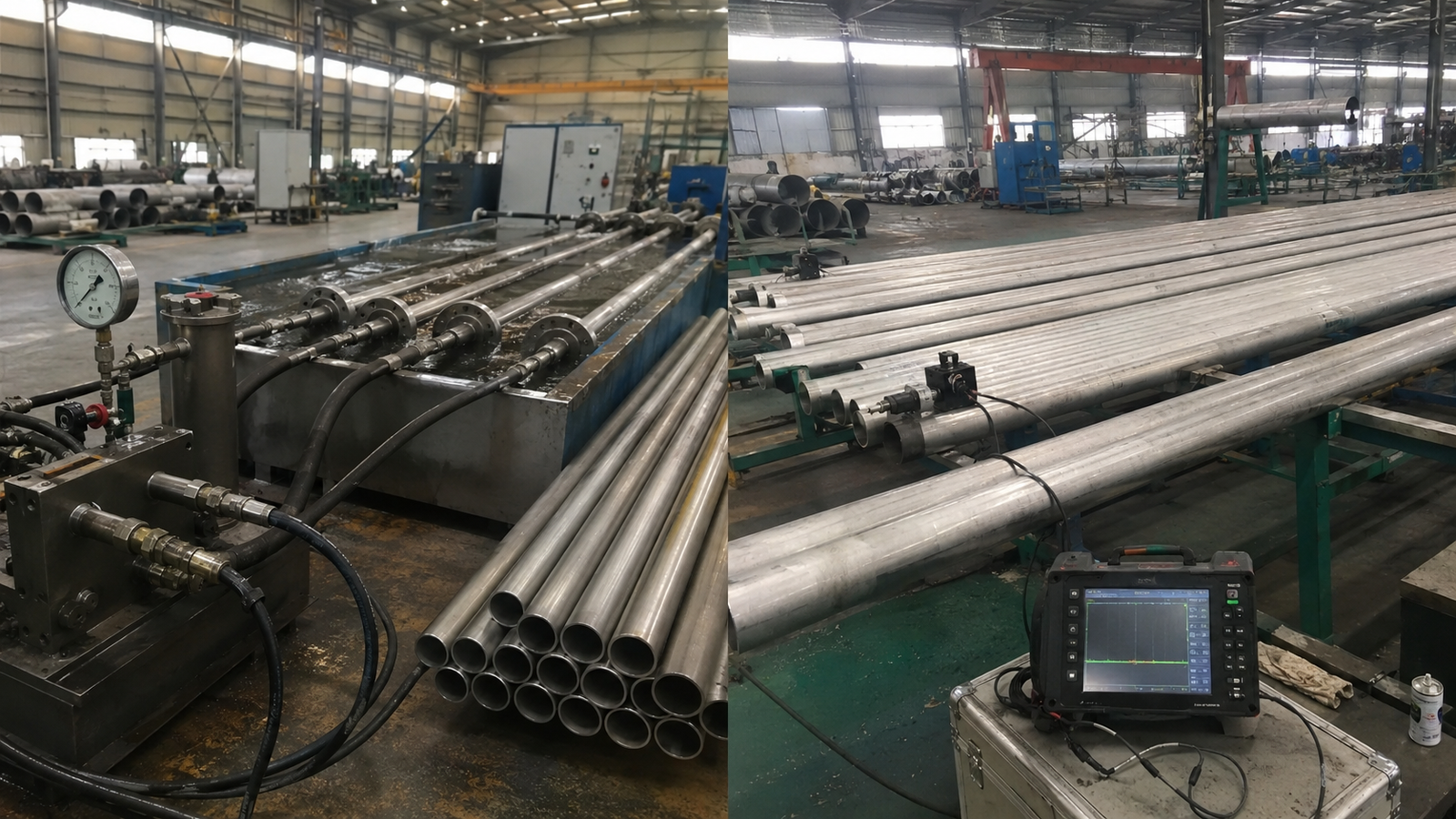
Image credit: Mar11, Wikimedia Commons, CC BY-SA 4.0.
The wrong procurement question is:
“Which alloy has the highest general corrosion resistance?”
A more useful question is:
“Which tube material and manufacturing condition have been qualified for this exact urea process, equipment location, passivation regime, and tube-joint design?”
Why Urea-Grade Tubes Are Different From Standard Corrosion-Resistant Tubes
Urea synthesis begins with ammonia and carbon dioxide, producing ammonium carbamate before part of the carbamate is converted into urea.
The high-pressure synthesis loop may contain:
- Ammonium carbamate
- Urea
- Ammonia
- Carbon dioxide
- Water
- Passivation oxygen
- Process impurities
- Liquid and vapour phases
Hot ammonium carbamate can cause rapid active dissolution when the stainless-steel surface is not maintained in a suitably passive condition.
Material selection and process operation therefore work together.
| Requirement | Ordinary Tube Procurement | Urea-Grade Tube Procurement |
|---|---|---|
| Alloy identity | Grade and UNS number | Grade, UNS number, urea-class requirements, and licensor approval |
| Chemistry | Standard composition range | Additional control of elements affecting phase formation and corrosion |
| Microstructure | General product acceptance | Austenitic condition or controlled duplex phase balance |
| Ferrite and intermetallics | Standard or welding requirement | Project-specific limits related to urea corrosion |
| Heat treatment | Product-standard requirement | Urea-project cycle, rapid cooling, and phase-control requirements |
| Corrosion test | Often not required | Licensor or project-specific corrosion testing |
| Selective attack | Rarely specified | May require maximum depth or morphology limits |
| Surface | General pickled or bright condition | Defined oxide removal, cleanliness, and absence of harmful defects |
| Passivation | Not part of raw tube selection | Must be compatible with the plant oxygen-passivation strategy |
| Equipment position | Often unnecessary | Essential to the material decision |
| Tube joint | Fabricator responsibility | Must be coordinated with tube material and corrosion system |
The word urea grade should therefore be treated as a contractual technical requirement, not as a marketing label.
Material Selection and Oxygen Passivation Cannot Be Separated
Many stainless steels used in high-pressure urea equipment rely on an oxidizing passivation system to maintain a protective surface film.
The required oxygen level is not a universal material constant.
It may depend on:
- Urea process technology
- Alloy
- Equipment location
- Temperature
- Ammonia-to-carbon-dioxide ratio
- Water content
- Liquid composition
- Plant load
- Gas and liquid distribution
- Startup and shutdown procedure
Research on oxygen passivation in a urea stripper demonstrated that temperature and solution composition affect the passivation current and that oxygen-injection location can affect protection throughout the stripper.
This means:
- A material approved for one licensed process may require different oxygen control in another process.
- A tube cannot compensate indefinitely for loss of passivation.
- The passivation-air requirement should come from the process licensor or approved corrosion study.
- Normal operation, minimum load, startup, shutdown, and oxygen-loss scenarios should all be addressed.
Oxygen passivation is an operating requirement, not a property reported on the tube MTC.
Why Stripper-Tube Wetting Matters
A CO₂ stripper commonly relies on a controlled liquid film flowing over the internal tube surface.
Uneven distribution can create:
- Partially dry areas
- Incomplete passivation
- Local temperature differences
- Concentrated corrosion
- Uneven wall loss
- Premature tube plugging or replacement
The buyer should not evaluate stripper tubes only by alloy name.
The complete stripper design should also address:
- Distributor design
- Tube-end geometry
- Tube straightness
- ID consistency
- Internal surface
- Vertical installation
- Operating turndown
- Liquid load
- Fouling
- Tube-to-tubesheet alignment
Material suppliers can confirm tube dimensions and surface requirements, but liquid-distribution performance remains an equipment-design responsibility.
Which Materials Are Commonly Considered?
The following materials represent different generations and design strategies.
They are not interchangeable.
Modified 316L or 316L Urea Grade
Modified 316L is a specially controlled version of 316L developed for urea service.
It may still be reported under UNS S31603, which creates a procurement risk: the UNS designation alone does not prove that the material satisfies the project’s urea-grade requirements.
Potential controls may include:
- Lower carbon
- Controlled silicon
- Controlled sulfur and phosphorus
- Higher or controlled molybdenum
- Austenitic microstructure
- Ferrite or intermetallic-phase limits
- Solution annealing
- Rapid cooling
- Urea corrosion testing
Typical historical applications include selected:
- Carbamate condensers
- Scrubbers
- Decomposers
- High-pressure piping
- Equipment linings
Ordinary commercial 316L should not be substituted for modified 316L without written approval.
UNS S31050: 25Cr-22Ni-2Mo Urea Grade
UNS S31050 is an austenitic stainless steel developed specifically for demanding urea-carbamate environments.
It is commonly known through descriptions such as:
- 25Cr-22Ni-2Mo
- 25-22-2
- 310MoLN
- EN 1.4466
Its higher chromium level and controlled chemistry support improved performance in urea service compared with conventional 316L under appropriate passivation conditions.
Possible applications include:
- CO₂ stripper tubes
- High-pressure carbamate piping
- Linings
- Fittings
- Ferrules
- Selected condenser and scrubber components
The order should specify UNS S31050, not only “25-22-2,” because commercial descriptions can be interpreted differently.
UNS S32906: Urea-Grade Duplex Stainless Steel
UNS S32906 is a high-alloy duplex stainless steel developed for urea synthesis environments.
Compared with a fully austenitic grade, a qualified urea duplex material may offer:
- Higher yield strength
- Potential wall-thickness advantages
- Strong corrosion resistance under its approved passivation conditions
- A different oxygen-passivation requirement in certain licensed processes
The buyer must still control:
- Austenite–ferrite balance
- Harmful intermetallic phases
- Heat treatment
- Cooling rate
- Weld procedure
- Weld phase balance
- Hardness
- Carbamate corrosion performance
Generic UNS S31803 or S32750 should not be substituted for a urea-grade duplex material merely because both are described as duplex or super duplex stainless steel.
Newer Urea-Specific Duplex Grades
Additional duplex grades have been developed for severe stripper conditions.
A NACE study on a newer urea duplex alloy found that direct testing in ammonium-carbamate solution produced distinctions that were not fully represented by conventional standardized corrosion tests.
This supports an important procurement rule:
A new alloy should be approved from representative urea-service evidence, not only from PREN, chromium content, or a generic datasheet.
Titanium and Bimetallic Tube Systems
Titanium and titanium-containing or bimetallic tubes have been used in selected urea-equipment designs.
Possible reasons include:
- A licensor-approved corrosion strategy
- Reduced dependence on conventional stainless-steel passivation
- Specific liner or tube-bundle construction
- A defined cooling-water or process-side environment
The complete system must be evaluated, including:
- Titanium grade
- Process-side chemistry
- Oxygen
- Hydrogen-generation conditions
- Crevices
- Tube-sheet material
- Galvanic coupling
- Welding or mechanical bonding
- Differential thermal expansion
- Inspection and repair method
A titanium tube should not be proposed as a direct replacement for S31050 or S32906 without equipment-level approval.
Nickel Alloys
Alloy 625, Alloy 825, C-22, and C-276 provide valuable corrosion resistance in many chemical industries.
They should not be treated as the automatic premium choice for ammonium-carbamate service.
Research on active dissolution of stainless steels in urea-plant solution found that higher nickel content did not automatically improve performance in a deaerated high-temperature urea solution.
A nickel-alloy tube should therefore be considered only when:
- The exact grade is approved by the licensor or project authority.
- Representative carbamate corrosion data are available.
- Its weld condition has been evaluated.
- The product form and heat treatment are defined.
- Its use solves a specific corrosion or mechanical problem.
“More nickel” is not a valid urea-material-selection method.
Quick Material Comparison
| Material Family | Possible Role | Main Procurement Risk |
|---|---|---|
| Ordinary 316L | Lower-risk or noncritical areas where specifically approved | May not meet urea-grade chemistry, structure, or corrosion tests |
| Modified 316L Urea Grade | Selected high-pressure equipment and piping in established designs | Same UNS number as ordinary 316L may hide missing supplementary requirements |
| UNS S31050 | Stripper tubes, HP piping, linings, ferrules, and other carbamate-wetted components | Performance still depends on passivation, heat treatment, welds, and operating conditions |
| UNS S32906 | Licensor-approved HP equipment, stripper tubes, and carbamate service | Generic duplex cannot be substituted; phase balance and welding are critical |
| Newer urea duplex grades | Severe stripper or project-specific service | Availability, code status, licensor approval, and test method must be confirmed |
| Titanium or bimetallic tube | Specific licensed equipment and composite designs | Tube-sheet joint, hydrogen, galvanic, repair, and thermal-expansion issues |
| Nickel alloy | Special project-approved component | High nickel content does not establish urea-carbamate compatibility |
How Should Material Selection Change by Equipment?
High-Pressure CO₂ Stripper
The stripper commonly represents one of the most demanding tube applications because it can combine:
- High temperature
- High pressure
- Hot carbamate
- Falling-film flow
- Gas–liquid counterflow
- Passivation dependence
- Local temperature and wetting differences
Common material strategies may include:
- UNS S31050
- Licensor-approved UNS S32906
- Another approved urea duplex grade
- Titanium or bimetallic construction in specific designs
The stripper-tube specification should include more than a product grade.
It should define:
- Tube OD and wall
- Minimum or average wall basis
- Length
- Straightness
- ID and OD surface
- Heat treatment
- Microstructure
- Corrosion test
- Selective-attack limit
- NDT
- Tube-end preparation
- Tube-to-tubesheet joint
- Passivation design interface
High-Pressure Carbamate Condenser
The carbamate condenser may expose tubing to fresh or highly corrosive ammonium-carbamate formation.
The correct material depends on:
- Process technology
- Condenser type
- Which fluid is inside the tube
- Temperature profile
- Vapour and liquid distribution
- Heat flux
- Passivation strategy
- Tube-sheet construction
- Weld design
Possible material families include modified 316L, S31050, urea duplex, or another licensor-approved alloy.
The word condenser is not enough to determine the tube grade.
High-Pressure Scrubber
A high-pressure scrubber may contain carbamate, ammonia, CO₂, condensate, and oxygen under varying phase conditions.
Important requirements include:
- Material continuity between tube and tube sheet
- Resistance of the weld and heat-affected zone
- Vapour-phase condensation
- Local oxygen availability
- Crevice control
- Surface condition
The tube material should follow the scrubber’s corrosion circuit rather than a general plant materials list.
High-Pressure Carbamate Piping
High-pressure piping connects equipment that may use different materials and linings.
The piping specification should address:
- Exact fluid composition
- Material continuity
- Dissimilar-metal transitions
- Pipe, fitting, and flange material
- Filler metal
- Weld procedure
- Heat treatment
- Branch connections
- Dead legs
- Low points
- Passivation during startup
- Inspection access
A urea-grade pipe should not be connected to an ordinary stainless fitting without confirming that the fitting, weld, and heat-affected zone satisfy the same corrosion requirements.
What Does “Urea Grade” Need to Mean in the Purchase Order?
The term should be converted into measurable requirements.
| Purchase Requirement | What the Buyer Should Define |
|---|---|
| Material | Exact grade and UNS or EN designation |
| Urea classification | Applicable licensor or project specification |
| Product form | Seamless, welded, welded-and-cold-worked, straight, or U-bent |
| Product standard | ASTM, ASME, EN, code case, or project standard |
| Chemistry | Full limits including supplementary restrictions |
| Heat treatment | Temperature range, holding, cooling, and records |
| Microstructure | Austenitic condition or duplex phase balance |
| Ferrite | Method, location, and acceptance where applicable |
| Intermetallic phases | Test and acceptance criteria |
| Corrosion test | Method, number of periods, specimen condition, and acceptance |
| Selective corrosion | Maximum depth and evaluation method |
| Mechanical properties | Tensile, yield, elongation, hardness, and temperature basis |
| Dimensions | OD, ID where relevant, wall, length, straightness, and ovality |
| Surface | Pickled, bright annealed, ground, cleaned, or project-specific |
| NDT | Method, coverage, calibration, and acceptance |
| Pressure testing | Hydrostatic or another approved method |
| Tube ends | Cut, deburred, machined, expanded, or weld preparation |
| Identification | Grade, heat, lot, size, and piece or bundle traceability |
| Documentation | MTC, heat treatment, dimensions, corrosion, NDT, and conformity |
| Inspection | Buyer or third-party hold and witness requirements |
A line stating only:
“Urea-grade seamless tube”
is incomplete.
Why ASTM A262 Practice C Is Not Enough
ASTM A262-15(2021) includes Practice C, the boiling nitric-acid test often referred to as the Huey test.
It can provide evidence about susceptibility to intergranular attack in applicable austenitic stainless steels.
ASTM explicitly states that the test does not predict resistance to:
- General corrosion
- Pitting
- Stress-corrosion cracking
- Every other service environment
For urea-grade procurement, the project may additionally define:
- Maximum average corrosion rate
- Maximum individual-period corrosion rate
- Number and duration of test periods
- Specimen orientation
- Sensitization treatment
- Selective-attack depth
- Grain-boundary morphology
- Weld test specimens
- Direct ammonium-carbamate testing
The buyer should copy the complete licensor or project test clause—not merely write “ASTM A262 C.”
Corrosion Test Specimens Must Represent the Supplied Product
The test result should be linked to the actual production route.
Questions to confirm include:
- Is the specimen taken from the tube or from the starting billet?
- Does it represent the final heat treatment?
- Is the tube seamless or welded?
- Is the weld included?
- Is the heat-affected zone included?
- Is the specimen longitudinal or transverse?
- Does the test represent the final surface?
- Is one specimen used per heat, lot, or heat-treatment load?
- Are retest rules defined?
A plate coupon from the same nominal alloy may not represent a cold-drawn and solution-annealed tube.
Welding Requirements Are Part of Material Qualification
Urea equipment corrosion can be concentrated at:
- Weld metal
- Fusion boundary
- Heat-affected zone
- Repair weld
- Tube-to-tubesheet joint
- Crevice behind a weld
- Area with incomplete oxide removal
Research on 316L weld corrosion in urea synthesis showed that harmful phase formation during multiple weld passes can influence corrosion.
The fabrication specification should define:
- Welding process
- Filler metal
- Heat input
- Interpass temperature
- Shielding and purge
- Ferrite or phase requirements
- Weld surface
- Oxide removal
- Repair-weld limits
- Corrosion testing of weld procedure qualification
- NDT
- Final passivation
A satisfactory parent-tube MTC cannot qualify a completed weld.
Seamless or Welded Tubes?
Neither product form should be approved or rejected solely from its name.
Seamless Tubes
Possible considerations include:
- Wall eccentricity
- Drawing history
- Internal surface
- Heat-treatment uniformity
- Long-length capability
Welded Tubes
Possible considerations include:
- Starting strip traceability
- Weld procedure
- Weld-bead condition
- Cold working after welding
- Weld heat treatment
- Weld NDT
- Weld corrosion qualification
The final choice should follow:
- Equipment design
- Product standard
- Process licensor
- Pressure code
- Size availability
- Corrosion-test evidence
- Tube-to-tubesheet joining method
“Seamless is always safer” is not a technically complete specification.
What Should Be Inspected Before Shipment?
| Inspection Area | Required Evidence |
|---|---|
| Material identity | Grade, UNS, heat, and project specification |
| Chemistry | Heat and product analysis where required |
| Heat treatment | Furnace chart and load traceability |
| Microstructure | Austenitic condition or duplex phase balance |
| Ferrite or phases | Approved method and results |
| Corrosion testing | Full report, specimen source, periods, and acceptance |
| Selective attack | Metallographic depth and photographs where required |
| Mechanical properties | Heat- or lot-specific report |
| Dimensions | OD, wall, length, ovality, and straightness |
| Surface | ID and OD inspection |
| NDT | Method, calibration, coverage, and results |
| Pressure integrity | Required product-standard test |
| Ends | Burrs, deformation, and weld preparation |
| Cleanliness | Project-specific cleaning and preservation |
| Marking | Heat, lot, material, and size |
| Packaging | Heat separation and surface protection |
An MTC should be part of this package, not the entire package.
What Buyers Should Include in the RFQ
| RFQ Category | Required Information |
|---|---|
| Plant technology | Urea process and licensor or project specification |
| Equipment | CO₂ stripper, carbamate condenser, scrubber, HP piping, or another item |
| Tube side | Exact process fluid inside the tube |
| Shell side | Steam, condensate, cooling medium, or process fluid |
| Operating condition | Normal, maximum, minimum, startup, shutdown, and turndown |
| Passivation | Oxygen source, normal range, upset condition, and licensor requirement |
| Material | Exact grade, UNS, EN number, and urea classification |
| Product form | Seamless, welded, straight, U-bent, or composite |
| Product standard | ASTM, ASME, EN, code case, or project specification |
| Dimensions | OD, wall, length, tolerance, quantity, and spare tubes |
| Heat treatment | Final condition and furnace records |
| Chemistry | Base standard plus urea-specific supplementary limits |
| Microstructure | Austenitic or duplex requirements |
| Ferrite and phases | Test method and limits |
| Corrosion test | Method, periods, corrosion rate, and selective depth |
| Mechanical test | Tensile, yield, elongation, hardness, and sampling |
| NDT | ECT, UT, hydrostatic, or approved alternatives |
| Surface | ID, OD, oxide removal, roughness, and cleanliness |
| Tube ends | Machining, ferrules, expansion, or welding preparation |
| Tube joint | Tube-sheet material and joining procedure |
| Traceability | Heat, lot, tube, bundle, and test specimens |
| Inspection | ITP, third-party inspection, hold points, and witness points |
| Documentation | MTC, corrosion, heat treatment, NDT, dimensions, and conformity |
| Approval | Party responsible for final material and design approval |
This information allows a manufacturer to determine whether the requested tube is technically manufacturable.
Common Procurement Mistakes
| Mistake | Why It Is Risky | Better Approach |
|---|---|---|
| Ordering normal 316L as urea grade | UNS S31603 alone may not include urea-specific controls | Add the complete modified-316L specification |
| Selecting by nickel content | High nickel does not automatically improve carbamate resistance | Use representative urea-service data |
| Substituting generic super duplex for S32906 | General chloride resistance is not the same as urea qualification | Require the approved UNS and project specification |
| Writing only “25-22-2” | Commercial descriptions may be interpreted differently | Add UNS S31050 and chemistry limits |
| Copying another plant’s oxygen limit | Passivation depends on process, alloy, location, and temperature | Use the licensor’s operating envelope |
| Requiring only ASTM A262 C | It does not qualify all urea corrosion mechanisms | Add project corrosion and selective-attack criteria |
| Testing billet instead of final tube | Final drawing, welding, and heat treatment may change performance | Test the representative final product |
| Ignoring tube wetting | A qualified alloy may corrode in an unpassivated dry area | Review stripper distribution and turndown |
| Accepting the tube but ignoring the joint | The tube-sheet weld or crevice may control failure | Qualify the complete joint |
| Assuming seamless is always superior | Seamless and welded products have different risks | Evaluate the actual manufacturing route |
| Selecting titanium after stainless failure | The original mechanism may remain unresolved | Identify the failure mechanism and approve the complete titanium system |
| Treating MTC as service qualification | MTC does not prove carbamate performance | Review corrosion and microstructure reports |
Frequently Asked Questions
What is the most common material for urea stripper tubes?
There is no single universal material. UNS S31050 and licensor-approved urea duplex grades such as UNS S32906 are established candidates in different process designs. Modified 316L, newer duplex grades, titanium, or composite tubes may be used in specific equipment.
Is ordinary 316L the same as 316L Urea Grade?
No. Modified or urea-grade 316L normally includes tighter chemistry, microstructure, heat-treatment, and corrosion-test requirements. The same UNS S31603 designation may appear on both, so the supplementary specification is essential.
What is UNS S31050?
UNS S31050 is a high-chromium, high-nickel, molybdenum- and nitrogen-containing austenitic stainless steel developed for urea-carbamate service. It is commonly described as 25Cr-22Ni-2Mo or 310MoLN.
Is UNS S32906 the same as ordinary super duplex stainless steel?
No. S32906 was developed for specific urea-process environments. It should not be replaced by S32750, S32760, or another duplex grade without licensor and project approval.
Is Alloy 625 better than S31050 for urea service?
Not automatically. Alloy 625 has broad corrosion resistance in many industries, but high nickel content does not prove superior resistance to ammonium-carbamate solutions. Representative urea-service evidence and project approval are required.
Can C-276 be used for urea stripper tubes?
Only when the licensor or responsible materials engineer has approved it for the exact process conditions and product form. Its resistance in other acids does not automatically establish urea-carbamate suitability.
Can titanium replace urea-grade stainless steel?
It may be used in selected equipment or composite designs. The titanium grade, tube sheet, joint, galvanic conditions, hydrogen risk, thermal expansion, inspection, and repair method must be evaluated as one system.
Why is oxygen added to a urea plant?
Oxygen is used in many urea-process designs to help maintain a passive protective film on stainless-steel surfaces exposed to carbamate. The required concentration and injection point are process- and material-specific.
Does a higher oxygen level always provide better protection?
No. Oxygen control should remain within the licensor-approved operating range. Excess or insufficient oxygen can affect process operation and corrosion differently, and one plant’s value should not be copied without engineering review.
Is the Huey test sufficient for urea-grade tubes?
No. ASTM A262 Practice C provides information about susceptibility to intergranular attack. A urea project may also require stricter corrosion-rate limits, selective-attack measurements, weld testing, or direct carbamate testing.
Should urea stripper tubes be seamless?
The permitted construction depends on the equipment design, licensor, product standard, weld qualification, and corrosion evidence. Seamless construction is not automatically the only technically acceptable option.
Why can an approved tube still fail in a stripper?
Possible causes include loss of oxygen passivation, uneven liquid distribution, local overheating, deposits, unsuitable tube-to-tubesheet joints, weld defects, incorrect heat treatment, or operation outside the qualified envelope.
What should be sent when requesting a urea-grade tube quotation?
Send the equipment location, process licensor, material and UNS designation, product standard, dimensions, tube form, heat treatment, chemistry, microstructure, corrosion-test limits, NDT, surface, ends, tube-joint requirements, documentation, quantity, and inspection plan.
Conclusion
Urea-grade tube procurement cannot be reduced to choosing the alloy with the highest nickel, chromium, or molybdenum content.
The tube must be qualified as part of a complete corrosion-control system involving:
- Ammonium-carbamate chemistry
- Equipment location
- Process temperature
- Oxygen passivation
- Liquid distribution
- Alloy chemistry
- Microstructure
- Heat treatment
- Weld condition
- Corrosion testing
- Selective-attack limits
- Tube-to-tubesheet design
- Inspection and documentation
Modified 316L, UNS S31050, UNS S32906, newer urea duplex grades, titanium, composite tubing, and project-approved nickel alloys all occupy different technical positions.
The most important procurement rule is:
Do not accept a generic material name where the project requires a urea-qualified product.
For project-approved nickel-alloy or titanium tube enquiries, buyers should provide the exact grade, UNS designation, equipment location, dimensions, product standard, condition, corrosion-test requirement, NDT, tube-end preparation, certification, and packaging scope.
Emily PIPE can review whether the requested nickel-alloy or titanium tube dimensions, manufacturing condition, surface, testing, documentation, and delivery requirements are technically manufacturable.
Final approval of urea-grade stainless steel, duplex steel, titanium, nickel alloy, passivation conditions, and equipment design should remain with the process licensor, equipment designer, and responsible materials or corrosion engineer.