
Why Can Alloy Tubes Fail Under Deposits Despite Good Datasheet Corrosion Resistance?
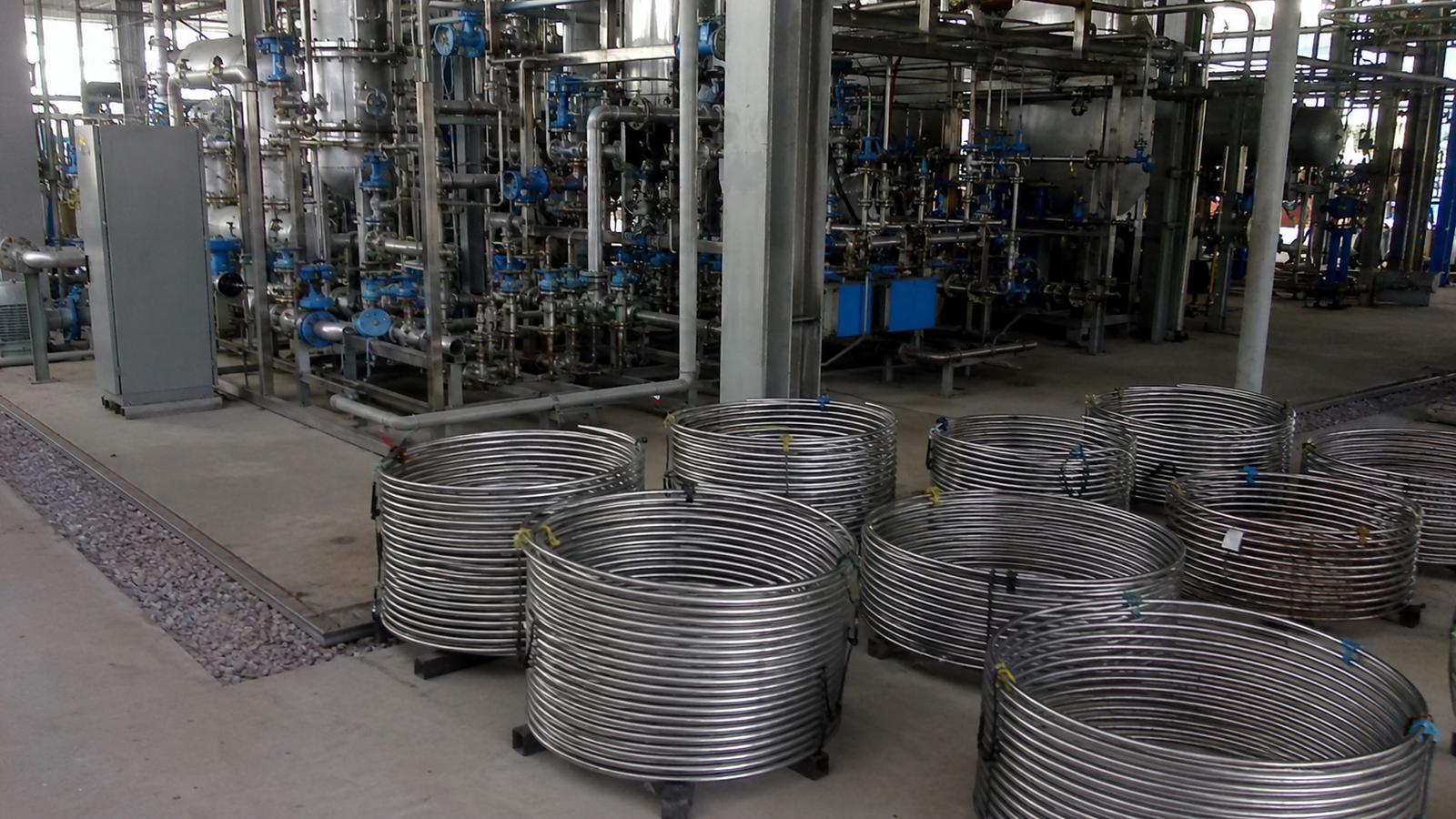
Image credit: Taprogge GmbH / Wikimedia Commons, CC BY-SA 3.0.
An alloy tube can show a low corrosion rate in clean laboratory fluid and still develop deep localized attack beneath scale, sludge, corrosion products, biofilm, or process deposits.
This happens because the fluid trapped beneath a deposit may no longer have the same chemistry as the bulk process stream.
A material datasheet confirms the alloy’s composition, mechanical properties, and performance under specified test conditions. It normally does not predict deposit formation, restricted mass transfer, local pH changes, ion concentration, heat-flux effects, microbial activity, or shutdown conditions.
Under-deposit corrosion must therefore be evaluated as an application-specific localized-corrosion risk.
What Is Under-Deposit Corrosion?
Under-deposit corrosion is localized metal attack that develops beneath or beside material accumulated on a metal surface.
Possible deposits include:
- Mineral scale
- Suspended solids
- Corrosion products
- Process sludge
- Catalyst particles
- Biological films
- Salt crystals
- Debris from upstream equipment
A deposit alone is fouling.
It becomes an under-deposit corrosion problem when the covered area develops a sufficiently aggressive local environment to damage the tube.
The resulting damage may appear as:
- Pits
- Broad local thinning
- Crevice-like attack
- Intergranular attack
- Microbiologically influenced corrosion
- Cracking where environmental and stress conditions permit
Under-deposit corrosion is not automatically the same as erosion-corrosion. One is primarily associated with a restricted local environment; the other involves mechanical removal or damage caused by flowing fluid or particles.
Why the Datasheet Cannot Predict It
| Datasheet Information | Information Needed for Under-Deposit Risk |
|---|---|
| Nominal chemical composition | Deposit chemistry and trapped impurities |
| Room-temperature tensile strength | Actual stress and metal temperature |
| General corrosion rate in clean fluid | Maximum penetration beneath deposits |
| Pitting-resistance comparison | Actual deposit geometry and process chemistry |
| Product heat treatment | Weld, bend and finished surface condition |
| Bulk chloride concentration | Chloride concentration beneath deposits |
| Normal operating temperature | Local temperature and shutdown conditions |
| Standard surface finish | Deposit adhesion and cleaning history |
| Material certificate | Process-specific corrosion qualification |
A low uniform corrosion rate does not prove resistance to localized penetration.
A tube can retain most of its original wall thickness while one hidden pit penetrates deeply enough to cause leakage.
What Changes Beneath a Deposit?
Restricted Mass Transfer
A deposit limits exchange between the covered metal surface and the bulk fluid.
Depending on the system, this may change:
- Oxygen concentration
- pH
- Dissolved metal ions
- Chloride or sulfate concentration
- Oxidation-reduction potential
- Inhibitor concentration
Differential aeration is one possible mechanism, but it is not the only explanation for under-deposit corrosion.
Local Acidification
Metal dissolution and hydrolysis reactions inside an occluded area can reduce local pH.
This may destabilize the passive film on stainless steels, nickel alloys, or titanium even when the bulk fluid remains within an apparently acceptable pH range.
Salt Concentration
Where evaporation, boiling, repeated wetting and drying, or membrane-like transport occurs, aggressive salts may become concentrated beneath a deposit.
Bulk-water analysis may therefore underestimate the chloride, sulfate, caustic, or acidic condition directly at the tube surface.
Heat-Flux Effects
On a heat-transfer surface, a thick deposit can increase thermal resistance.
Where heat flows through the deposit, the underlying tube metal may operate at a different temperature from the clean surface. In boilers or evaporative equipment, concentration beneath porous deposits can also become more severe.
This effect should not be assumed in every tube system; heat direction, deposit conductivity, thickness, and local boiling conditions must be defined.
Microbiological Activity
Biofilms can:
- Restrict oxygen transport
- Retain solids and ions
- Change local pH
- Generate corrosive metabolites
- Create nonuniform surface conditions
The risk depends on the organisms, nutrients, water treatment, temperature, and operating cycle.
Which Conditions Increase the Risk?
| Risk Factor | Why It Matters |
|---|---|
| High suspended solids | Increases deposit formation |
| Scaling water chemistry | Produces mineral deposits |
| Low-flow or stagnant zones | Allows solids to settle |
| Maldistributed flow | Creates local deposition zones |
| Intermittent operation | Encourages concentration during shutdown |
| Wet–dry cycling | Can concentrate soluble salts |
| Heat flux | May change local temperature and chemistry |
| Crevices and supports | Retain deposits and restrict cleaning |
| Rough or damaged surfaces | May provide additional attachment sites |
| Biofouling | Creates a persistent occluded environment |
| Inadequate cleaning | Allows deposits to thicken and age |
| Process contamination | Introduces unexpected corrosive species |
A smooth tube surface may reduce attachment in some services, but it cannot prevent deposits caused by precipitation, biological growth, stagnant geometry, or upstream contamination.
Why a Higher Alloy Grade May Still Fail
Replacing stainless steel with Alloy 625, C-22, C-276, Alloy 825, duplex steel, or titanium may increase the localized-corrosion margin.
It does not eliminate:
- Deposit formation
- Extreme local concentration
- Uncontrolled fluoride
- Severe acidic or caustic conditions
- Microbial activity
- Hot spots
- Crevice geometry
- Mechanical damage
- Inadequate cleaning
An alloy upgrade may extend service life without correcting the underlying deposit mechanism.
The engineering decision should therefore address two questions separately:
- How resistant is the alloy to the local environment beneath the deposit?
- How will the system prevent, remove, monitor, or inspect the deposit?
Which Laboratory Tests Are Useful?
There is no single standard test that represents every form of under-deposit corrosion.
ASTM G31
ASTM G31-21(2025) guides laboratory immersion corrosion testing.
It is useful for evaluating the process liquid, but its scope does not specifically evaluate localized attack or flow effects.
A clean-fluid G31 result should not be treated as proof of under-deposit resistance.
ASTM G78
ASTM G78-20(2025) provides guidance for comparing crevice-corrosion resistance of iron- and nickel-base alloys in seawater and other chloride-containing aqueous environments.
A deposit can create a crevice-like condition, but the test geometry and chemistry must still relate to the application.
ASTM G48
ASTM G48-25 compares pitting and crevice-corrosion initiation in oxidizing ferric-chloride solutions.
It can rank alloys for selected chloride risks.
It cannot establish resistance in nonchloride deposits or predict service life in the actual equipment.
Process-Specific Deposit Test
A more representative program may expose the final tube material beneath an actual or synthetic deposit.
The test should define:
| Test Variable | Required Information |
|---|---|
| Bulk fluid | Complete normal and upset composition |
| Deposit | Source, chemistry, mass and coverage |
| Temperature | Fluid and tube-metal temperature |
| Heat flux | Included where relevant |
| Flow | Static, agitated or flowing |
| Aeration | Actual oxygen condition |
| Duration | Long enough to identify localized initiation |
| Specimen | Parent tube, weld, bend or cold-worked condition |
| Cleaning | Method used before final examination |
| Evaluation | Maximum pit depth, affected area and mass loss |
Average mass loss alone is not sufficient.
How Should Damage Be Evaluated?
Deposits should be documented and sampled before cleaning whenever possible.
After cleaning, examination may include:
- Visual inspection
- Borescope examination
- Pit-depth measurement
- Cross-sectional metallography
- Deposit chemical analysis
- Wall-thickness mapping
- Eddy-current testing
- Ultrasonic testing
- Leak testing
ASTM G1-25 provides procedures for cleaning and evaluating corrosion-test specimens.
ASTM G46-21 provides guidance for examining and evaluating pitting corrosion.
For installed nonmagnetic heat-exchanger tubes, ASTM E690-25 covers in-situ eddy-current examination.
The inspection method must be qualified for the tube material, dimensions, defect orientation, geometry, and expected damage.
What Buyers Should Request Before Selecting the Alloy
| Category | Required Information |
|---|---|
| Bulk fluid | Complete chemistry and normal range |
| Upset chemistry | Maximum chloride, fluoride, acid, caustic or oxidant |
| Deposit source | Scale, solids, corrosion products or biofilm |
| Deposit analysis | Chemical and mineral composition where available |
| Flow | Minimum, normal and maximum velocity |
| Stagnation | Shutdown and standby duration |
| Temperature | Fluid and tube-metal temperature |
| Heat transfer | Heat flux and boiling condition where relevant |
| Cleaning | Method, chemical, frequency and effectiveness |
| Tube location | Inlet, outlet, bend, support or low-flow area |
| Alloy | Exact grade and UNS designation |
| Product form | Seamless or welded tube |
| Condition | Heat treatment, cold work and surface finish |
| Dimensions | OD, wall, length and tolerance |
| Fabrication | Bending, welding and tube-to-tubesheet joints |
| Qualification | Clean-fluid and deposit-covered testing |
| Acceptance | Maximum general loss and maximum pit depth |
| NDT | ECT, UT, pressure testing or project method |
| Documentation | MTC, heat treatment, NDT and corrosion reports |
A request stating only:
“Need a corrosion-resistant alloy tube for fouling water.”
does not provide enough information for a technically reliable material recommendation.
Frequently Asked Questions
Is under-deposit corrosion always caused by low oxygen?
No. Differential aeration is one possible mechanism. Local pH changes, salt concentration, heat flux, microbial activity and chemical reactions may also control the attack.
Does a higher PREN prevent under-deposit corrosion?
No. PREN can support comparison of selected stainless steels in chloride environments, but it does not include deposit chemistry, pH, temperature, microbiology, fluoride, heat flux or cleaning conditions.
Are nickel alloy tubes immune?
No. Nickel alloys may provide stronger resistance in many aggressive environments, but sufficiently severe local chemistry can still cause pitting, crevice attack or cracking.
Is titanium always better under deposits?
No. Titanium performs strongly in many oxidizing chloride environments, but hot crevices, reducing conditions, acidic fluoride, hydrogen and other local conditions require review.
Can surface polishing solve the problem?
A smoother surface may reduce initial adhesion in some systems. It cannot prevent precipitation, biofouling, stagnant-zone deposits or chemistry concentration.
Can ASTM G48 qualify the tube?
No. ASTM G48 ranks resistance under specified oxidizing ferric-chloride conditions. It does not reproduce every process deposit.
What is the most important acceptance criterion?
Maximum localized penetration is usually more informative than average mass loss when the main risk is a hidden pit or local wall perforation.
What should buyers send with an RFQ?
Provide fluid chemistry, deposit source, temperature, flow, shutdown conditions, cleaning method, alloy, tube dimensions, condition, testing, NDT and documentation requirements.
Conclusion
A clean corrosion datasheet cannot predict under-deposit corrosion because it does not reproduce the local environment beneath a real deposit.
Reliable evaluation requires the buyer to define:
- What forms the deposit
- Where it accumulates
- Which species become trapped or concentrated
- Whether heat flux or stagnation changes local conditions
- How the deposit will be removed or monitored
- How localized damage will be measured
- Which finished tube condition will be tested
Selecting a higher alloy grade may increase the safety margin, but it does not replace deposit control, representative testing and inspection.
For nickel-alloy or titanium tube enquiries, buyers should provide the exact alloy, UNS designation, product standard, dimensions, supplied condition, surface requirements, process chemistry, deposit information, testing, NDT and documentation scope.
Emily PIPE can review whether the requested tube grade, dimensions, heat-treatment condition, surface, inspection and certification requirements are technically manufacturable.
Final material approval, deposit-control strategy, corrosion qualification and inspection interval should remain with the equipment designer and responsible materials or corrosion engineer.